Attitudes towards the Gaza War, Risk Perception and Manifestations of Post-traumatic Stress Disorder
[Las actitudes hacia la guerra de Gaza, la percepción del riesgo y las manifestaciones del trastorno de estrés postraumático]
Nesreen K. Hosny & Rehab M. Ahmed
Cairo University, Cairo, Egypt
https://doi.org/10.5093/apj2026a16
Received 17 November 2024, Accepted 13 November 2025
Abstract
The current study aimed to know the role of attitudes towards the Gaza War and perceptions of its risk in predicting manifestations of PTSD among Egyptian society. The sample consisted of 42 individuals (26 males, 16 females), aged between 20-57 years (M = 28.74, SD = 8.13). Participants completed the Attitudes toward Gaza War Scale (AGWS), the Risk Perception of the War Scale (RPWS) and the Post-Traumatic Stress Disorder Scale (PTSDS). Results showed attitudes toward the Gaza war predict manifestations of PTSD, except for the cognitive component of attitudes. Perceptions of the risk of the Gaza war predict manifestations of PTSD, except for the component of responsibility prevalence. The study concluded that there is no interaction between attitudes toward the Gaza war and perceptions of its risk in predicting manifestations of PTSD.
Resumen
Este estudio se ha propuesto conocer el papel de las actitudes hacia la guerra de Gaza y la percepción del riesgo en la predicción de la aparición de trastorno de estrés postraumática (TEP) en la sociedad egipcia. Componían la muestra 42 personas (26 varones y 16 mujeres) de edades entre 20 y 57 años (M = 28.74, DT = 8.13). Los participantes cumplimentaron la Escala de Percepción del Riesgo de Guerra y la Escala del Trastorno de Estrés Postraumático. Los resultados muestran que las actitudes hacia la guerra de Gaza predicen las manifestaciones del TEP menos el componente cognitivo de las actitudes y la percepción del riesgo de la guerra de Gaza predice las manifestaciones del TEP.
Palabras clave
Actitudes, Percepción de riesgos, Trastornos de estrés postraumático, Guerra de Gaza, Sociedad egipciaKeywords
Attitudes, Risk perception, Post-traumatic stress disorder (PTSD), The Gaza war, Egyptian societyCite this article as: Hosny, N. K. & Ahmed, R. M. (2026). Attitudes towards the Gaza War, Risk Perception and Manifestations of Post-traumatic Stress Disorder. Anuario de Psicología Jurídica, 36, Article e260483. https://doi.org/10.5093/apj2026a16
Correspondence: rehabpsychology5@gmail.com (R. M. Ahmed).Since the start of the Israeli war on Gaza on October 7, 2023, Egypt’s response has received more attention than other Arab countries due to its regional weight and because it is the only Arab country that shares a border with the Gaza Strip, which makes it directly linked to the ongoing events, whether through following and responding to them or being affected by them on the security and economic levels in general and psychologically in particular. Among the many serious psychological consequences of the Gaza war is the significant impact on the psychological health of the Egyptian population, which should not be overlooked, as they began to feel a mixture of negative feelings towards the current situation of cutting off Gaza, such as anxiety, pessimism, and a sense of helplessness, and some manifestations of PTSD, which were monitored through visual observations of some of their behaviors, which were represented by some of them trying to avoid watching videos of the intentional killing and torture of the Palestinian people, in addition to boycotting foreign products that support the aggressor party, or trying to donate money to charities entrusted with providing humanitarian aid to the Gaza Strip (Levi-Belz et al., 2024). Their level of negative feelings has been exacerbated by the current economic problems, their view of the violations of the rights of the Palestinian people without seeking a radical solution to stop this, and the collapse of justice (Moussa, 2024). Most studies have focused on psychological disorders, especially PTSD (as the most closely related to war as it represents a traumatic event) among Palestinians who were directly exposed to attacks (Abudayya et al., 2023; Altawil et al., 2008; Altawil et al., 2023; El-Khodary et al., 2020; Manzanero et al., 2024; Thabet et al., 2013). In fact, direct exposure to traumatic events carries with it a greater likelihood of developing psychological symptoms and diagnoses. However, in some cases, the impact of war may extend beyond those who were directly exposed to traumatic events; therefore, it is important to understand the psychological consequences of attacks from a broader perspective, which requires examining the response of citizens in neighboring countries, especially since they are constantly exposed to witnessing a variety of traumatic events, including witnessing the killing of the Palestinian people, the demolition of their homes, their bombing, and their arrest. These events have been linked to PTSD (Levi-Belz et al., 2024). PTSD as a disabling condition negatively affects many individuals throughout their lives. It rarely has a short-term impact but often has negative effects on individuals for several years after they have experienced traumatic events. Studies have shown that people diagnosed with PTSD, or suffering from some of its manifestations, are more susceptible to anxiety, personality disorders, suicidal thoughts, suicide attempts and substance abuse. In addition, PTSD has a significant economic and health burden, as it is associated with increased direct costs associated with treatment and indirect costs associated with lost productivity. Studies have shown that PTSD can cause many chronic health disorders, such as cardiovascular disease, bone and joint diseases, and gastrointestinal disorders. Therefore, it is essential to detect this psychological disorder so that we can take appropriate short- and long-term health measures to reduce its negative consequences (Hamza et al., 2019; Radwan et al., 2022). Despite the importance of studying the negative impact resulting from the Gaza war as a traumatic experience that Egyptians are constantly exposed to, researchers did not find any study that addressed this aspect. Therefore, the current study aimed to identify the level of Egyptians’ infection with some manifestations of PTSD, in addition to the factors that contribute to increasing the level of this infection, the most important of which is the Egyptians’ attitude towards the Gaza war and their awareness of its seriousness on the personal and societal levels. Understanding attitudes toward war is important from a psychological perspective. For example, psychologists can use such information to predict other attitudes that may or may not be related to war, such as increased incidence of certain psychological and personality disorders (Dupuis & Cohn, 2011). Some researchers argue that during times of war, people become more skeptical of peace and more supportive of war (Carnagey & Anderson, 2007), as attitudes toward war are primarily and clearly linked to defending the group (the Palestinian people) and its interests and preferring an aggressive way of dealing with external threats. Individuals who adopt this orientation therefore tend to see the world as dangerous and threatening to them on a personal and societal level, so they tend to be aggressive in their attitudes toward external threats as they see war as a tool for resolving conflicts and mitigating threats, which makes them prey to some manifestations of PTSD as a result of their great follow-up to current violent events, and they also become more reactive to them, more sensitive to them, and aware of their risks (Bizumic et al., 2013). These manifestations are represented in re-experiencing the experience of the traumatic event (in a more precise sense, repeating memories of the traumatic event involuntarily to the mind in a way that is difficult to prevent and suffering from nightmares and disturbing dreams about traumatic events) and hyperarousal, as people exposed to a traumatic event are often in a state of constant alert. They have difficulty concentrating, sleep poorly, are easily aroused, react impulsively, have trouble forming ideas and beliefs about the traumatic event, and experience negative emotions, such as sadness, danger, and self-blame (Bizumic et al., 2013). However, other findings suggest that exposure to war and violence and their experiences may lead to the development of negative attitudes towards war in favor of tolerance and reconciliation as a result of the high number of casualties and deaths. Individuals who support values that are characterized by a high degree of equality and tolerance are more likely to care about peace than those who want to promote war as a tool to maintain the achievement of justice, which leads them to avoid following current violent events and all the stimuli associated with them, as they try to avoid everything that may remind them of the traumatic event that they witnessed or heard about from people, places, or situations, which may lead them to isolation and deny the risk of these events to them. This is one of the manifestations of PTSD, as these individuals care about the present moment, which is that they live safely in their homeland and that they are far from those violent scenes of killing and torture (Braun-Lewensohn et al., 2014). Despite the importance of emphasizing the role of the interaction between individuals’ attitudes toward the Gaza war and their perception of its danger to them in developing some manifestations of PTSD, studies in this research area are in an early stage. It has become clear that there is a noticeable scarcity in Western and Arab studies, which calls for the need to arouse the interest of researchers in this promising research area. From the above, we conclude by defining the formulation of the questions that the current study seeks to answer, as follows:
Literature Review Attitudes In the field of psychology, an attitude encompasses a collection of emotions, beliefs, and actions directed toward a specific object, individual, item, or occasion. Attitudes typically form as a result of personal experiences or upbringing, and they possess the ability to strongly impact behavior. Although attitudes tend to be long-lasting, they are also capable of undergoing change (Cherry, 2018). Kegan et al., (1994) described how individuals develop strong beliefs and attitudes toward various ethnic groups, foreigners, wealthy individuals, impoverished individuals, men, women, social issues, government policies, and more as they mature (Logan & Hodges, 2012). As shown previously, it is suggested that “attitudes are acquired and not innate”, but this explanation may only encompass attitudes that are consciously expressed, learned from parents, or developed during interaction within one’s own community (Gaiseanu, 2020). Attitudes are important both practically and theoretically due to their significant and predictable impact on behavior. However, identifying the attitudes that most reliably correlate with behaviors in specific conditions has proven to be a very intricate task. Studies have shown that certain individuals are more inclined to act according to their attitudes than others. Moreover, certain situations are more conducive to promoting behaviors that align with one’s attitudes (Eaton & Visser, 2008). Accordingly, people form strong opinions about political parties, national security, and other societal issues and institutions. These attitudes have a significant impact on our lives, shaping our preferences for things we have positive attitudes towards and our opposition to things we have negative attitudes towards (Logan & Hodges, 2012). The concept that war and peace can coexist leads us to suggest that individuals’ attitudes toward peace and war may be separate but inversely related aspects. We posit that attitudes toward peace are mainly focused on embracing social harmony and equality (or rejecting structural violence), and attitudes toward war are primarily focused on accepting direct violence (as opposed to rejecting it) (Bizumic et al., 2013). Risk Perception One of the most important basic areas is psychological research on risk perception, which has its roots in empirical studies of how people assess probabilities and make decisions. A significant advancement in this field has been the identification of a collection of mental strategies, or heuristics, that individuals use to comprehend an unpredictable world. While these guidelines are applicable in certain situations, they can also result in significant and long-lasting biases in others, which have serious implications for risk evaluation (Slovic, 1987). The concept of perceived or subjective risk is a cognitive process that can be significantly influenced or directed by emotions. However, perceived risk is typically not considered a feeling (Wolff et al., 2019). The process of risk perception involves individuals making subjective judgments about an event based on the impact of their everyday experiences. Factors that influence risk perception can be categorized into five types, which are the physical environment, loss and compensation, individual socio-economic attributes, social trust, and mental attitudes (Wei & Kuo, 2023). Despite that, research on risk perception has acknowledged for a considerable time that social interactions play a crucial role in shaping how individuals perceive risks, rather than being solely determined by individual cognitive processes. In this context, the concept of “affect heuristic” was proposed by Slovic and colleagues (Finucane et al., 2000; Slovic et al., 2004; Slovic et al., 2007) as a mental shortcut used for making risk judgments. Essentially, people are believed to associate varying levels of positive or negative emotions with their mental representations of objects and events, termed as ‘affect’ in decision-making literature. When individuals make decisions or judgments, they are thought to utilize the positive and negative emotional associations linked with those mental representations, whether consciously or unconsciously. Consequently, individuals evaluate the likelihood of a hazard occurring not only based on facts and logical reasoning but also on their emotional responses to it. The more negative the affect, the greater the perceived risk of the hazard (Lauriola et al., 2024). Post-Traumatic Stress Disorder (PTSD) The psychological consequences of war trauma can include depression, anxiety, PTSD, and other psychiatric disorders. Hence, it is crucial to have a deep understanding of the experiences related to war in the clinical field (Küçükertan & Karancı, 2023). After conducting a thorough review (Al-Ghzawi et al., 2014), it was found that within Arab communities, the prevalent psychological consequences of war and conflict were Post-Traumatic Stress Disorder (PTSD) and Major Depressive Disorder (Hamadeh et al., 2024). Experiencing war stress can lead to a recognized psychological condition known as post-traumatic stress disorder, or PTSD. It results in psychological, perceptual, or cognitive disturbances, making the individual lose control over their emotions and feel dazed and terrified. They often relive frightening war scenes and struggle to concentrate on their surroundings. This can lead to disturbed sleep due to upsetting nightmares, even if they are far from the war zone (Singer, 2019). In addition to that, experiencing the disturbing impacts of war, rape, genocide, or violent abuse inflicted on others indirectly can lead to PTSD and is considered a qualifying trauma. Indirect exposure can also happen through viewing photos, videos, hearing verbal accounts, or reading written accounts (American Psychological Association [APA, 2022]). It is worth noting that the focus in current research will be on the manifestations of the disorder in a sample of normal individuals not diagnosed with post-traumatic stress disorder and these individuals will be those who obtained a high score on the scale. At the end of the presentation of the literature review, the relationship between the study variables can be clarified, where it can be indicated that there is a relationship between an individual’s perception of risks and the development of symptoms of post-traumatic stress disorder, as studies have documented that the perceived lack of familiarity and inability to control the hazard impact the levels of perceived risk and can also influence an individual’s chances of developing PTSD. Additionally, the perception of being threatened by life could be a predictor of PTSD following a significant traumatic event (Yin et al., 2021). However, the relationship between PTSD and risk perception still lacks thorough examination (Geng et al., 2021). Design The predictive correlational design was adopted, as the current study aimed to know the role of attitudes towards the Gaza war and perceptions of its risk in predicting mManifestations of PTSD among Egyptian society. The predictive role can only be verified after examining the correlations between the study variables as a preliminary step. Participants The sample consisted of 42 individuals. The age ranged from 20 to 57 years (26 males, 16 females), with an average age of (28.74) years and a standard deviation of (8.13). All participants were similar in intelligence and socioeconomic level as verified by the basic data form, which asked about education level, marital status, and income as indicators of the aforementioned variables. The sample was limited to individuals who had agreed to applied the scales, as there were many individuals who refrained from applying the study tools due to the sensitivity of the topic to them. Their consent was obtained verbally, either by telephone or in person. The research concept and its importance were explained to them, ensuring their full willingness to participate freely and without coercion. In addition, some items were deleted when designing the scales that were highly sensitive or might affect the psychological health of the research participants. Instruments The Attitudes toward Gaza War Scale (AGWS) Developed by the two researchers, the AGWS is a 16-items self-report scale that comprises three subscales assessing: cognitive component (4 items) (which includes items that measure people’s knowledge and beliefs about the Gaza war), affective component (5 items) (which measures individuals’ feelings and emotions towards the Gaza war), and behavioral component (7 items) (which includes individuals’ tendencies and behaviors that they perform in solidarity with Gaza). The items are evaluated on a 5-point Likert scale, ranging from 1 (never or totally disagree) to 5 (totally agree). The scale includes a number of reversed items, which are the following numbers (2, 6, 16). Table 1 Reliability and Validity of Tests (AGWS, RPWS & PTSDS) 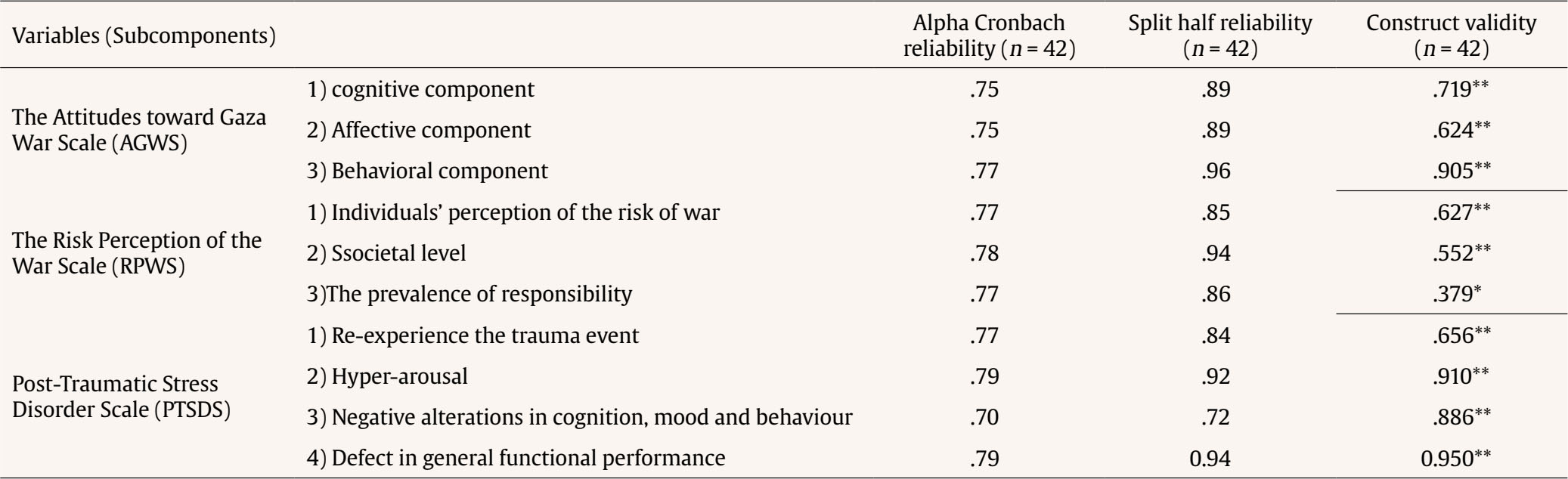 *p < .05, *p < .01 (both two-tailed). The scale was prepared based on reviewing the research framework related to studying attitudes towards wars, and reviewing the available scales that specialize in measuring attitudes towards wars in general, and the Gaza/Palestine war in particular. Among the scales that were reviewed; the War Attitude Scale, prepared by Dupuis and Cohn (2011); the Attitudes Toward Peace and War (APW) Scale, prepared by Bizumic et al. (2013); and the Scale of Empathy Towards Gaza, prepared by Buheji and Ahmed (2024). The current scale is reported to have good reliability (Cronbach’s alpha and split half) and construct validity (measured through correlation between subcomponent and total score). Table 1 Indicates that the reliability coefficient and construct validity of all the scales and their subcomponents were acceptable. However, it was noted that weak association between PTSD and re-experiencing: the limited association between PTSD and re-experiencing symptoms is noteworthy, as re-experiencing is one of the core symptoms of PTSD. Some researchers (Manzanero et. al, 2020) have interpreted this since traumatic memories are more complex than non-traumatic ones given their more sensory and analogical nature, which can also undermine accuracy of recall their details in addition to the psychological distress caused by them. In other words, psychological distress may contribute to participants’ confusion in recalling details of traumatic events while retaining negative feelings. The Risk Perception of the War Scale (RPWS) Developed by the two researchers, the RPWS is a 10-item self-report scale that comprises three subscales: the first component (3 items) deals with individuals’ perception of the risk of war on a personal level (psychologically, professionally, financially); the second component (4 items) includes perception of the seriousness of war on a societal level (security, economically, socially); and the third component (3 items) is the perception of the extent of the prevalence of responsibility in preparing to confront events related to war (army-society-individuals). The items are evaluated on a 5-point Likert scale, ranging from 1 (totally disagree) to 5 (totally agree). The scale includes a number of reversed items, which are the following numbers (4, 7). The scale was prepared based on reviewing the research framework related to studying the risk perception of the war and reviewing the available scales that specialize in measuring risk perception of the war. Among the sources that were used to prepare the scale (Bodas at el., 2015). The current scale is reported to have good reliability (Cronbach’s alpha and split half) and construct validity (measured through correlation between subcomponent and total score) (Table 1). Post-Traumatic Stress Disorder Scale (PTSDS) Developed by the two researchers, the PTSDS is a 23-items self-report scale arranged in four subscales; the first includes re-experience the trauma event component (3 items) (it revolves around the recurrence of memories of the traumatic event involuntarily in a way that is difficult to prevent, and suffering from nightmares and disturbing dreams about the traumatic events); the second component (5 items) is hyper-arousal (people who experience a traumatic event are often in a constant state of alert; they have difficulty concentrating, sleep poorly, are easily aroused, and react impulsively); the third component (9 items) is negative alterations in cognition, mood and behaviour (as a result of traumatic events, a person may face a problem in forming some ideas and beliefs, and suffer from negative feelings, such as feeling sad, in danger, and blaming himself, and may avoiding everything that reminds him of the event, as the person tries to avoid everything that might remind him of the traumatic event that he experienced, saw, or heard about, whether people, places, or situations; which may lead him to isolation); and the fourth component is defect in general functional performance (6 items as a result of a person being exposed to a specific traumatic event, whether by seeing it indirectly, hearing about it, or experiencing it in real life, the various aspects of the person’s life are affected, whether academic, professional, personal, or social). The scale was prepared after reviewing the research framework of the concept, and a number of scales that specialize in measuring the symptoms of post-traumatic stress disorder, such as the PTSD Checklist-civilian version (PCL-C), prepared by Weathers at al. (2003); the Diagnostic and Statistical Manual of Mental Disorders (DSM5-TR, 2023; the War Trauma Exposure Scale, prepared by Küçükertan and Karancı (2023); the PTSD scale, prepared by Badr (2016); and the PTSD Checklist 5 (PCL-5), revised by Khattab and Mohammed (2024). The current scale is reported to have good reliability (Cronbach’s alpha and split half) and construct validity (measured through correlation between subcomponent and total score) (Table 1). The items are evaluated on a 5-point Likert scale, ranging from 0 (never) to 4 (usually), where a high score indicates the manifestation severity of the disorder. The total severity of symptoms ranges from (0 to 92). The severity of symptoms can be classified as follows:
Table 2 Pearson correlation among Attitudes towards the Gaza War and Perceptions of Its Risk in Predicting Manifestations of PTSD 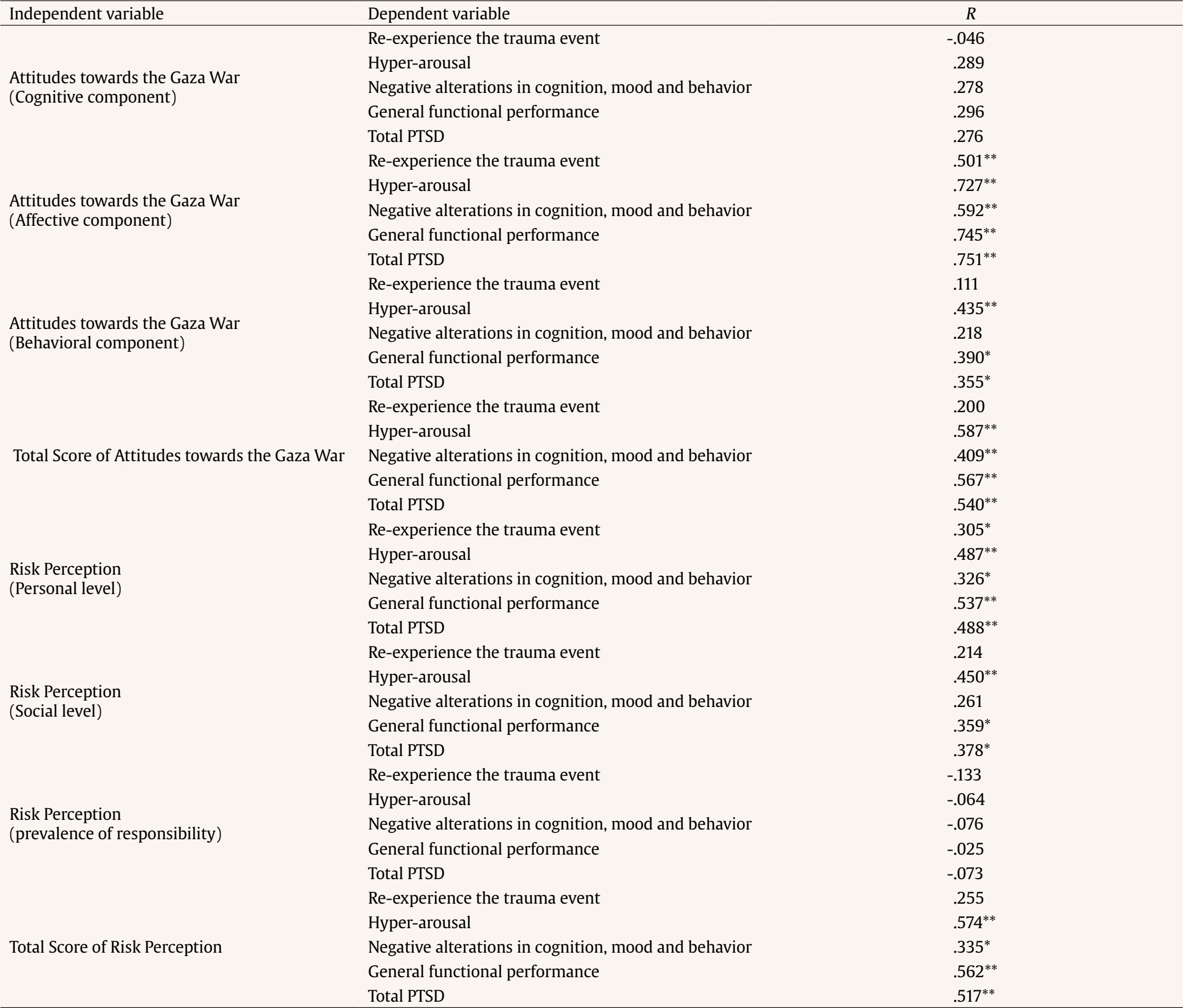 *p < .05, **p < .01 (both two-tailed). Correlations Pearson’s correlation coefficient was per performed to reveal the relationships between the variables in the current study. The results are displayed in Table 2. An examination of Table 2 reveals a positive and significant relationship between the total score of attitudes towards the Gaza war and all manifestations of PTSD (hyper-arousal, negative alterations in cognition, mood and behavior, general functional performance) except the re-experience of the trauma event. With regard to the components of attitude towards the Gaza war, it was found that there is a positive correlation between the affective component of attitude and all manifestations of PTSD, while the behavioral component is associated with some manifestations of PTSD, such as hyper-arousal and general functional performance. The cognitive component was also found not to be associated with any manifestation of PTSD. Table 3 Simple Linear Regression of Attitudes towards the Gaza War and Perceptions of its Risk (independent variables) and Manifestations of PTSD (dependen tvariables) 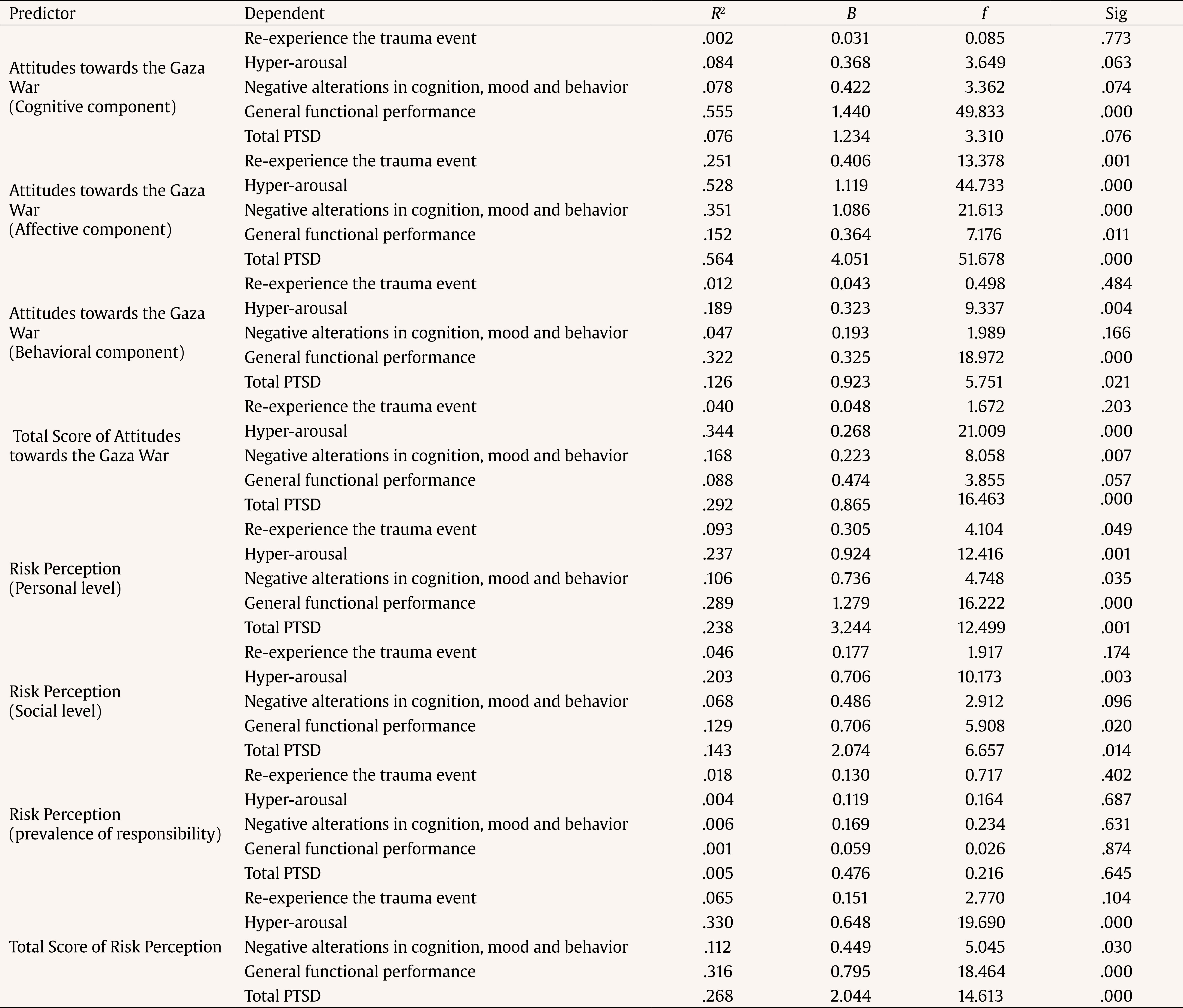 *p < .05. Regarding the relationship between the perception of the risk of the Gaza war and the manifestations of PTSD, it was found that there is a positive correlation between the perception of the risk of the Gaza war and all manifestations of PTSD except for re-experience the trauma event. With regard to the components of the perception of the risk of the Gaza war, it was found that there is a positive correlation between the perception of the risk of war on a personal level and all manifestations of PTSD, while the perception of the risk of war on a social level is associated with some manifestations of PTSD, as hyper-arousal and general functional performance. The prevalence of responsibility was also found not to be associated with any manifestation of PTSD. Regression Analyses Concerning the manifestations of PTSD as dependent variable, first a simple regression analysis was performed with manifestations of PTSD as the dependent variable and attitudes towards the Gaza war and the perceptions of its risk (each separately) were taken as independent variables (Table 3). A study of Table 3 shows that the total score of attitudes towards the Gaza war predicted all manifestations of PTSD (hyper-arousal, general functional performance, negative alterations in cognition, mood and behavior) except the re-experience of the trauma event. With regard to the components of attitude towards the Gaza war, it was found that the affective component of attitude predicted all manifestations of PTSD, while the behavioral component predicted some manifestations of PTSD, i.e., general functional performance and hyper-arousal. The cognitive component was also found not to be predicted with any manifestation of PTSD. Regarding the perception of the risk of the Gaza war, it was found that it predicted all manifestations of PTSD, except the re-experience of the trauma event. With regard to the components of the perception of the risk of the Gaza war, it was found that perception of the risk of war on a personal level predicted all manifestations of PTSD, while the perception of the risk of war on a social level predicted some manifestations of PTSD, i.e., hyper-arousal and general functional performance. The prevalence of responsibility was also found not to predict any manifestation of PTSD. To answer the fifth question of the current study, we relied on the multiple stepwise regression analysis, which requires that there is no strong correlation between the independent variables in order to avoid the problem of multicollinearity, which may affect the interpretation of the effect of the independent variables on the dependent variable. The existence of this problem can be verified by calculating the correlation matrix between the independent variables, where if the correlation coefficient exceeds (.80), this means the presence of multicollinearity, so the correlation matrix between the independent variables was calculated for the study sample as shown in Table 4. Table 4 Pearson Correlation among Attitudes towards the Gaza War and Perceptions of Its Risk 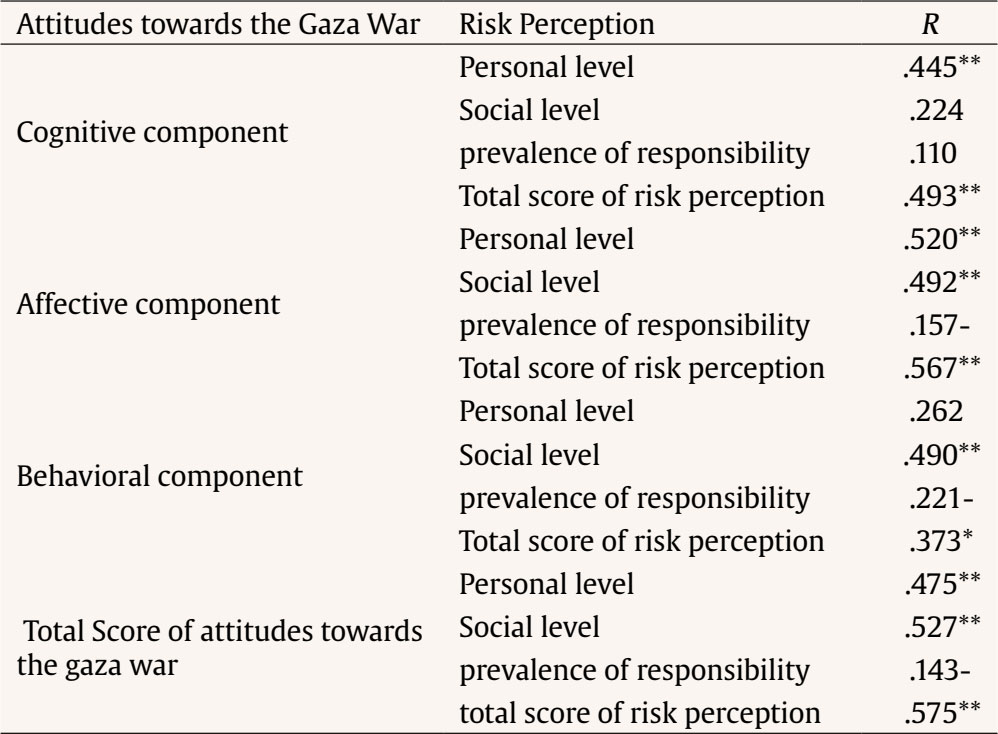 *p < .05, **p < .01 (both two-tailed). The previous table shows a decrease in the correlation coefficients between the independent variables, and thus the problem of multicollinearity disappears from the regression analysis model. Therefore, we will display the results of the multiple stepwise regression analysis in the Table 5. Table 5 Multiple Stepwise Regression of Attitudes towards the Gaza War and Perceptions of its Risk (independent variables) and Manifestations of PTSD (dependent variables)  Examining the previous table showed that the model consisting of the components of the attitude towards the Gaza war and the components of the perception of the risk of this war together was unable to explain the variation in the manifestations of PTSD. Therefore, we limited ourselves to presenting the most predictive variables of the manifestations of PTSD, which was represented by the emotional component of the attitude towards the Gaza war alone. It was found to be able to explain 56% of the variance in all manifestation of PTSD, followed by 55% in general functional performance, 52% of the variance in hyper-arousal, 35% of the variance in negative alterations in cognition, mood and behavior, and 25% of the variance in re-experience the trauma event. The current study aimed to examine individuals’ attitudes towards the Gaza war and their perception of its risks with its various components as predictors of the manifestations of PTSD. The current study was not limited to studying its concepts in general, but it was rather focused on the sub-components of each concept in its relationship to the other, in addition to focusing on its role in predicting it, which has not been comprehensively addressed in the research heritage. Therefore, this study represents a new addition to scientific research that requires further research and application on larger samples and on a wider scale of different age groups. Regarding the results of the first hypothesis, this study aimed to explore the relationship between attitudes towards the Gaza war and some manifestations of PTSD. The findings suggest a strong correlation between emotional and behavioral aspects of these attitudes and certain manifestations of PTSD, excluding re-experiencing the traumatic event and negative mood and behavioral changes. This finding aligns with previous research suggesting that psychological factors, such as emotional responses to traumatic events, are more influential in predicting PTSD than demographic or mental health variables. Studies have shown that emotions like fear, helplessness, and horror can trigger PTSD, and even non-life-threatening events can lead to emotional responses that contribute to the development of the disorder (Ehlers et al., 1998; Lancaster at al., 2011; Lee, et al., 2001; Valentine, 2011; Weiss & Ozer, 2006). Although the A2 criterion in the DSM included fear, helplessness, and horror, subsequent empirical and theoretical research has not confirmed these emotions as uniquely predictive of PTSD development. The correlation of only two components of attitudes (affective and behavioral) with some of manifestations of PTSD can also be explained by factors like attitude strength, accessibility, and emotional intensity. Strong, accessible, and emotionally charged attitudes are more likely to influence behavior. Additionally, direct personal experience can strengthen the link between attitudes and behavior (Glasman & Albarracín, 2006). However, the study’s findings suggest that indirect experience can also influence this relationship, highlighting the complexity of the factors involved. More specifically, individuals who experience traumatic events may develop maladaptive avoidance behaviors to reduce exposure to reminders of the trauma. These behaviors can involve avoiding thoughts, feelings, or situations associated with the event. Such avoidance strategies, while providing temporary relief, can hinder emotional processing and increase the risk of developing or worsening PTSD symptoms (Forbes et al., 2020). Regarding the results of the second hypothesis, which states that “there is a correlation between the perception of the risk of the Gaza war and all manifestations of PTSD”, the results of the current study revealed that this hypothesis was largely fulfilled, as a significant positive correlation was found between the perception of the risk of war on a personal level and all manifestations of PTSD, while the perception of the risk of war on a social level is associated with some manifestations of PTSD, which are hyper-arousal and general functional performance. The prevalence of responsibility was also found not to be associated with any manifestation of PTSD. This result can be explained in light of what Slovic assumed that the concept of risk perception can be illustrated through two-factor representations, which are “dread risk” and “unknown risk”. Dread risk is characterized by a sense of lack of control, fear, and potential for catastrophic consequences, while unknown risk is characterized by hazards perceived as unobservable, unfamiliar, new, and with delayed manifestation of harm (Geng et al., 2021). From the result reached, it can be said that the first factor, “the dread risk,” is the most influential on the sample’s perception of the war’s risk. The findings can also be interpreted through the Health Belief Model, which suggests that perceived risk influences preventive behaviors (Shahrabani at al., 2012). In the context of war, individuals may adopt protective measures based on their perceived vulnerability. Additionally, cognitive theories propose that negative interpretations of traumatic events contribute to PTSD development. Individuals with PTSD may hold negative beliefs about external threats and internal capabilities, leading to distorted perceptions and heightened emotional responses (Alex et al., 2024). Regarding the results of the third and fourth hypothesis, they can be discussed in the light of the meta-analysis conducted by Ozer et al., 2003, which included characteristics of the person that were considered relevant to the development of PTSD. They also included factors that were part of the traumatic event or that immediately followed it. There was a range of these factors that were examined, among them, perceived threat to event, perceived support, and feelings surrounding the event’s “emotional aspect”. There are also a number of studies that have indicated that psychological factors are more important than demographic or cognitive variables in predicting who will develop PTSD. These psychological factors are represented by the subjective evaluation and perception of the event, and how an individual interprets, understands, and feels the traumatic events. Other factors that contribute to these individual differences include an individual’s ability of act, self-efficacy, and coping skills (Weiss & Ozer, 2006). Regarding the results of the fifth hypothesis stating that achieving “the emotional component of the attitude towards the Gaza war alone can predict the occurrence of some manifestations of PTSD without any interaction with perception of war risks”, the present study offers more evidence in favor of the claim that feelings at the time of potentially traumatic events predict later PTSD symptoms of panic, helplessness, and fear as defined by the DSM criteria (Lancaster et al., 2011). However, the current study found that only the affective component was able to predict the manifestations of post-traumatic stress disorder – without any effect of the cognitive component – which may be due to the nature of the affective disorder, which is considered one of the anxiety disorders. The result may also be due to the predominance of feelings and emotions among the Egyptian people over the rational aspect of judging and being affected by events. This study reflects a number of findings. Attitudes toward the Gaza war (affective and behavioral components) predict PTSD symptoms, except for the cognitive component of attitudes. Perceptions of Gaza war risks (at the personal and social levels) predict PTSD symptoms, except for the diffusion of responsibility component. The study concluded that there was no interaction between attitudes toward the Gaza war and perceptions of its risks in predicting PTSD symptoms, and that the affective component alone was able to explain a large proportion (56%) of the true variance in predicting PTSD symptoms. Limitations and Future Research Although the study contributes to extant literature, it has three limitations. First, not all age groups are well represented. Second, various factors such as gender, other psychological variables such self-efficacy, attribution, adaptation skills, were not considered in this study. Third, the small sample size is due to the retention of the targeted sample members who suffer from PTSD of various degrees (from mild to severe), while excluding non-target participants, which led to the small sample size and limited the generalization of the results on a wide scale within the Egyptian society. These factors may have influenced the results and future research could be conducted on these variables. Conflict of Interest The authors of this article declare no conflict of interest. Cite this article as: Hosny, N. K. & Ahmed, R. M. (2026). Attitudes towards the Gaza war, risk perception and manifestations of post-traumatic stress disorder. Anuario de Psicología Jurídica, 36, Artículo e260483, 1-9. https://doi.org/10.5093/apj2026a16 References |
Cite this article as: Hosny, N. K. & Ahmed, R. M. (2026). Attitudes towards the Gaza War, Risk Perception and Manifestations of Post-traumatic Stress Disorder. Anuario de Psicología Jurídica, 36, Article e260483. https://doi.org/10.5093/apj2026a16
Correspondence: rehabpsychology5@gmail.com (R. M. Ahmed).Copyright © 2026. Colegio Oficial de la Psicología de Madrid


Herramientas:
 PDF
PDF e-PUB
e-PUB CrossRef
 JATS
JATS Imprimir
 Enviar
ALERTA POR E-MAIL
La Revista de Anuario de Psicología Jurídica está distribuida bajo una licencia de Creative Commons Reconocimiento-NoComercial-SinObra Derivada 4.0 Internacional.com