Anger Rumination as a Moderator of the Association between Factor 2 of Psychopathy and Proactive Aggression
Carolina Sarrate-Costa, Marisol Lila, Luis Moya-Albiol, & Ángel Romero-Martínez
University of Valencia, Spain
https://doi.org/10.5093/pi2026a10
Received 1 December 2025, Accepted 22 December 2025
Abstract
Objective: Scholars have identified psychopathic traits as facilitators of intimate partner violence (IPV). Analyzing anger management strategies might clarify how these personality traits contribute to violence proneness. One potential moderator to consider is the tendency to ruminate about anger (or anger rumination). However, the pattern of association between psychopathic traits and violence proneness differs depending on psychopathy factors and the subtypes of violence expression (reactive or proactive). Therefore, the main objective of this study was to examine whether the two factors of psychopathy and/or the total score would explain the expression of violence subtype (reactive and proactive), introducing anger rumination as a moderator and controlling the effect of potential confounding factors. Method: A total of 125 healthy men (64 IPV perpetrators and 61 controls) were recruited. All of them were interviewed and answered to a set of self-reports. In addition, a psychophysiological record was collected during a resting period. Results: The results showed that all participants (IPV and controls) who scored high in factor 2 of psychopathy presented a high tendency toward proactive aggression when they exhibited moderate or high levels of anger rumination. This model remained significant after controlling for the effect of potential confounding variables. Conclusions: Our findings highlight the importance of developing specialized modules in the interventions for IPV perpetrators or other violent men. These modules should focus on offering adaptative strategies to deal with anger and reduce anger rumination tendencies. This might help increase their threshold and reduce violence proneness and/or IPV recidivism.
Keywords
Anger rumination, IPV perpetrators, Proactive aggression, Psychopathy traits, Reactive aggressionCite this article as: Sarrate-Costa, C., Lila, M., Moya-Albiol, L., & Romero-Martínez, Á. (2026). Anger Rumination as a Moderator of the Association between Factor 2 of Psychopathy and Proactive Aggression. Psychosocial Intervention, 35, Article e260818. https://doi.org/10.5093/pi2026a10
Correspondence: Angel.Romero@uv.es (Á. Romero-Martínez)., Correspondence: Angel.Romero@uv.es (Á. Romero-Martínez).Intimate partner violence (IPV) against women perpetrated by their male partners carries numerous health costs, including serious short- and long-term physical, mental, sexual, and reproductive health problems for victims, as well as other behavioral and emotional disturbance in indirect victims such as children (World Health Organization, 2021). Beyond documenting its prevalence and impact, it is essential to analyze the main causes and/or underlying risk factors of IPV perpetration from a multidisciplinary lens, which includes a biopsychosocial perspective (Gracia et al., 2025; Gracia et al., 2021; Hardesty & Ogolsky, 2020). The deeper our knowledge regarding these main causes of violence proneness in IPV perpetrators, the better our ability to target their therapeutic needs, potentially facilitating the development of effective therapeutic programs to reduce future IPV recidivism (Lila & Gilchrist, 2023). In this context, considering both reactive and proactive aggression in IPV perpetrators is particularly relevant, as these complementary forms of violence may be partly explained by different underlying mechanisms and may require partially differentiated intervention strategies (Romero-Martínez et al., 2022). The General Aggression Model (GAM) applied to IPV (DeWall, Anderson, et al., 2011) conceives proneness to this kind of violence as the result of the interaction between personal factors (e.g., personality traits, sociodemographic factors, attitudes toward IPV, genetic vulnerability, etc.) in combination with situational factors (e.g., presence of aggressive cues, frustration, provocation, incentives, alcohol misuse, among others). The interaction between the above-mentioned variables reduces the threshold for perpetrating IPV (decision on action) through their effects on cognition, emotion, and arousal (inner states) when coping with certain stimulus and/or stressful circumstances. Out of all the personal risk factors for violence proneness in IPV perpetrators, several scholars have remarked the importance of certain personality traits, especially, psychopathic traits, which seem instrumental in explaining chronic anger expression (Kosson et al., 2020) and IPV perpetration (Collison & Lynam, 2021; Cunha et al., 2021; Iyican & Babcock, 2018; Lila et al., 2012; Santos-Hermoso et al., 2022). This personality is composed of traits such as lack of remorse, manipulativeness, callousness, shallow emotion, and persistent antisocial behaviors (Hare, 2003). However, it is necessary to bear in mind that the analysis of traits that compose psychopathy tend to be differently associated with aggression and violence (Porter y Woodworth, 2006; Skeem & Mulvey, 2001; Thomson et al., 2019). To properly understand the association between psychopathy and the distinct forms of violence, it is necessary to differentiate from the two factors that Hare (1991, 2003) established for psychopathy. Accordingly, Factor 1 includes two facets. One of the facets is related to affective traits (e.g., the inability to bond affectively with others, a reduced or absent capacity to feel emotions, lack of remorse, etc.) and the other one is related to interpersonal aspects (e.g., the use of lies, manipulation, a sense of superiority and grandiosity, etc). Factor 2 consists of two additional facets, lifestyle (e.g., the need for continuous stimulation, impulsivity, parasite style of life, etc.) and antisocial facets (e.g., poor behavioral control, juvenile delinquency, criminal versatility, etc.) (Hare, 1991, 2003). As stated by a meta-analysis (Blais et al., 2014), Factor 1 tends to be associated with proactive violence (deliberate, cool-blooded, calculated, and instrumental aggression), while Factor 2 is closely related to emotionally-driven or reactive violence (impulsive and spontaneous aggression). However, these conclusions were not unanimous and exhibited a considerable heterogeneity across studies (Blais et al., 2014; Hecht et al., 2016). This variation in the association between both factors of psychopathy and both types of aggressive behaviors could be due to specific methodological issues and a lack of consideration of the impact of several potential confounding variables that might interfere or moderate the association between the above-mentioned variables. Given that there was no complete agreement regarding the relationship between the two factors of psychopathy and the different types of expression of aggression and violence (reactive and proactive) and based on the GAM (DeWall, Anderson et al., 2011), it was relevant to include some moderating factors to help reduce this heterogeneity. Focusing on the personal factors described by GAM, anger rumination becomes relevant in explaining proneness to violence. In fact, it might help clarify the existence of heterogeneity across studies that explore the relationship between psychopathic factors and both proactive and reactive aggression. Anger rumination has been defined as the tendency to pay attention to thoughts and emotions related to anger experiences, increasing the processing of challenging stimuli, generating aggressive thoughts, reducing inhibitions, increasing arousal and, in general, favoring hostile interpretation of certain stimulus (Babcock & Potthoff, 2021; Denson 2013; Hosie et al., 2022; Mozley et al., 2019; Peled & Moretti, 2010; Sarrate-Costa et al., 2022; White & Turner, 2014). Accordingly, it has been concluded that the higher the Factor 1 psychopathy score (measured with Levenson Self-Report Psychopathy Scale), the higher the proneness to proactive aggression, especially among healthy young adults scoring high in anger rumination (Guerra & White, 2017). Furthermore, the higher the Factor 2 score, the higher the proneness to reactive aggression among healthy young adults scoring high in anger rumination (Guerra & White, 2017). Therefore, this suggests that anger rumination contributes to reactive violence proneness and impulsive antisocial acts (Denson, Pedersen, et al., 2011; Li et al., 2019; Witt & Donnelan, 2008). This association would be particularly stronger among individuals who have difficulty regulating their own anger expression, that is, individuals characterized by poor anger control (Denson, Pedersen, et al., 2011; Kosson et al., 2020; Li et al., 2019). This connection is framed within Howard’s Quadripartite Violence Typology, which explains how proneness to violence is higher among individuals with psychopathy or who score high in psychopathic traits (Howard, 2015). Therefore, a high tendency to ruminate on anger may serve as the moderating variable that helps clarify the varying association between psychopathic factors and both forms of aggressive behavior. Not only is it necessary to pay attention to the personal factors proposed by GAM to better understand the association between psychopathy and aggressive behavior, but also to other important factors such as certain sociodemographic variables, including age and educational or academic level (Blais et al., 2014; Estrada et al., 2021; Gillespie et al., 2023; Gracia et al., 2023; Gracia et al., 2009; Riaz et al., 2021; Hecht et al., 2016; Thomson et al., 2021). Accordingly, the lower the age and the academic level of participants, the stronger the association between psychopathic traits, without differentiating between both factors and both reactive and proactive aggression. Additionally, psychophysiological dysregulation, assessed with psychophysiological markers or the balance between both branches of the autonomous nervous system (ANS), was highlighted as a potential moderator in the association between psychopathic traits and aggression (reactive and proactive) (De Looff et al., 2022; Muñoz-Centifanti et al., 2013). In this regard, individuals who scored high in traits corresponding to Factor 1 of psychopathy and had a low dysregulation between both branches of the ANS exhibited a high proneness to proactive aggression. Finally, it has also been suggested that alcohol misuse explains the association between those variables (Okano et al., 2016; Quigley et al., 2018). In this sense, the higher the alcohol misuse, the higher the risk of emotionally driven violence, including IPV, among individuals scoring high in Factor 2 of psychopathy (e.g., high impulsivity). Keeping all this in mind, the main objective of this research was to study the relationship between psychopathic traits and violence (reactive and proactive) in a sample of men (IPV perpetrators and controls or community sample), including anger rumination as the moderating variable, controlling for potential confounding variables. According to previous conclusions in this field of research (Blais et al., 2014; Denson, 2013; DeWall, Anderson et al., 2011; Guerra & White, 2017; Hecht et al., 2016; Sarrate-Costa et al., 2022; Witt & Donnelan, 2008), we hypothesized that the higher the Factor 1 of psychopathy score, the higher the proactive aggression, and the higher the Factor 2 of psychopathy, the higher the reactive aggression in both groups of men, being these associations more significant among men scoring high in anger rumination. Additionally, we expected these models to remain significant after controlling for the effect of potential confounding variables such as group, age, educational level, psychophysiological variables, and alcohol misuse. Method Participants We estimated a minimum number of 122 participants for the sample size to test the regression models, considering a power analysis of .80, a significance level of .05, medium effect size (.39), and nine predictors (Statistics Kingdom, 2022). In this sense, after checking for 140 potential participants, the screening process assessing exclusion criteria allowed us to include a total of 125 healthy male volunteers (64 IPV perpetrators and 61 controls). IPV perpetrators were recruited from the CONTEXTO Program, a community-based psychoeducational intervention program that is mandatory for men convicted of intimate partner violence (see Lila et al., 2018 for further details). Men who took part in this program had been sentenced to fewer than two years for intimate partner violence and had no previous criminal record, receiving a suspension of their conviction on the condition that they attended this intervention program or serving in a community intervention program. Men attending this intervention were approached in person and offered to take part in this study. Before starting the first session of the intervention program, they were asked if they wanted to voluntarily participate in the study, having been previously informed about the characteristics of the research. In addition, the inclusion criteria for this study were also to not have any neurological (traumatic brain injuries, stroke, etc.) or mental disorders (e.g., schizophrenia, depression, etc.) and to have good writing and speaking skills in Spanish. For the control group, participants were recruited in the city of Valencia (Spain) through advertisements posted on social networks, flyers in the University and personal contact with potential candidates. People who were interested in participating in our study were selected after verifying via email that they met the inclusion criteria. To take part in our study, not only was the absence or neurological and mental disorders necessary, but it was also mandatory to not have any previous criminal record (verified based on a criminal record certificate issued by a public institution and voluntarily provided by participants) and to score below 1 in the Conflict Tactic Scale 2 (CTS-2) (Muñoz-Rivas et al., 2007; Straus et al., 1996). Furthermore, controls presented similar socio-demographic characteristics (age, educational level, nationality, etc.) to the IPV perpetrators, in addition to an absence of IPV. The study was conducted in accordance with the Declaration of Helsinki and approved by the Ethics Committee of the University (code: H1515749368278). All participants voluntarily agreed to participate and gave their written informed consent before the study began and were informed about the nature of the study. Procedure The procedure was carried out in two experimental sessions in the Psychobiology laboratories, with each session lasting approximately an hour and a half. The sessions always took place between 4:00 and 7:00 p.m. During the first session, the informed consent was signed, and the sociodemographic characteristics were collected through a short, individual, and semi-structured interview. Moreover, alcohol misuse was assessed. For this, we used the Spanish version of the Alcohol Use Disorders Identification Test (AUDIT) (Contell-Guillamón et al., 1999; Saunders et al., 1993). In the second session, we collected the baseline (5 minutes) of the skin conductance level (SCL) and respiratory sinus arrhythmia (RSA) through the psychophysiological recording instrument (VU-AMS). Subsequently, we administered the Spanish version of the Reactive-Proactive Aggression Questionnaire (RPQ) (Andreu et al., 2009; Raine et al., 2006) and the Anger Rumination Scale (ARS) (Ortega-Andrade et al., 2017; Sukhodolsky et al., 2001). Lastly, the Hare’s Psychopathy Rating Scale-Revised (PCL-R) (Hare, 1991, 2003) was used as a semi-structured interview. The Hare Psychopathy Checklist-Revised (PCL-R) We employed the Spanish version (Moltó et al., 2000) of The Hare Psychopathy Checklist-Revised (PCL-R) (Hare, 1991). This 20-item instrument was administered by two interviewers trained on the PCL-R and with over 3 years of experience working with IPV perpetrators assessing personality and mental disorders in the forensic field. Interviewers should answer the items ranging from 0 to 2 (0 = absent, 1 = partially, and 2 = present) based on a 45-minutes interview with participants, accompanied with file reviews contrasting participants answers. These interviews were complemented with a set of self-reports measuring several dimensions directly related to psychopathy. Inter-rater agreement between both interviewers was above .90 for all dimensions considered. These items were divided into two factors: 1 (interpersonal and affective) and 2 (lifestyle and antisocial behaviors). Cronbach alphas for this study were .88 for total score, .92 for Factor 1, and .84 for Factor 2. This study used the total score and the two facets of psychopathy. This instrument was validated in the Spanish population (Moltó et al., 2000) and has demonstrated its validity (Hare et al., 2000) for assessing psychopathy in IPV perpetrators (Cunha et al., 2021). Reactive-Proactive Aggression Questionnaire (RPQ) The Spanish version (Andreu et al., 2009) of the RPQ (Raine et al., 2006) was employed to assess reactive and proactive aggression in adults (Andreu et al., 2009). It is composed of 23 items based on a reactive (11 items) versus proactive (12 items) dimension. Cronbach alpha for this study for both scales was higher than .70. For this study, reactive and proactive subscales were employed as dependent variables. This test has been used to measure reactive and proactive aggression in IPV perpetrators, and also presents significant correlations with other indicators that measure aggressive behavior (Brzozowski et al., 2021; Sarrate-Costa et al., 2022). Anger Rumination Scale (ARS) The anger rumination tendency was assessed using the Spanish version (Ramos-Cejudo et al., 2017) of The Anger Rumination Scale (ARS) by Sukhodolsky et al. (2001). This questionnaire, validated in community samples, analyzes the tendency to focus on angry and negative thoughts, moods, and memories, recall past anger episodes and think over the causes and consequences of anger experiences. It is comprised of 19 items rated on a four-point Likert scale (1 = almost never, 2 = sometimes, 3 = often, 4 = almost always). An overall score was obtained from the sum of all its items. Cronbach’s alpha for this study was .91 and the total score was employed as an independent variable. It has been applied to assess anger rumination in IPV perpetrators (Sarrate-Costa et al., 2022) and has also presented positive associations with other scales measuring aggressive behavior (Ramos-Cejudo et al, 2017). Alcohol Misuse We employed the Spanish version (Contell-Guillamón et al., 1999) of the Alcohol Use Disorders Identification Test (AUDIT) (Saunders et al., 1993) to check for the quantity and frequency of alcohol use in adults. This test contains 10 items, eight of which range from 0 (never) to 4 (daily or almost daily), and two items which are scored with 0 (No), 2 (Yes, but not in the last year), and 4 (Yes, within the last year). In all cases, a higher score indicates a higher alcohol misuse. Cronbach alpha for this study was .86. This test has been widely used to differentiate between IPV perpetrators who exhibit alcohol misuse and those who do not (Catalá-Miñana et al., 2017; Kane et al., 2019), showing a positive association with other instruments assessing alcohol misuse (Kuteesa et al., 2019). Revised Conflict Tactics Scale (CTS2) We used the Spanish version (Muñoz-Rivas et al., 2007) of this measure (Straus et al., 1996). The CTS2 is a self-report inventory that assesses how individuals tend to solve their relationship conflicts. Participants report on their own behaviors and those of their partners during conflicts. The measure consists of 78 items rated on an 8-point Likert-type scale. Cronbach alphas for this study were above .70 for all scales. This instrument is widely employed to measure different types of strategies used when dealing with conflicts between couples, including IPV perpetration (Carbajosa et al., 2017; Chapman, & Gillespie, 2019) and has also been positively associated with other instruments assessing IPV (Chapman, & Gillespie, 2019). Psychophysiological Recording To carry out the psychophysiological recording, the Ambulatory Monitoring System (VU-DAMS) was used. We placed seven pre-gelled electrodes (EL503) on the individual’s chest and back to explore the respiratory sinus arrhythmia (RSA). This parasympathetic indicator was measured in msec. Additionally, the BIOPAC TSD203 combined with isotonic gel (GEL101) was used to record another sympathetic indicator, skin conductance level (SCL), which was measured from the medial phalanges of the index, middle or ring finger, in microSiemens (μSi). As a marker of parasympathetic system, we employed the respiratory sinus arrythmia (RSA) measured in milliseconds (msec). This was calculated after subtracting the shortest inter beat interval from the longest. Both autonomic indicators have been shown to be suitable for the measurement and evaluation of emotional regulation (Fraziet et al., 2004), including samples of IPV perpetrators (Vitoria-Estruch et al., 2018). Table 1 Means (Standard Deviations) and Percentages of Sociodemographic, Psychological Variables, and Physiological Baseline Levels 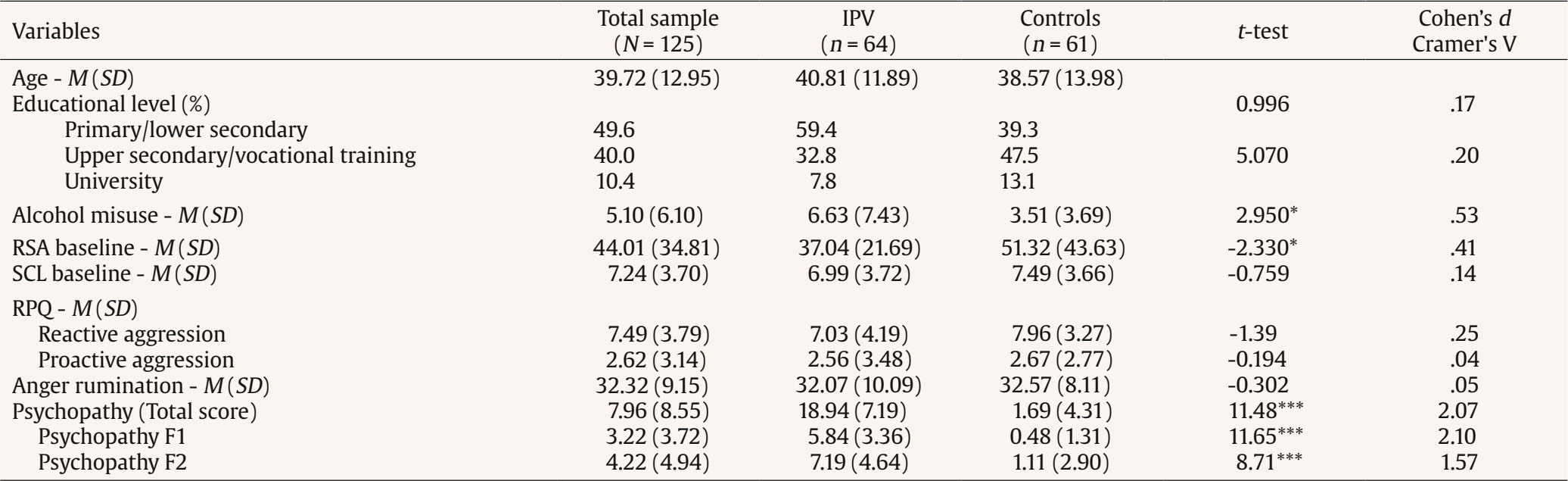 Note. IPV = intimate partner violence; RSA = respiratory sinus arrhythmia; SCL = skin conductance level; RPQ = Reactive-Proactive Aggression Questionnaire; F1 = Factor 1, F2 = Factor 2. *p ≤ .05, ***p ≤ .001. Data Analysis Before applying moderation models as stated by Hayes and Rockwood (2020), we checked whether predictors or independent variables (Factors 1 and 2 as well as total score of psychopathy and anger rumination) were not only significantly associated between them, but also with those with reactive and proactive aggression (dependent variables) by conducting partial correlations in the full sample including the following covariates: group, age, educational level, alcohol misuse, SCL and RSA baseline to control their potential confounding effects. Afterwards, moderation models among independent and dependent interrelated variables were tested. The next step was to run a regression analysis by initially introducing covariates (Step 0), followed by the main psychopathy predictor (Factor 1, Factor 2 or total score of psychopathy) in combination with anger rumination (Step 1): followed by the two-way interaction between psychopathic variable and anger rumination as a moderator (Step 2). Considering the existence of a moderation in which change in explained variance significantly increased from step 1 to 2. Following the recommendations of Hayes and Rockwood (2020), we then tested for simple slopes, specifically the interaction between each of the main predictor and the moderator being divided into low (16th percentile), moderate (50th percentile), and high (84th percentile). The use of three percentiles instead of values corresponding to ± 1 SD of the mean was recommended, as these three percentiles are more sensitive when the moderator is skewed, although it is also appropriate when the moderator adjusts to normality (Hayes, 2022; Igartua & Hayes, 2021). All statistical analyses were performed with IBM Statistical Package for the Social-Sciences (SPSS) for Windows, Version 26.0, with the α level set at .05. Furthermore, to conduct the moderation analysis, we employed PROCESS 3.5., selecting 5000 as the number of bootstrap samples. Characteristics of the sample included in the study are summarized in Table 1. Partial Correlations Partial correlation analyses between psychopathy (Factor 1, Factor 2, and total score), anger rumination, and reactive and proactive aggression, controlling for group, age, educational level, alcohol, and SCL and RSA baseline covariates, revealed that the total score of psychopathy was positively associated with proactive aggression, but unrelated to reactive aggression and/or anger rumination. Factor 1 of psychopathy was not related to any form of aggression or anger rumination, whereas Factor 2 of psychopathy was positively related to both (reactive and proactive aggression) and anger rumination. Finally, both types of expression of violence were positively related to anger rumination (Table 2). Furthermore, an additional supplementary table is provided that details the association between the above-mentioned variables, RSA and SCL baselines, and alcohol misuse (Table S1 in the Appendix). Table 2 Partial Correlational Analysis between Psychopathy, Anger Rumination, Reactive and Proactive Aggression for the Full Sample  Note. F1 = Factor 1, F2 = Factor 2. *p ≤ .05, **p ≤ .01, ***p ≤ .001. Table 3 Regression Model Testing for the Interaction between Predictors (psychopathy traits, Factor 2, anger rumination) to Predict Proactive Expression of Aggression 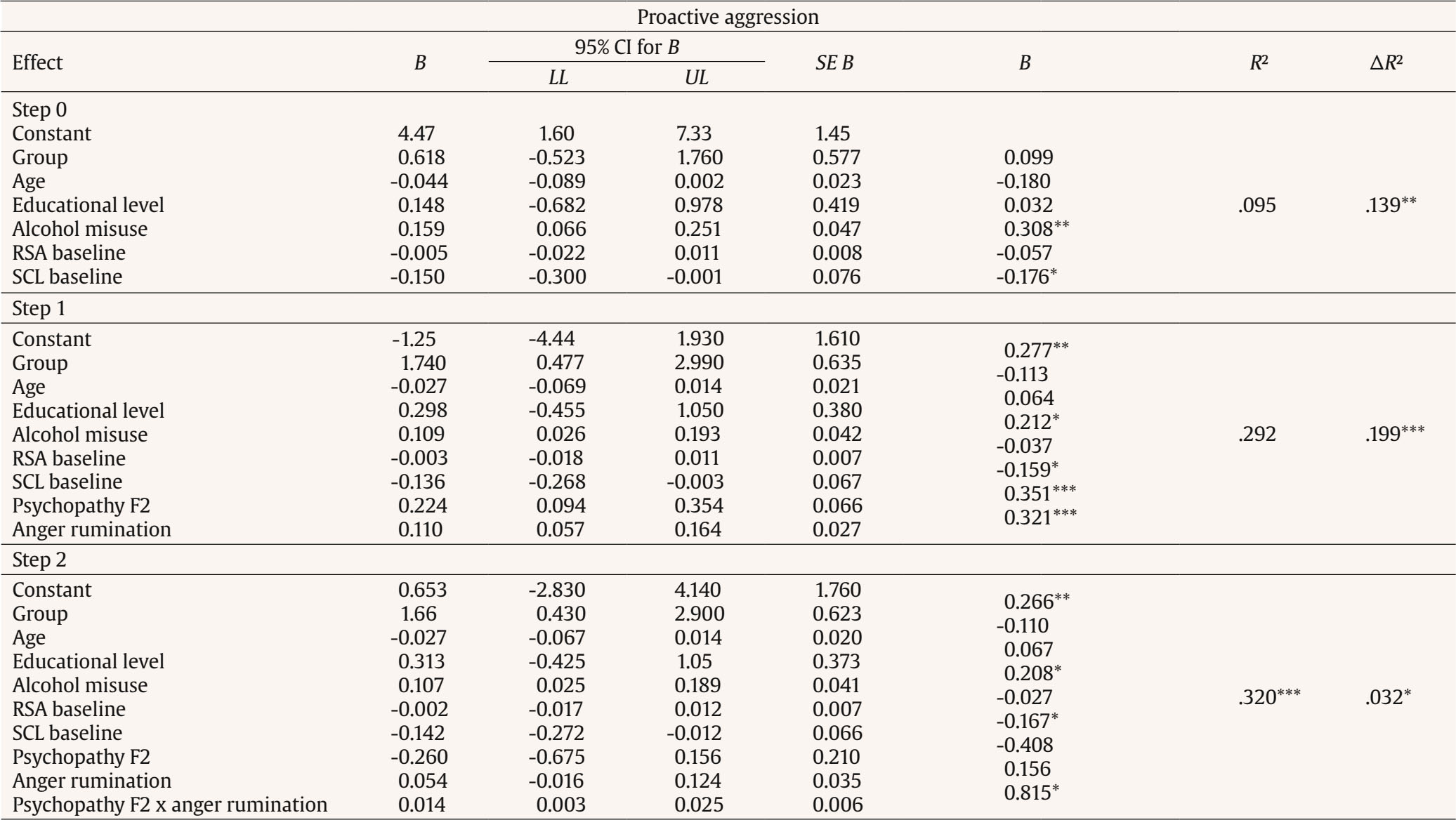 Note. Confidence interval; LL = lower limit, UL = upper limit; RSA = respiratory sinus arrhythmia; SCL = skin conductance level; F1 = factor 1, F2 = factor 2. **p ≤ .01, ***p ≤ .001. Regression Model As stated above, it was only possible to conduct a moderation model including Factor 2 of psychopathy and anger rumination (moderator) as predictors of proactive aggression given that those variables were significantly related. Nonetheless, it was not possible to conduct the model for factor 1 of psychopathy as it was not related to the dependent variable (proactive or reactive aggression). Accordingly, the inclusion of the interaction between factor 2 of psychopathy and anger rumination in step 2, increased the amount of explained variance (R2 = .320, R2 change = .032, p = .017). The bootstrap analysis for the interaction revealed the following values: coefficient = .014, bootmean = .014, bootSE = .006, 95% CI [.002, .027]. The calculation of simple slopes pointed out that the moderation was exclusive to participants with moderate (standardized effect = .16, SE = .070, t = 2.21 , p = .0289, 95% CI [.016 to .29]), and high anger rumination (standardized effect = .32, SE = .08, t = 4.24, p < .001, 95% CI [.17 to .47]), but not to participants with low anger rumination (standardized effect = .07, SE = .09, t = 0.81, p = .422, 95% CI [-.11 to .25]) (Table 3). Thus, among participants scoring high in Factor 2 of psychopathy, proactive expression of aggression was high when they scored moderate or high in anger rumination (Figure 1). We have included the regression model without considering covariates in the supplementary material (Table S2 in the Appendix). Figure 1 Factor 2 of Psychopathy as a Predictor of Proactive Aggression Moderated by Anger Rumination for the Full Sample. 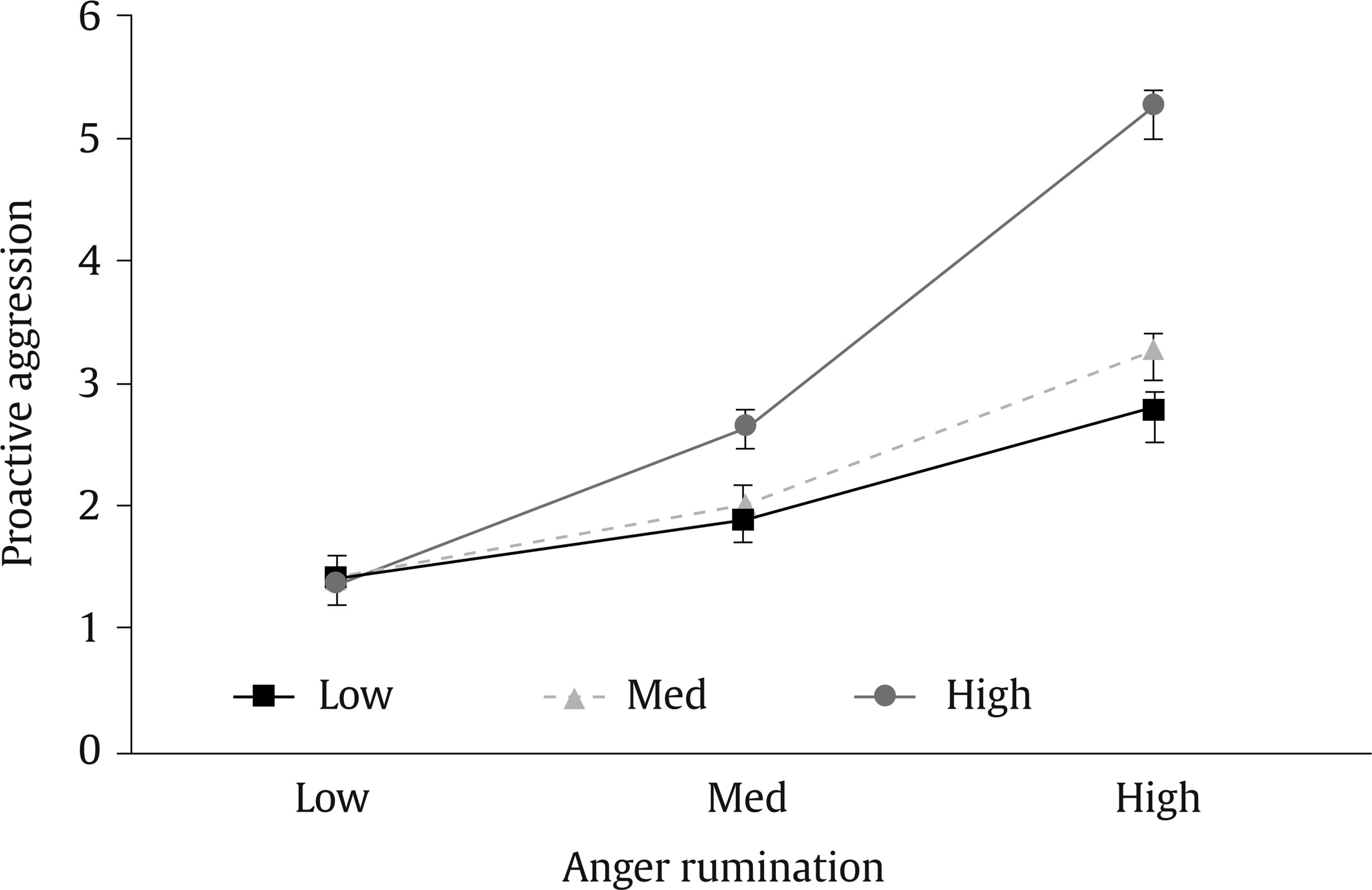 The main objective of the present study was to investigate the relationships between different facets of psychopathy and reactive and proactive expression of aggression in a group of male IPV perpetrators and controls, paying special attention to the moderating role of anger rumination in this association. In this sense, our data pointed out that all participants scoring high in facet 2 of psychopathy presented high proactive expression of aggression, particularly, in men scoring moderate or high in anger rumination. Contrary to our initial hypothesis, our data did not support the positive association between Factor 1 and proactive aggression, and Factor 2 entailed high reactive aggression, as stated previously in scientific literature (Blais et al., 2014; Hecht et al., 2016). Our data did not completely contradict previous research, given that authors of meta-analysis have recognized the existence of an association in the sense that we obtained, but it was relatively low and affected by heterogeneity across studies. In fact, our study highlighted that the association with both forms of anger expression was important for facet 2 of psychopathy, but not for facet 1. It should also be kept in mind that the association between these variables was exactly the same for IPV perpetrators and controls, as we controlled the role of ‘group’ for all the analysis, even after controlling for potential confounding variables. Regarding the association of psychopathy and anger rumination, many authors suggest that anger rumination is equally associated with both facets of psychopathy (Denson, 2013; Guerra & White, 2017; Witt & Donnelan, 2008). Nonetheless, our results partly support this association, that is, only participants scoring high in facet 2 of psychopathy with high tendency to ruminate anger tend to express aggression in a proactive manner. In other words, our data allowed us to conclude that participants characterized by irresponsibility, persistent, and versatile antisocial tendencies tend to ruminate anger (e.g., spending time with revenge feelings, hostile interpretation of other intentions, etc.), which, in turn, facilitates proactive or non-emotionally mediated aggression. This is a key point for developing intervention programs, not only focused on emotional regulation modules, but also positive ways of dealing with anger or changing cognitive anger schemas. Future studies should consider including self-control to understand the association between psychopathy and both anger rumination and proactive aggression, as has been previously stated (Denson, Pedersen, et al., 2011; Kosson et al., 2020; Li et al., 2019). This association between personality disorders is especially evident and stronger the lower the self-control (Howard, 2015). Due to the heterogeneity of the included sample, we controlled for the role of several potential confounding variables such as sociodemographic, alcohol misuse, and emotional regulation. The association between variables was equal in IPV perpetrators and controls. Perhaps this points to the fact that anger rumination increases the relationship between psychopathic traits and the expression of violence in a differentiated manner depending on the instrument employed for assessing psychopathy or aggression instead of the sample assessed. This, in turn, reinforces the need for conducting additional research controlling for several confounding variables, which would help dilucidated the association between facets of psychopathy with anger rumination and anger expression. Despite the noteworthy strengths of this study, certain limitations should be noted. First, due to the characteristics of the sample, this is a quasi-experimental study. This is because it was not possible to randomly assign or select the sample to the different groups. Moreover, the nature of the study was uncontrolled and was mainly assessed with self-reports, which makes it difficult to establish causal relationships between variables and to reinforce the biases of these instruments, such as social desirability. Furthermore, it would be important to conduct additional research in a larger sample size including a heterogeneous sample, which would in turn increase the external validity of our conclusions. Additionally, it would be important to keep in mind that combining two very different samples might undermine the confidence in their replicability. Another limitation is that psychopathy traits, the manifestation aggression profile, and anger rumination have been assessed by a self-report survey and interviews. Although these measures have been validated previously, they could be biased by the high social desirability (Dutton & Hemphill, 1992). Accordingly, other complementary and more objective forms of measurement (e.g., file reviews) should be included. However, our assessment instruments have reported high internal consistency. Hence, future research should consider these limitations to achieve high quality results. Additionally, the RPQ is specific to physical aggression, a reason why other forms of aggression should be studied. As a key point, our study reinforces the need to focus interventions to reduce anger expression and anger rumination, especially in interventions focused on IPV perpetrators. Actually, many studies have shown that the reduction of aggressive responses through training in self-control and emotional regulation allowed reducing the tendency of some violent individuals to ruminate angry memories and thoughts (Denson, Capper, et al., 2011; DeWall, Finkel et al., 2011; Finkel et al, 2009). Moreover, it is important to incorporate specialized modules in IPV perpetrators to reduce the tendency to ruminate anger. In this sense, several studies have demonstrated how certain interventions effectively reduce different risk factors, such as emotional regulation and/or coping with couple stress in IPV perpetrators, which, in turn, leads to a low risk of recidivism (Lila et al., 2018, 2020; Romero-Martínez et al., 2019; Romero-Martínez et al., 2022). Hence, this reinforced the need for conducting additional research targeting anger rumination and to assess whether specific interventions help reduce this tendency of dealing with anger. In conclusion, our results highlight the importance of evaluating and considering new risk factors, especially personality traits and anger rumination, before, during, and after interventions that target IPV perpetrators, given that tendency toward anger rumination has been shown to increase the expression of proactive violence in men exhibiting high levels of antisocial and lifestyle psychopathy traits. Along these lines, targeting anger rumination during treatment may help reduce the risk of physical aggression. This would enable the development of more effective and integrative interventions that aim to reduce the individual, social, health, and economic costs of IPV perpetration. Conflict of Interest The authors of this article declare no conflict of interest. Cite this article as: Sarrate-Costa, C., Lila, M., Moya-Albiol, L., & Romero-Martínez, A. (2026). Anger rumination as a moderator of the association between factor 2 of psychopathy and proactive aggression. Psychosocial Intervention, 35, Article e260818. https://doi.org/10.5093/pi2026a10 Funding This research was partially supported by grant number PID2022-142287OA-I00; funded by MCIN/AEI/10.13039/501100011033 and by ERDF, EU and The Prometeo Program for research groups of excellence of the Ministry of Innovation, Universities, Science and Digital Society of the Generalitat Valenciana, grant number CIPROM/2021/46. Due to the characteristics of the sample and for data protection reasons, all data supporting the findings of this study are available from the corresponding author upon request. Access to the data is granted solely for academic and research purposes, and all requests will be reviewed to ensure compliance with privacy and ethical considerations. Appendix Supplementary Materials Table S1 Partial Correlational Analysis between Psychopathy, Anger Rumination, Reactive and Proactive Aggression, Psychophysiological Baselines, and Alcohol Misuse for the Full Sample Controlling for Group, Age and Educational Level 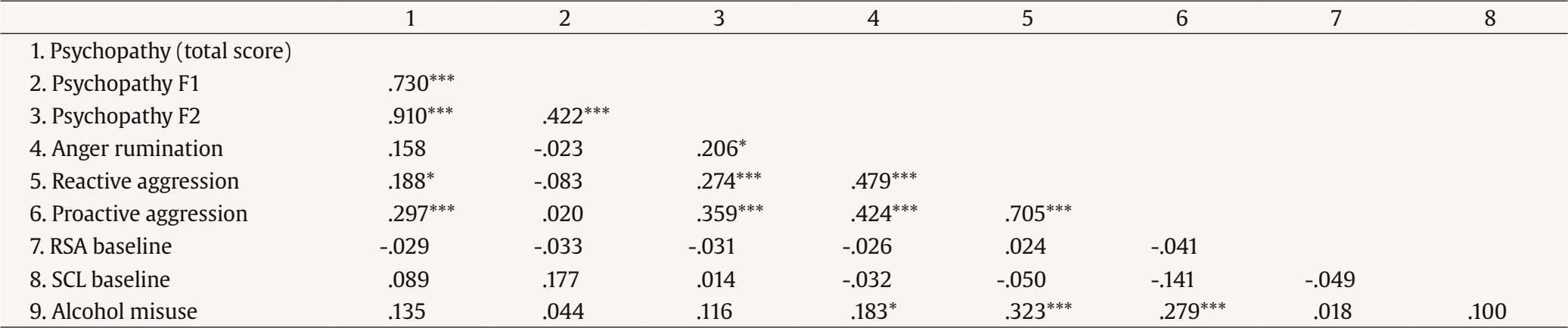 Note. F1: factor 1, F2: factor 2; RSA: respiratory sinus arrythmia, SCL: skin conductance level. *p ≤ .05, **p ≤ .01, ***p ≤ .001. Table S2 Regression Model Testing for the Interaction between Predictors (psychopathy traits - factor 2, anger rumination) to Predict Proactive Expression of Aggression without Covariates 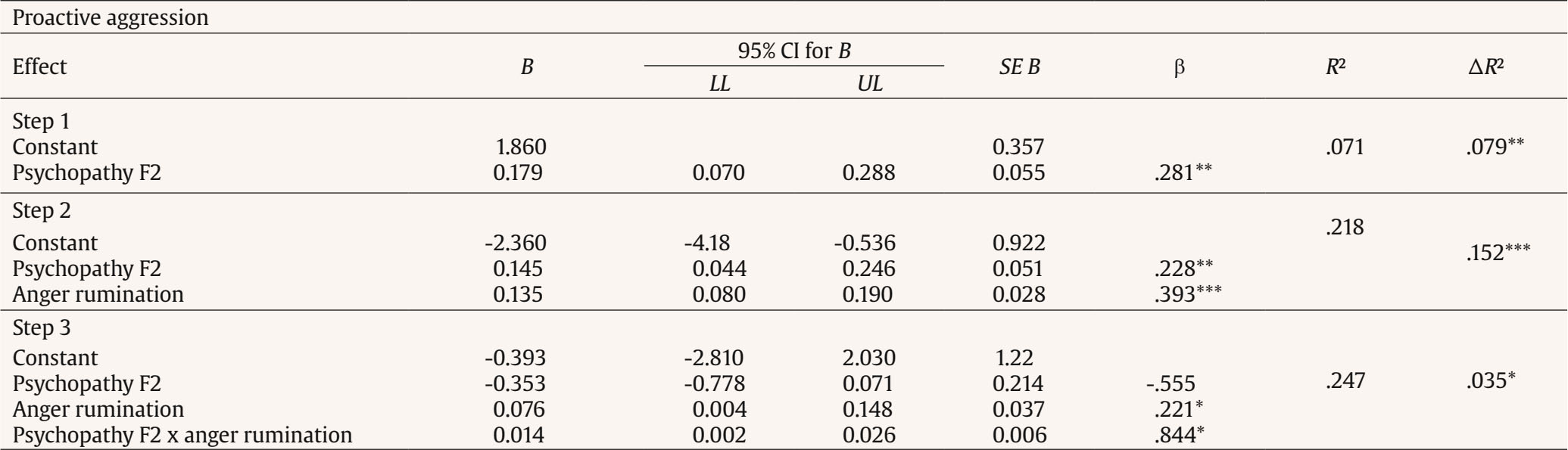 Note. Confidence interval: LL: lower limit, UL: upper limit; F1: factor 1, F2: factor 2. *p ≤ .05, **p ≤ .01, ***p ≤ .001. |
Cite this article as: Sarrate-Costa, C., Lila, M., Moya-Albiol, L., & Romero-Martínez, Á. (2026). Anger Rumination as a Moderator of the Association between Factor 2 of Psychopathy and Proactive Aggression. Psychosocial Intervention, 35, Article e260818. https://doi.org/10.5093/pi2026a10
Correspondence: Angel.Romero@uv.es (Á. Romero-Martínez)., Correspondence: Angel.Romero@uv.es (Á. Romero-Martínez).Copyright © 2026. Colegio Oficial de la Psicología de Madrid


 PDF
PDF e-PUB
e-PUB CrossRef
 JATS
JATS Print
Print Send
Send