Attachment, Emotional Regulation, and Perceived Academic Efficacy in Adolescence: A Basis for Psychoeducational Intervention
Pablo Doménech1, Ana M. Tur-Porcar2, & M. Vicenta Mestre-Escrivá2
1Universidad Internacional de Valencia (VIU), Spain; 2Universitat de València (UV), Spain
https://doi.org/10.5093/pi2026a8
Received 24 September 2025, Accepted 19 December 2025
Abstract
Objective: This study examined the relationships between secure attachment to parents and peers, emotional regulation strategies (cognitive reappraisal and expressive suppression), and perceived academic self-efficacy in adolescence. The research also aimed to identify how secure attachment is related to these variables to inform psychosocial interventions in educational and family contexts. Method: A total of 703 adolescents (351 boys, 352 girls; aged 15-18) completed validated questionnaires assessing attachment to mothers, fathers, and peers, emotional regulation, and perceived academic self-efficacy. Descriptive statistics, independent-sample t-tests, correlation analyses, and structural equation modelling were conducted to examine variable relationships and sex-specific patterns. Results: Secure parental attachment was positively associated with cognitive reappraisal and academic self-efficacy, and negatively with expressive suppression. Secure peer attachment showed a negative association with expressive suppression and a weak positive association with cognitive reappraisal. Boys reported higher use of both regulation strategies, whereas girls reported higher perceived academic self-efficacy. Structural equation models showed that parental secure attachment is associated with adolescents’ emotional regulation and academic self-efficacy, with mothers and fathers exerting differential influences across sexes. These findings indicate potential leverage points for psychosocial interventions. Conclusions: The study underscores the importance of fostering secure parent and peer secure attachment to enhance adaptive emotional regulation and academic competence in adolescents. The findings can guide the development of school-based and family-focused psychosocial programs that integrate emotional skills training, support adaptive coping strategies, and strengthen secure attachment relationships to improve adolescents’ well-being and academic outcomes.
Keywords
Attachment, Emotional regulation, Academic self-efficacy, Adolescence, Educational intervention strategiesCite this article as: Doménech, P., Tur-Porcar, A. M., & Mestre-Escrivá, M. V. (2026). Attachment, Emotional Regulation, and Perceived Academic Efficacy in Adolescence: A Basis for Psychoeducational Intervention. Psychosocial Intervention, 35, Article e260816. https://doi.org/10.5093/pi2026a8
Correspondence: pablo.domenech@professor.universidadviu.com (P. Domenech).Emotional development in adolescence is closely connected to family and social relationships, which provide security (Reeck et al., 2016). Adolescents experience intense emotions due to the cognitive, physiological, behavioral, and emotional changes they undergo (Steinberg, 2016). Adolescence is characterized by a degree of vulnerability compared to childhood and adulthood (Martin-Blesa et al., 2024; Riquelme et al., 2018). In this sense, emotional regulation stands out as a key protective element during adolescence in the development of a more adaptive psychological adjustment (Rueth et al., 2017), as well as the sense of self-efficacy in successfully tackling complex tasks (Bandura, 2001). These efficacy beliefs facilitate involvement in learning and are good predictors of health and personal adjustment (Schmitt, 2008). Adolescents experience significant biological, social, and psychological changes, together with increased academic stress and peer pressure, as their relational environment expands, providing opportunities for development and affective bonds (Coe-Odess et al., 2019). These developmental changes impact parent-adolescent relationships (Soenens et al., 2019). During adolescence, parental role tends to decrease while peer influence becomes more prominent (Alcaide et al., 2025; Morris et al., 2021) Currently, there is growing concern about research exploring the link between parental attachment and emotional regulation in adolescents (Boldt et al., 2020). This study aims to fill that gap by examining the relationships between secure attachment to both parents (father and mother separately), secure attachment to peers, perceived academic self-efficacy, and the dimensions of emotional regulation—cognitive reappraisal and expressive suppression. Although prior studies have typically addressed these constructs in isolation, recent literature highlights the need for comprehensive models. Our study responds to this call by examining parental and peer attachment, emotional regulation strategies, and perceived academic self-efficacy together in adolescence. Understanding how secure attachment and emotional regulation relate to perceived academic self-efficacy may inform the design of educational programs and family support strategies that foster emotional skills and academic performance in adolescents. Attachment to Parents and Peers Bowlby’s (1988) attachment theory highlights that individuals’ emotional experiences with primary caregivers are associated with their capacity to connect with others and cope with affective or stressful situations. Armsden and Greenberg’s (1987) theoretical model of attachment considers secure attachment to be characterized by high levels of trust and communication with others and low levels of alienation. Trust and communication reflect understanding and mutual respect, whereas alienation refers to feelings of isolation. These dimensions are shaped in the relationships with caregivers (Kerns et al., 2015). It is now widely accepted that both parents are attachment figures but may play different roles (Bacro, 2012). Classical attachment theory has traditionally emphasized the role of the mother as the primary attachment figure (Bowlby, 1969, 1984). However, recent research also highlights the relevance of the father as a significant figure in the development of attachment within the father-child relationship (Cabrera et al., 2018). Parental secure attachment has been linked to better social, emotional, and academic functioning, which may extend beyond adolescence (Holt et al., 2018). Adolescents with secure parental attachment learn to regulate emotions and to understand the need to control them, expressing them more positively (Dane & Marini, 2014). Secure parental attachment also facilitates the establishment of secure peer relationships (Zou et al., 2020), indicating close ties between parental and peer attachment (McDowell & Parke, 2009). Parental warmth appears to be especially valuable in helping adolescents feel loved and appreciated by the family (Ertema et al., 2025), develop a secure attachment (Cornella-Font et al., 2020), and achieve good adaptation (García et al., 2020; Krauss & Orth, 2024), this being especially relevant in the academic field (Fuentes et al., 2019; Reyes et al., 2023). Conversely, adolescents with insecure parental attachment experiences face greater difficulties in establishing peer relationships (Ward et al., 2018) and may even be at greater risk of affiliating with deviant peers (Kliewer et al., 2018). Thus, during adolescence, the role of peers is added to the predominant role of parental attachment figures, which contributes reinforcement and well-being (Laghi et al., 2016). Regarding sex differences, adolescent girls show higher peer attachment, as peer influence begins earlier for them than for boys (Miljkovitch, 2021). Emotional Regulation Emotional regulation refers to the process by which individuals consciously or unconsciously modulate their emotions to respond appropriately to contextual demands; it includes managing both positive and negative emotions, either by decreasing or enhancing their impact (McRae & Gross, 2020). The ability to regulate emotions according to goals and context allows children and adolescents to cope with daily challenges (Oram et al., 2017). The theoretical model of emotional regulation divides strategies into two phases (McRae & Gross, 2020). The first phase involves antecedent-focused strategies, i.e., those activated before the emotional experience occurs, such as cognitive reappraisal (Gross & John, 2003). The second phase involves response-focused strategies, i.e., strategies implemented after the emotion is triggered, including expressive suppression (Gross & John, 2003). Research in this field has shown that cognitive reappraisal use is associated with more adaptive outcomes, such as better physical health (Appleton et al., 2014), higher academic performance (Ivcevic & Brackett, 2014), and more adaptive social relationships (English & Eldesouky, 2020). Adjusted behavior requires effective regulation and control of both positive and negative emotions. The greater the ability to manage and sustain positive emotions, the greater the resources to buffer against negative ones and the better the preparation to promote positive behaviors that may result from environmental situations (Caprara et al., 2010). Conversely, expressive suppression is associated with lower well-being and greater difficulties in establishing interpersonal relationships (Cameron & Overall, 2018; English & Eldesouky, 2020). There is a developmental evolution in the use of regulation strategies: response-focused strategies are more common in childhood, while antecedent-focused ones tend to increase with maturation and better emotional management (Stifter & Augustine, 2019). During adolescence, emotional regulation becomes increasingly complex due to developmental changes (Denham, 2019). Regarding sex differences, results are inconclusive. In adults, women seem to have more difficulties with emotional regulation (Momeñe et al., 2017). In adolescents, it remains unclear whether sex plays a differential role in the use of regulation strategies (Kokkinos et al., 2019). For cognitive reappraisal, some studies found no significant differences between adolescent boys and girls (Gross & John, 2003; Gullone & Taffe, 2012), whereas others reported lower levels in boys (Gullone et al., 2010). Cognitive reappraisal showed a strong relationship with emotional self-concept, as men generally reported a higher emotional self-concept than women (Alcaide et al., 2025; García et al., 2024; Martin-Blesa et al., 2024). Boys also show greater use of expressive suppression (Gullone & Taffe, 2012), possibly linked to their greater impulsivity in social relationships and tendency toward externalizing behaviors such as aggression (Knyazev, 2004). Men show greater difficulty in adequately expressing emotions compared to women (Reyes et al., 2023; Villarejo et al., 2024). Recent studies in the Spanish adolescent population show that boys obtain higher scores in cognitive reappraisal and expressive suppression, while girls obtain better scores in emotional self-efficacy skills, both positive and negative (Doménech et al., 2025). These findings suggest that educational programs focusing on teaching cognitive reappraisal strategies and adaptive emotional management could be especially beneficial for promoting adolescent well-being and academic adjustment, considering sex differences in emotional regulation. Attachment to Parents and Peers, Emotional Regulation, and Academic Self-Efficacy in Adolescence In recent years, there has been growing interest in analyzing the relationships between attachment and emotional regulation at different stages of the life cycle (Chen et al., 2019; Kokkinos et al., 2019; Morris et al., 2017). Cognitive reappraisal and expressive suppression are also related to emotional self-efficacy (Doménech et al., 2024). Children learn to manage their emotions based on parental attitudinal models that they later apply in other contexts (Denham, 2019; Leerkes & Bailes, 2019; Morris et al., 2017). Parenting is inherently an emotional task (Leerkes & Augustine, 2019). However, beyond the perceptions and attitudes associated with emotional regulation, it is necessary to analyze the influence parents exert on such regulation and on academic functioning (Oram et al., 2017). Machado and Duarte (2014) found that secure paternal attachment is associated with more effective emotional regulation strategies. Conversely, insecure attachment predicts more maladaptive emotional management, both in adolescence (Machado & Duarte, 2014) and in emerging adulthood (Tani et al., 2018). Positive family relationships during adolescence are associated with greater emotional regulation skills (Herd et al., 2022). Affective attachment bonds with parents have implications for children’s emotional development (Cooke et al., 2019; Karreman & Vingerhoets, 2012). Although research traditionally focused on the mother’s role, recent studies in children indicate that the combined influence of attachment security with both parents predicts better emotional regulation outcomes than the specific contributions of each parent separately (Fernandes et al., 2021). Attachment security to both mother and father was negatively associated with the limited use of emotional regulation strategies (Gambin et al., 2021). Furthermore, recent studies have concluded that secure attachment to mothers and fathers is positively related to cognitive reappraisal and negatively related to expressive suppression in U.S. preadolescents (Abtahi & Kerns, 2017), Chinese adolescents (Chen et al., 2019), and Greek adolescents (Kokkinos et al., 2019). Peer attachment fosters close social behavior requiring more adaptive regulation strategies, such as cognitive reappraisal, which directs the emotional state toward the common good (Sabatier et al., 2017). Secure attachment is associated with regulation strategies that favor adaptation and effective emotional management, such as cognitive reappraisal (Huang et al., 2022). Nevertheless, culture and socioeconomic circumstances may shape the role of parents as facilitators of self-regulation (Grolnick et al., 2019). Academic self-efficacy is a crucial component of motivation and learning theories and can be defined as an individual’s beliefs about their own abilities regarding learning or carrying out educational activities (Khine & Nielsen, 2022). It is related to aspects such as school performance, motivation, academic activities, work pace, or school attendance (Tur-Porcar et al., 2019). According to Khine and Nielsen (2022), increasing attention is being paid to the measurement and research on academic self-efficacy. Secure maternal attachment has been associated with better academic performance and adjustment (Furrer & Marchand, 2020). In addition to maternal attachment, paternal, and peer attachment have also been linked to improved academic, social, and emotional functioning (Holt et al., 2018), partly because parents’ emotional expression can help regulate and manage negative emotions to foster academic success (Moed et al., 2017). Thus, alongside the role of parents, peer groups act as mechanisms of personal protection and school connectedness (Oldfield et al., 2018). Other authors have directly linked paternal attachment to academic self-efficacy in children (Bacro, 2012). During adolescence, attachment is connected with other dimensions that affect academic self-efficacy, such as motivation and school participation (Duchesne & Larose, 2007). Secure attachment has been positively associated with school motivation, from which academic self-efficacy derives (Yang et al., 2024). Emotional competence learned during childhood and adolescence supports the resolution of tasks that facilitate academic and social mastery (Denham, 2019). By contrast, emotional dysregulation may act as a risk factor for academic success (Oram et al., 2017). Students reporting secure attachment show greater confidence, stronger belief in their academic decisions, and in the correctness of those decisions (Wright et al., 2014). Peer support creates a favorable climate for participation and learning in school (Villar et al., 2025). As can be observed, most studies link attachment with academic outcomes, school participation, motivation, or academic adjustment. All these factors influence academic self-efficacy, which, according to Khine and Nielsen (2022), is associated with student engagement, study habits, learning styles, and personality, and predicts and explains a wide range of student activities and achievements. Attachment—whether parental, peer, or romantic—is closely linked to the sense of academic self-efficacy (Macakova & Wood, 2022). Regarding academic self-efficacy and sex differences, adolescent girls appear to show higher levels of academic efficacy and performance than boys, as well as a more positive evaluation of their studies (Instituto Nacional de Evaluación Educativa [INEE, 2015]). Sex moderates the association between attachment security and academic motivation (Yang et al., 2024). Objectives and Hypotheses This study integrates parental (mother/father) and peer attachment with emotion regulation and perceived academic self-efficacy in middle to late adolescence (15-18 years), a period characterized by marked maturational changes. Our aim is to clarify sex specific patterns of association consistent with prior evidence on the distinct parental roles and the rising salience of peers in adolescence. This research has two objectives:
Since fathers and mothers may act and influence their children differently, and sons and daughters may also respond and influence their parents differently, as explained by Bornstein (2013), the study examines the four types of dyads (mother-son, father-son, mother-daughter, and father-daughter). Two hypotheses are formulated:
Participants Of the 750 students invited, 703 participated, yielding a response rate of 93.7%. No participants withdrew during data collection. Finally, a total of 703 adolescents participated: 351 boys (49.9%) and 352 girls (50.1%), aged 15 to 18 years (M = 15.86, SD = 0.30). The age distribution was as follows: 15 years: 251 (35.7%), 16 years: 325 (46.2%), 17 years: 98 (13.9%), and 18 years: 29 (4.1%). Sex was recorded based on biological criteria (male/female) as reported by participants. Although gender identity was not assessed in this study, all procedures were conducted with respect for participants’ self-perception and diversity, in accordance with ethical standards for research with minors. SAGER guidelines were followed, differentiating between sex (biological attributes) and gender (social roles and identities) in the design, analysis, and interpretation of data. Participants were enrolled in the final year of compulsory secondary education 349 (49.6%) and in high school 354 (50.4%). Participants were recruited using stratified convenience sampling across eight secondary schools (public and private-subsidized) in the province of Valencia. Of these, 348 (49.5%) attended public schools and 355 (50.5%) private-subsidized schools. Regarding family background, 652 (92.7%) were Spanish, 10 (1.4%) from other European countries, 36 (5.1%) from Latin America, 2 (0.3%) from North Africa, and 3 (0.4%) from Southeast Asia. Instruments Emotion Regulation Questionnaire (ERQ; Gross & John, 2003; Spanish adaptation by Cabello et al., 2013). This instrument evaluates the use of two emotional regulation strategies: cognitive reappraisal and expressive suppression. It consists of 10 items rated on a 7-point Likert scale (1 = strongly disagree to 7 = strongly agree). These strategies were selected because they represent the most widely studied and theoretically central dimensions of emotion regulation, and they are easily understood by adolescents, which facilitates interpretation and future psychoeducational interventions. Although more comprehensive instruments exist (e.g., Emotion Regulation Questionnaire for Children and Adolescents, ERQ-CA; the Difficulties in Emotion Regulation Scale, DERS), the ERQ provides a parsimonious and validated measure of these two key strategies. In the present study, Cronbach’s alpha was α = .80 for cognitive reappraisal and α = .74 for expressive suppression, similar to those obtained in the Spanish population (α = .79 for cognitive reappraisal and α = .75 for expressive suppression; Cabello et al., 2013). Example item: “When I want to feel a more positive emotion, I can change the way I’m thinking about the situation.” Inventory of Parent and Peer Attachment (IPPA; Armsden & Greenberg, 1987; Spanish adaptation by Delgado et al., 2016). This questionnaire assesses attachment to mothers, fathers, and peers across the dimensions of trust, communication, and alienation. The full version includes three subscales of 25 items each, rated on a 5-point Likert scale (1 = never to 5 = always). In the present study, internal reliability was α = .90 for maternal attachment, α = .91 for paternal attachment, and α = .88 for peer attachment. Example item: “I like to get my mother’s/father’s opinion on things that are important to me.” Perceived Academic Self-Efficacy Scale (Tur-Porcar et al., 2019). This instrument assesses self-perceptions on a scale from 1 to 10 across the following domains: (1) academic performance, (2) motivation and interest in academic activities, (3) adequate work pace, (4) whether they consider themselves good students, and (5) ability to establish relationships with classmates and avoid conflict. The aggregation of these factors reflects perceived academic self-efficacy. Cronbach’s alpha was .79. Confirmatory factor analysis indicated satisfactory fit (χ² = 60.414/16, p < .001; NFI = .973; CFI = .980; TLI = .960; RMSEA = .076; 90% CI [.056, .097]). Example item: “How do you consider yourself in terms of motivation and interest in academic activities?” Procedure The sample was selected based on the classification of secondary education centers in the province of Valencia. Participation was preceded by authorization from the educational centers, families, and students, who provided informed consent. The study was conducted in accordance with the ethical principles of the Declaration of Helsinki and national regulations on research with minors. It was carried out within the official Doctoral Program in Psychological Research at the University of Valencia (Faculty of Psychology), under academic supervision and institutional oversight. All procedures ensured voluntary participation, anonymity, confidentiality, and informed consent from legal guardians and adolescents. Students could withdraw at any time, but none chose to do so. No missing data were recorded. Data collection sessions lasted 40–45 minutes. Data Analysis First, descriptive statistics were explored, followed by t-tests to examine possible sex differences in the analyzed variables and correlational analyses among them. Subsequently, a structural equation model was estimated using confirmatory techniques. Predictor variables included attachment to peers, mothers, and fathers, to observe their effects on outcome variables: cognitive reappraisal, expressive suppression, and perceived academic self-efficacy. This model was estimated using raw scores for the variables and a robust estimator for quantitative variables (MLR). Given deviations from multivariate normality, the robust MLR estimator (maximum likelihood robust) was applied in Mplus. This estimator adjusts standard errors and fit indices for non-normal data, ensuring greater accuracy in parameter estimation and model interpretation. Statistical analyses were conducted using SPSS 24.0 and Mplus 8 (Muthén & Muthén, 1998-2017). Prior to the analyses, the absence of missing data was verified through visual inspection of the database and confirmation in SPSS (complete frequencies for all variables). Therefore, no imputation procedures or MCAR tests were required A cross-sectional design was employed due to feasibility constraints and the aim of exploring associations among attachment, emotional regulation strategies, and academic self-efficacy at a specific developmental stage. While this design does not allow for causal inference or temporal sequencing, it provides valuable insights into concurrent relationships and informs hypotheses for future longitudinal research. Multivariate normality was assessed using Mardia’s coefficient, and given deviations from normality, the robust MLR estimator (Maximum Likelihood Robust) was applied. The model was estimated using observed scores (rather than latent variables) for reasons of parsimony and statistical power. Considering that the aim of the study was to analyze structural relationships for applied purposes rather than to validate the internal structure (already supported by previous research), this approach reduced the number of parameters and improved the stability of estimates. Given the high correlation between maternal and paternal attachment (r ≈ .70), multicollinearity was assessed by calculating the variance inflation factor (VIF) and tolerance. The values were acceptable (maternal attachment: VIF = 1.97, tolerance = .51; paternal attachment: VIF = 2.00, tolerance = .50; peer attachment: VIF = 1.07, tolerance = .94), indicating no problematic collinearity. A two-factor MANOVA (Sex × Age group: 15-16 vs. 17-18) was conducted on secure attachment (mother, father, peers), cognitive reappraisal, expressive suppression, and perceived academic self-efficacy. Multivariate and univariate tests were examined, and effect sizes are reported as partial η². Assumptions were checked (Box’s M for homogeneity of covariance matrices; Levene’s tests for homogeneity of variances). Given multivariate non-normality, the SEM analyses used MLR; MANOVA results are reported with standard GLM assumptions. Descriptive Analyses A leptokurtic distribution is observed, more pronounced in the attachment variables (peers, mothers, and fathers) and less accentuated in cognitive reappraisal and perceived academic efficacy, which indicates a concentration around the mean values. These same variables show a longer left tail (negative skewness). In expressive suppression, skewness is positive; therefore, there is less clustering around the mean values, with more scores above the mean (Table 1). Table 1 Descriptive Analysis of the Variables 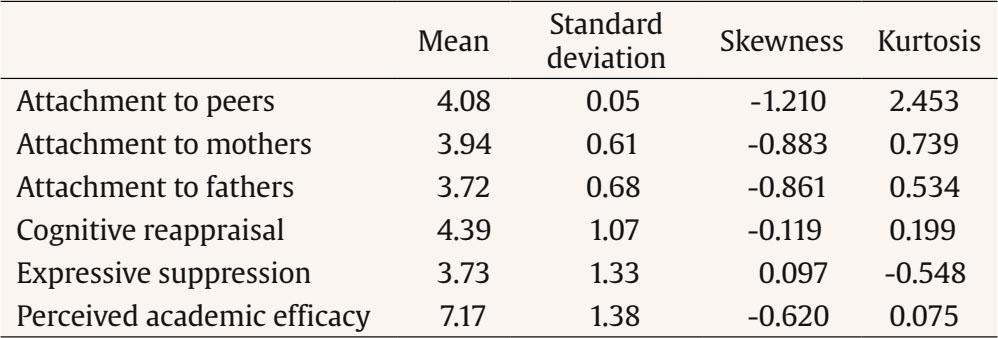 The independent-samples Student’s t-test, accompanied by effect size using Cohen’s d (1992), was conducted to examine the strength of the differences as a function of sex. The results show a significant difference in peer attachment and perceived academic efficacy, favoring females. Significant differences also emerged in cognitive reappraisal and expressive suppression, favoring males. The effect size, according to Cohen’s (1992) d, falls within the small to medium range (Table 2). Attachment to mothers and fathers did not show significant differences, indicating that adolescent boys and girls perceive their attachment relationships with both parents in a similar manner. With regard to the dimensions of emotion regulation, boys reported higher scores in both cognitive reappraisal and expressive suppression. The effect size was medium for cognitive reappraisal and small for expressive suppression (Table 2). Table 2 Differential Analysis by Sex  Correlational Analyses Given the significant differences found in the variables analysed by sex, correlational analyses were conducted separately for boys and girls (Table 3). Table 3 Correlations between Variables by Sex of Participants  Note. Girls = bottom left; boys = top right. *p < .05, **p < .01. Peer, mother, and father attachment correlated negatively with expressive suppression and positively with cognitive reappraisal in both sexes (Table 3). The internal relationship among the attachment variables was positive and significant for both sexes. A particularly strong association was observed between mother attachment and father attachment (r = .701; p < .01 for girls, and r = .679; p < .01 for boys). Finally, perceived academic efficacy correlated positively with mother attachment, father attachment, and cognitive reappraisal in both boys and girls, whereas the associations between expressive suppression and perceived academic efficacy were weak and only present among boys (r = -.127, p < .05). Besides Fisher’s r-to-z tests were applied to examine whether correlations differed between boys and girls. None of the comparisons was significant (all p > .05), indicating that the correlational patterns are comparable across sex. Full results are provided in Appendix. Multivariate Analysis of Variance Table 4 shows the Multivariate Tests. The Box’s M test was non-significant (M = 46.993, F = 0.723, df1 = 63, df2 = 81926.424, p = .952), and Levene’s tests indicated homogeneous variances for all dependent variables. The multivariate effect of Sex was significant, Wilks’ Λ = .949, F(6, 665) = 5.952, p < .001, η²p = .051; the effect of Age group was non-significant, Wilks’ Λ = .988, F(6, 665) = 1.320, p = .246, η²p = .012; and the Sex × Age group interaction approached significance, Wilks’ = .982, F(6, 665) = 1.999, p = .064, η²p = .018 (see Table 4). Table 4 Multivariate MANOVA Tests (Sex × Age group)  Note. Multivariate statistics reported with Wilks’ lambda. Box’s M = 46.993; F = 0.723, df1 = 63, df2 = 81926.424, p = .952 (homogeneity of covariance matrices met). Levene’s tests were non-significant for all dependent variables (homogeneity of variances). Table 4 shows the univariate tests. Significant Sex effects emerged for secure attachment to peers, F(1, 670) = 11.678, p = .001, η²p = .017; girls > boys, cognitive reappraisal, F(1, 670) = 11.224, p = .001, η²p = .016; boys > girls, and expressive suppression, F(1, 670) = 4.260, p = .039, η²p = .006; boys > girls, whereas secure attachment to mothers and fathers were nonsignificant. Age group effects were nonsignificant across outcomes. A small Sex × Age group interaction was found for perceived academic selfefficacy, F(1, 670) = 6.217, p = .013, η²p = .009, with girls reporting higher selfefficacy at 15-16 than at 17-18, while boys remained stable or slightly higher at 17-18 (see Table 5). Table 5 Univariate tests by dependent variable  Note. F and partial η² from Type III sums of squares; sex coded 1 = boys, 2 = girls; age group coded 1 = 15-16, 2 = 17-18. A dash (–) indicates value not shown in the SPSS extract (non-significant). Structural Equation Model A structural equation model was specified and estimated in which peer attachment, mother attachment, and father attachment, as antecedent variables, had an effect on cognitive reappraisal, expressive suppression, and academic self-efficacy, with participant sex as the grouping variable. Before estimating the structural equation model, multivariate normality was assessed using Mardia’s coefficient, which analyzes multivariate skewness and kurtosis. The results indicated deviations from normality (skewness = 12.84, kurtosis = 146.27, p < .001), confirming that the data did not strictly meet this assumption. This lack of normality is consistent with the observed distributions of the variables, where positive kurtosis values were detected in the attachment measures (e.g., attachment to peers = 2.45). The model was estimated using the robust MLR estimator in Mplus. It is a path analysis with three antecedent variables and three consequent variables (Figures 1 and 2). The model was saturated; therefore, the weakest relationship was removed to allow identification (the relationship between expressive suppression and academic self-efficacy). The model showed satisfactory fit, χ²(2) = 0.275, p > .05, CFI = .99, RMSEA = .000, 90% CI [.000, .055], SRMR = .004. Figure 1 Model for Boys. 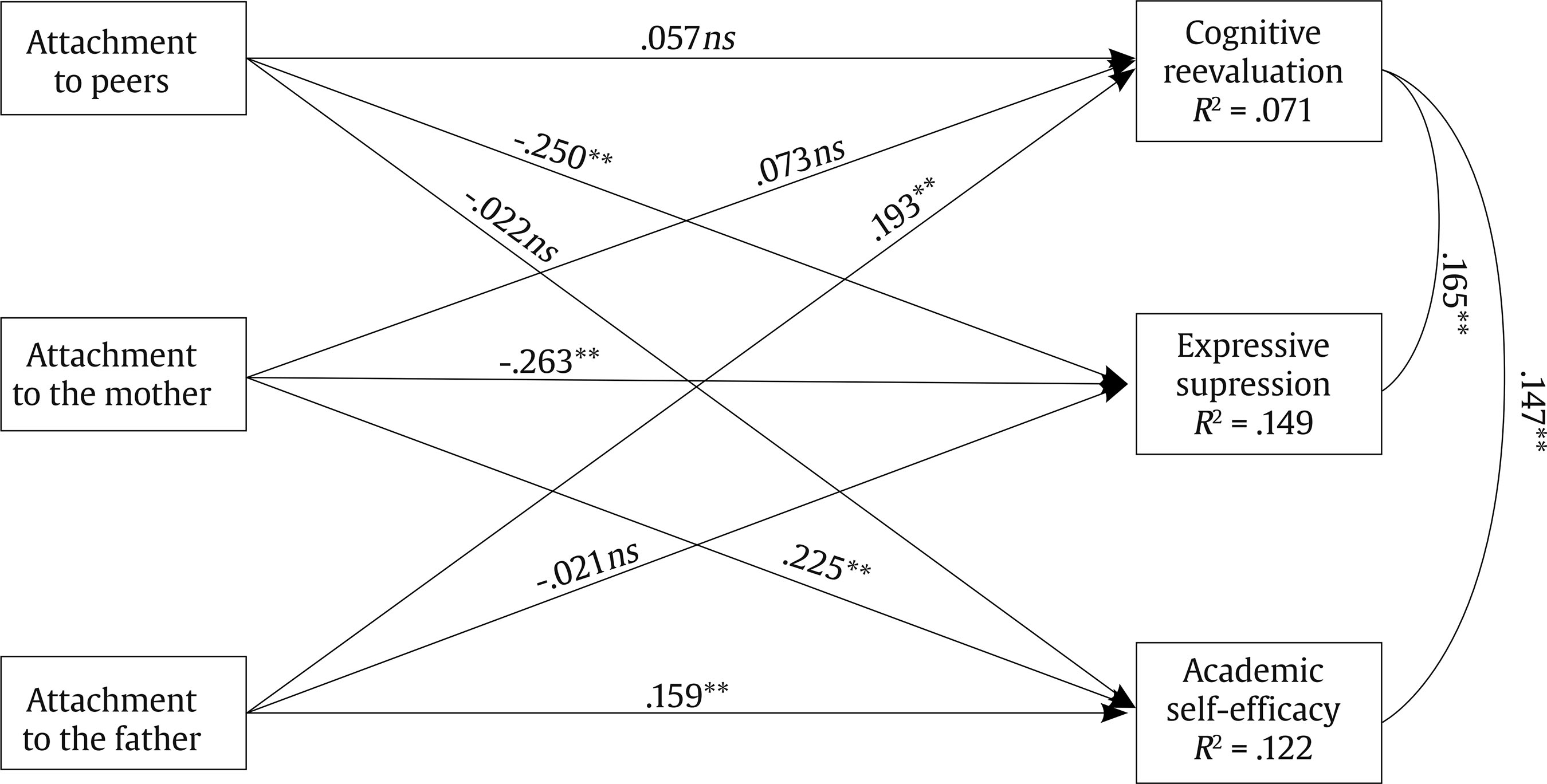 Figure 2 Model for Girls. 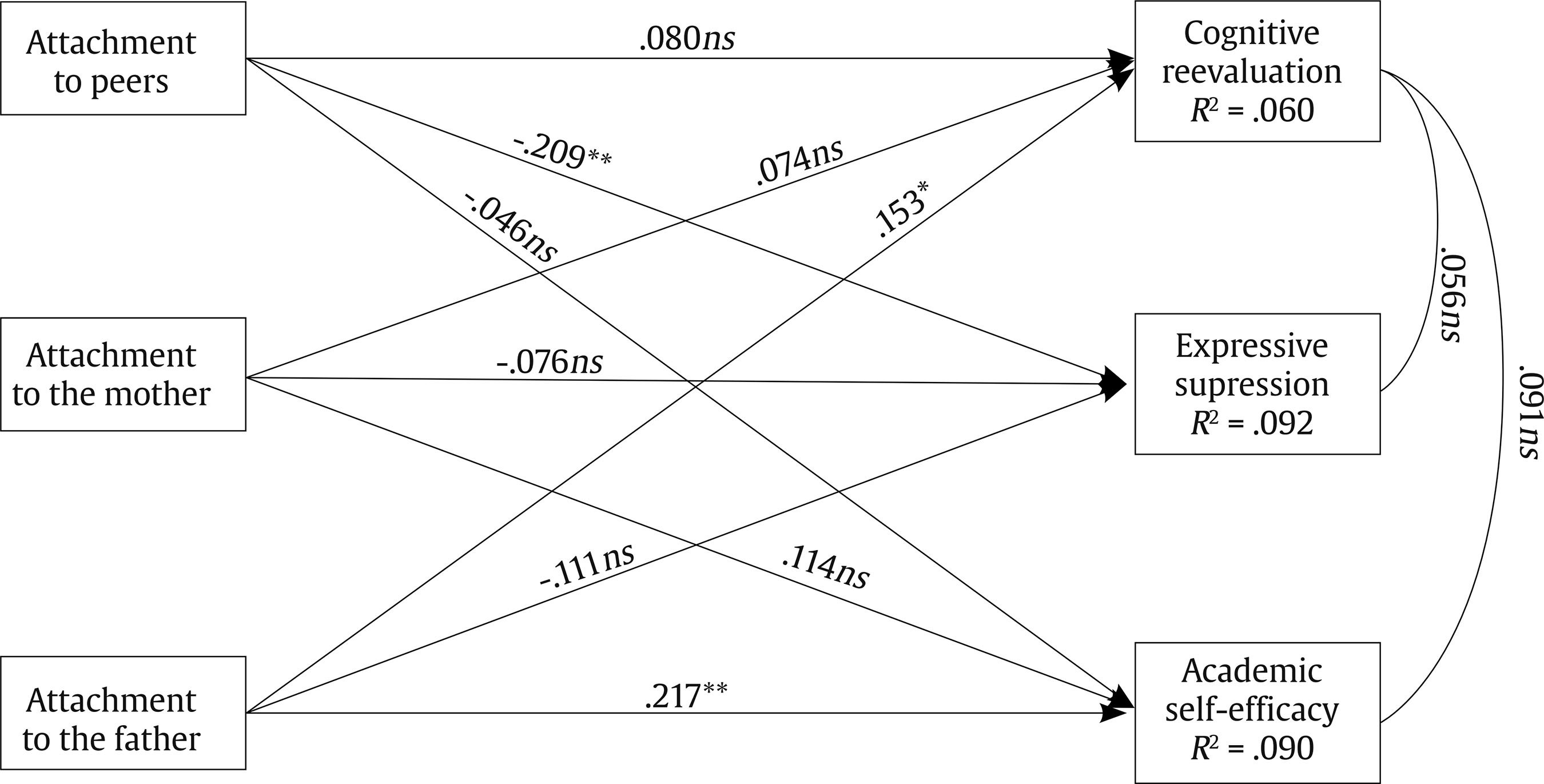 In the models, cognitive reappraisal was positively affected by father attachment but not significantly influenced by peer or mother attachment. With respect to expressive suppression, it was negatively affected by peer attachment. Regarding the effect of mother attachment, a different pattern emerged for boys and girls: this variable had a negative and significant effect for boys, whereas the effect was nonsignificant for girls. As for the effect of father attachment on expressive suppression, this variable did not show a significant effect in either group. Finally, concerning the effects on academic self-efficacy, this variable was not significantly influenced by peer attachment. Academic self-efficacy was affected by both father and mother attachment for boys, and by father attachment only for girls. As for the correlations, these were positive and significant between cognitive reappraisal and expressive suppression, and between cognitive reappraisal and academic self-efficacy in the case of boys, whereas these relationships were not significant for girls. The model explained a total of 7.1% of the variance in cognitive reappraisal, 14.9% of the variance in expressive suppression, and 12.2% of the variance in self-efficacy for boys, and 6%, 9.2%, and 9%, respectively, for girls. This empirical study aimed to analyze the relationships between attachment to parents, mothers, and peers, with emotional regulation and perceived academic efficacy in Spanish adolescents, as well as to examine the role of attachment in explaining emotional regulation and perceived academic efficacy in adolescent boys and girls. In the present context, our conclusions refer to secure attachment to mothers, fathers, and peers, highlighting its associations with cognitive reappraisal, expressive suppression, and perceived academic self-efficacy. Regarding Hypothesis 1, the results show: First, adolescent boys make greater use than girls of antecedent-focused strategies for managing emotional experiences, that is, cognitive reappraisal, which supports the activation of cognitive mechanisms aimed at managing emotional expression to achieve more adaptive responses (McRae & Gross, 2020). At first glance, these findings differ from other studies that found lower scores in cognitive reappraisal for boys (Gullone et al., 2010; Kokkinos et al., 2019). However, such comparisons are affected by the disparity in ages analyzed. The study by Gullone et al. (2010) focused on an Australian population in late childhood, preadolescence, and early adolescence, while Kokkinos et al. (2019) examined preadolescence and early to middle adolescence. It is worth noting that those authors themselves regarded such findings as unexpected and with little effect, stressing the need for continued research in this area. Similarly, our results are also inconsistent with Gross and John (2003), who found no sex differences in the use of cognitive reappraisal among emerging adult university students. Our study, however, is centered on middle to late adolescence (ages 15-18). During this extended developmental period, spanning from the end of childhood through adolescence to emerging adulthood, individuals undergo substantial transformations at the cognitive, physiological, emotional, and behavioral levels (Steinberg, 2016). Therefore, it is expected that changes occur in the emotional regulation process (Stifter & Augustine, 2019). Adolescents may increasingly adopt more antecedent-focused, adaptive strategies (Appleton et al., 2014). This can be explained by relating cognitive reappraisal to other variables such as emotional self-concept where men score higher than women (Alcaide et al., 2025; García et al., 2024; Martin-Blesa et al., 2024). Nevertheless, such arguments would require longitudinal research covering the period from preadolescence to emerging adulthood. Second, boys also make greater use of expressive suppression, which confirms previous findings (Gross & John, 2003; Gullone et al., 2010). Emotion regulation strategies focused on responses are less reflective and more impulsive, thus leading to less favorable and more maladaptive outcomes (Gullone & Taffe, 2012; Knyazev, 2004). These results may be related to boys’ impulsivity in social relationships, as well as their tendency toward externalizing behaviors (Knyazev, 2004). Third, regarding sex differences, adolescent girls reported greater perceived academic efficacy than boys, supporting previous research on girls’ better academic outcomes, both as students and in terms of achievement (INEE, 2015). Fourth, regarding attachment, the results distinguish between peer attachment and parent attachment. Adolescent girls reported greater attachment to peers than boys. The shift in attachment from parents to peers occurs earlier in girls than in boys, which explains the higher levels of peer attachment among girls during adolescence (Miljkovitch, 2021). Conversely, and contrary to expectations regarding attachment to parents, boys and girls reported similar levels of attachment to both parents. Fathers and mothers are influential attachment figures, although they may play different roles in childrearing (Bacro, 2012). Hypothesis 2 was aimed at analyzing the correlational and predictive relationships of attachment to both parents and to peers with emotional regulation strategies and perceived academic efficacy, differentiating by sex. The results indicate: First, attachment to both parents correlated positively with cognitive reappraisal and negatively with expressive suppression for both boys and girls (Abtahi & Kerns, 2017; Chen et al., 2019; Kokkinos et al., 2019). However, when examining the models more closely, differences emerged between mother and father attachment in relation to their children. For boys, mother attachment was negatively related to expressive suppression, while father attachment was positively related to cognitive reappraisal. In this sense, the maternal role reduces the use of expressive suppression, while the paternal role fosters cognitive reappraisal strategies. For girls, on the other hand, father attachment—rather than mother attachment—was positively related to cognitive reappraisal. These sex-based differences suggest that fathers and mothers play distinct roles in attachment relationships and in the development of emotional regulation strategies, consistent with previous findings in children up to age 12 (Bacro, 2012). Adolescents seek maternal and paternal availability in moments of distress and vulnerability (Kerns et al., 2015). Our study shows that, although they play different roles, both father and mother attachment security is associated with the use of effective emotional regulation strategies (Fernandes et al., 2021; Gambin et al., 2021; Machado & Duarte, 2014). Secure attachment is associated with adaptive strategies (Huang et al., 2022). Classical attachment theory by Bowlby (1969, 1984) has traditionally emphasized the role of the mother as the primary attachment figure; however, our findings align more with more recent research that highlights the importance of the father as an essential attachment figure (Cabrera et al., 2018). For boys, secure maternal attachment was associated with lower expressive suppression, whereas secure paternal attachment was associated with higher cognitive reappraisal; for girls, paternal (rather than maternal) attachment was associated with higher cognitive reappraisal (Bacro, 2012; Fernandes et al., 2021; Gambin et al., 2021). Second, peer attachment correlated negatively with expressive suppression and partially positively with cognitive reappraisal for both boys and girls. In the models, a negative relationship between peer attachment and expressive suppression was observed. Therefore, peer attachment during adolescence is associated with lower use of ineffective emotional regulation strategies. Response-focused strategies can reduce well-being and increase difficulties in establishing effective social relationships (Cameron & Overall, 2018; English & Eldesouky, 2020). Peer attachment enhances fluid social interactions, fostering mutual support and establishing a solid basis for the development of affective bonds in social interactions (Coe-Odess et al., 2019). Peer attachment in adolescence can serve to curb impulsive and less effective regulatory strategies, which may otherwise lead to emotional outbursts with negative consequences for harmony and coexistence (Sabatier et al., 2017). During adolescence, secure peer attachment is associated with lower reliance on expressive suppression and less use of impulsive, less effective regulatory responses, facilitating emotional expression and social adjustment (Cameron & Overall, 2018; English & Eldesouky, 2020; Sabatier et al., 2017). Third, regarding correlations between attachment and perceived academic efficacy, the results revealed strong associations with both mother and father attachment in boys and girls. In the models, however, for boys, both parents were positively associated with academic self-efficacy, whereas for girls, this relationship was found only with fathers. Bacro (2012) had already highlighted that parental attachment showed a stronger influence on academic self-efficacy than maternal attachment. High levels of perceived academic efficacy are linked to positive attitudes toward school and academic success (Oram et al., 2017). Similarly, secure parental attachments influence feelings of academic efficacy and positive academic attitudes as sources of personal protection (Furrer & Marchand, 2020; Oldfield et al., 2018). Peer attachment, however, was not associated with perceived academic self-efficacy. This may be due to the fact that academic self-efficacy is a broad construct that should be analyzed separately (Yang et al., 2024). Furthermore, regarding correlations among the three types of attachment analyzed, the results indicate strong interconnections, particularly between mother and father attachment. Overall, adolescents seem to maintain relatively close attachment relationships with both parents, despite differential profiles between them (Kokkinos et al., 2019). Moreover, adolescents with secure parental attachment are better prepared to form positive peer bonds, which fosters more adaptive relationships (McDowell & Parke, 2009; Ward et al., 2018; Zou et al., 2020). For such relationships to be fluid and effective, more adaptive regulatory strategies are required (Sabatier et al., 2017). Thus, attachment relationships within the family and immediate social environment may serve as mechanisms for strengthening emotional, social, and academic functioning (Holt et al., 2018), providing personal protection (Oldfield et al., 2018), and acting as sources of resilience and well-being (Laghi et al., 2016; Ward et al., 2018). During adolescence, the influence of parents usually decreases, while the influence of peers becomes more important (Alcaide, et al., 2025; Morris et al., 2021). In conclusion, the findings of this study shed light on the relationships between secure attachment to mothers, fathers, and peers with emotional regulation mechanisms and perceived academic efficacy during adolescence. Both parents act as secure attachment figures in the processes of emotional regulation and beliefs about academic efficacy. However, although parental secure attachment is clearly established, it is not experienced in the same way by sons and daughters. Peer attachment, on the other hand, plays a role in reducing expressive suppression strategies during group adaptation (Stifter & Augustine, 2019). These findings may be important because secure attachment relationships within the family and with peers serve as sources of personal protection and well-being (Holt et al., 2018). The results suggest that fostering secure attachment relationships with both parents and peers may be a key objective in preventive intervention programs in school contexts, aimed at promoting adaptive emotional regulation and enhancing perceived academic efficacy (Holt et al., 2018; Oldfield et al., 2018; Tur-Porcar et al., 2019). Both parents act as secure attachment figures in the processes related to emotion regulation and perceived academic self-efficacy. The results suggest that fostering secure attachment relationships with both parents and peers may be a key objective in preventive, school-based and family-focused programs, given their associations with adaptive emotion regulation and perceived academic self-efficacy (Furrer & Marchand, 2020; Holt et al., 2018; Oldfield et al., 2018). The effective use of emotional regulation strategies provides personal and social security and protection (Holt et al., 2018; Oldfield et al., 2018). This, in turn, can foster fluid interactions with the environment, based on more adaptive regulatory strategies. Such strategies may be characterized by greater use of cognitive reappraisal mechanisms and reduced reliance on expressive suppression. These findings could guide evidence-based interventions aimed at strengthening affective bonds and emotional competencies in adolescents, complementing traditional educational strategies. In applied terms, this study provides a framework for the development of school and family programs that integrate the strengthening of affective ties and the teaching of emotional regulation strategies as resources to improve academic efficacy and adolescent well-being. This study has some limitations. First, the cross-sectional nature of the design limits causal inference and prevents conclusions about developmental trajectories. Future research should employ longitudinal designs to examine changes over time. Although our findings are novel and complement previous research, longitudinal studies are needed to confirm these relationships and their development over time. Second, the analysed variables are part of a broader study, and potential fatigue bias may have occurred, although this was mitigated by limiting the duration of each session. Third, the study focused on adolescents, with a strong representation of middle adolescence, making it necessary to extend research to childhood and adulthood to better understand developmental and social changes over the lifespan. Additionally, all measures relied on self-report questionnaires, which may introduce biases such as social desirability or inaccurate self-perception. The study did not include contextual variables such as parental educational level, socioeconomic status, or family composition, which could influence attachment and academic outcomes. The study did not assess sexual orientation or gender identity (SOGI), which may be relevant for understanding individual differences in attachment and emotional regulation. Finally, the sample consisted exclusively of Spanish adolescents, which limits the generalizability of the findings to other cultural contexts. Practical Implications for Psychoeducational Programs Based on the observed associations, psychoeducational programs should include components that strengthen secure attachment with parents and peers while teaching adaptive regulation skills:
Conflict of Interest The authors of this article declare no conflict of interest. Cite this article as: Doménech, P., Tur-Porcar, A. M., & Mestre-Escrivá, M. V. (2026). Attachment, emotional regulation, and perceived academic efficacy in adolescence: A basis for psychoeducational intervention. Psychosocial Intervention, 35, Article e260816. https://doi.org/10.5093/pi2026a8 The data and code used to generate the estimated models are available from the authors upon request. Appendix Table A1 Fisher’s r-to-z Tests Comparing Correlations by Sex (boys vs. girls). 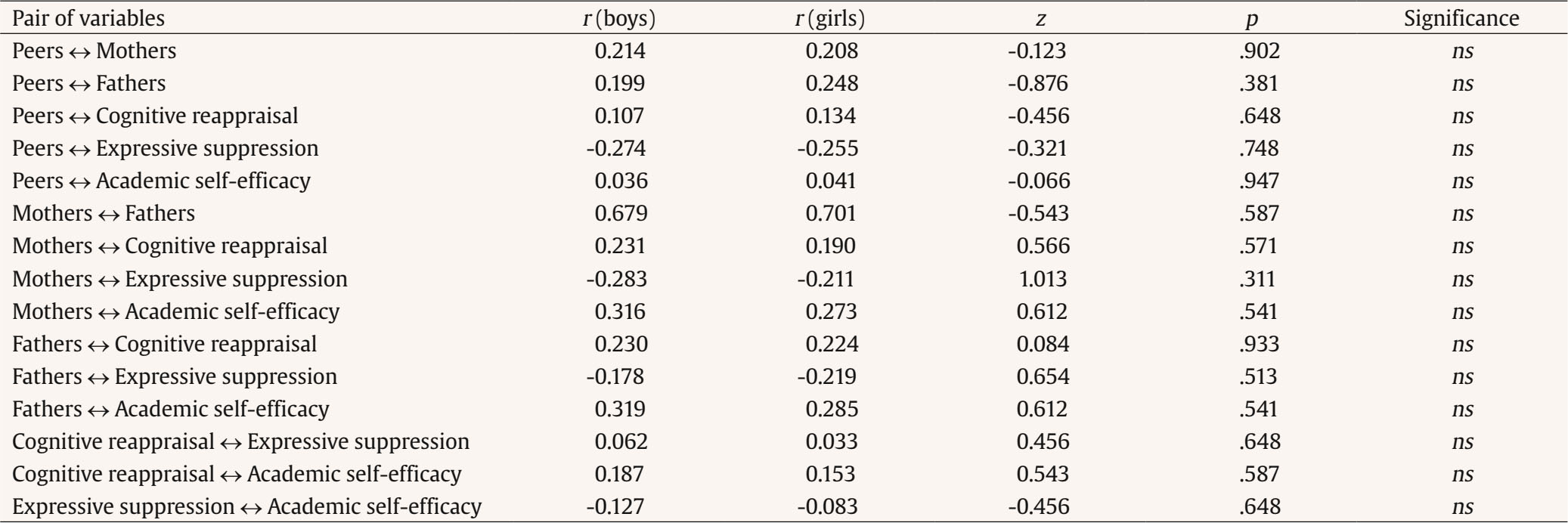 Note. Correlations by sex were taken from Table 3; n_boys = 351, n_girls = 352. Two-tailed tests. No comparison reached statistical significance (all p > .05). |
Cite this article as: Doménech, P., Tur-Porcar, A. M., & Mestre-Escrivá, M. V. (2026). Attachment, Emotional Regulation, and Perceived Academic Efficacy in Adolescence: A Basis for Psychoeducational Intervention. Psychosocial Intervention, 35, Article e260816. https://doi.org/10.5093/pi2026a8
Correspondence: pablo.domenech@professor.universidadviu.com (P. Domenech).Copyright © 2026. Colegio Oficial de la Psicología de Madrid


 PDF
PDF e-PUB
e-PUB CrossRef
 JATS
JATS Print
Print Send
Send