Unraveling the Connection Between Psychopathic Trait Profiles and Risk Behavior Tendencies
[Explorando la conexión entre los perfiles de rasgos psicopáticos y la tendencia a las conductas de riesgo]
Raquel Gómez-Leal, María T. Sánchez-López, Pablo Fernández-Berrocal, & Alberto Megías-Robles
Department of Basic Psychology, University of Málaga, Spain
https://doi.org/10.5093/ejpalc2026a7
Received 5 May 2026, Accepted 24 August 2026
Abstract
Background/Aim: Using a person-centered approach, this study examined risk perception and risk-taking across five domains (ethical, health/safety, financial, social, and recreational) as a function of distinct psychopathy profiles. These variables were assessed using the DOSPERT-30 and the SRP-III. Method: The sample included 371 participants (age range 18-59, M = 24.04, SD = 6.72). A cluster analysis identified four distinct psychopathy profiles: a high psychopathy with criminal tendencies group (HPCTG), a high psychopathy group (HPG), an erratic lifestyle group (ELG), and a low psychopathy group (LPG). Results: The results showed that the HPCTG reported lower risk perception and greater risk-taking than the LPG across the risk domains, except for the social domain. The two intermediate profiles, HPG and ELG, also provided informative findings. An erratic lifestyle was associated with increased risk-taking, an association that became more pronounced when combined with other psychopathic traits. Similarly, the HPG exhibited elevated risk-taking, which was further intensified and extended across a broader range of risk domains when criminal tendencies were also present. Conclusions: The potential clinical and theoretical implications of these findings are discussed.
Resumen
Antecedentes/objetivo: Usando un enfoque centrado en la persona, este trabajo examina la percepción de riesgo y la toma de riesgos a través de cinco dominios (ético, salud/seguridad, financiero, social y recreativo) en función de los diferentes perfiles de riesgos psicopáticos. Las variables fueron evaluadas usando las escalas DOSPERT-30 y SRP-III. Método: La muestra incluyó a 371 participantes (rango de edad 18-59, M = 24.04, DT = 6.72). El análisis de clúster identificó cuatro perfiles psicopáticos diferenciados: un grupo de alta psicopatía con tendencias criminales (high psychopathy with criminal tendencies group, HPCTG), un grupo de alta psicopatía (high psychopathy group, HPG), un grupo de estilo de vida errático (erratic lifestyle group, ELG), y un grupo de baja psicopatía (low psychopathy group, LPG). Resultados: Los resultados mostraron que el HPCTG informó de una menor percepción de riesgo y una mayor toma de riesgos que el LPG en todos los dominios de riesgo, excepto en el dominio social. Los dos perfiles intermedios también aportaron resultados reveladores. Un estilo de vida errático se asociaba con un aumento en la conducta de riesgo, una asociación que se volvió más pronunciada cuando se combinaba este rasgo con otros rasgos psicopáticos. Del mismo modo, el grupo HPG mostró una mayor propensión al riesgo, que se intensificó aún más y se extendió a una gama más amplia de ámbitos de riesgo cuando también estaban presentes las tendencias criminales. Conclusiones: Se analizan las posibles implicaciones clínicas y teóricas de estos hallazgos.
Keywords
Risk perception, Risk-taking, Psychopathy, Person-centered approach, Cluster analysisPalabras clave
Percepción de riesgo, Asunción de riesgos, Psicopatía, Enfoque centrado en la persona, Análisis de clústersCite this article as: Gómez-Leal, R., Sánchez-López, M. T., Fernández-Berrocal, P., & Megías-Robles, A. (2026). Unraveling the Connection Between Psychopathic Trait Profiles and Risk Behavior Tendencies. The European Journal of Psychology Applied to Legal Context, 18, Article e260182. https://doi.org/10.5093/ejpalc2026a7
Correspondence: mtsl@uma.es (M. T. Sánchez-López).Empirical research has demonstrated that psychopathy is associated with lower risk perception and a greater propensity to engage in risky behaviors (Hosker-Field et al., 2016; Kastner & Sellbom, 2012; Swogger et al., 2010). However, it is well established that risk is domain-specific (Blais & Weber, 2006; König, 2021; Lozano et al., 2017; Sánchez-López et al., 2022a, 2022b), suggesting that the propensity to engage in risk-taking behaviors may vary depending on the decision-making context. The primary aim of this work was to determine the specific domains in which individuals with psychopathic traits are more prone to distort perceived risk and behave in a risky manner. Furthermore, unlike previous studies, we employed a person-centered approach to analyze psychopathy. Rather than focusing on individual variables separately, this method examines profiles composed of multiple factors. Such an approach offers greater sensitivity to individual differences, allowing us to capture how the relationship between psychopathy and risk behavior can vary from person to person, depending on each unique combination of traits (Howard & Hoffman, 2018). Psychopathic Traits Psychopathy is a personality construct characterized by dysfunctional interpersonal, behavioral, and emotional patterns, including low empathy, callousness, self-centeredness, impulsiveness, and the exploitation of others (Gómez-Leal et al., 2021; Hare & Neumann, 2008; Megías et al., 2018; Pennington et al., 2015). While psychopathy has often been examined as a personality disorder, it can also be conceptualized as a set of dimensional personality traits that are continuously distributed in the general population (Edens et al., 2006; Sellbom & Drislane, 2021). The present study adopts this dimensional approach by examining psychopathic traits in a community sample. Much of the literature has conceptualized psychopathy as a two-component construct, comprising affective/interpersonal traits (factor 1) and characteristics related to social deviance (factor 2) (Hare, 1991, 1993, 2003; Neumann et al., 2007). However, subsequent studies on clinical and subclinical groups have provided evidence supporting a four-component model (Hare & Neumann, 2008; Mahmut et al., 2011; Neal & Sellbom, 2012): factor 1 is “callous affect” (an individual’s lack of emotion, empathy, remorse, and guilt); factor 2 is “interpersonal manipulation” (achieving goals through superficial charm, egocentricity, and pathological lying); factor 3 is “erratic lifestyle” (behavioral tendencies and characteristics such as recklessness and impulsivity); and factor 4 is “criminal tendencies” (antisocial characteristics and engagement in criminal activity). For this research, we adopted the four-factor model of psychopathy proposed by Hare and Neumann (2008), as it provides a well-defined conceptual framework and has received considerable empirical support (Neumann et al., 2015). These affective, interpersonal, and behavioral facets of psychopathy have been consistently linked to a range of maladaptive outcomes. Existing literature has demonstrated a positive correlation between psychopathic traits and behaviors such as aggression, criminal activity, deceit, emotional manipulation, risk-taking, and difficulty regulating emotions, among other actions with harmful societal consequences (Frick et al., 2003; Garofalo et al., 2018; Grieve & Mahar, 2010; Hampejs et al., 2025; Piatigorsky & Hinshaw, 2004; Stanwix & Walker, 2021; Walker et al., 2022). Risk Behavior Risk behavior refers to actions that carry a certain probability of significant losses, whether objective or subjective, for the individual (Yates & Stone, 1992). The consequences of such behaviors can seriously threaten both mental and physical health (Pellmar et al., 2002; World Health Organization, 2018). A key characteristic of risk behavior is its domain-specific nature. Depending on the context in which a risk decision is made, the cost-benefit analysis carried out by each individual can differ, meaning that risky tendencies may not remain stable across different contexts (Blais & Weber, 2006; König, 2021; Lozano et al., 2017; Sánchez-López et al., 2022a, 2022b; Weber et al., 2002). The risk literature suggests five domains to contextualize risk (see Weber et al., 2002): ethical, health/safety, financial, social, and recreational domain. The ethical domain includes behaviors related to the violation of moral values (for example, evading tax or passing off someone else’s work as your own); the health and safety domain relates to behaviors that may cause health problems (for example, failing to stop at a red traffic light or having unprotected sex); the financial domain is related to investments and gambling (for example, betting large sums of money on a game of poker or investing a considerable proportion of your salary in a new business); the social domain encompasses behaviors involving interaction with others (for example, disagreeing with a figure of authority or starting a new career in midlife); and the recreational domain involves risk-taking behaviors related to recreation and extreme sports (for example, bungee jumping or flying a light aircraft). Thus, risk-taking behaviors can vary according to the specific domain in which they occur; consequently, an individual may tend to take risks in financial matters while being cautious when it comes to health and safety issues. Given the domain-specific nature of risk-taking, an important question is whether individuals’ risk perceptions change within these domains and, if so, how these changes influence their willingness to engage in risky behaviors. The literature on the relationship between risk perception and risk-taking presents somewhat mixed findings. Evidence supports the intuitive notion that engaging in risky behavior is influenced by perceived risk; the greater the perceived risk of a situation or event, the less likely an individual will engage in risky behavior (Brewer et al., 2007; Finucane et al., 2000; Weber et al., 2002). Given a specific situation, if there is a perceived high risk of significant loss (for example, when faced with the possibility of tax evasion, the individual perceives that there is a high probability they will end up paying a fine), the likelihood that such behavior will ultimately be carried out will decrease. Nonetheless, some studies suggest that the relationship between perception and risk-taking may not always be straightforward. Contextual factors, characteristics of the risk stimulus, levels of impulsivity, and sensitivity to rewards or punishment, may moderate this relationship, leading individuals to engage in risky behavior even when risk perception is high (Fryt et al., 2024; Maldonado et al., 2016; Maldonado et al., 2020; Megías-Robles et al., 2022; Megías et al., 2015; Mills et al., 2008; Reyna & Farley, 2006; Sitkin & Pablo, 1992; Weller & Tikir, 2011). Thus, a driver may perceive a high risk in exceeding the speed limit in a residential area or in running a red light, and yet end up doing so anyway, because the desire not to be late for work carries greater weight in the decision, because of certain personality characteristics, or because this type of behavior has become a habit driven by contextual cues. Therefore, examining how risk perception and risk-taking vary across contexts and domains is critical to understanding the factors that drive these behaviors and their potential association with distinct personal and psychological traits. Given that individuals with higher levels of psychopathic traits tend to show higher impulsivity, greater reward sensitivity, less sensitivity to punishment, and may misinterpret contextual factors and risk-relevant cues (Hare & Neumann, 2008; Johnson et al., 2014; Mahmut et al., 2011; Neal & Sellbom, 2012; Włodarska et al., 2021), in the present study we sought to investigate the relationship between psychopathy and both risk perception and risk-taking. Psychopathy and Risk Behavior In recent decades, the association between the factors that comprise psychopathy and the tendency to engage in risky behavior has been widely studied (e.g., Dean et al., 2013; Hosker-Field et al., 2016; Hunt et al., 2005; Maneiro et al., 2020; Stanwix & Walker, 2021). For instance, using self-report measures, Stanwix and Walker (2021) found a positive association between psychopathy and risk domains, including ethical, health/safety, financial, social, and recreational. Similarly, Hosker-Field et al. (2016) reported positive correlations between all four psychopathy factors and both perceived risk and the likelihood of engaging in risky behaviors in the domains of ethics, health/safety, finances, and recreation. In the social domain, however, risky behavior was only positively associated with the psychopathy factors of interpersonal manipulation and erratic lifestyle. In line with this, Yap and Berezina (2021) observed that the social risk domain showed a weaker correlation with psychopathy than the other risk domains. The positive association between psychopathy and risk behavior has also been confirmed through behavioral tasks in laboratory settings, such as the Balloon Analogue Risk Task (see Hunt et al., 2005). Previous studies have employed a variable-centered approach to explain the relationship between psychopathy and risk-taking, offering broad insight into how these variables relate to one another, but without capturing how psychopathy factors may combine within individuals. In contrast, our research adopted a person-centered approach (Howard & Hoffman, 2018; Morin et al., 2018). Based on individuals’ scores on each of the four factors of psychopathy, we aimed to identify different profiles according to how these factors are configured. This approach categorizes individuals into profiles based on shared factors, distinguishing, for example, between those with high scores across all four psychopathy factors and those with high scores on only some of them. This would be the case, for instance, of a profile with high psychopathy scores but without pronounced criminal tendencies, as observed in previous studies (Cooke & Michie, 2001; Cooke et al., 2004). By studying the risk tendencies of each of these profiles, we seek to provide a deeper perspective on the relationship between psychopathy and risk behavior. Aims The first aim of this research was to group individuals through cluster analysis according to their scores on all four psychopathy factors. Along with the expected identification of two clusters, one with high and one with low scores on all psychopathy factors, we explored the possibility of identifying additional clusters based on the greater presence or absence of specific psychopathy factors. Once individuals were classified, the study’s second and primary aim was to examine differences in risk perception and risk-taking among the identified clusters across various risk domains. Based on the existing literature, we expected: (1) profiles characterized by high scores on all four psychopathy factors would show lower risk perception and higher risk-taking than profiles with low scores on all four factors; (2) given the domain-specific nature of risk-taking, these differences could vary across risk domains, with prior findings suggesting stronger associations in the ethical, health/safety, financial, and recreational risk domains; and (3) profiles characterized by different combinations of psychopathy factors would exhibit distinct patterns of risk perception and risk-taking. Participants A total of 371 young adults were included in the study sample. They were recruited through advertising on the University of Málaga, social media, and various online platforms. Participants who failed to respond appropriately to the control questions were excluded (see questionnaire description). The ages of the participants from 18 to 59 (Mage = 24.04, SD = 6.72), of whom 98 were men (26.42%). All participants provided online consent to participate and were assured that their data would remain anonymous, and their treatment adhered to the guidelines outlined in the Helsinki Declaration (World Medical Association, 2008). The study protocol was approved by the ethics committee of the University of Málaga (approval number: CEUMA 144-2023-H), forming part of this research project (B1-2021_10). In accordance with the guidelines of the Declaration of Helsinki, participants were informed of the confidentiality and anonymity of their data (World Medical Association, 2008). Procedure and Instruments Data were collected in a single session, during which participants utilized the LimeSurvey online platform (http://limesurvey.org) to complete a set of questionnaires assessing levels of psychopathy, risk perception, and risk-taking. The authors sent email invitations to grant access to these questionnaires. Participants dedicated approximately 20 minutes to completing the assessment. A detailed explanation of each scale is provided below. To assess psychopathy, we used the SRP-III (Self-Report Psychopathy Scale-III; Mahmut et al., 2011) in its Spanish version (Gómez-Leal et al., 2021). It is a self-report questionnaire consisting of 34 items to evaluate each of the four factors of psychopathy (Interpersonal manipulation, Callous affect, Erratic lifestyle, and Criminal tendencies) through a 5-point Likert scale (1 = strongly disagree, 5 = strongly agree). The construct validity and reliability of this scale have been demonstrated across diverse populations (Garofalo et al., 2018). The questionnaire demonstrated adequate internal consistency in our sample (α = .87). To assess risk perception and risk-taking, we utilized the DOSPERT-30 (Domain-Specific Risk-Taking Scale; Blais & Weber, 2006) in its Spanish version (Lozano et al., 2017). It is a self-report questionnaire of 30 items assessing risk perception and the likelihood of engaging in risk behaviors in five domains (Ethical, Health/safety, Financial, Social, and Recreational; 6 items per domain) using a 7-point Likert scale (1 = extremely unlikely, 7 = extremely likely). While the original scale includes three parallel subscales (Risk perception, Risk-taking, and Expected benefits of behavior), our study focused solely on the Risk perception and Risk-taking subscales. For each subscale, the questionnaire provides a score for each risk domain, calculated as the sum of the item scores within that domain (range = 6–42), and a Total score, calculated as the mean of the five risk-domain scores (range = 6-42). Internal consistency in our sample was adequate (α = .86 for risk perception and α = .81 for risk-taking). To improve the reliability of the assessment, we added two control items to both scales. Participants were instructed to “choose alternative 3” for control item 1 and “choose alternative 4” for control item 2. Data Analysis First, we computed descriptive statistics for the four factors and the total score of the SRP-III, as well as for the total and domain-specific scores of Risk perception and Risk-taking on the DOSPERT. Second, we conducted Pearson correlations between psychopathy factors and the DOSPERT scores to examine the relationships among the variables. Third, we performed a hierarchical cluster analysis using Ward’s method and squared Euclidean distance to create distinct profiles based on the scores of the participants across the four psychopathy factors. Raw scores were used for the cluster analysis because all SRP-III subscales were measured on the same 5-point Likert scale; standardization was therefore not required (Hair et al., 2019) . To determine the optimal number of clusters, we examined the dendrogram and agglomeration schedule. Additionally, we employed a discriminant analysis with the Wilks’ Lambda test to confirm the meaningful distinctions between the identified clusters. Finally, we conducted Analyses of Covariance (ANCOVA) for the total scores of Risk Perception and Risk-taking on the DOSPERT, and multivariate analyses of covariance (MANCOVA) for their corresponding domain scores, to examine differences among the identified clusters. Clusters were treated as independent variables, with age and gender as covariates. In cases where significant main effects were found, the Bonferroni method was used to perform the post-hoc comparisons at a 5% significance level. The statistical analyses mentioned were performed using SPSS 24.0 (IBM Corporation, Armonk, NY, USA). Descriptive statistics and Pearson correlations for all study variables are presented in Tables 1 and 2, respectively. Pearson correlations revealed that all psychopathy scores (total and factors) were negatively related to Total Risk perception and positively related to Total Risk-taking (all p < .05). Regarding the DOSPERT domains, total psychopathy scores were significantly correlated with Risk perception and Risk-taking across all domains (ps < .01), except for Social Risk perception (p > .05). Finally, according to each psychopathy factor and risk domain, we found: a) Callous affect was negatively related to Risk perception in the Ethical and Health/safety domains (p < .01), and positively related to Risk-taking in the Ethical, Health/safety, and Financial domains (p < .01); b) Interpersonal manipulation was related to all DOSPERT domains (ps < .05), except the Social domain (ps > .05); c) Erratic lifestyle was related to all DOSPERT domains (ps < .05), except the Social domain in Risk perception (p > .05); d) Criminal tendencies was related to all DOSPERT domains (p < .05), except the Total, Social, and Recreational domains in Risk perception (p > .05). Overall, although most significant correlations were small (32 of the 60 coefficients were ≤ |.30|), several moderate-to-large correlations emerged primarily between Total psychopathy and the Erratic lifestyle factor on the one hand, and Risk-taking, on the other, especially in Total, Ethical, Health/Safety, and Recreational Risk-taking (see Table 2). Table 1 Means and Standard Deviations (SD) for the Study Variables 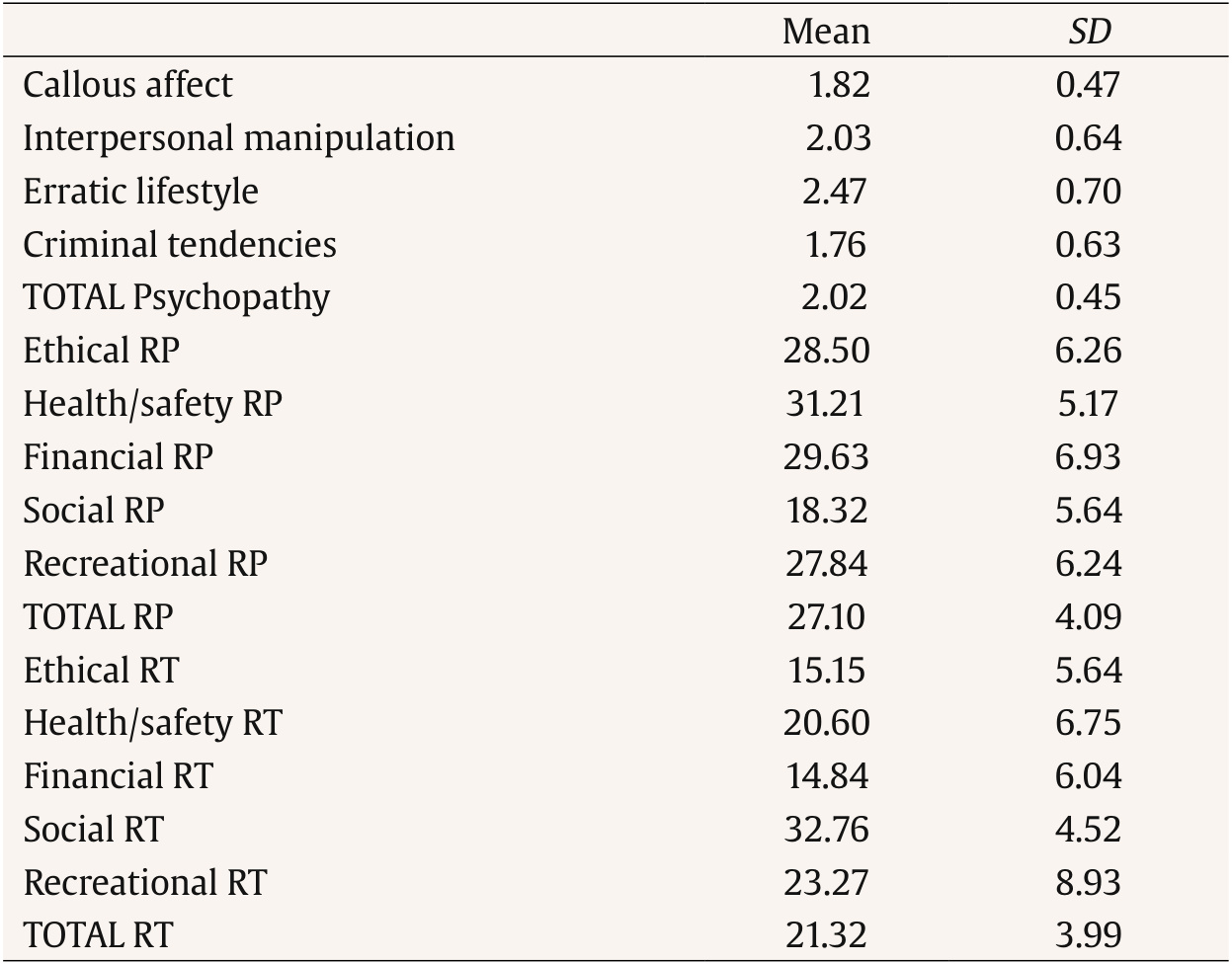 Note. RP = risk perception; RT = risk-taking. Table 2 Pearsons’ Correlations between Psychopathy Factors and Risk Scores 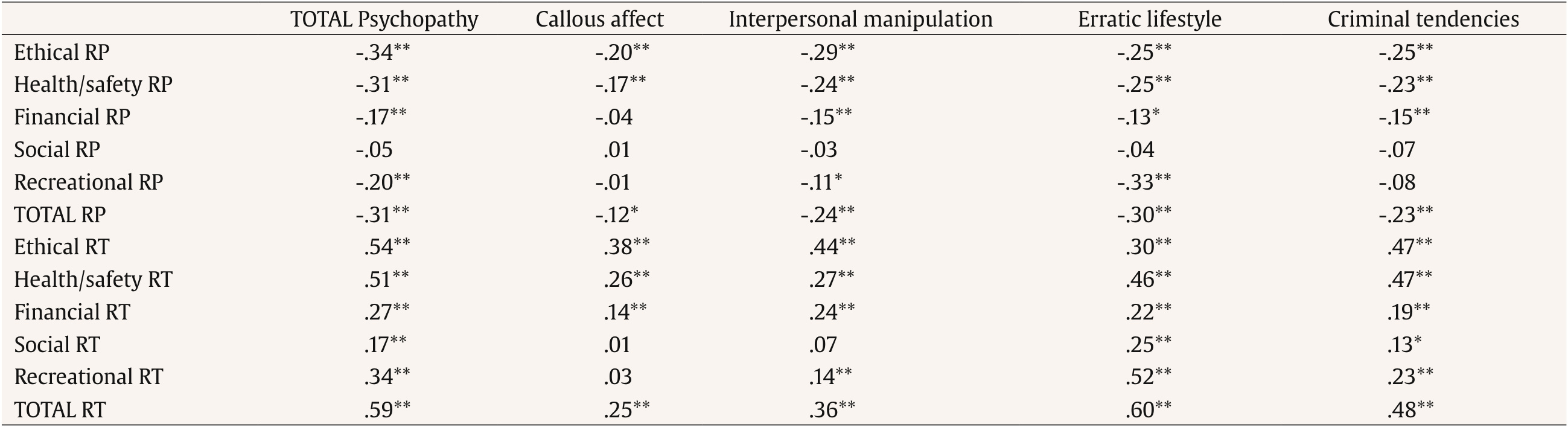 Note. RP = risk perception; RT = risk-taking. *p < .05, **p < .01. Cluster Analysis The dendrogram and the agglomeration schedule supported a four-cluster solution as the best fit for the data. Figure 1 illustrates these four clusters and the psychopathy scores for each cluster. The first cluster showed scores below the mean across all factors and was labeled the Low psychopathy group (LPG; n = 199). The second cluster presented scores above the mean for the Erratic lifestyle factor, and scores close to the mean for the remaining factors, termed the Erratic lifestyle group (ELG; n = 60). The third cluster was characterized by scores above the mean for all factors except Criminal tendencies, where scores were below the mean. This cluster was labeled the High psychopathy group (without Criminal tendencies) (HPG; n = 51). Finally, the fourth cluster presented scores well above the mean across all factors and was labeled the High psychopathy with Criminal tendencies group (HPCTG; n = 61). A discriminant analysis (Wilks’ lambda test) revealed good discrimination among clusters (p < .001), with 85.7% of cases correctly classified. Figure 1 Cluster Solution and Psychopathy Factor Scores for Each Cluster. 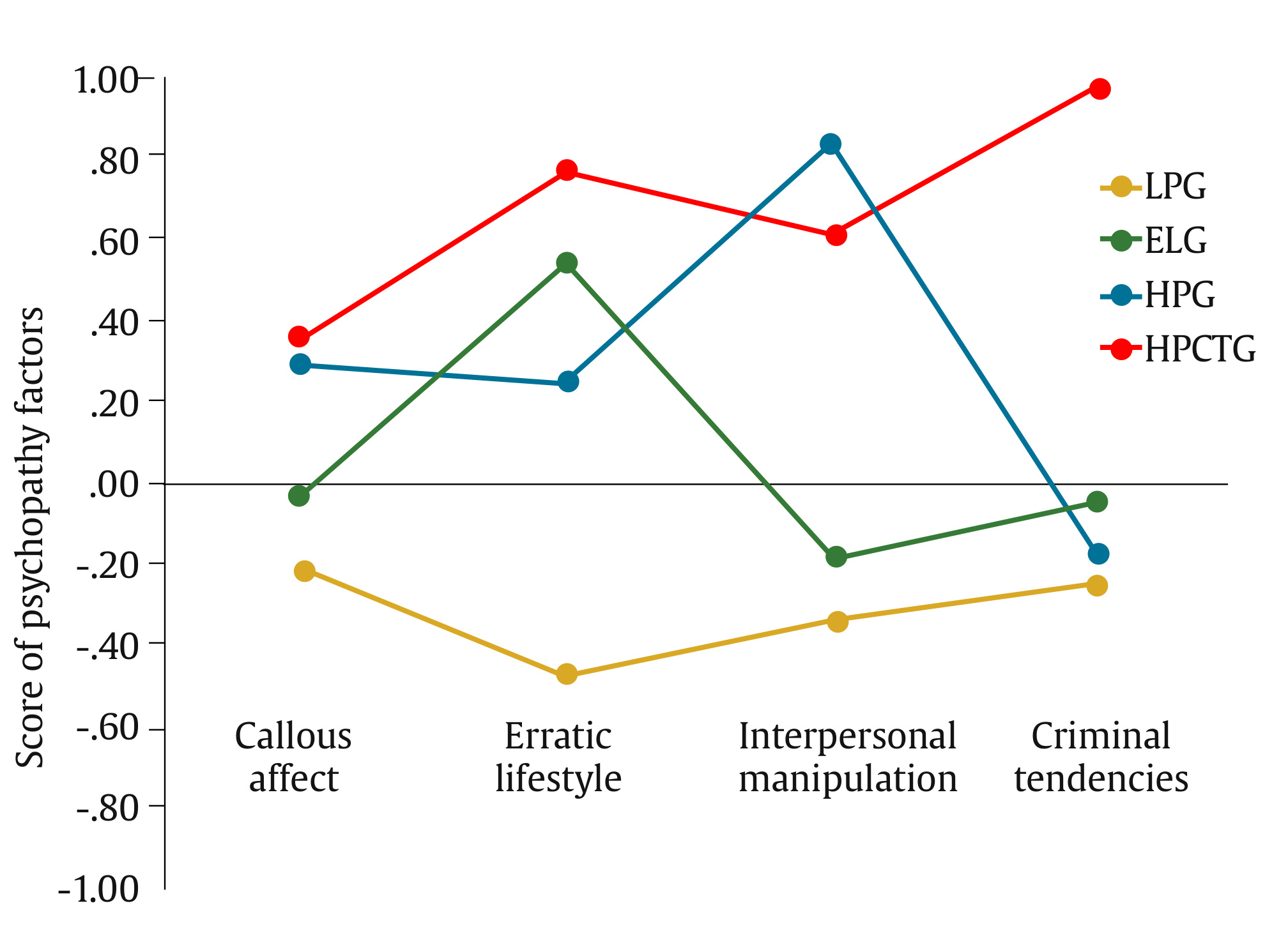 To facilitate comprehension, scores were adjusted by subtracting the mean of each psychopathy factor from the corresponding cluster score. Note. LPG = Low psychopathy group; ELG = Erratic lifestyle group; HPG = High psychopathy group; HPCTG = High psychopathy with Criminal tendencies group. Risk Perception Differences in Risk perception between the four identified psychopathy clusters were analyzed using ANCOVA for the total score of the DOSPERT and MANCOVA for the DOSPERT domains. Prior to conducting these analyses, assumptions of normality and homoscedasticity of residuals were evaluated. Visual inspection of Q-Q plots, together with skewness (ranging from -1.01 to 0.66) and kurtosis (ranging from -0.81 to 1.26) values, indicated that the residuals were normally distributed (Kline, 2023; Tabachnick & Fidell, 2013). Box’s M test and Levene’s tests were both non-significant (ps > .05), indicating that the assumptions of homogeneity of covariance matrices and error variances were met. The ANCOVA revealed a significant main effect of Cluster, F(3, 365) = 6.50, p < .001. The MANCOVA also showed a significant multivariate effect of Cluster (Wilk’s lambda = .88, F(15, 996) = 2.93, p < .001. Follow-up univariate analyses of the MANCOVA indicated significant differences between clusters in the Ethical, F(3, 365) = 7.42, p < .001, Health/safety, F(3, 365) = 4.37, p < .001, Financial, F(3, 365) = 3.14, p < .05, and Recreational, F(3, 365) = 5.26, p < .001, risk domains. However, no significant differences were observed for the Social domain (p > .05). Table 3 and Figure 2 show the Bonferroni post-hoc comparisons between clusters. These results revealed: a) across all significant domains and for Total Risk perception, the LPG showed higher Risk perception scores than the HPCTG (ps < .05); b) in the Ethical domain, the LPG showed higher Risk perception scores than the HPG (ps < .05); and c) in the Recreational domain, the LPG showed higher Risk perception scores than the ELG (ps < .01). Figure 2 Total Risk Perception and Domain Scores for Each Cluster. 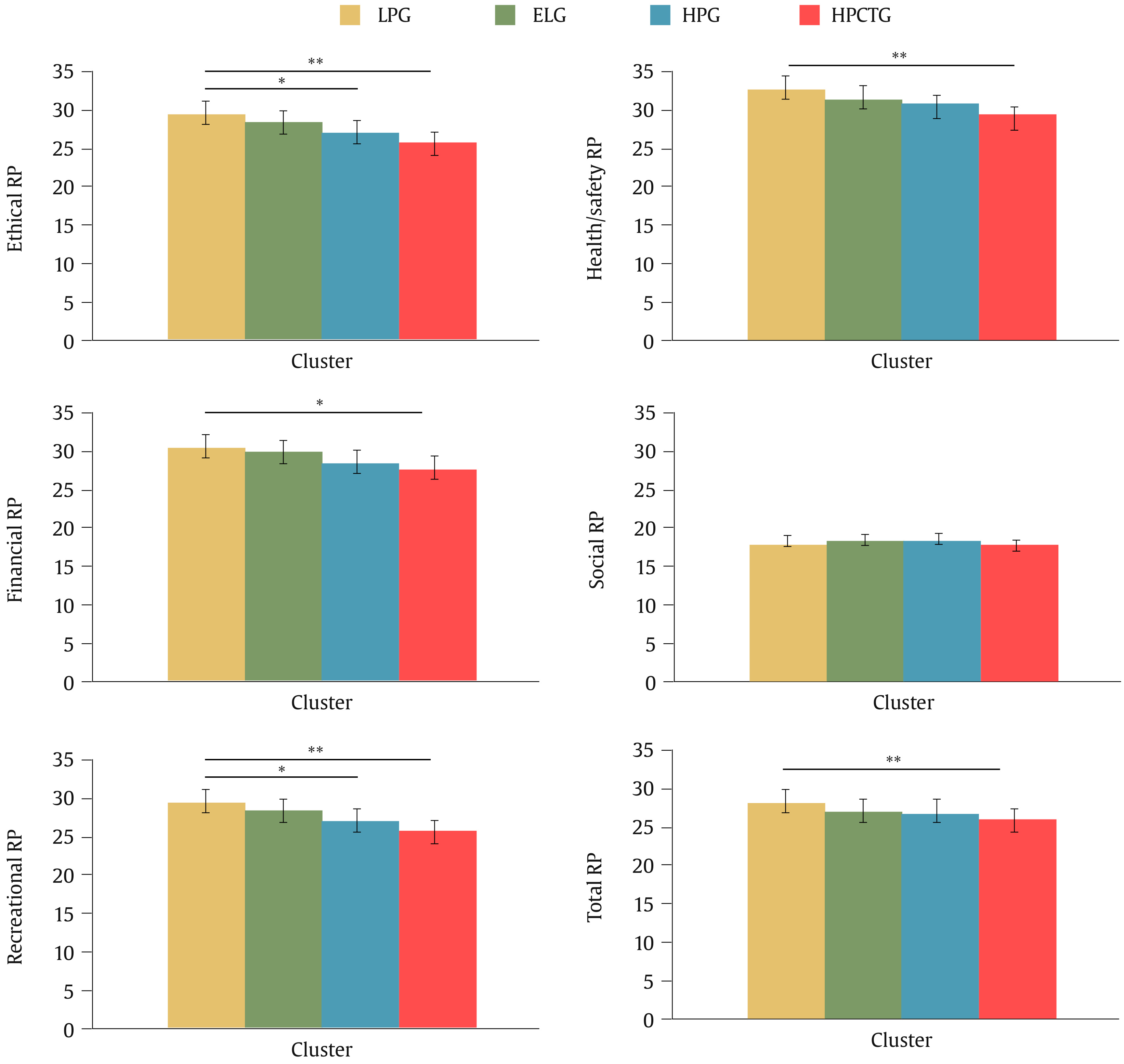 RP = risk perception; LPG = low psychopathy group; ELG = erratic lifestyle group; HPG = high psychopathy group; HPCTG = high psychopathy with criminal tendencies group. *p < .05, **p < .01. Table 3 Means and Standard Deviations (SD) of the Risk Perception Scores for Each Cluster and between-Cluster Comparisons  Note. RP = risk perception; LPG = low psychopathy group; ELG = erratic lifestyle group; HPG = high psychopathy group; HPCTG = high psychopathy with criminal tendencies group. Means with the superscript corresponding to each cluster are significantly different from each other (Bonferroni post-hoc test). The superscript representing each psychopathy cluster (1, 2, 3, and 4) is specified in the name of the cluster. *p < .05, **p < .01. Risk-taking Behavior As with Risk perception, differences in Risk-taking behavior between the four identified psychopathy clusters were examined using an ANCOVA for the total score and a MANCOVA for the domain scores. Visual inspection of Q–Q plots and skewness (-0.97 to 0.95) and kurtosis (-0.92 to 1.07) values indicated that the residuals were normally distributed. The only exception was observed for kurtosis in the LPG group in the Social domain, which showed a value of 2.70; however, this value remained within an acceptable range for assuming normality (Kline, 2023). Box’s M test and Levene’s tests were both non-significant (ps > .05), confirming homogeneity of covariance matrices and error variances. The ANCOVA showed a significant main effect of Cluster, F(3, 365) = 43.14, p < .001. The MANCOVA revealed a significant multivariate effect of Cluster (Wilk’s Lambda = .67, F(15, 996) = 10.50, p < .001. Follow-up univariate analyses of the MANCOVA for each risk domain showed significant differences between clusters for the Ethical, F(3, 365) = 32.35, p < .001, Health/safety, F(3, 365) = 27.01, p < .001, Financial, F(3, 365) = 6.60, p < .001, and Recreational, F(3, 365) = 16.67, p < .001, domains. The Social domain showed no significant differences (p > .05). Table 4 and Figure 3 show the Bonferroni post-hoc comparisons between clusters. The results revealed the following differences: a) Total Risk-taking: the LPG showed lower scores than the HPG, ELG, and HPCTG (ps < .01). In addition, both the ELG and the HPG showed lower scores than the HPCTG (ps < .01); b) Ethical domain: the LPG showed lower scores than the HPG and HPCTG (ps < .01). The ELG also showed lower scores than the HPG and HPCTG (ps < .05), whereas the HPG showed lower scores than the HPCTG (ps < .05); c) Health/safety domain: the LPG showed lower scores than the HPG, ELG, and HPCTG (ps < .01). The ELG and the HPG showed lower scores than the HPCTG (ps < .01); d) Financial domain: the LPG showed lower scores than the HPCTG (ps < .01); and e) Recreational domain: the LPG showed lower scores than the ELG and HPCTG (ps < .01), whereas the HPG showed lower scores than the HPCTG (ps < .05). Figure 3 Total Risk-taking and Domain Scores for Each Cluster. 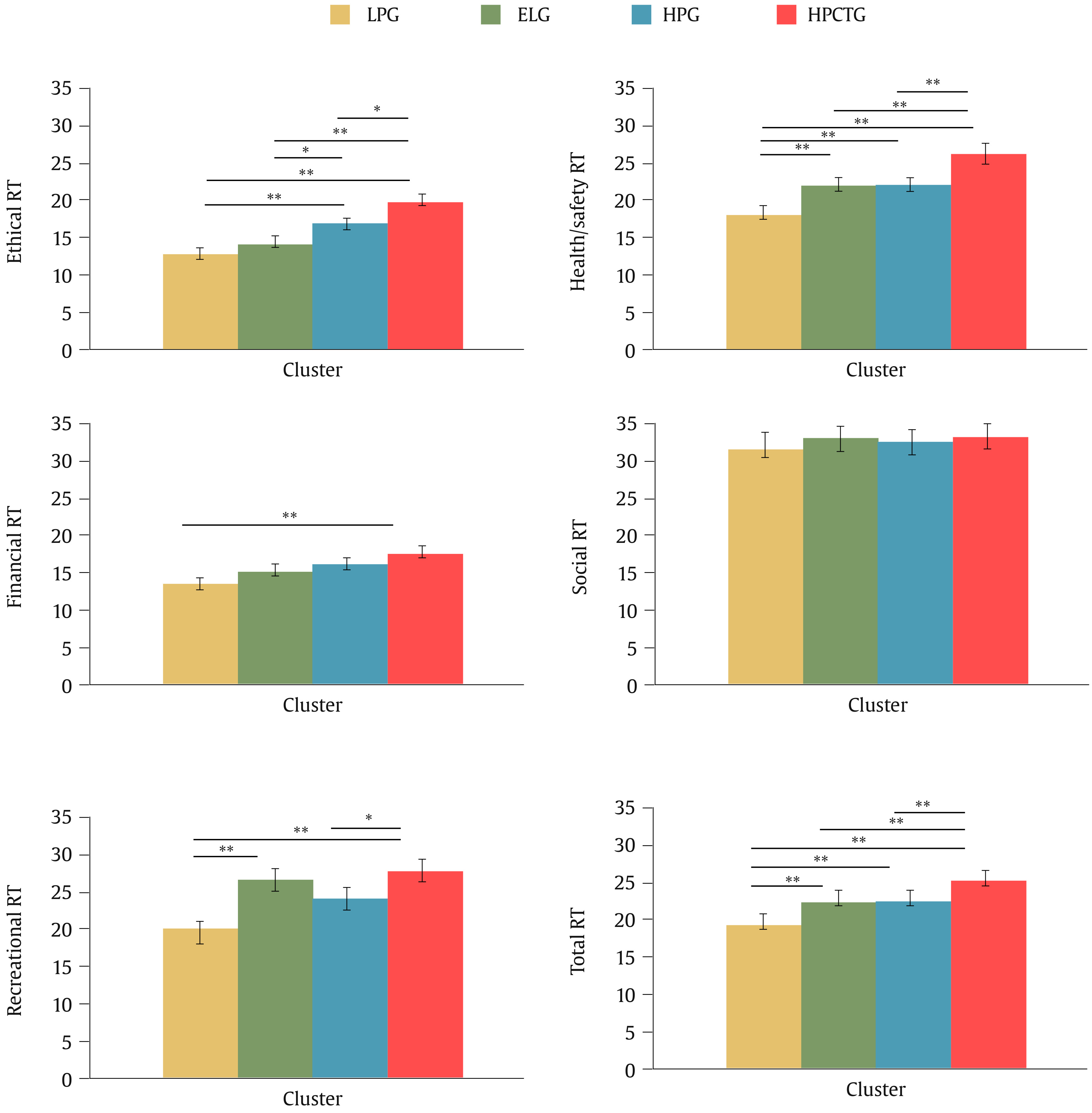 Note. RT = risk-taking; LPG = low psychopathy group; ELG = erratic lifestyle group; HPG = high psychopathy group; HPCTG = high psychopathy with criminal tendencies group. *p < .05, **p < .01. Table 4 Means and Standard Deviations (SD) of the Risk-taking Scores for Each Cluster and between-Cluster Comparisons  Note. RT = risk-taking; LPG = low psychopathy group; ELG = erratic lifestyle group; HPG = high psychopathy group; HPCTG = high psychopathy with criminal tendencies group. Means with the superscript corresponding to each cluster are significantly different from each other (Bonferroni post-hoc test). The superscript representing each psychopathy cluster (1, 2, 3, and 4) is specified in the name of the cluster. *p < .01. This study adopted a person-centered approach to examine psychopathy profiles and their association with risk perception and risk-taking behavior across five domains: ethical, health/safety, financial, social, and recreational. Cluster analyses identified four distinct profiles based on the psychopathy factors: the LPG (Low psychopathy group), with low scores on all psychopathy factors; the ELG (Erratic lifestyle group), with high scores only on the erratic lifestyle factor; the HPG (High psychopathy group), with high scores on all factors except criminal tendencies; and the HPCTG (High psychopathy with criminal tendencies group), with high scores on all four psychopathy factors, including criminal tendencies. Consistent with our first hypothesis, the results showed that the HPCTG exhibited lower risk perception and a greater general tendency to engage in risk-taking than the LPG. These findings support previous research suggesting that individuals with elevated levels of psychopathic traits are more likely to underestimate potential risks and engage in risky behaviors than those with low levels of these traits (Hosker-Field et al., 2016; Stanwix & Walker, 2021). This pattern of results could be explained by several cognitive and affective factors related to both risk behavior and psychopathy, such as impulsivity and lack of anticipatory fear (Fowles & Dindo, 2009; Reyna & Farley, 2006; Snowden & Gray, 2011). Psychopathy is characterized by deficits in emotional reactivity (Hare & Neumann, 2008; Lykken, 1995), which may overshadow the perceived costs in a decision-making process, diminishing the sensitivity to punishment and potentially leading to a mismatch in the cost-benefit assessment of taking a risk (Benning et al., 2005; Fowles & Dindo, 2009). As a result, individuals with psychopathic traits could undervalue the likelihood of behavioral costs and favor more impulsive behaviors driven by immediate rewards despite future risks (Benning et al., 2005; Blais & Weber, 2006; Figner et al., 2009; Maslowsky et al., 2011; Włodarska et al., 2021). Our findings were also in line with the second hypothesis, showing that the HPCTG and LPG differed in both risk perception and risk-taking across the ethical, health/safety, financial, and recreational domains, but not in the social domain, consistent with the domain-specific nature of risk. These results are supported by the existing literature, which shows that individuals with psychopathic traits are more likely to engage in health-related risks, such as risky sexual behavior and substance abuse (Chinchilla et al., 2026; Fulton et al., 2010; Kastner & Sellbom, 2012; Walsh et al., 2007), violate ethical standards (Glenn et al., 2009; Hosker-Field et al., 2016; Stevens et al., 2012), and engage in high-risk financial activities and sports (Hosker-Field et al., 2016; Hunt et al., 2005; Stanwix & Walker, 2021). Regarding the social domain, the absence of differences aligns with a number of prior studies reporting weak associations between psychopathy and social risk-taking assessed by the DOSPERT (e.g., Hosker-Field et al., 2016; Stanwix & Walker, 2021; Yap & Berezina, 2021). One possible interpretation could be that the conceptualization of social risk assessed by the DOSPERT is characterized by features that render it more adaptive than the risks captured by the other domains (see Stanwix & Walker, 2021, for a distinction between advantageous and disadvantageous risk-taking). Whereas most items in the questionnaire assess behaviors that constitute maladaptive risks, involving potential negative consequences associated with seeking immediate rewards or the violation of norms, the items of the social domain primarily comprise situations involving potentially adaptive risks related to assertiveness and personal development (e.g., “Starting a new career in your mid-thirties” or “Disagreeing with an authority figure on a major issue”). In this sense, the social risk operationalized by the DOSPERT may not capture the type of interpersonal risk-taking traditionally associated with psychopathy, such as interpersonal manipulation. Consequently, the conceptual overlap between the social risk measured by the DOSPERT and the psychological processes characteristic of psychopathy may be limited, thereby reducing the likelihood of observing significant associations. Future research using alternative measures of social risk-taking is needed to clarify whether the present findings are specific to the DOSPERT or reflect a broader pattern. Supporting the person-centered approach adopted in this study (Howard & Hoffman, 2018; Morin et al., 2018), our third hypothesis was confirmed. Profiles characterized by different combinations of psychopathy factors exhibited distinct patterns of risk perception and risk-taking in total scores and across the different risk domains. Beyond the expected low and high psychopathy profiles (LPG and HPCTG), the two intermediate profiles (ELG and HPG) provided particularly informative findings, as they exhibited distinct patterns despite not representing opposite ends of the psychopathy continuum. When comparing the ELG profile with the LPG, individuals in the ELG profile perceived less recreational risk and reported greater risk-taking in the health/safety and recreational domains and in the total score. However, they exhibited lower levels of ethical, health/safety, and total risk-taking compared with the HPCTG, and lower levels of ethical risk-taking compared with the HPG. These results show that an erratic lifestyle is related to risk behavior, although its combination with other psychopathic traits is linked to a further increase in risk-taking propensity. This suggests that erratic lifestyle alone does not fully explain the pattern of risk-taking associated with psychopathy, particularly in contexts involving ethical decisions. Nevertheless, the relationship between erratic lifestyle and risk behavior appears clear and may be explained by the pursuit of intense sensations and immediate rewards that characterizes individuals with high scores on this factor, for whom impulsivity and recklessness represent core features (Gómez-Leal et al., 2021; Hare & Neumann, 2008; Mahmut et al., 2011; Neal & Sellbom, 2012; Włodarska et al., 2021). This would explain, for example, why in recreational risk-taking contexts, which typically involve activities that provide excitement and stimulation (Blais & Weber, 2006; Sánchez-López et al., 2022a; Weber et al., 2002), the tendency to prioritize intense sensations and their immediate rewards may lead these individuals to underestimate potential costs and overestimate expected benefits, thereby reducing perceived recreational risk and increasing engagement in such activities. Similarly, the impulsive and poorly planned behavioral style characteristic of this profile may increase health/safety risk-taking, as decisions are driven more by immediate reward than by consideration of long-term consequences, for instance, engaging in risky sexual behavior for short-term gratification without considering the risk of contracting a sexually transmitted disease (Hare & Neumann, 2008; Mahmut et al., 2011; Neal & Sellbom, 2012). Another contribution of this study concerns the comparison between the HPG and HPCTG clusters, which could help shed light on the ongoing debate about whether the criminal tendencies factor is central to psychopathy (De Brito et al., 2021; Hare & Neumann, 2005; Vitacco et al., 2005), particularly in relation to risk-taking. Our results showed that, compared with the HPCTG, individuals in the HPG consistently engaged in less ethical, health/safety, recreational, and total risk-taking. Nevertheless, relative to the LPG, they perceived lower risk in the ethical domain and exhibited greater risk-taking in the health/safety and ethical domains, as well as total risk-taking. These findings suggest that elevated risk-taking can be observed in profiles characterized by psychopathic traits and an absence of criminal tendencies. However, the presence of criminal tendencies appears to intensify this propensity and extend it to a broader range of risk domains. This pattern may be explained by the nature of criminal tendencies, which reflect a greater willingness to violate social norms and disregard the potential consequences of one’s behavior (Neumann et al., 2015). Consequently, individuals scoring highly on this dimension may be more willing to engage in behaviors involving ethical violations (e.g., theft or tax evasion), health and safety risks (e.g., reckless driving and violation of traffic regulations), and certain risky recreational activities (e.g., piloting a helicopter with passengers without professional certification). Several limitations must be considered before extrapolating these results to the general population. First, our analyses were correlational in nature, which does not allow causal inferences to be drawn. Second, the variables under study were measured through self-reports, which introduces potential biases related to subjectivity and social desirability in the participants’ responses. Future studies should use behavioral measures to objectively assess risk perception and risk-taking whenever possible, for example, by using virtual reality headsets that allow individuals to be immersed in high-risk situations within controlled environments. Third, the present study was conducted in a non-clinical sample with generally low levels of psychopathic traits. Therefore, the identified clusters should be interpreted as reflecting relative differences within this sample, rather than as clinically meaningful psychopathy subgroups. Finally, further research should replicate and extend our results using a larger and more gender-balanced sample, as well as clinical samples consisting of individuals with a psychopathy diagnosis. Conclusions The present study advances understanding of psychopathy by adopting a person-centered approach, which revealed distinct profiles reflecting individuals’ unique combinations of the four psychopathy factors assessed by the SRP-III. These profiles were differentially associated with risk perception and risk-taking across risk domains, suggesting that risk-taking depends not only on overall psychopathy severity, but on how psychopathic traits are configured within the person. Our findings extend previous literature by clarifying how psychopathy is associated with an increased propensity toward risk-taking, while also contributing to the ongoing debate regarding the role of criminal tendencies within the psychopathy construct. From an applied perspective, considering distinct psychopathy profiles, rather than the overall level of psychopathic traits, may provide a more informative framework for risk assessment in clinical and forensic settings. Although future research in clinical populations is needed, identifying distinct psychopathy profiles and their corresponding patterns of risk-taking may inform the development of more targeted prevention and intervention strategies tailored to the specific characteristics of each profile, rather than relying on general risk-reduction programs. Such an approach could contribute to reducing maladaptive risk-taking behaviors and their associated negative consequences at both the individual and societal levels. Conflict of Interest The authors of this article declare no conflict of interest. Funding: This study was supported by the University of Málaga (B1-2021_10 to R.G.-L. and II PPIT PPRO-A3.2-2024-03 to M.T.S.-L.), the Spanish Ministry of Economy, Industry and Competitiveness (PSI2017-84170-R to P.F-B.), the Regional Government of Andalusia, Spain (PPRO-CTS578-G-2023 to P.F.-B), and the Spanish Ministry of Science and Innovation (CNS2022-136082 to A.M-R.). Cite this article as: Gómez-Leal, R., Sánchez-López, M. T., Fernández-Berrocal, P., & Megías-Robles, A. (2026). Unraveling the connection between psychopathic trait profiles and risk behavior tendencies. European Journal of Psychology Applied to Legal Context, 18, Article e260182. https://doi.org/10.5093/ejpalc2026a7 |
Cite this article as: Gómez-Leal, R., Sánchez-López, M. T., Fernández-Berrocal, P., & Megías-Robles, A. (2026). Unraveling the Connection Between Psychopathic Trait Profiles and Risk Behavior Tendencies. The European Journal of Psychology Applied to Legal Context, 18, Article e260182. https://doi.org/10.5093/ejpalc2026a7
Correspondence: mtsl@uma.es (M. T. Sánchez-López).Copyright © 2026. Colegio Oficial de la Psicología de Madrid


 PDF
PDF e-PUB
e-PUB CrossRef
 JATS
JATS Print
Print Send
SendEMAIL ALERT
The European Journal of Psychology Applied to Legal Context is licensed under a Creative Commons Attribution-NonCommercial-NoDerivatives 4.0 International License