What Makes People Willing to Help Victims of Child-to-Parent Violence?
[¿Qué hace que las personas estén dispuestas a ayudar a las víctimas de violencia filio-parental?]
Helena Cortina & Ana M. Martín
Universidad de La Laguna, Tenerife, Spain
https://doi.org/10.5093/ejpalc2026a3
Received 31 October 2025, Accepted 9 March 2026
Abstract
Background/Aim: Parents who endure child-to-parent violence (CPV) often experience social isolation and feel that their environment blames them for their suffering. However, the scientific literature has not yet addressed which elements facilitate the development of support networks for victims of CPV. This study aims to propose and empirically test the first theoretical model to explain the willingness to help victims of CPV. Method: To this end, 1,589 participants from the general population responded to an online questionnaire that measured social and personal norms regarding CPV, causal explanations of CPV, attribution of blame to the victim, sexist attitudes, and emotions toward the victim. Through structural equation modeling, we obtained a theoretically consistent model that presented a good fit to the data and explained 54% of the variance of the willingness to help. This model, consistent with previous models on antisocial and prosocial behavior, goes a step further in integrating psychosocial variables and theoretical approaches that had not been tested simultaneously in a single equation. Results: The findings indicate that sexist attitudes are related to victim blaming and that this blaming, together with social norms on CPV, are internalized to give rise to a personal norm based on which we morally judge the phenomenon, a personal sense of “right and wrong” that compels us to act to help victims of CPV. Conclusions: The results are discussed in relation to their practical implications for the design of awareness and prevention strategies aimed at increasing the social support that victims of CPV receive.
Resumen
Antecedentes/objetivo: Los padres que sufren violencia filio-parental (VFP) a menudo experimentan aislamiento social y sienten que su entorno les culpa por su sufrimiento. Sin embargo, la literatura científica aún no ha abordado qué elementos facilitan el desarrollo de redes de apoyo para las víctimas de VFP. El objetivo de este estudio es proponer y contrastar empíricamente el primer modelo teórico que explique la disposición a ayudar a las víctimas de VFP. Método: Para ello, 1,589 participantes de la población general respondieron a un cuestionario en línea que medía las normas sociales y personales relativas a la VFP, las explicaciones causales sobre la VFP, la atribución de culpa a la víctima, las actitudes sexistas y las emociones hacia la víctima. Mediante el modelado de ecuaciones estructurales obtuvimos un modelo teóricamente coherente que se ajustaba bien a los datos y explicaba el 54% de la varianza de la disposición a ayudar. El modelo, coherente con modelos anteriores sobre el comportamiento antisocial y prosocial, va un paso más allá al integrar variables psicosociales y enfoques teóricos que no se habían probado simultáneamente en un solo modelo. Resultados: Los resultados obtenidos indican que las actitudes sexistas están relacionadas con la culpabilización de la víctima y que esta culpabilización, junto con las normas sociales sobre la VFP, se internaliza para dar lugar a una norma personal mediante la que juzgamos moralmente el fenómeno, un sentido personal del «bien y el mal» que nos impulsa a actuar para ayudar a las víctimas de VFP. Conclusiones: Los resultados se analizan a la vista de sus implicaciones prácticas para el diseño de estrategias de sensibilización y prevención dirigidas a aumentar el apoyo social que reciben las víctimas de VFP.
Keywords
Child-to-parent violence, Victim-blaming, Social norms, Personal norm, Sexist attitudesPalabras clave
Violencia filio-parental, Culpabilización de las víctimas, Normas sociales, Norma personal, Actitudes sexistasCite this article as: Cortina, H. & Martín, A. M. (2026). What Makes People Willing to Help Victims of Child-to-Parent Violence?. The European Journal of Psychology Applied to Legal Context, 18, Article e260178. https://doi.org/10.5093/ejpalc2026a3
Correspondence: ammartin@ull.edu.es (A. M. Martín).Child-to-parent violence (CPV) is characterized by repeated behaviors of physical, psychological, or economic violence directed at parents or caregivers (Pereira et al., 2017). Research indicates that these behaviors primarily target mothers in community, judicial, and clinical samples (Holt, 2016; Simmons et al., 2018). However, there is no consensus on the perpetrators’ age range (Curtis et al., 2022) or on whether their main motivation is to exert control and power over their victims (Rogers & Ashworth, 2024). CPV has traditionally been one of the less researched types of family violence. However, its social and scientific visibility has increased in recent years due to the greater social alarm caused by media coverage of the problem since 2004 (Calvete & Pereira, 2019; Moreno & Legaz, 2025; Pereira, 2006). The turning point for the public interest in Spain was the reform of articles 153 (on abuse) and especially 173.2 (on habitual abuse) of the Spanish Penal Code, when the new Organic Law 11/2003 came into force. As a result of these legal modifications, the number of complaints for cases of CPV filed in the juvenile divisions of provincial prosecutors’ offices saw a sharp increase (Fiscalía General del Estado, 2004; Martín et al., 2022). The legal modifications of the Spanish Penal Code redefined CPV cases that were previously considered misdemeanors as crimes, requiring victims seeking civil protection measures to file a complaint. Therefore, reports for CPV related offenses increased, but not necessarily because the number of CPV cases went up. In fact, the number of complaints for CPV offenses subsequently stabilized and has remained stable ever since at around 4,000 per year (Fiscalía General del Estado, 2025). Beyond the high number of reports filed each year, the high proportion of CPV offenses compared to other offenses committed by minors (Cuervo, et al., 2025), or the prevalence of CPV in the general population (Junco-Guerrero et al., 2025), this social problem must also be addressed because of the negative consequences it causes. These negative consequences, that can impact the individual, family, and social spheres, have been well documented by psychologists, criminologists, and social workers, among other professionals. CPV has a particularly strong impact on mothers because they are the most frequent victims. They experience physical, psychological, and economic consequences that allow their children to control their lives (Arias-Rivera et al., 2022; Bautista-Aranda et al., 2025; Jiménez-Granado et al., 2023; Junco-Guerrero et al., 2025; Toole-Anstey et al., 2023, 2024). Since parents are consciously prone to dissimulate clinic symptomatology and give socially desirable responses in forensic contexts (Arce et al., 2025), the negative impact of CPV on mothers is likely worse than they report. CPV scientific literature has tended to address the problem by focusing on the identification of risk factors at different levels (Simmons et al., 2018), predominantly individual and family variables (Arias-Rivera & Hidalgo, 2020; Arias-Rivera et al., 2022; Chen et al., 2024; Cuervo, 2025; Junco-Guerrero et al., 2025). Just recently, social and professional demands for effective interventions have shifted the focus from single variables to profiles of adolescents involved in this type of violence (Calvete, 2023; Cano-Lozano et al., 2023). Although such knowledge is essential to approach the phenomenon, variables that would move the focus away from the family and contextualize this violence in the broader scenario in which it occurs are also needed to have a better understanding of CPV as a social problem (Holt, 2021; Martín & Cortina, 2025). Parents are reluctant to report CPV and seek help, as they experience complex and contradictory feelings, wanting to protect their children and deal with the problem privately (Arias-Rivera et al., 2022; Toole-Anstey et al., 2023). In addition, they feel constantly judged, stigmatized, and blamed, both in their close environment and within professional settings when seeking protection and resources (Toole-Anstey et al., 2023). This lack of support is related to revictimizing and victim-blaming discourses (Cortina & Holt, 2024; Toole-Anstey et al., 2023) that can lead to social isolation (Bautista-Aranda et al., 2025; Jiménez-Granado et al., 2023; A. Hernández et al., 2020; A. Hernández & Martín, 2025). On the contrary, social support plays a mediator role in the relationship between CPV and mothers’ psychological disorders (Bautista-Aranda et al., 2025). In dating violence cases, a victim’s willingness to seek help has been related to the perceived severity of that violence (Arrojo et al., 2024). In this line, Rogers and Ashworth (2024) have stressed the need for research to focus on the barriers to and facilitators of help-seeking by CPV victims. However, to the best of our knowledge no study has yet explored the variables related to people’s willingness to help CPV victims. The Present Study This study aims to hypothesize and empirically test a conceptual model on the willingness to help CPV victims, proposing theoretical relationships between six psychosocial variables: (1) social norms regarding CPV, (2) personal norms against CPV, (3) explanations of CPV, (4) ambivalent sexist attitudes, (5) attribution of blame to the victim, and (6) negative emotions towards the victim. The selection of these variables was based on a review of previous research on the impact of norms, attribution, and willingness to help victims in general (e.g., Gracia et al., 2018; Malle, 2023, 2025; Wenzel & Woodyatt, 2025), as well as the evidence provided by the few studies that explore the social perception of CPV (Cortina & Holt, 2024; Cortina et al., 2022; Cortina & Martín, 2020, 2023). Figure 1 reflects the proposed model. The selection of the variables and the hypothesized relationships between them are described in turn. Figure 1 Hypothesized Model on the Relationship between Norms, Emotions, Attributions, Sexist Attitudes, and the Willingness to Help. 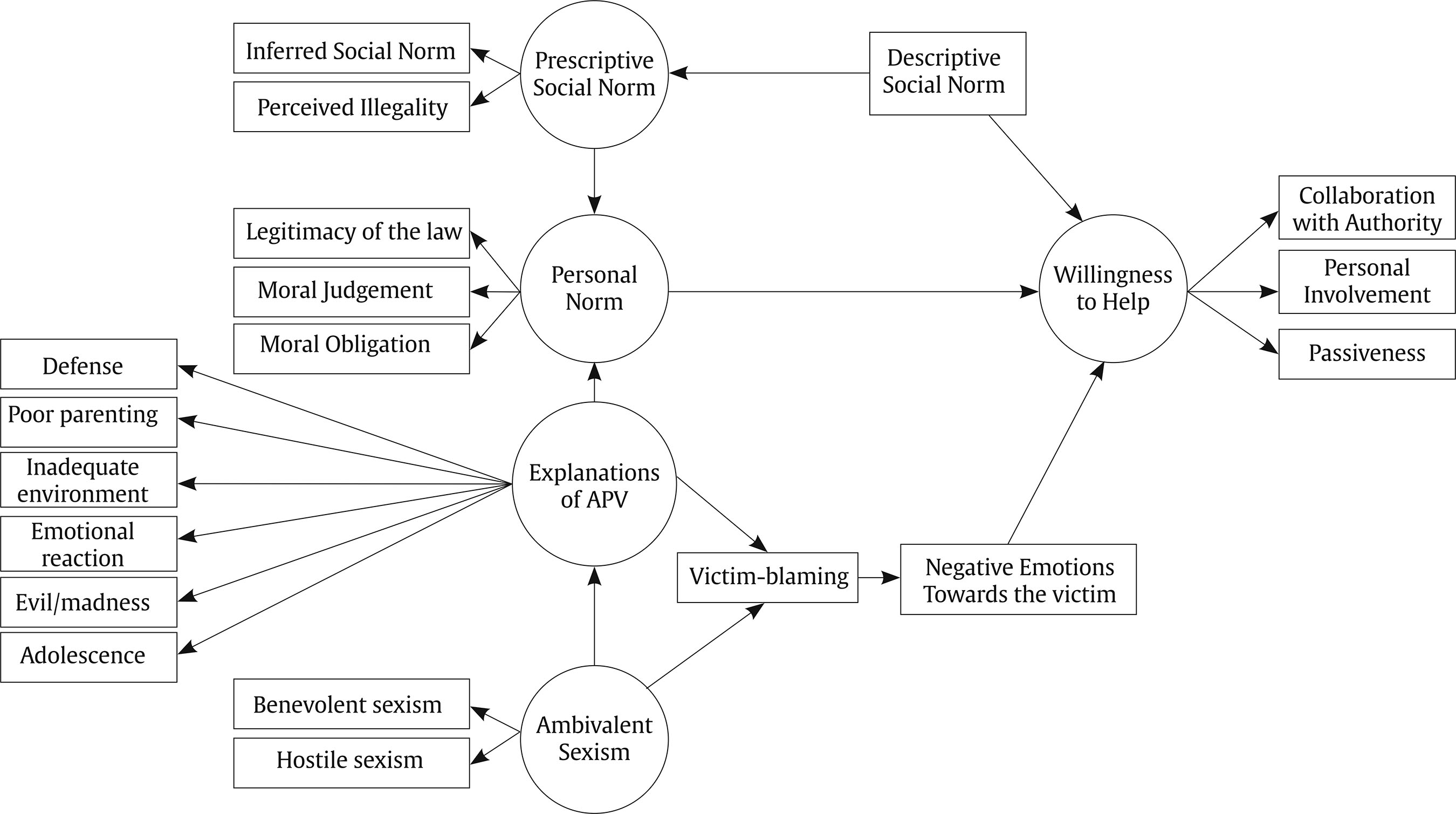 First, we hypothesize that the Personal Norm regarding CPV will be the variable with the strongest association to the Willingness to Help. Passiveness, Personal Involvement, and Collaboration with Authority will be used as indicators to measure the Willingness to Help (Gracia et al., 2018). The stronger the Personal Norm against CPV, the greater the disposition to help the victim. This prediction is consistent with the work of Schwartz (1977) and is supported by empirical evidence provided by Tyler (1990), Thørgensen (2006), Wenzel (2004b, 2004a), Corral-Verdugo and Frías-Armenta (2006), Frías-Armenta et al. (2009), B. Hernández et al. (2010), and Martín et al. (2014). Based on Tyler’s (2006a, 2006b) formulations, we selected Moral Judgment and Perceived Legitimacy of the Law as indicators to measure the Personal Norm, as well as the Moral Obligation to Help the Victim, drawing on Schwartz’s (1977) Personal Norm Activation Theory. A second expected predictor of the Willingness to Help was the Descriptive Social Norm. This hypothesized relationship is based on the Focus Theory of Normative Conduct (Cialdini et al., 1990), which indicates that perceiving a phenomenon to be widespread in society influences behavioral intention and it is supported by evidence provided by Cialdini (2003), B. Hernández et al. (2010), and Martín et al. (2014). Furthermore, following Wenzel’s (2004b, 2004a), Haidt’s (2001), and Thørgensen’s (2006) norm internalization continuum, according to which we internalize as personal norms those norms on which we perceive a social consensus, we anticipated that Prescriptive Social Norms will be associated with the Willingness to Help through Personal Norms. Thus, we hypothesize that the Descriptive Social Norm will antecede the Prescriptive Social Norm, which in turn will predict the Personal Norm. The Inferred Social Norm (Cialdini et al., 1991; Cialdini et al., 1990) and the Perceived Illegality (Finnis, 2002) will be used as indicators to measure the Prescriptive Social Norm. The third hypothesized predictor of the Willingness to Help is the Negative Emotion towards the victim aroused in the observer, following Weiner’s (1986, 2018) Attributional Theory of Motivation and Emotion. According to this theory, attributing people’s suffering to a cause under their control leads to blaming them for their suffering, generating negative emotions that decrease helping behavior, whereas the attribution to a cause beyond their control generates positive emotions that in turn increase helping behavior (Weiner, 2018). From this perspective, positive and negative emotions are two poles of the same continuum that would predict opposite behaviors, relating to the criterion variable positively or negatively, but to the same extent. Therefore, given the large number of variables included in this study as well as to avoid multicolinearity, we only included Negative Emotions in the model. In this way, it is expected that Explanations of CPV will influence Victim-Blaming, which in turn will predict Negative Emotions Toward the Victim. Evidence provided by Osborne and Weiner (2015), Weiner et al. (2011), and Rudolph et al. (2004) support these predictions. Ambivalent Sexist Attitudes are expected to predict Explanations of CPV, given that such a relationship has been found regarding other forms of domestic violence (Martín-Fernández, Gracia, Marco, et al., 2018). Finally, Explanations of CPV will influence Personal Norm, given that there is evidence suggesting that Personal Norm mediates the relationship between attributions and behavior (Hoffmann, 2013). Participants The sample was initially composed by 1,589 participants between the ages of 14 and 74 (M = 28.43, SD = 10.81); 64.1% were women. To address missing values, all records with any missing values in the observed variables were excluded from the structural equation analysis (listwise deletion). The final sample was composed by 1,110 Spanish speakers, 86% of whom were based in Spain, aged 14 to 74 (M = 27.7, SD = 10.3); 62.2% were women and 35.9% men, 2% identified as non-binary, and 14.8% had offspring. The educational levels in this final sample were primary studies (1.1%), compulsory education (7.4%), mid-level professional training (2.9%), high school level (31%), and university studies (57.7%). Variables and Instruments We developed a questionnaire to assess the variables included in the model. For this purpose, we elaborated a scenario of CPV using three behaviors from the Spanish adaptation of the Beliefs about Child-to-Parent Abuse Questionnaire that have proven to be perceived as severe (Cortina & Martín, 2023): threatening the parent with an object, hitting or slapping the parent, and keeping the parent from getting medical care. The hypothetical scenario was as follows: “Carlos is a teenager who lives with his 40-year-old mother, Cristina. Carlos behaves violently towards her, threatening her with objects, hitting and slapping her, even causing injuries on occasion. He also once prevented Cristina from receiving medical attention.” After reading the scenario, participants answered several questions, using a 11-point Likert-type scale ranging from 0 (totally) to 10 (absolutely not), except for the social desirability scale, which was a dichotomous. These items were included in the following tools: Victim-Blaming “To what extent do you think the mother is to blame for what is happening to her?”. Explanations of Adolescent-to-Parent Violence Scale (Cortina & Martín, 2021) This scale consists of 28 items that comprise six factors corresponding to possible explanations for CPV. The internal consistency of these factors, measured with McDonald’s ω, was .83 for Defense, .79 for Poor Parenting, .79 for Inadequate Environment, .73 for Emotional Reaction, .78 for Adolescence, and .63 for Evil/Madness. Negative Emotion toward the Victim It was measured through the following question: “Given the situation presented, what are your feelings towards Cristina, the mother?”. Participants indicated to what extent they felt Irritation, Annoyance, and Anger towards her. The internal consistency, measured through McDonald’s ω, was .82. The mean of the scores in the three emotions was calculated to obtain a total Negative Emotion score. Personal Norm It was measured through three questions: (a) “To what extent do you personally believe that it is wrong not to intervene in such a situation?” (Moral Judgment), (b) “To what extent do you think there should be a law that punishes adolescents who engage in these behaviors?” (Perceived Legitimacy of the Law), and (c) “To what extent would you feel morally obliged to act if you encountered these situations?” (Moral Obligation to Act). Descriptive Social Norm It was measured through the following question “To what extent do you think most children carry out these behaviors toward their parents?”. Prescriptive Social Norm It was measured through two questions: (a) “To what extent do you think most people think the following behaviors are wrong?” (Inferred Social Norm) and (b) “To what extent do you think the following behaviors are illegal?” (Perceived Illegality). Ambivalent Sexist Attitudes They were measured through the Scale of Ambivalent Sexism towards Women by Glick and Fiske (1996), in the reduced version, adapted to Spanish by Expósito et al. (1998). This instrument consists of 12 items and two subscales and measures ambivalent attitudes, both hostile and benevolent, towards women. Hostile sexism refers to sexism with a negative emotional tone, whereas Benevolent sexism refers to sexism with a positive affective tone, which includes the ideas that men should care for and protect women, that female characteristics are complementary to male characteristics, and that men depend on women for certain issues, such as reproduction. The internal consistency, measured through McDonald’s ω, was .93 for Hostile sexism, .84 for Benevolent Sexism, and .93 for the total Ambivalent Sexism. Willingness to Help It was measured through three questions taken from Gracia et al. (2018): (a) “If you witnessed this behavior, would you be likely to ignore it?” (Passiveness), (b) “If you witnessed this behavior, would you be likely to intervene to stop it?” (Personal Involvement), and (c) “If you witnessed this behavior, would you be likely to call the police?” (Collaboration with Authority). Social Desirability It was measured through Reynolds’ (1982) short version of the Crowne and Marlowe’s (1960) scale, using Ferrando and Chico’s (2000)’s adaptation to Spanish. It consists of 13 items that measure the tendency of participants to respond in a socially appropriate way and that are answered dichotomously, with 0 = false and 1 = true (e.g., “I always try to practice what I preach”). Since this tool is an index rather than a scale, the final score is obtained by adding up the positive responses. Therefore, it is not relevant to calculate its internal consistency (Diamantopoulos & Winklhofer, 2001). Items’ presentation order was randomized to control the carry-over effect. The questionnaire also included questions on gender, age, level of education, and place of residence. Procedure Participants accessed the questionnaire online through a link that was distributed by university students using the snowball sampling technique and through social media. Students were asked to find participants of both masculine and feminine gender and different age ranges in their immediate surroundings. Participants were informed that the research topic was on conflicts between parents and their offspring. The anonymity and confidentiality of their responses were assured, and participants gave their informed consent voluntarily. The procedure was approved by the Research Ethics and Animal Welfare Committee of the Universidad de La Laguna (CEIBA2024-3399). Data Analysis Data were analyzed using the Jamovi 2.3.28 software package. Data did not follow a normal distribution, as participants’ scores tended to concentrate in the extremes. Therefore, the statistics used to describe the variables were median, mode, percentiles 25th and 75th, as well as Spearman correlations. McDonald’s ω was used as an indicator of reliability for scales composed of several items. For the same reasons, the estimation method used to carry out the structural equation modeling (SEM) was the diagonally weighted least squares (DWLS). SEMs are multivariate statistical analysis that allow testing hypothesized theoretical relationships between variables and estimating their effect. Moreover, as in factor analysis, SEMs allow the number of observable variables (or indicators) to be reduced to a smaller number of unobservable variables (or latent variables). SEMs have two separate parts: the measurement model and the structure model. First, the measurement model examines the proposed latent factors underlying the observable indicators chosen to measure them, as a confirmatory factor analysis. When these relationships are statistically significant, the convergent construct validity in the measures used is considered adequate (Corral-Verdugo & Figueredo, 1999). Second, the structure model examines the proposed theoretical relationships between the variables. In the graphical representation of the model, the observed variables are depicted with rectangles, and the latent variables with circles (Sánchez-Iglesias et al., 2022). Several indicators were considered to assess the goodness-of-fit of the model. First, the chi-square statistic (χ2) indicates a good fit when its value is low and not significant (p > .05). However, this indicator tends to result in a statistically significant value when the sample used is large, as is the case in this study. Therefore, other indicators such as the comparative fix index (CFI) and the Tucker-Lewis index (TLI) were also used. Their value should be equal or higher than .90 (Bentler, 2006). The root mean squared error of approximation (RMSEA) and the standardized root mean squared residual (SRMR) index, which require a value below .06, were also considered (Browne & Cudeck, 1992). Table 1 shows the descriptive statistics for all variables assessed in the study. The medians and the modes indicate that, in our sample, the participants tend to express strong personal norms against CPV and consider that there is a social consensus in this regard. Furthermore, they do not believe CPV to be a normal and widespread phenomenon. In general, they present low scores on negative emotions experienced towards the victim. As for attributions about the cause of the CPV, although they do not tend to blame the victim for the situation overtly and directly, the mode is near the middle of the scale when considering CPV a consequence of poor parenting. Regarding the willingness to help, the participants in this study indicate a predisposition to become personally involved and to collaborate with the authority, and to not ignore the situation. Table 1 Descriptive Statistics of the Analyzed Variables 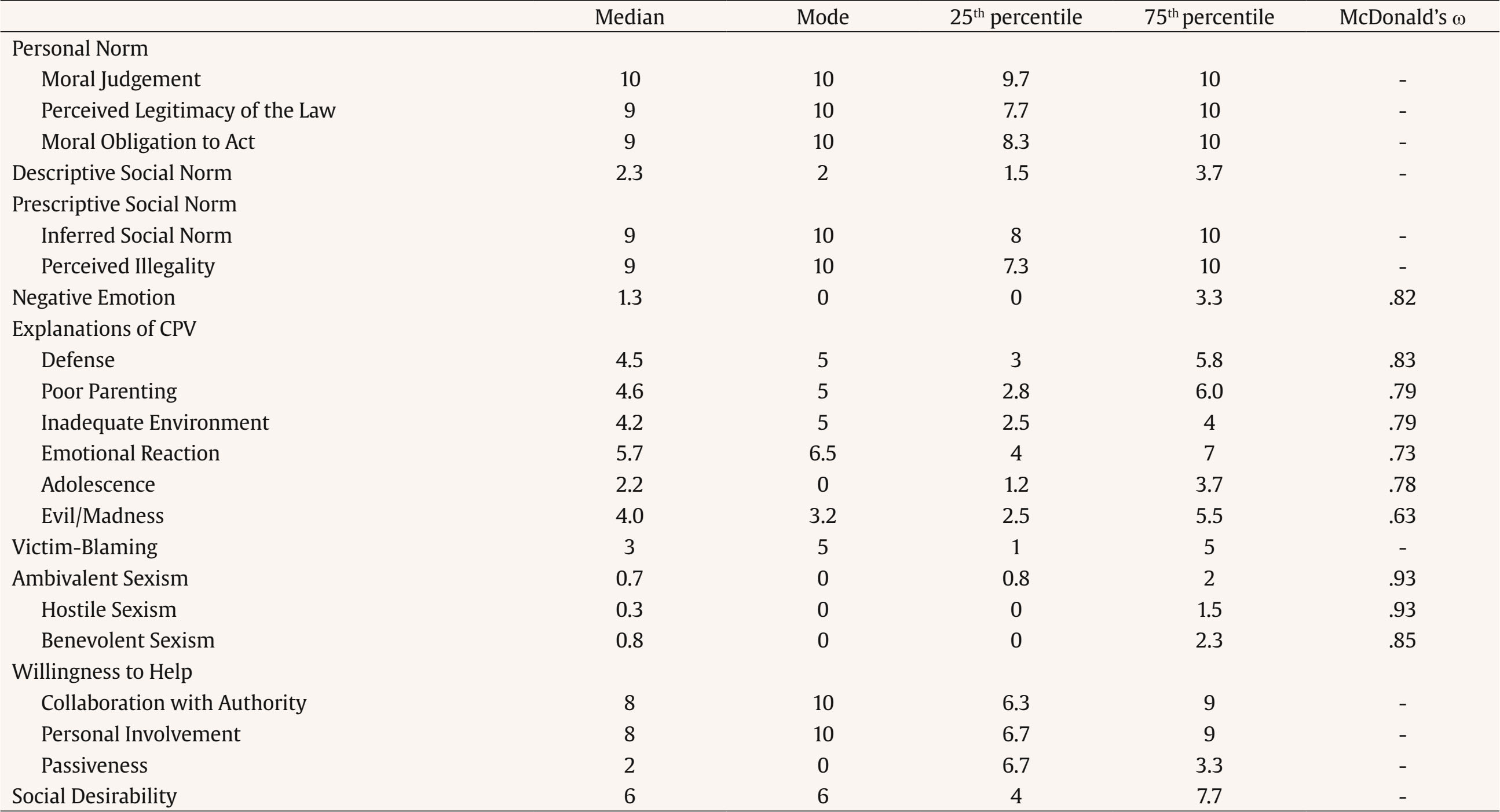 Note. For all variables, except Social Desirability, the minimum score is 0, and the maximum 10; for Social desirability the minimum score is 0 and the maximum 13. Table 2 shows the Spearman correlation matrix of the variables included in the model, which ranged from -.52 to .51. Correlations were in line with expectations. The variables of Negative Emotion towards the victim, Poor Parenting, Victim-Blaming, Ambivalent Sexism, and Passiveness were positively related to each other. The highest negative correlations were those of Passiveness with Personal Involvement (ρ = -.52, p < .001) and with Collaboration with Authority (ρ = -.34, p < .001). The highest positive correlations were those between Moral Obligation to Act with Personal Involvement (ρ = .51, p <.001), between Collaboration with Authority and Personal Involvement (ρ = .49, p < .001), and between Victim-blaming and Poor Parenting (ρ = .45, p < .001). Table 2 Spearman’s Rho Correlation of the Analyzed Variables 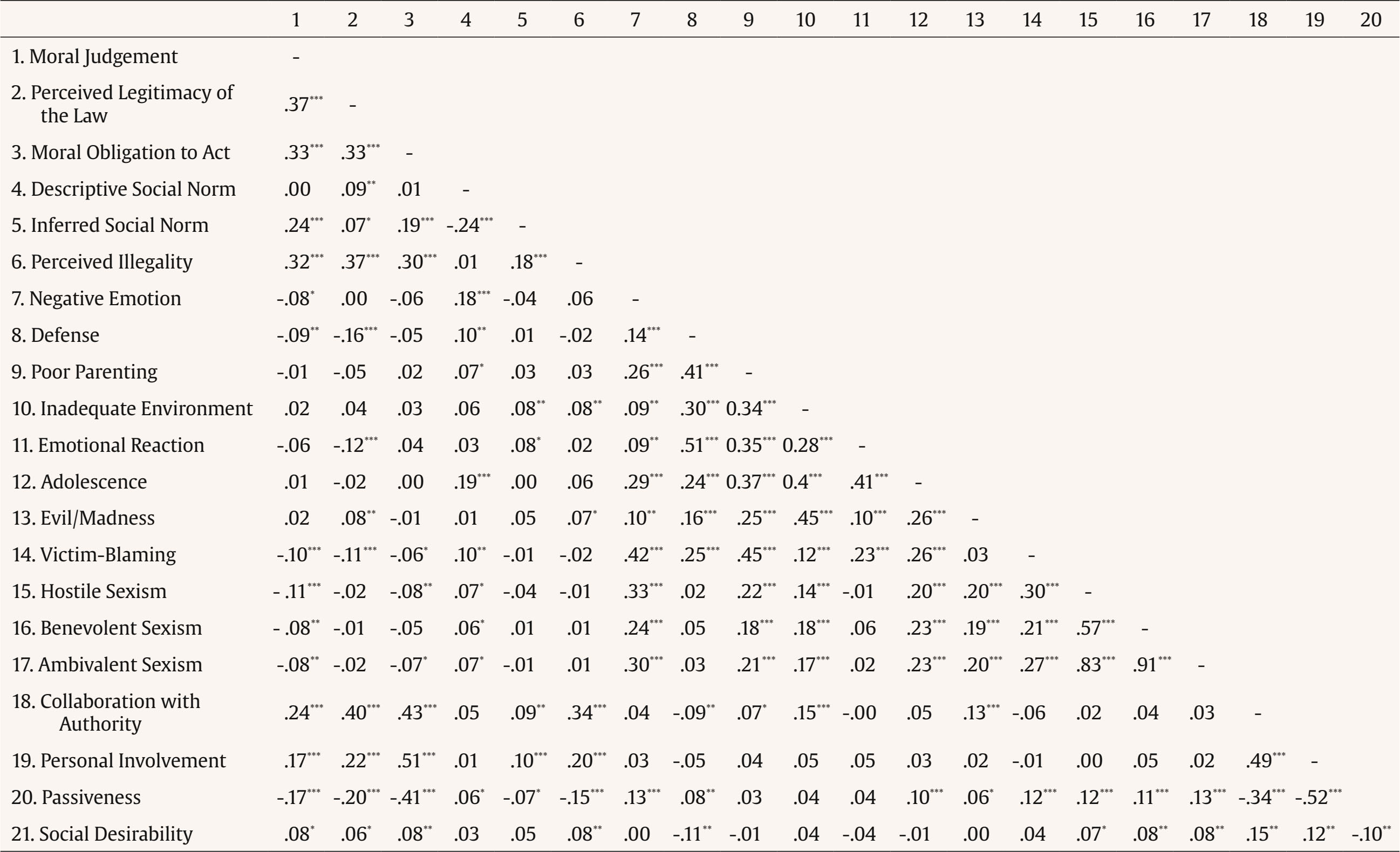 *p < .05, **p < .01, ***p < .001. Starting with the hypothesized model, several alternative equation models were tested and compared in terms of their theoretical coherence, goodness of fit, and percentage of explained variance. The hypothesized relationships for the Prescriptive Social Norm and Explanations of CPV were not statistically significant and did not improve the variance explained by the model, even slightly worsening the goodness-of-fit indicators. Therefore, these variables were excluded from subsequent equation modeling. In addition, the model’s goodness of fit was improved by replacing Sexist Attitudes with a total score resulting from averaging all items of the scale, instead of including it as a latent variable as initially hypothesized. The final model, shown in Figure 2, explained 54% of the variance of the Willingness to Help and obtained the best goodness-of-fit of all those tested, χ2(32) = 109, p < .001; CFI = .93; TLI = .90; RMSEA = .047, 95% CI [.037, .056]; SRMR = .058. The Personal Norm explained 33% of the variance, and Victim-blaming 8%. The measurement model indicated an adequacy of the indicators to measure the three subjacent latent variables (Prescriptive Social Norm, Personal Norm, and Willingness to Help), and the structural model supported the proposed relationship between the variables. Figure 2 Results of the Structural Equation Model on the Likelihood of Helping CPV Victims. 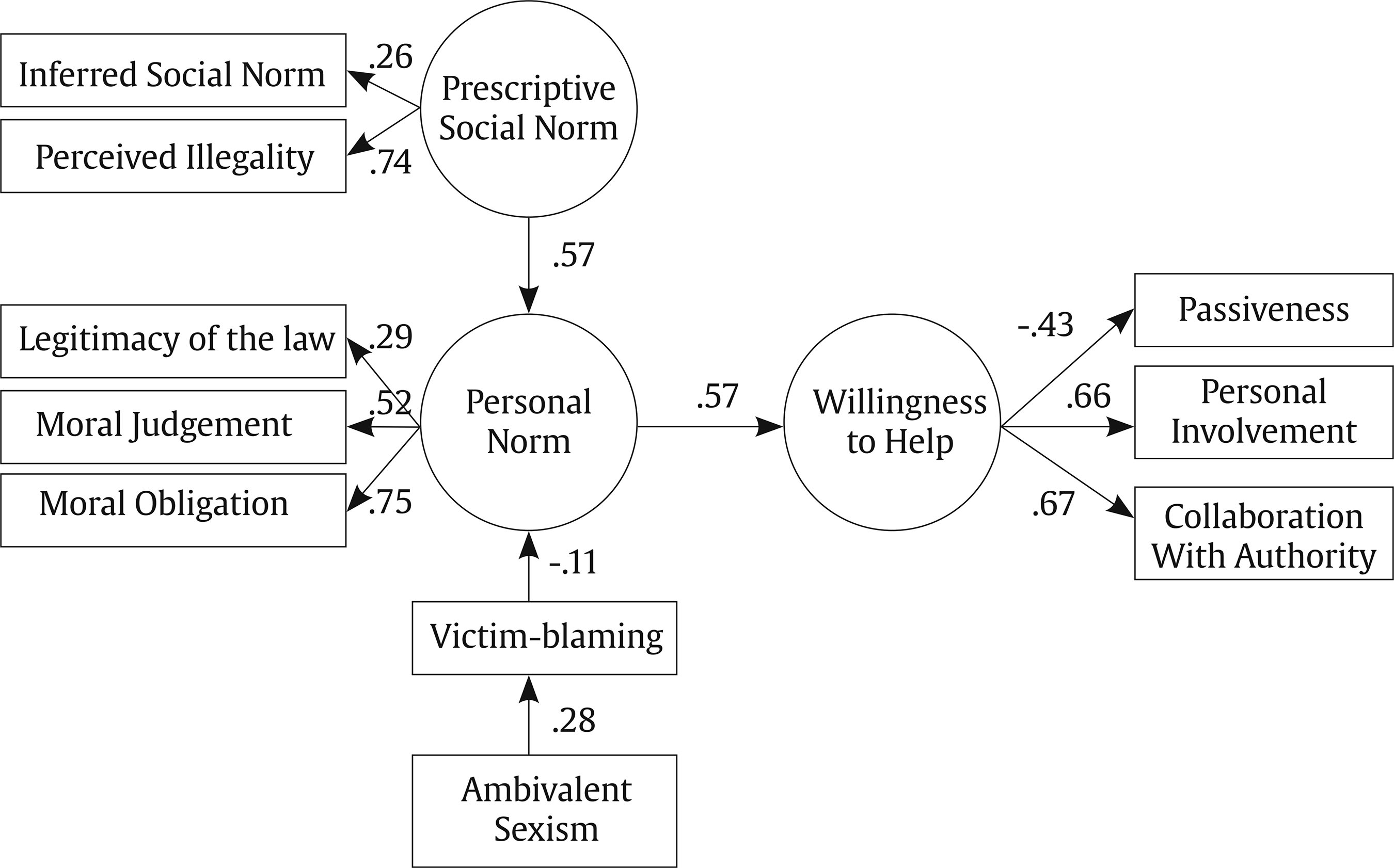 Note. All coefficients are statistically significant at p < .001. The highest regression standardized coefficients show that Prescriptive Social Norm is defined mainly by Perceived Illegality (γ = .74), Personal Norm by Moral Obligation to Act (γ = .75), and Willingness to Help almost equally by Collaboration with Authority (γ = .67) and Personal Involvement (γ = .66). The path standardized coefficients display that the relationships between the variables resulted as anticipated, since Prescriptive Social Norm presents a positive and significant association with the Personal Norm (β = .57, p < .001), which in turn predicted the Willingness to Help (β = .73, p < .001). Contrary to what was first hypothesized, although still theoretically coherent, Victim-blaming predicted the Willingness to Help indirectly through the Personal Norm (β = -.11, p < .001) and not through Negative Emotions towards the victim, as originally anticipated. As expected, Ambivalent Sexism is positively and significantly associated with Victim-blaming (β = .28, p < .001). The theoretical model proposed in this study is the first in the CPV literature aimed at explaining willingness to help victims of CPV. It accounts for a significant percentage of the criterion variable by combining social and personal norms, emotions, attributions, and attitudes. Results support a model consistent with previous studies on antisocial and prosocial behavior that goes a step further in integrating psychosocial variables and theoretical approaches that had not been tested simultaneously in a single equation until now. The main predictor of the willingness to help was, as expected, the personal norm, which was the link between the prescriptive social norm and the willingness to help. These results are coherent with those of Wenzel (2004a, 2004b), Haidt (2001), Thørgensen (2006), B. Hernández et al. (2010), and Martín et al. (2014), among others, on both antisocial and prosocial behaviors, providing convergent validity to the study. Although not explicitly hypothesized, the fact that the moral obligation to act is the indicator with the highest regression standardized coefficients for the personal norm, is coherent with Personal Norm Activation Theory, as Schwartz (1977) stated that “personal norms are experienced as feelings of moral obligation, not as intentions” (p. 227). This relationship was unexpected because in the studies by Martín et al. (2014) and B. Hernández et al. (2010) moral judgment and legitimacy of the law were better indexes for personal norm than moral obligation. This difference may be due to several reasons. First, the models proposed in those studies were aimed at predicting antisocial behaviors, whereas the present model is focused on prosocial behaviors. Second, in previous studies, participants were asked to make a moral judgment about the prospect of engaging in a behavior (“To what extent do you personally believe that it is wrong to behave in this way?”), whereas in the present study they were asked to make a moral judgment about “not” engaging in a behavior (“To what extent do you personally believe that it is wrong not to intervene in such a situation?”). Third, Martín et al. (2014) and B. Hernández et al. (2010) measured moral obligation differently from how it is measured in this study. They assessed moral obligation using Tyler’s (1990) scale, which is more related to the constructs of people’s obligations to law and legal authorities and conservatism, as was discussed by Martín et al. (2014). In contrast, we assessed moral obligation using Schwartz’s (1977) wording, closer to the original definition of the construct. Another unexpected finding, although still theoretically coherent with Weiner’s (1986, 2018) Attributional Theory of Motivation and Emotion, is that victim blaming was not directly related to the willingness to help, but indirectly through the personal norm. This may be due to Weiner’s model focusing on attributions and emotions, excluding norms. Thus, the results suggest that, when norms are included in the model, they may mediate the relationship between attribution and behavior. The same explanation can be applied to sexist attitudes being related to personal norms indirectly through victim-blaming, since previous studies that included norms and attitudes did not consider blame attributions (B. Hernández et al., 2010; Martín et al., 2014). Our results suggest that sexist attitudes are associated with blaming the victims of CPV, which is in turn associated with considering it acceptable not to assist them. Three of the variables we proposed in the hypothesized model are absent in the final model: the negative emotion toward the victim, the explanations of CPV, and the descriptive social norm. None of these variables’ coefficients were statistically significant, and, when included in the equation, they slightly worsened the model’s goodness-of-fit. However, the results do not allow us to definitively rule out these variables as irrelevant to CPV research, as there are still questions to be clarified in future research that were not possible to address on this occasion. The excluded variables may share variance with other variables with higher unique contributions to the explained variance. For example, both negative emotions and the explanation of poor parenting positively relate to victim-blaming. However, this explanation does not apply to the absence of descriptive social norm in the final model. To make sense of this unexpected result, it is necessary to consider that previous research addresses either prosocial or antisocial behavior, but not both types simultaneously. In this study, participants gave their opinions not only on the adolescent antisocial behavior (perceived legitimacy of the law, perceived illegality of the behavior, descriptive social norm, inferred social norm, and some of the causal explanations on CPV). They also answered questions regarding the victim (victim blaming and some of the causal explanations on CPV), and regarding themselves (emotions, moral obligation, moral judgment, and willingness to help). Perhaps this target variability has influenced the relationships among the psychosocial variables. Future research should study the influence of the variables related to offspring, parents, and observers separately before including them in a single willingness to help model. The main limitation of the study may be that the characteristics of the topic addressed could have elicited socially desirable responses to some extent, even though the people who have participated have done so anonymously. Social desirability correlates with the observed variables, but the effect sizes are lower than small, except for the indicators of willingness to help and, also in this case, the size effects are still small. However, the responses are clearly in line with what is socially desired, reflecting very low levels of sexist attitudes, strong social and personal norms against CPV, as well as low levels of victim blaming. The sample was composed of a high percentage of people with university-level education and, therefore, although large enough, it should not be assumed that it is representative of the general population. It could be convenient for future research to use panel samples to ensure greater social representativeness and to test the variance-invariance of the model in relation to different social groups, such as those defined by gender and age (Kline, 2023), as well as to keep a measure of social desirability to assess the extent to which it may influence the data and, if necessary, statistically control it. Another consideration for future research is that the scenarios presented, although adequate for testing a theoretical model on the willingness to help CPV victims, may not be the most common scenarios that people encounter on a day-to-day basis, as this type of violence is a hidden phenomenon that takes place inside the home. Recently, Toole-Anstey et al. (2023) have provided evidence showing that when the escalation of violence increases and mothers are afraid of it occurring in public they try to avoid going out with their children. Future research should tackle the question of how to construct a believable scenario in which a stranger witnesses an incident that usually occurs in the privacy of the home. It would also be interesting to depict scenarios closer to those that occur more frequently in everyday life, using information from different sources such as mothers, young people, practitioners, and other family members who may have been involved in some way in the dynamics of violence. This may involve focusing on the willingness to help of family, friends, and acquaintances rather than strangers. The availability of these types of scenarios would allow experimental designs to draw conclusions on the causal relationships between variables. SEM is a useful tool for proposing and testing theoretical relationships between multiple variables. However, SEM do not allow us to confirm the existence of cause-effect relationships in the absence of an experimental design, nor do their results allow ruling out other possible untested relationships. This does not mean that the evidence provided by this methodology is not relevant. As non-experimental studies with consistent results accumulate, the degree of certainty with which statements about the relationship between variables and the direction of these relationships increases (Sánchez-Iglesias et al., 2022). In this vein, it is a strength of this study to have based the proposed variable relationships on previous theoretical approaches that, although not necessarily sustained by experimental designs, have been empirically supported (Cialdini, 2003; Cialdini et al., 1991; Cialdini et al., 1990; Corral-Verdugo & Frías-Armenta, 2006; Finnis, 2002; Frías-Armenta et al., 2009; Haidt, 2001; B. Hernández et al., 2010; Hoffmann, 2013; Martín et al., 2014; Martín-Fernández, Gracia, & Lila, 2018; Schwartz, 1977; Thørgensen, 2006; Tyler, 1990, 2006a, 2006b; Wenzel, 2004b, 2004a). As a final consideration for future research, it is important to note that study designs would benefit from drawing on the insight and experience of families and their needs (A. Hernández et al., 2020; A. Hernández & Martín, 2025). In this sense, to further explore how to increase the support received specifically by CPV victims, it is necessary to take into account the mothers’ perspective on what kind of help they consider beneficial and necessary. In the present study, calling the police was one of the forms of measuring the willingness to help, drawing on similar models in the IPVAW field. However, recent research suggests that, when discussing police involvement following phone calls from community members who have witnessed violence, the mothers who experience CPV do not perceive this decision by neighbors as supportive (Toole-Anstey et al., 2023). Instead, they view the police as a last resort that they do not want to have to turn to. Therefore, it would be interesting for future research to consider the needs expressed by families when classifying the different options to intervene to help, such as calling the police, as supportive or not. This idea is aligned with the approach of feminist theories, which state that women’s experiences must be not peripheral but central to the creation of knowledge, (Daly & Chesney-Lind, 1988; Lilly et al., 2019). Despite the acknowledged limitations, this study provides reliable and relevant findings on the variables related to the willingness to help victims of CPV. This evidence could be useful in designing intervention strategies to increase the likelihood of mothers receiving help from their surroundings, by encouraging social involvement in not only CPV detection and control, but also in supporting victims, in line with the approach adopted for intervention in IPVAW (Gracia et al., 2018). More specifically, public policies should promote interventions that encourage people to internalize social and legal norms that condemn CPV, as well as encourage support for those who suffer violence. However, these internalized personal norms will not lead to helping behavior unless they are activated as feelings of moral obligation. To do so, public policies should approach CPV as a social problem in which we can all play a role, fostering individuals’ awareness that their behaviors can have consequences for families experiencing CPV, and that looking the other way can exacerbate the problem. This suggestion, which highlights the importance of moral obligation, is consistent with evidence showing that mechanisms of moral disengagement moderate the relationship between prior exposure to violence at home and engaging in CPV (Contreras et al., 2025). Community support networks have been identified as mediating the relationship between family structure and violence (Pagani et al., 2003). Therefore, providing resources to more isolated families and ensuring that the general population can assume a supportive rather than a blaming role requires delving further into these types of community, exosystemic, and macrosystemic variables to address CPV as the social problem that it is. Conflict of Interest he authors of this article declare no conflict of interest. Cite this article as: Cortina, H., & Martín, A. M. (2026). What makes people willing to help victims of child-to-parent-vilence? European Journal of Psychology Applied to Legal Context, 18, Article e260178. https://doi.org/10.5093/ejpalc2026a3 References |
Cite this article as: Cortina, H. & Martín, A. M. (2026). What Makes People Willing to Help Victims of Child-to-Parent Violence?. The European Journal of Psychology Applied to Legal Context, 18, Article e260178. https://doi.org/10.5093/ejpalc2026a3
Correspondence: ammartin@ull.edu.es (A. M. Martín).Copyright © 2026. Colegio Oficial de la Psicología de Madrid


 PDF
PDF e-PUB
e-PUB CrossRef
 JATS
JATS Print
Print Send
SendEMAIL ALERT
The European Journal of Psychology Applied to Legal Context is licensed under a Creative Commons Attribution-NonCommercial-NoDerivatives 4.0 International License