Verbal Indicators of Omission Lies: The Effect of Omission Size and Narrative Part Significance on Verbal Veracity Cues
[Indicadores verbales de las mentiras por omisión: el efecto del tamaño de la omisión y el significado de la parte narrativa en las señales verbales de veracidad]
Aldert Vrij1, Sharon Leal1, Haneen Deeb1, Dora Giorgianni1, & Ronald P. Fisher2
1University of Portsmouth, United Kingdom; 2Florida International University, United States of America
https://doi.org/10.5093/ejpalc2026a4
Received 9 September 2025, Accepted 16 March 2026
Abstract
Background/Aim: Omission lies (lies whereby lie tellers deliberately leave out information they do not wish the target person to know) are frequently told, yet under investigated. Detecting such lies could be challenging for practitioners because all information a lie teller provides could be truthful. We examined the effect of (1) the size of the omission (leaving out a smaller or larger pieces of information) and (2) saliency of the reported information (whether the reported information is essential - about experiences that happened just before and just after the omission - or non-essential). Method: A total of 145 participants were sent on a mission in which they followed a target of interest. During the mission the target met two people at different locations. After completing the surveillance mission truth tellers reported the mission truthfully. Small-omission lie tellers omitted the second meeting that occurred and large-omission lie tellers omitted both meetings. We only analysed the parts of the mission that all lie tellers and truth tellers could truthfully report. The dependent variables were details, complications, common knowledge details and self-handicapping strategies. Results: Regardless the size of the omission, lie tellers reported more common knowledge details than truth tellers. This veracity effect occurred in both the essential and non-essential parts of information. Conclusions: Despite lie tellers being entire truthful, verbal differences occurred between their accounts and truth tellers’ accounts.
Resumen
Antecedentes/objetivo: Las mentiras por omisión (mentiras en las que los mentirosos omiten deliberadamente información que no desean que la persona destinataria conozca) son muy frecuentes, aunque no se han investigado adecuadamente. Su detección puede ser un reto para los profesionales dado que toda la información que da una persona podría ser cierta. Se analizó el efecto (1) del tamaño de la omisión (omisión de partes pequeñas o grandes de información) y (2) la saliencia de la información reportada (si la información reportada sobre las experiencias que acontecieron justo antes y después de la omisión es esencial o es no-esencial). Método: Un total de 145 participantes fueron enviados a una misión en la que buscaban un objetivo de interés. Durante la misión la persona objetivo se reunió con dos personas en lugares diferentes. Tras completar la misión de vigilancia los participantes de la condición que dijeron la verdad informaron de la misma con sinceridad. Los que mentían utilizando pequeñas omisiones omitieron la segunda reunión y aquellos que mentían haciendo un mayor uso de omisiones no informaron de ninguna de las dos reuniones. Sólo se analizaron las partes de la misión que tanto los que mentían como los que decían la verdad podían informar de forma veraz. Las variables de medida fueron: detalles, complicaciones, detalles de dominio público y estrategias de autoprotección. Resultados: Con independencia del grado de omisión, los participantes de la condición de mentira informaron de más detalles de conocimiento general (estereotipos), que los que decían la verdad. Este efecto de veracidad se registró tanto en las partes de información esenciales como en las no esenciales. Conclusiones: A pesar de que los que mentían, todo lo que dijeron era verdad, se observaron diferencias entre sus relatos y los relatos de los que decían la verdad.
Keywords
Deception, Details, Complications, Common knowledge details, Self-handicapping strategiesPalabras clave
Engaño, Detalles, Complicaciones, Detalles de dominio público, Estrategias de autoprotecciónCite this article as: Vrij, A., Leal, S., Deeb, H., Giorgianni, D., & Fisher, R. P. (2026). Verbal Indicators of Omission Lies: The Effect of Omission Size and Narrative Part Significance on Verbal Veracity Cues. The European Journal of Psychology Applied to Legal Context, 18, Article e260179. https://doi.org/10.5093/ejpalc2026a4
Correspondence: aldert.vrij@port.ac.uk (A. Vrij).Lie tellers who deliberately omit information they want to hide from the target person are telling an omission lie. Practitioners we work with are interested in omission lies probably for at least two reasons. First, omission lies may occur frequently. Lie tellers prefer to stay close to the truth (Leins et al., 2013) and omission lies fit this purpose because when telling such a lie all the information lie tellers report could be truthful. Second, omission lies may be difficult to detect. If all the information someone conveys is truthful, lie detection could be challenging. Investigators who possess independent evidence (e.g., named witness, CCTV footage) can sometimes use this to detect omission lies. Suppose an interviewee is suspected of shoplifting and the police have CCTV evidence that the interviewee was in the shop at the time the theft occurred. Further, suppose that the interviewee reports all their activities during that day but fails to mention to have been in or even near the shop. The failure to mention visiting the shop could be a memory error but could also indicate an omission lie (Granhag & Hartwig, 2015; Oleszkiewicz & Watson, 2021). When investigators do not possess independent evidence, they can ask interviewees to provide it. Truth tellers are more likely to provide verifiable sources demonstrating their innocence (“On that particular afternoon I went to the cinema and their CCTV footage will show that”) than lie tellers (Palena et al., 2021; Verschuere et al., 2021). On many occasions investigators do not possess evidence and truth tellers are unable to report evidence showing that they are telling the truth (“I visited the shop but I didn’t steal anything”). In those scenarios, interviewers must rely on the quality of the speech content to decide whether the interview is telling the truth or lying (Vrij et al., 2022). Research has shown that quality differences in speech do emerge between truth tellers and lie tellers in omission lie scenarios (Leal et al., 2024; Leal et al., 2020; Leal, Vrij, Deeb, Burkhardt et al., 2023; Leal, Vrij, Deeb, & Fisher, 2023; Van Swol et al., 2012; Vrij et al., 2025). The theory of self-regulation provides an explanation (Carver & Scheier, 2012; Vohs & Baumeister, 2016). The theory refers to the ability to manage one’s own behaviour, emotions, and thoughts to achieve the desired goals. The aim of a truth teller in an interview is that the interviewer comes to know what they know. A lie teller has the opposite aim: they want the interviewer “not” to know what they know (Hartwig & Granhag, 2023). These opposite aims lead to opposite strategies. Whereas truth tellers are willing to tell it all, lie tellers prefer to keep their stories simple (Granhag & Hartwig, 2008; Hartwig et al., 2007; Vrij et al., 2010). Lie tellers’ ‘keep-it-simple’ strategy even occurs when lie tellers tell an omission lie (Leal Vrij, Deeb, Buckhardt, et al., 2023; Leal Vrij, Deeb, & Fisher, 2023; Leal et al., 2024; Vrij et al., 2025). The present omission lies experiment shows considerable overlap with Vrij et al. (2025) but one important change was made. The large-omission lie was more extensive than in Vrij et al. (2025). Small versus Large-Omission Lies Omissions can differ from each other in different ways. A lie teller may consider some omissions more important than other omissions. Alternatively, omissions may differ in size. The present experiment (Vrij et al., 2025) focused on the latter type of omissions. The size of the omission could affect how lie tellers formulate their omission lies. If lie tellers deliberately leave out larger parts of an experience, they automatically have less information to report. This may concern lie tellers because they typically believe that they must report enough information to sound convincing (Nahari et al., 2014). This is a legitimate concern because the less people say, the less convincing their statements sound (Bell & Loftus, 1988, 1989). Lie tellers can deal with this ‘having-to-provide-enough-information’ issue in different ways. If they cannot be truthful about their activities, for example they cannot admit visiting location A so must claim they were at location B instead, they can resolve it by delivering vague statements. Research has supported this assumption. When lie tellers lie about their whereabouts, they are inclined to produce statements that (i) do not include sources investigator can verify (e.g., named witnesses, CCTV footage) (Nahari, 2019; Palena et al., 2021) and (ii) lack contextual embeddings (no detailed information where they exactly were and at what time) (Nahari & Nisin, 2019; Nisin et al., 2022). Lie tellers like to stay close to the truth (Leins et al., 2013) and an omission lie, where possible, gives them the opportunity to do just that. How they report the truthful information may depend on how much information they want to omit. If they wish to omit much information, they may decide to report many details about the parts of their experience they can be truthful about. In this way they may report enough information to sound convincing. This could mean that lie tellers are reluctant to use a keep-it-simple strategy in large-omission lies. In contrast, if the omission is small, lie tellers may feel less urge to compensate and may still employ their preferred keep-it-simple strategy when discussing their experiences. This would mean that veracity differences are more likely to occur when comparing truth tellers with small-omission lie tellers than with large-omission lie tellers. Vrij et al. (2025) tested this hypothesis. The results for small and large omission lies were very similar in their experiment, meaning that the hypothesis was not supported. Vrij et al. (2025) reasoned that the amount of information lie tellers were requested to omit in the large-omission lie condition was too small to yield an effect. In the present experiment we instructed lie tellers in the large-omission lie condition to omit more information than in Vrij et al. (2025). Verbal Cues to Omission Lies The contrasting self-regulations between truth tellers and lie tellers result in contrasting verbal strategies: whereas truth tellers are willing to tell it all, lie tellers are inclined to keep their stories simple. We expect that these opposing verbal strategies become notable in truth tellers’ and lie tellers’ statements through the presence of six verbal cues: external details, contextual details, internal details, complications, common knowledge details and self-handicapping strategies. These six verbal cues were also examined by Leal et al. (2024) and Vrij et al. (2025). External details are perceptual details, contextual details are spatial and temporal details, internal details are details about feelings, complications are occurrences that make a statement more complex (e.g., “There was a really big seagull that made lots of noise and that scared me”), common knowledge details refer to strongly invoked stereotypical (general) knowledge about the event (e.g., “And eventually we got to the park”), and self-handicapping strategies are justifications as to why someone is not able to provide information (e.g., “I was walking too far behind him to see what he was doing”). Keeping stories simple may be associated with reporting fewer external, contextual and internal details because the fewer details someone reports, the simpler a statement becomes. Keeping stories simple may also be associated with fewer complications because complications make a story more complex which is the opposite of keeping it simple. Keeping it simple may be associated with reporting more common knowledge details (reporting stories in a general way) and more self-handicapping strategies (as a justification why someone cannot report some details). Table 1 shows the relationships between these six verbal cues and veracity in research where people tell lies other than omission lies (embedded lies or fabrications, first and second columns) and in omission lies (columns 3 to 7). The scores represent Cohen d-effect sizes. A blank column means that the cue is not investigated. Column 1 shows the result of a meta-analysis into details (Gancedo et al., 2021) and shows that, as predicted, in embedded lies and fabrication deception scenarios, truth tellers report more perceptual and contextual details than lie tellers. However, no effect emerged for internal details (only bold d-scores are significant). The absence of an internal details effect is most likely caused by such details not occurring frequently (floor effect). Column 2 shows the results of a meta-analysis into complications, common knowledge details and self-handicapping strategies (Vrij et al., 2021). It shows that in embedded lies and fabrication deception scenarios, truth tellers report (as predicted) more complications but fewer common knowledge details and self-handicapping strategies than lie tellers. Table 1 The Verbal Cues as a Function of Veracity 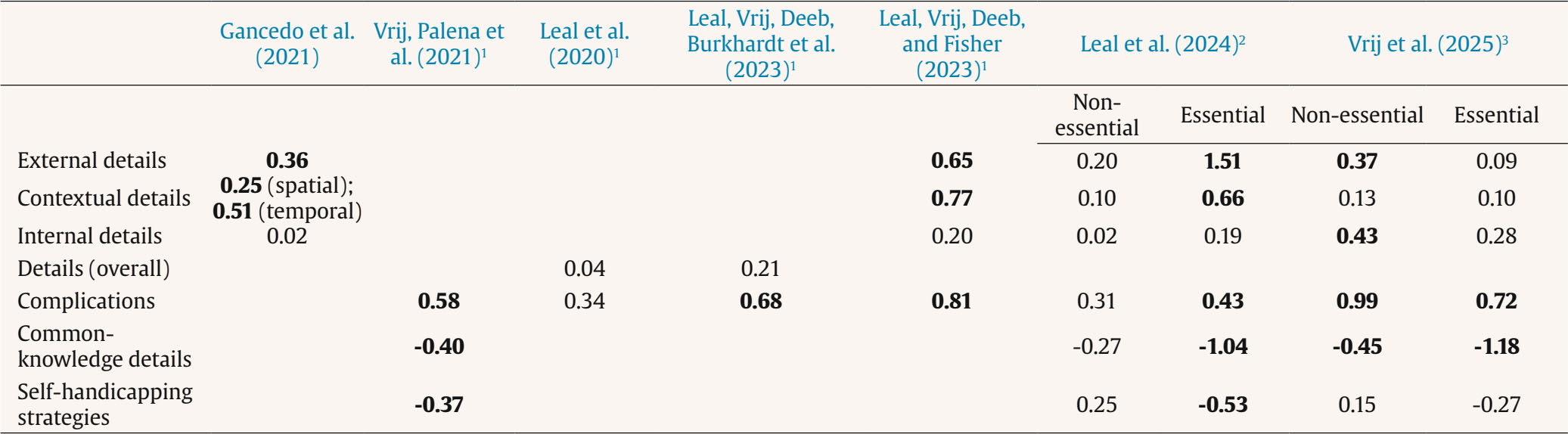 Note. Scores in bold are significant (p < .05). Positive scores mean that truth tellers report the cue more than lie tellers whereas negative scores mean that lie tellers report the cue more than truth tellers. 1Results refer to the free recall stage of the interviews only. 2 All three stages combined. 3 Results for small-omission and large-omission lie tellers combined (not reported in the article). Columns 3 and 7 show the results for the five individual omission lies experiments published to date examining (some of) the six verbal veracity cues. The results are not entirely consistent, but a trend emerges showing that in omission lies scenarios, truth tellers (vs. lie tellers) report more complications and fewer common knowledge details. In their omission lies experiments, Leal et al. (2024) and Vrij et al. (2025) made a distinction between essential and non-essential information. According to their definition, essential information is information about experiences that happened just before and just after the experience lie tellers omit. They labelled this essential information because lie tellers must be careful when reporting those experiences and avoid making slip-ups. Non-essential information is information about the remaining experiences. Since these experiences are not close in time to the omitted experiences, lie tellers could report them without the risk of making any slip-ups. Table 1 shows that the effects for complications and common knowledge details were more pronounced in the essential than the non-essential parts of the statement. It is difficult to compare the embedded lies/fabrications results with the omission lies results because these different types of lie were never examined in a single experiment. As a result, differences could be due to differences between experiments. However, Table 1 shows similarity between the findings for embedded lies/fabrications (columns 1 and 2) and omission lies (columns 3 to 7): Compared to lie tellers, truth tellers report more details and complications and fewer common knowledge details than lie tellers. This suggests that the verbal strategies that affect truth tellers’ and lie tellers’ verbal statements are similar in embedded lies/fabrications and omission lies scenarios. Strategies Strategies refer to tactics truth tellers and lie tellers used to appear convincing in the interview. Examining strategies is relevant because they could possibly explain veracity differences (DePaulo et al., 2003). Our understanding that truth tellers are inclined to tell it all whereas lie tellers prefer to keep their stories simple was derived from strategies research (Granhag & Hartwig, 2008; Hartwig & Granhag, 2023; Hartwig et al., 2007). In research, strategies are measured in two different ways. First, participants are asked via an open- ended question what they have planned to do in the interview to sound convincing or what they did in the interview to sound convincing (Colwell et al. 2006; Hartwig et al., 2010). Alternatively, participants could indicate in a deception strategies questionnaire what they did in the interview to sound convincing (Leal, Vrij, Deeb, & Fisher, 2023). We explored the strategies participants reported to have planned to carry out in the interview and the strategies they said to have carried out during the interview. Hypotheses The experimental design included three Veracity cells: truth tellers, small-omission lie tellers and large-omission lie tellers. We tested the three pre-registered hypotheses (https://osf.io/yp5wj/?view_only=1af70a39a2f94a7eb9feac10539248ed). Hypotheses 1 and 2 are like those tested by Vrij, Leal, Deeb et al. (2025) but Hypothesis 3 is new (the effect of essential and non-essential information was explored but not hypothesised in Vrij et al. 2025). Lie tellers will report in the post-interview questionnaire that they used a ‘keep-it-simple’ strategy more than truth tellers, particularly in the small-omission lie condition (Hypothesis 1). Truth tellers will report the most details (external, contextual and internal) and complications and the fewest common knowledge details and self-handicapping strategies, whereas lie tellers in the small-omission lie condition will report the fewest details (external, contextual and internal) and complications and the most common knowledge details and self-handicapping strategies (Hypothesis 2). The differences between truth tellers and lie tellers in reporting details, complications, common knowledge details and self-handicapping strategies will be more pronounced when describing the essential parts than when describing the non-essential parts of the mission (Hypothesis 3). Participants A G*Power analysis revealed that we needed a minimum of 150 participants to obtain 99% power and a medium effect size (f2 = 0.15). We based the effect choice on previous omission lies deception research (Leal et al., 2020; Leal, Vrij, Deeb, Burkhardt, et al., 2023; Leal, Vrij, Deeb, & Fisher, 2023, 2024; Vrij et al., 2025). We recruited 153 participants. We discarded eight participants for failing to adhere to the instructions (for example, they lost the target person during the mission or did not see an exchange happening). The sample included 145 participants, most of them were females (n = 90); 46 were males, two were non-binary persons and five did not say. The participants were on average M = 21.41 (SD = 4.47) years old. The largest group of participants were British (n = 60), the others were non-British white (n = 18), African (n = 16), Indian (n = 12), other Asian (n = 21), Arab (n = 2), mixed (n = 10) or other (n = 2). Four participants did not say. For most participants (n = 114) A-levels was the highest level of education. For others it was Bachelors (n = 34), Masters (n = 8), O-levels (n = 3) and PhD (n = 2). All procedures performed in studies involving human participants were in accordance with the ethical standards of the institutional [University of Portsmouth Faculty of Science and Health Ethics Committee SHFEC C-2023-084A] and the funding (HIG) research committee (2024-11_714-23) and with the 1964 Helsinki declaration and its later amendments or comparable ethical standards. Informed consent was obtained from all individual participants included in the study. Design Data were analysed with MANOVAs. For the questionnaire variables and deception strategies, Veracity (truth, small-omission lie, large-omission lie) was the only factor. For the verbal veracity cues a 3 Veracity (truth, small-omission lie, large-omission lie) x 2 Saliency (non-essential, essential) MANOVA was carried out. Veracity was a between-subjects factor and Saliency a within-subjects factor. We also report Pearson correlations between the deception strategies and verbal veracity cues. Materials Participants completed a pre- and a post-interview questionnaire. The pre-interview questionnaire measured background characteristics (age, gender, ethnicity, level of education), motivation to perform well during the interview, preparation thoroughness and preparation time. This part of the questionnaire was taken from Vrij et al. (2025). In addition, we asked participants via an open-ended question whether they had prepared a strategy. If they did not, we asked them to justify why not; if they did, we asked them to describe the strategy. The post-interview questionnaire measured (i) the amount of information deliberately not reported, (ii) percentage of truth telling during the interview, perceived likelihood of (iii) having to write a statement, (iv) being entered into the prize draw, (v) winning the prize of the best surveillance officer, and (vi) rapport with the interviewer. It also measured the participants’ self-reported deception strategies via the Deception Strategies Questionnaire (DSQ) (Leal, Vrij, Deeb, & Fisher, 2023). This part of the questionnaire was taken from Vrij et al. (2025). In addition, we asked participants via an open-ended question to report the strategy they have used. Procedure Participants were recruited through the participant pool and university portals. We also emailed those who had taken part in our research before (albeit not in omission lies research) and who volunteered in previous research to take part in future research. We used the same advertisement as Vrij et al. (2025). It was entitled: “Are you following me? Investigating credibility cues when individuals lie or tell the truth about a surveillance mission.” The advertisement mentioned that the study would take 90 minutes to complete and that participants should be 18 years or older with a good grasp of English. It then explained that participants were to follow a target person and that they subsequently had to tell the truth or lie about what they had witnessed. It was mentioned that those who took part in a similar experiment the year before were not allowed to sign up this time. (Nobody who took part in Vrij et al., 2025 participated in the present experiment.) The advertisement also explained that participants had to complete a pre- and post-interview questionnaire; that they would be entered in a ‘most convincing interviewee’ cash draw with three prizes worth £150, £75, and £50 if the interviewer would believe that they were telling the truth; and that they would be entered in a ‘best surveillance officer’ cash draw with three prizes worth £150, £75, and £50 if the target person was not aware to be followed. The advertisement finally mentioned that each participant would receive £15 or 1.5 course credits for taking part. Those who volunteered to take part were emailed at least 24 hours prior to the experiment the participant information sheet and the consent form. On arrival in the laboratory, they were given the opportunity to discuss with the experimenter these two forms. All participants were happy to continue and signed the consent form. The experimenter then introduced the task the participant would have to carry out as follows (identical instructions as used by Vrij et al., 2025): “I would like you to imagine that you are a new surveillance officer for the government. I am about to send you on a mission to follow this target of interest [the experimenter showed picture of confederate]. We know that he usually wears a blue bandana on his wrist and that he goes out for a walk for about 20 minutes at this time of day. As with any surveillance operation, it is very important that you ensure that the target is unaware that you are following him. If the target was not aware that he was followed you will be entered into a draw for ‘best surveillance officer’ whereby you can win prizes worth £150 (first prize), £75 (second prize), or £50 (third prize). You will be interviewed what you have witnessed after completing the mission.” The Surveillance Mission The mission was identical to the mission used by Vrij et al. (2025). The target person left the University building and walked via a square to a cash machine to get money. The target person then went to nearby shopping centre where he met confederate 1 who gave him a package. The target person then walked to a park where he received a phone call nearby a tunnel. Soon after he met confederate 2 to whom he handed the package. The target person then returned to the University building. To add some details to the mission, the target person: (1) walked in one direction, stopped, changed his mind and then walked in the other direction when leaving the University building; (2) bent down to tie his shoelaces at the square; (3) went into a shop in the shopping centre. In addition, the target person frequently looked over his shoulder to check whether he was followed. Veracity Instructions The participants returned to the lab after completing the surveillance mission, where they were told that they would be interviewed by a security official about their mission. Participants were randomly assigned to the truth teller (n = 42), small-omission lie teller (n = 52) and large-omission lie teller (n = 51) conditions (an administrative error caused the relatively smaller cell of truth tellers). “Truth tellers” were asked to truthfully recall everything that they have witnessed. “Lie tellers in the small-omission condition” were told that the interviewer cannot be trusted and may act as a double agent. They were first asked whether they witnessed the target person meeting other people (all lie tellers mentioned to have witnessed the two meetings). They were then told that it is “vital” not to mention having witnessed the target person meeting the person in the park. Participants were further told that the interviewer knows they were on a surveillance mission to follow the target and that they can be truthful about everything else they witnessed during the surveillance task. These instructions to the truth tellers and small-omission lie tellers were identical to those given by Vrij et al. (2025) but the instructions to the “lie tellers in the large-omission condition” were somewhat different. They received the same instruction as the lie tellers in the small-omission condition with two differences: (1) as in Vrij et al. (2025) they were told that it is vital not to mention the target witnessing meeting one person in the shopping centre and another person in the park; (2) in addition to Vrij et al. (2025) they were told not to mention at all that the target even entered the shopping centre, as this could give the alleged double agent clues we do not want them to have. As a result of this manipulation, we considered all information interviewees reported from the target walking from the university building to the shopping centre and from the shopping centre to the park as non-essential information and all information interviewees reported about what happened in the park and shopping centre as essential information. To stress the importance of being convincing, participants in all three conditions were told that they could win three prizes worth £150, £75, and £50 if the interviewer believed they were telling the truth. If the interviewer would not believe them, they had to write a report about the mission instead. Participants were then given as much time as they wished to prepare themselves for the interview. Pre-Interview Questionnaire When participants indicated to be ready to be interviewed, they completed a pre-interview questionnaire. After investigating the background characteristics age, gender, ethnicity, and level of education it measured (1) how motivated they were to perform well during the interview (measured via a single item on a 5-point scale ranging from 1 = not at all motivated to 5 = very motivated); (2) how thorough their preparation for the interview was (measured via three items: 1 = shallow to 7 = thorough, 1 = insufficient to 7 = sufficient, and 1 = poor to 7 = good, Cronbach’s alpha = .92); and (3) what their preparation time was (measured via a single item on a 7-point scale ranging from 1 = insufficient to 7 = sufficient). All these questions were identical to the questions asked by Vrij et al. (2025). In addition, we asked participants about their planned strategies. We first asked: ‘Are you going to use a strategy to be convincing in the interview?’ (yes/no) followed by the open-ended question: ‘If so, please describe this strategy?’ and ‘If not, why not?’ The Interview To obtain a detailed account of the mission we carried out a three stages interview. The same interview protocol was used by Vrij et al. (2025) with one difference: Stages 2 and 3 were swapped. Stage 1 (free recall) was an invitation to report all they had witnessed in as much detail as possible. Stage 2 (sketching while narrating) invited participants to discuss two specific parts of the mission (taking money from the cash machine and what happened after the target received the phone call in the park) while sketching what they could experience at that time. Sketching while narrating often results in new details and complications, particularly from truth tellers (Vrij et al., 2020; Vrij et al. 2025; Vrij et al., 2010). Stage 3 (Model Statement) started by exposing the participants to an audio-recording of a detailed account of an event unrelated to the topic of investigation. We used Leal et al.’s (2015) model statement where someone describes attending a Formula 2 motor race. A model statement typically raises expectations amongst both truth tellers and lie tellers about how much information someone is expected to provide (Ewens et al., 2016; Vrij et al., 2017). It typically leads to a similar number of new details from both truth tellers and lie tellers, but in more complications from truth tellers than from lie tellers (Vrij, Leal, & Fisher, 2018). Appendix A contains a transcript of the interview protocol. Since the order in which the three stages were executed was not manipulated, we cannot draw any conclusions of the efficacy of each stage in eliciting information and veracity cues. For information only, the results for each separate stage are presented in the Appendix B. Post-interview Questionnaire Participants completed a post-interview questionnaire after the interview. First of all it measured the amount of information deliberately omitted via two questions: ‘I deliberately did not report some important details of the mission during the interview’ and ‘I deliberately did not report some details of the mission during the interview that I think were not important’. Both questions were answered on 7-point Likert scales ranging from 1 = disagree to 7 = agree. It further measured (2) the percentage of truth telling during the interview (on an 11-point Likert scale ranging from 0% to 100%); the perceived likelihood of (3) having to write a statement, (4) being entered into the prize draw and (5) winning the prize of the best surveillance officer (all on 7-point Likert scales from 1 = not at all likely to 7 = very likely). We also measured rapport with the interviewer using the nine-item Interaction Questionnaire (Vallano & Schreiber Compo, 2011) where participants rated the interviewer on nine characteristics (e.g., engrossed, involved, active and positive) using 7-point scales ranging from 1 = not at all to 7 = extremely (Cronbach’s alpha = .78). Strategies employed during the interview was measures in two ways: Via a questionnaire and through an open-ended question. Participants first completed the 21 item Deception Strategies Questionnaire (DSQ) (Leal, Vrij, Deeb, & Fisher, 2023) representing the (i) tell it all, (ii) keep it simple and (iii) demeanour strategies (the latter strategy was included because it is a frequently cited strategy amongst both truth tellers and lie tellers (Hartwig et al., 2007). Answers were given on 7-point Likert scales ranging from 1 = strongly disagree to 7 = strongly agree. The “tell it all” strategy consisted of six items including: ‘To recall the event in as much detail as possible’ and ‘To also report details that I remembered but thought were insignificant’. These six items were clustered into the “tell it all” index (Cronbach’s alpha = .68). The “keep it simple” strategy consisted of eight items including: ‘To keep to the point’ and ‘To describe the event in more general terms’. These eight items were clustered into the “keep it simple” index (Cronbach’s alpha = .75). The demeanour strategy consisted of seven items including: ‘To give a statement that sounds plausible (that sounds as the event really could have happened the way I described it)’ and ‘To make the story sound unrehearsed and spontaneous’. These seven items were clustered into the “demeanour” index (Cronbach’s alpha = .78). Strategies were also examined with an open-ended question: ‘Please describe in your own words the strategy you used (if any) to appear convincing during the interview?’ Debrief After completing the post-interview questionnaire, all participants were told that the target person was unaware to be followed and that the interviewer believed them. Therefore, all participants were entered into the two prize draws. The prize winners were randomly chosen after data collection was completed. Participants were finally given details how to receive the £15 participant payment and a debrief form describing the aims of the experiment. Table 2 Questionnaire Variables Results as a Function of Veracity 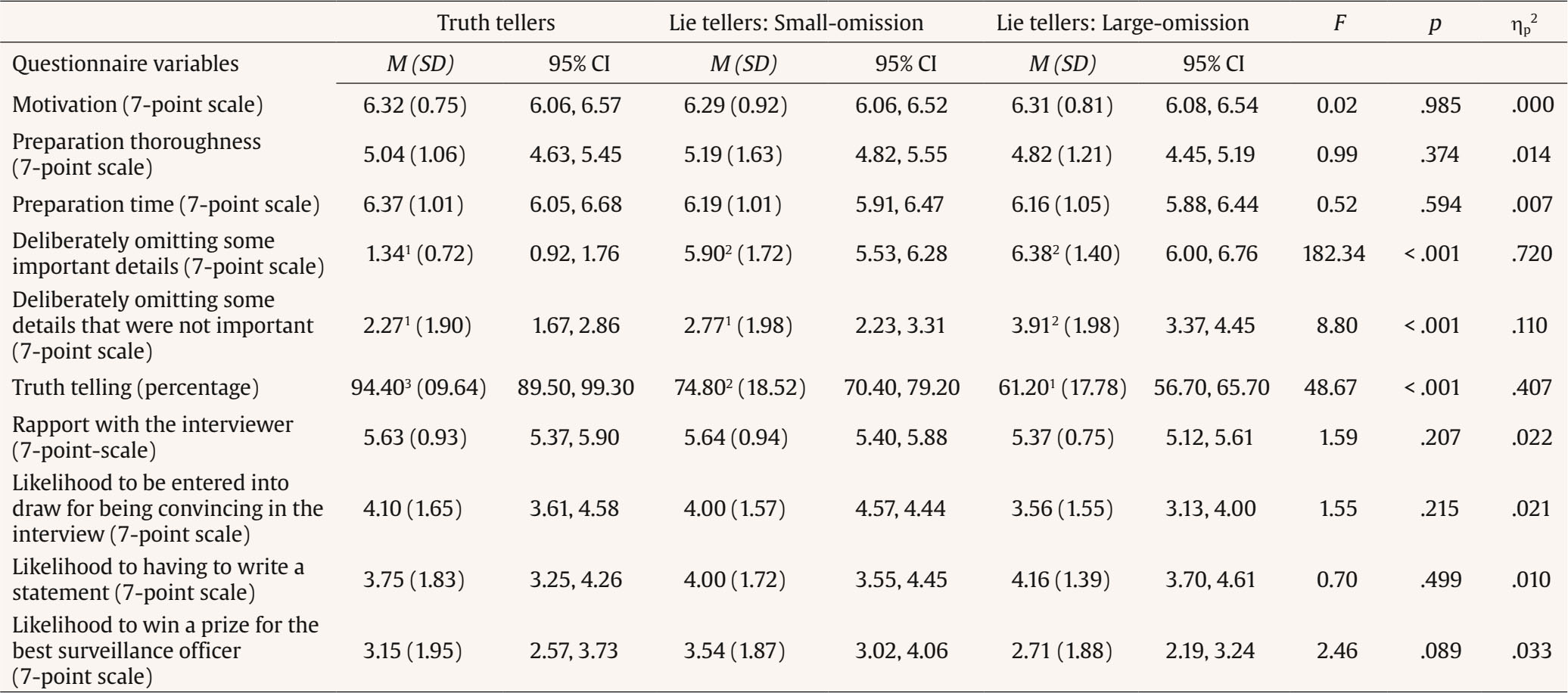 Note. Only mean scores with a different superscript differed significantly (p < .05) from each other. Coding The interview recordings were transcribed, and the transcripts were used for coding. Each detail was coded once; repetitions were ignored both within each interview stage as between the interview stages. Thus, if a detail was mentioned in both Stages 2 and 3, it would be coded only in Stage 2. One rater, blind to the veracity conditions and hypotheses, coded external, contextual and internal details (Bogaard et al., 2019; Leal, Vrij, Deeb, & Fisher, 2023; Leal et al., 2024; Vrij et al., 2025). External details is information about the mission gained from the senses (e.g., describing who, what, and where). The phrase “The target spoke with a man wearing a blue shirt, and black trousers” contains seven external details. “Contextual” details are descriptions of temporal or spatial relationships between objects and/or actors. The sentence “He past the bank, which was on his left and I followed him around the front” contains four contextual details. “Internal” details are details describing the subjective mood of the interviewee. The sentence ”The shop had great discounts. Something was £49 and now just £28. I was really surprised by that” contains one internal detail. A second rater, blind to the veracity conditions and hypotheses, coded the external, contextual and internal details of a random sample of 78 transcripts (54% of the total). Inter-rater reliability between the raters, using the two-way random effects model measuring consistency, was very good for all three verbal cues: external details (single measures ICC = .99), contextual details (single measures ICC = .99), and internal details (single measures ICC = .97). A third rater, blind to the veracity conditions and hypotheses, coded complications, common knowledge details and self-handicapping strategies (Vrij, Leal, Jupe et al., 2018). A complication is a cluster of details describing an occurrence that affects the storyteller and makes a situation more complex. The sentence ”I was afraid he would see me so I was hidden behind a bin but there was a terrible bin smell” contains two complications. The cluster of details are also coded as external, contextual and internal details. Common knowledge details is a cluster of details that refers to strongly invoked stereotypical knowledge about the event. The sentence: “And then he walked into the direction of Victoria Park” contains one common knowledge detail. The cluster of details are also coded as external, contextual, and internal details. Self-handicapping strategies are justifications as to why someone is not able to provide information. The sentence “There was a tree in the way, so I couldn’t see what he was doing” contains one self-handicapping strategy. The cluster of details are also coded as external, contextual, and internal details. A fourth rater, blind to the veracity conditions and hypotheses, coded the complications, common knowledge details and self-handicapping strategies in all 145 transcripts (100% of the total). Inter-rater reliability between the raters, using the two-way random effects model measuring consistency, was good for all three verbal cues: complications (average measures ICC = .94), common knowledge details (average measures ICC = .78) and self-handicapping strategies (average measures ICC = .76). The codings of the two raters were averaged and the averaged codings were used in the analyses. One rater read the open-question responses regarding the strategies the participants said they were going to use (pre-interview questionnaire) and have used (post-interview questionnaire) and put them into categories. A second coder was given these categories and asked to put each of the participants’ responses in these categories. The reliability between the two coders was good for the reasons not to have prepared a strategy (kappa = .90), prepared strategies as measured in the pre-interview questionnaire strategies (kappa = .81) and executed strategies as measured in the post-interview questionnaire strategies (kappa = .75). The disagreements between the raters were resolved by a third rater. Questionnaire Variables A MANOVA was carried out with Veracity (truth, small-omission lie, large-omission lie) as factor and the ten questionnaire variables listed in Table 1 as dependent variables. The multivariate Veracity effect was significant, F(20, 266) = 16.24, p < .001, ηp2 = .55. The Veracity univariate main effects are presented in Table 2. Table 3 Pearson Correlations between the Reported Strategies and Verbal Cues  *p < .05, **p < .01. Table 2 reveals significant effects for deliberately omitting details in the interview and percentage truth telling. Tukey post-hoc tests showed that lie tellers reported to have deliberately omitted more information than truth tellers. This applied to both groups of lie tellers (small-omission lie tellers: d = 3.31 [2.63, 3.88]; large-omission lie tellers: d = 4.37 [3.56, 5.06]), with the difference between the two lie tellers condition not being significant, d = 0.31 (-0.20, 0.69). In addition, large-omission lie tellers reported to have deliberately omitted more details they did not think were important than truth tellers, d = 0.84 (0.40, 1.26) and small-omission lie tellers, d = 0.58 (0.17, 0.96), with the difference between the latter two groups not being significant, d = 0.26 (-0.16, 0.67). Finally, truth tellers reported to have been telling the truth more than lie tellers in both the small, d = 1.29 (0.82, 1.71), and large, d = 2.26 (1.71, 2.75), omission lies conditions. Lie tellers in the small-omission condition reported to have been telling the truth more than lie tellers in the large-omission condition, d = 0.75 (0.34, 0.14). This means that lie tellers considered deliberately omitting information as lying, particularly when the omission was large. The percentages truth telling in the small (M = 74.80, SD = 18.52) and large-omission lies (M = 61.20, SD = 17.78) conditions were both above 50%, which indicates that both groups of lie tellers thought they were largely truthful when telling omission lies. The average mean scores showed that the participants were highly motivated to convince the interviewer that they were telling the truth. They also judged their preparation as thorough thought they had sufficient time to prepare themselves for the interview. Correlations between Strategies and Dependent Variables Table 3 presents the Pearson correlations between the three deception strategies and the “six” verbal cues. The keeping-it-simple strategy had the strongest relationship with the dependent variables. The more participants were inclined to keep their stories simple, the fewer external, contextual and internal details and complications they reported and the more common knowledge details they reported. Only the self-handicapping strategies cue was not correlated with the keeping-it-simple strategy. In addition, the tell-it-all strategy was positively correlated with reporting complications and the paying attention to demeanour strategy was negatively correlated with reporting external, contextual and internal details. Details in the Omission Part Following all the omission-lie experiments carried out to date, we included in the hypotheses-testing part of the analyses only the information all participants could report. We therefore excluded the information interviewees reported about meeting someone in the Park (both small-omission and large-omission tellers were instructed to omit this information) and anything that happened in the shopping centre (large-omission lie tellers were instructed to omit that the target visited the shopping centre). We carried out six between-subjects ANOVAs with the external, contextual and internal details, complications, common knowledge details and self-handicapping strategies truth tellers and small-omission lie tellers did report about these experiences that we excluded in the main analyses. The results are presented in Table 4. Table 4 Univariate Results for the Details Reported by Truth Tellers and Small-Omission Lie Tellers in the Parts Large-Omission Lie Tellers were Instructed to Omit  When describing the experiences lie tellers in the large-omission lie condition were instructed to omit, truth tellers reported more external and contextual details than small-omission lie tellers. This reflects the instruction small-omission lie tellers received to omit some information that truth tellers could report. No difference emerged in reporting internal details, complications, common knowledge details and self-handicapping strategies. Those details were rarely reported when describing the experiences lie tellers in the large-omission lie condition were instructed to omit, and the absence of significant effects could thus be the result of a floor effect. Hypothesis Testing We carried out frequentist analyses and Bayesian analyses to test our hypotheses. Bayesian analyses test the likelihood of the data under both the null hypothesis (H0) and the alternative hypothesis (H1) (Jarosz & Wiley, 2014). A Bayes Factor (BF10) between 1 and 3 indicates weak evidence for H1, between 3 and 20 indicates positive evidence, between 20 and 150 indicates strong evidence, and above 150 indicates very strong evidence for H1(Jarosz & Wiley, 2014). A Bayes factor close to 1 means no evidence can be derived from the data for either H0 or H1. Table 5 Deception Strategy Questionnaire Results as a Function of Veracity  To examine Hypothesis 1, a MANOVA was carried out with Veracity (truth, small-omission lie, large-omission lie) as factor and the three deception strategies as measured with the Deception Strategies Questionnaire presented in Table 5 as dependent variables. The multivariate effect was not significant, F(6, 280) = 1.23, p = .289, ηp2 = .03, neither were any of the univariate effects (see Table 5). Hypothesis 1 was therefore not supported. To examine Hypotheses 2 and 3, a MANOVA was carried out with Veracity (truth, small-omission lie, large-omission lie) and Saliency (non-essential, essential) as factor and the six verbal cues presented in Table 6 as dependent variables. At a multivariate level, significant main effects emerged for both Veracity, F(12, 274) = 5.31, p < .001, ηp2 = .19 and Saliency, F(6, 137) = 69.29, p < .001, ηp2 = .75. The multivariate Veracity x Saliency interaction effect was marginally significant, F(12, 274) = 1.74, p = .058, ηp2 = .07. The Saliency main effect is not interesting and will not be discussed. The univariate Veracity main effect results are presented in Table 6. In these univariate tests we made a Bonferroni correction for multiple comparisons and only p-values less .008 (.05/6) were treated as significant. The common knowledge details effect was significant with very strong evidence according to the Bayes factors analysis. Table 6 Univariate results for the Verbal Cues as a Function of Veracity 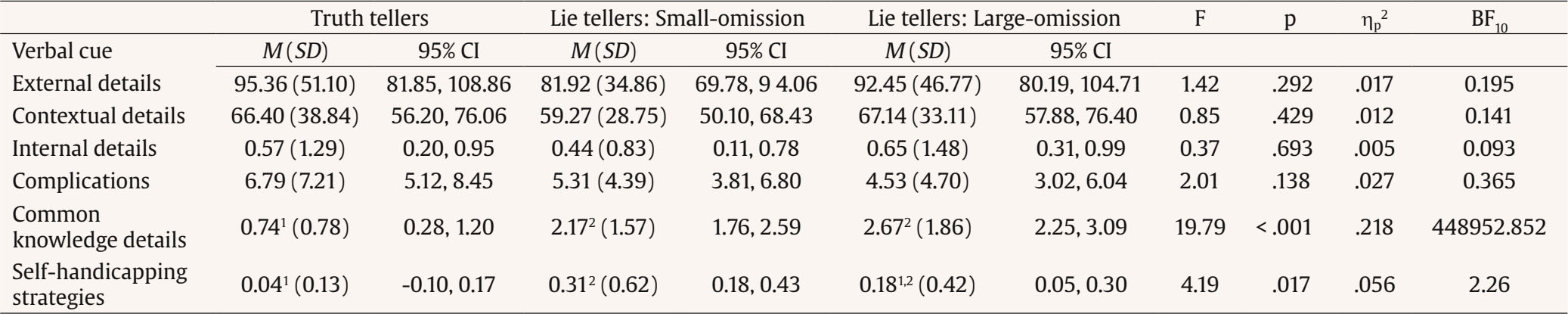 Note. Only mean scores with a different superscript differed significantly (p < .05) from each other. Regarding common knowledge details, Tukey posthoc tests showed that truth tellers reported fewer common knowledge details than both the small-omission (p <.001, d = 1.12 [0.66, 1.54], BF10 = 39430.394) and large-omission lie tellers (p < .001, d = 1.30 [0.83, 1.73], BF10 = 1.525 x 10⁶). Both significant effects have very strong evidence according to the Bayes Factor analyses. The two groups of lie tellers did not differ from each other (p = .225, d = 0.28 [-0.11, 0.67], BF10 = 0.724). These results show only limited support for Hypothesis 2. To further analyse the marginally significant Veracity x Saliency interaction effect, ANOVAs were carried out with Veracity (truth, small-omission lie, large-omission lie) as factor and the six verbal cues reported in Table 7 as dependent variables. One analysis included the non-essential information and the other analysis the essential information. Table 7 (top) shows that in the “non-essential information analysis” the common knowledge details effect was significant with very strong evidence according to the Bayes factor analyses. Tukey posthoc tests showed that truth tellers reported fewer common knowledge details than both the small-omission (p = .040, d = 0.65 [0.22, 1.06], BF10 = 20.98) and large-omission lie tellers (p < .001, d = 1.02 [0.57, 1.43], BF10 = 7093.168) but only the truth tellers – large omission lie tellers comparison was significant after the Bonferroni correction. There was strong evidence for this effect according to the Bayes factor analyses. The small-omission lie tellers reported fewer common knowledge details than the large-omission lie tellers (p = 0.027, d = 0.44 [0.04, 0.83], BF10 = 3.104) but the difference was not significant after the Bonferroni correction. Table 7 Univariate results for the Verbal Cues as a Function of Veracity for Non-Essential and Essential Details Separately 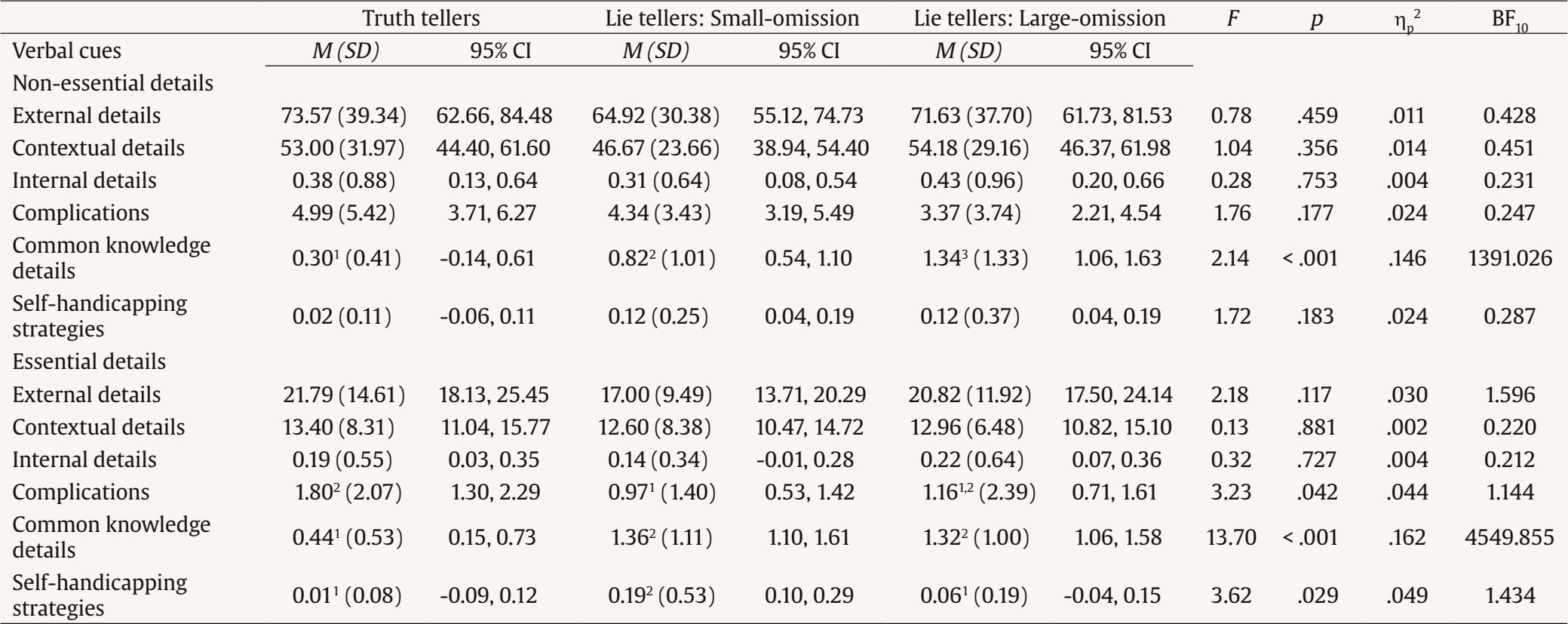 Note. Only mean scores with a different superscript differed significantly (p < .05) from each other. Table 7 (bottom) shows that in the “essential information analysis” the effects for complications, common knowledge details and self-handicapping strategies were all significant, but the Bayes Factor analysis only shows sufficient evidence for the common knowledge details effect. Tukey posthoc tests showed that truth tellers reported fewer common knowledge details than both the small-omission (p <.001, d = 1.02 [0.58, 1.44], BF10 = 4169.583) and large-omission lie tellers (p < .001, d = 1.07 [0.62, 1.49], BF10 = 13679.905) with very strong evidence according to the Bayes Factor analyses. The two groups of lie tellers did not differ significantly from each other (p = .983, d = 0.04 [-0.35, 0.42], BF10 = 4.879). Hypothesis 3 predicted that the significant effects would be more pronounced in the essential than non-essential information analyses. There is only very weak evidence for this, so Hypothesis 3 is rejected. Strategy-related Responses to the Open-Ended Questions The most popular reason both groups of lie tellers reported for not having prepared themselves for the interview was that they preferred to be spontaneous during the interview. The most frequently mentioned reason amongst truth tellers was that they did not need a strategy because they were going to be truthful in the interview. The most popular strategy both groups of lie tellers said to have prepared for the interview was to tell an omission lie. Since this is what lie tellers were instructed to do, it could be considered more a manipulation check than a strategy. Two real strategies were popular amongst both groups of lie tellers: The intentions to control their body language and to be detailed. Those were also the most popular strategies amongst truth tellers (particularly the intention to be detailed). Regarding the strategies participants reported to have executed in the interview, three of them were particularly popular amongst lie tellers: be truthful, be detailed and paying attention to body language (omitting information was the instruction, so not a strategy). The difference between both groups of lie tellers regarding these three strategies were marginal. For truth tellers the most popular strategy was to be detailed (to be truthful was the instruction they received). The open-ended responses did not support Hypothesis 1 either (that lie tellers -and particularly those in the small-omission lie condition, will report to have used a ‘keep-it-simple’ strategy more than truth tellers). In the present experiment, lie tellers lied by omitting information. Yet, the information they could report truthfully gave away that they lied. Replicating previous omission lies research we found that lie tellers reported more common knowledge details than truth tellers. The veracity differences, however, were less pronounced than in all other omission lies experiments (see Table 1), including Vrij et al. (2025), which the present experiment closely resembled. This could be the result of our manipulation. To create differences between small- and large omission-lies we created a very large omission lie. The result was that the part of the mission we focused on in the analyses (the parts all three groups of participants discussed truthfully) was quite short, and the shorter the experiences the less chance for verbal veracity cues to occur (Vrij et al., 2007). We created a large omission lie because Vrij et al. (2025) failed to find differences in verbal veracity cues between their small- and large-omission lies conditions and suggested that the large-omission lie was not large enough. Although we increased the difference in the amount of information we instructed small-omission and large-omission lie tellers to omit compared to Vrij et al. (2025), we again failed to find differences between the two types of lies. Creating a successful ‘omission lie size’ manipulation appears to be difficult. In the present experiment, large-omission lie tellers reported to have omitted many details (as we were hoping to achieve) but so did small-omission lie tellers with no difference between the two groups of lie tellers (Table 2). The only differences between the two groups of lie tellers was that, compared to small-lie omission lie tellers, the large-omission lie tellers reported to have left out more details they did not consider important and reported a lower percentage of truth telling. However, the two groups of lie tellers reported to have been largely truthful with the difference in percentage truth telling between large-omission lie tellers (61.20%) and small-omission lie tellers (74.80%) being rather small (Table 2). We could turn the question upside down: How small can an omission be to yield veracity differences? This is an empirical question that deserves attention in future research. It is an important question because we could assume that lie tellers would like to keep the omission as small as possible. As Table 2 shows, the smaller the omission, the more truthful lie tellers reported to have been and lie tellers prefer to be as truthful as possible (Leins et al., 2013). To date perhaps the smallest omission was introduced in Leal et al. (2004). We can determine the omission size in experiments by calculating how much information truth tellers reported about the event lie tellers were instructed to omit. In Leal et al. (2004), on average 20% of the truth tellers’ statements covered the part of the event lie tellers were instructed to omit. Despite the omission to be relatively small in Leal et al. (2004), the experiment revealed substantial veracity differences (see Table 1). The different strategies truth tellers and lie tellers reported to have used could explain these findings, as lie tellers were more inclined than truth tellers to keep their statement simple. Future research could make the omission size even smaller. We predicted lie tellers to be more inclined to keep their stories simple than truth tellers. Although this was found in previous experiments (Leal, Vrij, Deeb, Buckhardt, et al., 2023; Leal, Vrij, Deeb, & Fisher, 2023; Vrij et al., 2025), we did not find this in the present experiment. We did, however, find the expected correlations between the keep-it-simple strategy and the verbal cues we examined (Table 3). That is, the more inclined participants were to keep their stories simple, the fewer details and complications and the more common knowledge details they reported. Since we failed to find a veracity effect for the keep-it-simple strategy, we cannot conclude that the obtained common knowledge veracity effect was caused by this strategy. Instead, the effect could have been caused by another difference in strategies: lie tellers were more inclined to pay attention to their demeanour than truth tellers (Table 8). Although paying attention to demeanour was not directly correlated with common knowledge details there was an indirect relationship. Paying attention to demeanour was negatively correlated with reporting details (Table 3) and additional analyses showed that reporting common knowledge details was negatively correlated with reporting external details (r = -.39, p < .001) and contextual details (r = -.35, p < .001). People cannot pay attention to demeanour and speech content at the same time (Patterson, 1995, 2006) and the negative correlations between paying attention to demeanour and reporting details (Table 3) may reflect this. The finding that lie tellers focus more on their demeanour than truth tellers could be good news for practitioners who focus on speech content. If paying attention to someone’s own demeanour means that people neglect their speech, it could facilitate verbal lie detection. Table 8 Open-Ended Strategies Responses as a Function of Veracity 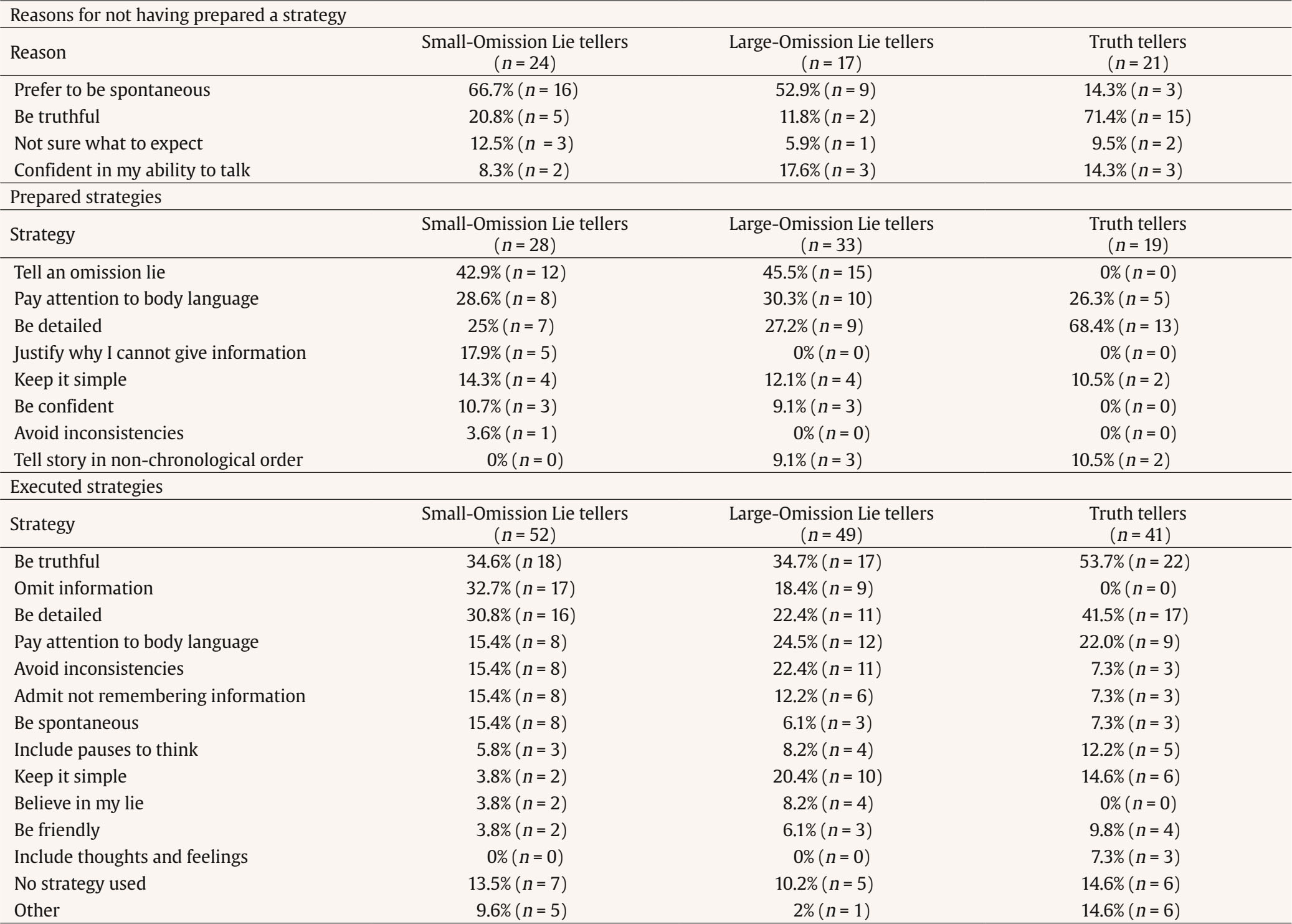 Although previous experiments showed more pronounced differences between truth tellers and lie tellers in the essential than in the non-essential parts of a statement (Leal et al., 2024; Vrij et al., 2025), we did not replicate this finding. The same explanation for the absence of veracity effects could be valid here: perhaps the parts we used to compare truth tellers’ and lie tellers’ statements were not substantial enough to yield an effect. Despite the lack of support for our hypotheses, the experiment advantaged our knowledge in different ways. First, it is proven difficult to manipulate the size of an omission. Although in the present experiment the difference between the small and large omission was objectively large, lie tellers did not perceive it as such. This could mean that omission size is not a concept that lie tellers recognise. And this suggest that omission size does not matter and does not affect lie tellers’ responses. Second, although previous omission lie experiments focused on details and complications, the present experiment and Leal et al. (2024) and Vrij et al. (2025) suggest that common knowledge details are also important to consider. Third, although the present experiment and previous omission lies experiments focused on the keep-it-simple strategy to predict and explain veracity differences an alternative strategy to consider is that lie tellers are inclined to pay more attention to their demeanour than truth tellers. Conflict of Interest The authors of this article declare no conflict of interest. Cite this article as: Vrij, A., Leal, S., Deeb, H., Giorgianni, D., & Fisher, R. P. (2026). Verbal indicators of omission lies: The effect of omission size and narrative part significance on verbal veracity cues. European Journal of Psychology Applied to Legal Context, 18, Article e260179. https://doi.org/10.5093/ejpalc2026a4 Funding: This work was supported by the High-Value Detainee Interrogation Group [Grant number 15F06723P0002341]. The funding body had no other involvement in the research than providing financial support. Any opinions, findings, conclusions, or recommendations expressed in this article are those of the authors and do not necessarily reflect the views of the U.S. Government. REFERENCES Appendix A The Interview Protocol I understand that you have been on a surveillance mission today to follow a target that is of interest to us. In this interview I will ask you questions about that mission. Depending on your answers, we may decide to interview you a second time. Q1. Please tell me in as much detail as possible everything you witnessed from the moment you left this building to the moment you came back. Q2. Thank you for that, what I would like to do now is to focus in on a specific part of your mission. We are aware from our mobile phone technical team that the target received a phone call whilst in Victoria Park. Therefore, this time I would like you to go back in your memory to the moment the target received a telephone call in Victoria Park. Please think about that particular moment -think about what you could see, what you could hear, what you could feel and what you could smell, and let me know when you are back in that moment? (Once participant says they are there say) Now please draw for me what you could see at that moment and whilst doing so, talk me through everything you experienced. If the person says they cannot draw well, reassure them that drawing ability does not matter. Also, if they stop talking whilst drawing remind them to keep narrating whilst drawing. If the participant denies witnessing the telephone call, then just say “ok in that case please think about the moment you first saw him in Victoria Park). Q3. Thank you for that, what I would like to do now is to again focus in on a different specific part of your mission. We are also aware that the target withdrew money from a cash machine. Therefore, this time I would like you to go back in your memory to the moment the target withdrew money from a cash machine. Please think about that particular moment -think about what you could see, what you could hear, what you could feel and what you could smell, and let me know when you are back in that moment? (Once participant says they are there say) Now please draw for me what you could see at that moment and whilst doing so, talk me through everything you experienced. If the person says they cannot draw well, reassure them that drawing ability does not matter. Also, if they stop talking whilst drawing remind them to keep narrating whilst drawing. (If the participant denies witnessing the target withdrawing money from a cash machine, then just say ‘OK, please draw what you could see when you saw him near the bank’). Thank you for that, I would now like you to tell me the entire mission from start to finish again, but this time, before doing so I would like to play you an audio clip which serves as an example of how many details I would like you to include in your response. The example I will play is a so called ‘Model Statement’ as it gives you an idea of a detailed response to a question. After listening to the example, I will ask you again about what happened during your mission, and would like you to be that detailed in your response ok? Play Model Statement and then say: Q4. Bearing in mind the amount of detail you heard in that clip, please tell me once more everything that happened from the moment you left the building till the moment you returned? Thank you, that is the end of my questions, thank you. Now please return to the experimenter. Questions 2 and 3 were counterbalanced. Appendix BSupplementary Materials Two findings are worth mentioning. First, truth tellers reported fewer common knowledge details than lie tellers in the free recall and sketching while narrating stages of the interview only (the effect for the model statement stage of the interview was no longer significant after the Bonferroni correction). Second, the model statement elicited more information than the sketches instruction, despite the model statement stage of the interview being carried out after the sketching while narrating stage. For common knowledge details in the free recall, Tukey posthoc tests showed that truth tellers reported fewer common knowledge details than both the small-omission (p < .001, d = 0.96 [0.49, 1.34], BF10 = 5.764 x 10⁴) and large-omission lie tellers (p < .001, d = 1.12 [0.66, 1.54], BF10 = 69109.738). There is very strong evidence for both effects according to the Bayes Factor analyses. The two groups of lie tellers did not differ significantly from each other (p = .480, d = 0.21 [-0.18, 0.59], BF10 = 0.430). For common knowledge details in the sketches while narrating stage of the interview, Tukey posthoc tests showed that truth tellers reported fewer common knowledge details than both the small-omission (p = .019, d = 0.63[ 0.21, 1.04], BF10 = 10.61) and large-omission lie tellers (p = .004, d = 0.77 [0.34, 1.18], BF10 = 116.23), but only the large-omission lie – truth tellers effect is significant after a Bonferroni Table B1 Univariate Results for the Verbal Cues as a Function of Veracity for Free Recall, Model Statement and Sketches Separately 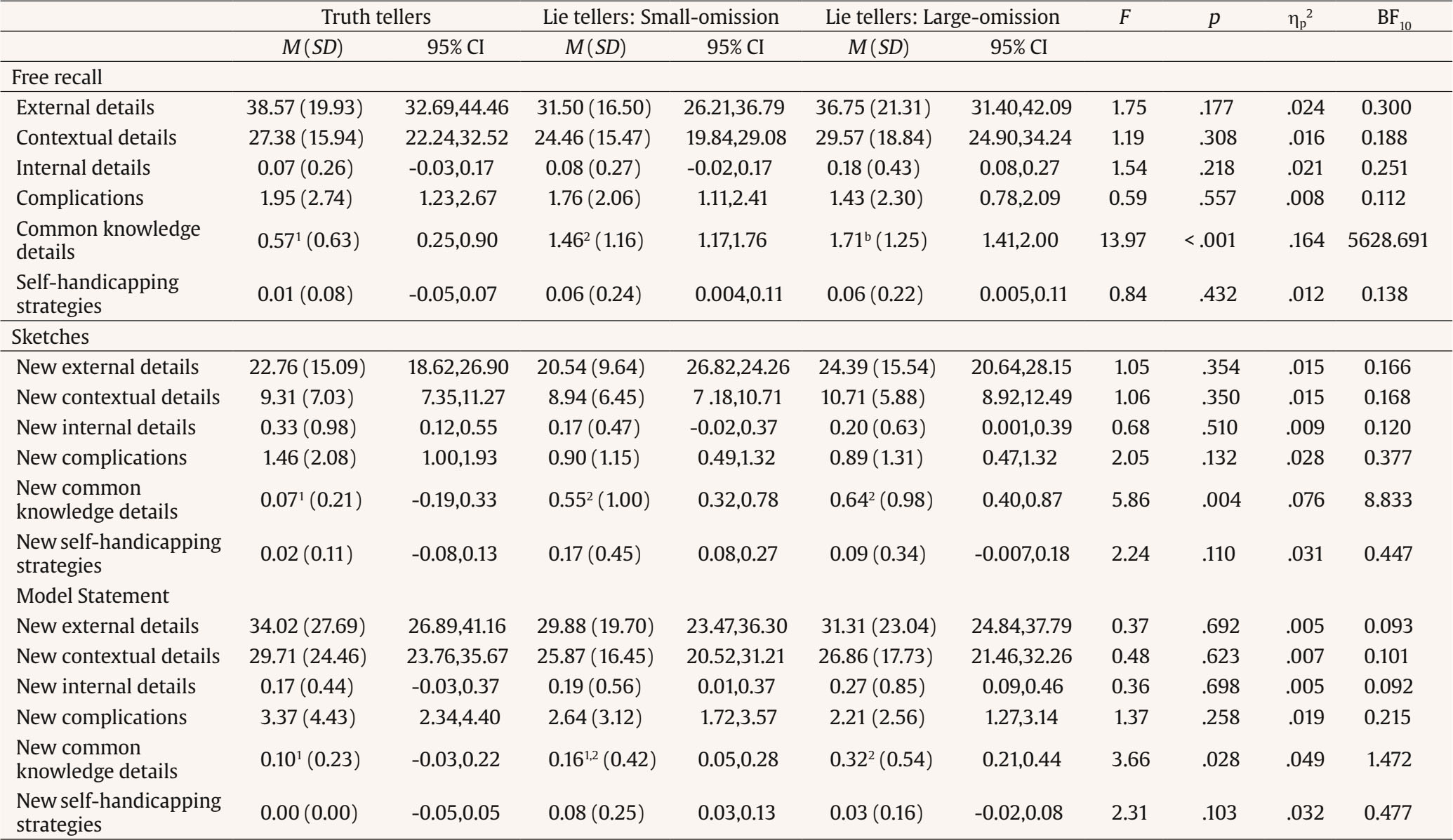 Note. Only mean scores with a different superscript differed significantly (p < .05) from each other. Two findings are worth mentioning. First, truth tellers reported fewer common knowledge details than lie tellers in the free recall and sketching while narrating stages of the interview only (the effect for the model statement stage of the interview was no longer significant after the Bonferroni correction). Second, the model statement elicited more information than the sketches instruction, despite the model statement stage of the interview being carried out after the sketching while narrating stage. For common knowledge details in the free recall, Tukey posthoc tests showed that truth tellers reported fewer common knowledge details than both the small-omission (p < .001, d = 0.96 [0.49, 1.34], BF10 = 5.764 x 10⁴) and large-omission lie tellers (p < .001, d = 1.12 [0.66, 1.54], BF10 = 69109.738). There is very strong evidence for both effects according to the Bayes Factor analyses. The two groups of lie tellers did not differ significantly from each other (p = .480, W = 0.21 [-0.18, 0.59], BF10 = 0.430). For common knowledge details in the sketches while narrating stage of the interview, Tukey posthoc tests showed that truth tellers reported fewer common knowledge details than both the small-omission (p = .019, d = 0.63[ 0.21, 1.04], BF10 = 10.61) and large-omission lie tellers (p = .004, d = 0.77 [0.34, 1.18], BF10 = 116.23), but only the large-omission lie – truth tellers effect is significant after a Bonferroni correction. There is very strong evidence for this effect according to the Bayes Factor analyses. The two groups of lie tellers did not differ significantly from each other (p = .853, d = 0.09 [-0.30, 0.48], BF10 = 0.241). |
Cite this article as: Vrij, A., Leal, S., Deeb, H., Giorgianni, D., & Fisher, R. P. (2026). Verbal Indicators of Omission Lies: The Effect of Omission Size and Narrative Part Significance on Verbal Veracity Cues. The European Journal of Psychology Applied to Legal Context, 18, Article e260179. https://doi.org/10.5093/ejpalc2026a4
Correspondence: aldert.vrij@port.ac.uk (A. Vrij).Copyright © 2026. Colegio Oficial de la Psicología de Madrid


 PDF
PDF e-PUB
e-PUB CrossRef
 JATS
JATS Print
Print Send
SendEMAIL ALERT
The European Journal of Psychology Applied to Legal Context is licensed under a Creative Commons Attribution-NonCommercial-NoDerivatives 4.0 International License