Psychometric Properties of the RS-14 Resilience Scale in Victims of Armed Conflict and Forced Displacement
[Las propiedades psicométricas de la Escala de Resiliencia RS-14 en víctimas de conflicto armado y desplazamiento forzado]
Marly J. Bahamón1, José J. Javela2, Ana M. Trejos-Herrera3, Mavenka Cuesta-Guzmán4, Andrea Ortega-Bechara5, Orlando González-Gutierrez6, & Milgen Sánchez-Villegas4
1Universidad Manuela Beltrán, Bogotá, Colombia; 2Universidad Militar Nueva Granada, Colombia; 3Universidad del Norte, Colombia; 4Universidad Simón Bolívar, Facultad de Ciencias Jurídicas y Sociales, Centro de Investigación e Innovación Social José Consuegra Higgins, Barranquilla, Colombia; 5Universidad de Sinú, Colombia; 6Universidad Simón Bolívar, Facultad de Ciencias Jurídicas y Sociales, Centro de Investigación en Estudios Fronterizos, Cúcuta, Colombia
https://doi.org/10.5093/clh2026a13
Received 9 June 2024, Accepted 30 December 2025
Abstract
This study evaluated the psychometric properties of the RS-14 Resilience Scale in Colombian victims of armed conflict and forced displacement. A confirmatory factor analysis (CFA) using diagonally weighted least squares estimation was conducted on a sample of 613 victims of violence aged 18 to 65 years. The results indicated high levels of resilience (M = 78.40) and showed that, after removing items 5, 7, and 10, the unidimensional model (Model 5), controlling for age and sex, demonstrated a significantly better fit compared to the other models (CFI = .89, IFI = .89, GFI = .98, AGFI = .98, RNI = .89, RMSEA = .08, SRMR = .04). The refined model also showed high internal consistency (α = .87, ω = .87). These findings suggest that the RS-14, under an adjusted unidimensional structure, is a valid and reliable instrument for assessing resilience in populations exposed to prolonged violence and extreme trauma.
Resumen
Este estudio evaluó las propiedades psicométricas de la Escala de Resiliencia RS-14 en víctimas colombianas del conflicto armado y desplazamiento forzado. Se realizó un análisis factorial confirmatorio (AFC) mediante estimación de mínimos cuadrados ponderados diagonalmente en una muestra de 613 víctimas de violencia de 18 a 65 años. Los resultados muestran un nivel elevado de resiliencia (M = 78.40) y que después de eliminar los ítems 5, 7 y 10 el modelo unidimensional (Modelo 5), controlado por edad y sexo, tenía un ajuste significativamente mejor en comparación con los otros modelos (CFI = .89, IFI = .89, GFI = .98, AGFI = .98, RNI = .89, RMSEA = .08, SRMR = .04). El modelo refinado también mostró una gran consistencia interna (α = .87; ω = .87). Estos resultados indican que la RS-14, con una estructura unidimensional ajustada, es un instrumento válido y fiable para evaluar la resiliencia en poblaciones expuestas a violencia prolongada y trauma extremo.
Palabras clave
Resiliencia, Salud mental, Víctimas de conflictos armados, Desplazamiento forzado, PsicometríaKeywords
Resilience, Mental health, Victims of armed conflict, Forced displacement, PsychometricsCite this article as: Bahamón, M. J., Javela, J. J., Trejos-Herrera, A. M., Cuesta-Guzmán, M., Ortega-Bechara, A., González-Gutierrez, O., & Sánchez-Villegas, M. (2026). Psychometric Properties of the RS-14 Resilience Scale in Victims of Armed Conflict and Forced Displacement. Clinical and Health, 37, Article e260727. https://doi.org/10.5093/clh2026a13
Correspondence: marly.bahamon@docentes.umb.edu.co (M. J. Bahamón).Approach to the Concept of Resilience Resilience is defined as the ability of humans to overcome difficult situations and continue with their lives after experiencing adversity, helping individuals preserve their emotional well-being and proper psychological functioning (Trejos-Herrera et al., 2023). Due to its nature, the study of resilience involves recognizing the close relationship between biological, psychological, social, and cultural factors that determine human responses to stress. Consequently, resilience is also defined as a set of stable personality traits, a dynamic process, or a positive outcome that allows individuals to cope with trauma (Masten et al., 2021). In general, resilience has been understood as a universal human capacity to face adversity and has been analyzed from two theoretical models: as a set of components and as a process. From the first perspective, resilience is seen as a skill composed of the “ability to protect oneself under pressure” and the “ability to build a positive life despite adversity.” From the second theoretical perspective, resilience is assumed to be a process that involves social and intrapsychic aspects to confront adversity (Park et al., 2021). Recent studies have shown that this capacity can be developed over time through various coping strategies that enable individuals to effectively overcome crises (Sutherland et al., 2020). Resilience, Self-Esteem, and Time Orientation Resilience, self-esteem, and time orientation are three psychological constructs that play a crucial role in individuals’ well-being, particularly in their ability to adapt and overcome adversity (Newman et al., 2014; Scaffidi Abbate et al., 2024). On one hand, self-esteem refers to a person’s subjective assessment of themselves. A healthy level of self-esteem is fundamental for developing a positive outlook on life, which allows individuals to effectively face challenges. Research has shown that people with high self-esteem tend to exhibit higher levels of resilience, as their self-confidence and sense of personal competence provide them with internal resources to cope with adversity (Alsarrani et al., 2022; Orth & Robins, 2022; Scaffidi Abbate et al., 2024) On the other hand, time orientation, defined as the perception individuals have of time (whether past, present, or future), also directly influences their resilience. People who adopt a future-oriented perspective tend to be more resilient, as they plan and anticipate their actions based on long-term goals, motivating them to face challenges with a growth and improvement mindset. In contrast, those who focus on the present, particularly with a hedonistic view, may prioritize immediate gratification, which can hinder their ability to confront adverse situations constructively (Altan-Atalay et al., 2020; Garcia et al., 2016). Zimbardo and Boyd’s (cited by García et al., 2016) model involves five time dimensions: (1) positive past, reflecting a nostalgic and favorable attitude toward the past, associated with high self-esteem and happiness; (2) negative past, which implies a predominantly negative view of the past and is linked to depression, low self-esteem, anxiety, sadness, and aggression; (3) hedonistic present, characterized by an attitude centered on pleasure and enjoyment of the moment without worrying about the future, associated with low need for predictability, poor impulse control, and a tendency to seek new experiences; (4) fatalistic present, which expresses a fatalistic, hopeless, and helpless stance toward the future and life in general, associated with aggression, anxiety, and depression; and (5) future, which refers to an orientation toward planning and achieving future goals, with the ability to postpone immediate gratification to achieve long-term objectives (Garcia et al., 2016). Together, resilience, self-esteem, and time orientation are interrelated components that not only influence how people handle stress and difficulties but also contribute to their overall well-being. Resilience allows individuals to stand firm in the face of challenges, self-esteem helps them maintain a positive self-perception during these times, and time orientation enables them to make decisions that favor their well-being both in the short and long term (Altan-Atalay et al., 2020; Hill et al., 2018). Moreover, time orientation can also influence how individuals perceive their self-esteem and resilience over time. Those with a future orientation, by planning and visualizing their progress, may experience higher self-esteem, as they view their efforts and achievements as important steps toward their long-term goals. This perspective provides them with motivation and perseverance in the face of obstacles. In contrast, individuals trapped in a fatalistic present orientation, believing that destiny or external circumstances are immutable, may show lower levels of resilience and self-esteem, as they perceive themselves as lacking control over their lives and decisions, negatively affecting their well-being and mental health (Long & Bonanno, 2020; McKay et al., 2018). The relationship between these constructs is key to psychological well-being. Resilience, by strengthening an individual’s capacity to overcome challenges, acts as a buffer against stress, anxiety, and other mental health issues. At the same time, positive self-esteem provides the confidence necessary to face difficulties without losing sight of one’s personal worth. This, in turn, is influenced by time orientation, as those who focus on the future are more likely to engage in self-care behaviors and health protection, given the perception that their current actions will affect their long-term well-being (Fisher et al., 2019). Resilience in War Victims and Refugees The study of resilience in war victims and refugees has gained relevance in research due to the extreme adversities faced by this population. Reports on this variable in conflict and post-conflict contexts highlight the role of multiple factors, including individual, social, and cultural dimensions. For instance, in Southeast Europe, specifically in Kosovo, resilience has been found to be influenced by cultural factors and social ecologies. Social support, a sense of purpose, and family solidarity emerge as key strengths that promote resilience in these collectivist societies. A similar situation has been observed in war victims in Ukraine, where maintaining communication with loved ones and receiving support from helpers and hosts were crucial factors in building resilience (Kelmendi & Hamby, 2023; Oviedo et al., 2022). Another important aspect in this population is polyvictimization, or exposure to multiple forms of violence, which has a negative impact on mental health. Resilience can play a mediating role in this relationship. Data from the population in Ethiopia show that polyvictimization is associated with poorer mental health, particularly among women (Miller et al., 2023). Contrary to what has been stated, one of the major risk factors for mental health in this population is polyvictimization, or exposure to multiple forms of violence, and in this regard resilience has shown an important mediating role between these variables, particularly among women as identified in Ethiopia (Miller et al., 2023). In addition to the above, refugees often have to confront overwhelming challenges due to forced displacement, including strategies for promoting their resilience that are less visible to health professionals, such as distraction activities or unconventional coping mechanisms (Renkens et al., 2022). Similarly to victims who have not been forcibly displaced from their territories, refugees exhibit social connections and emotional support as fundamental mechanisms that facilitate adaptation and well-being in their resettlement contexts, which suggests that resilience is a multidimensional process involving individual, social, and cultural factors, especially in contexts of extreme adversity such as war and forced displacement (Gebresilassie et al., 2022; Nurius et al., 2020; Oviedo et al., 2022). Studies on the Psychometric Properties of the RS-14 Over time, various tools have been developed to assess the factors inherent to resilience from different approaches. Some of these measures focus on evaluating the specific characteristics of resilience (Bartone, 2007), while others concentrate on the availability of resources and protective factors that help maintain or restore mental health, even in the face of significant adverse experiences (Connor & Davidson, 2003). In line with this, the Resilience Scale RS-14 (Wagnild & Young, 1993) was developed to assess the degree of individual psychological resilience through two factors: 1) Personal Competence and 2) Acceptance of Self and Life. This instrument, which initially contained 25 items, has been proven useful in various contexts after several revisions (Abiola & Udofia, 2011; Madewell et al., 2016; Wagnild & Young, 1993). The use of this scale has enabled the exploration of the relationship between resilience and various psychological aspects, such as self-esteem, depression, and life satisfaction (Laird et al., 2019; Martínez-Martí & Ruch, 2016; Wagnild, 2009; Wagnild & Collins, 2009), as well as general mental health across different population groups (Färber & Rosendahl, 2020; Linnemann et al., 2020; Zelviene et al., 2021). Subsequently, the authors revised the original scale to address limitations related to readability and ease of scoring, developing an abbreviated 14-item version, applicable to both adolescents and adults (Pritzker & Minter, 2014; Wagnild & Collins, 2009). Over the last decade, this instrument has been evaluated and revised in different contexts, identifying acceptable validity and reliability indices for its use in various populations. For example, in France, a unidimensional factorial solution was identified, with good fit and high internal consistency. Additionally, positive correlations were found with CYRM and SSQ scores, and a negative correlation was observed with psychological distress (Cénat et al., 2013, 2018). In a sample of university students in China, the unidimensional model of the RS-14 was tested, yielding acceptable fit indices such as χ²/df = 301.50/77 ≈ 3.91, p < .001, CFI = .92, TLI = .91, RMSEA = .07, CI [.07, .08], and SRMR = .040. The reliability indices were also satisfactory, with a general coefficient of .91 (Chen et al., 2020) resilience has received extensive attention in psychology. The 14-Item Resilience Scale (RS-14). In Italy, the RS-14 was evaluated in adults over the age of 18, showing that the total variance explained by the extracted factors was 50.67%, with 26.23% corresponding to Factor 1 and 24.44% to Factor 2. The correlation between the two factors was rho = .05 (p = .45). Cronbach’s alpha was .83 for Factor 1 and .82 for Factor 2, indicating acceptable internal consistency. Moreover, both factors significantly impacted the mental health of the evaluated individuals (Cuoco et al., 2022). In Greece, the psychometric properties of the instrument were analyzed in adults with chronic illnesses. Exploratory factor analyses showed Kaiser-Meyer-Olkin indices above .83, and all Bartlett’s tests of sphericity were significant (χ² = 2660.50, df = 91, p < .001). The reliability index was .89, and convergent validity was demonstrated through significant correlations with depressive symptoms, suicide risk, and reduced quality of life (Ntountoulaki et al., 2017). In vulnerable populations, studies on the psychometric properties of the RS-14 are more limited. In Poland, the instrument was validated in adolescents and young adults with special needs, showing a good fit of the factorial structure and adequate reliability indices for both populations (Surzykiewicz et al., 2019). In a population of cancer survivors, the RS-14 demonstrated excellent internal consistency (α = .91 to .96) and good test-retest reliability (ICC = .89). Significant correlations were found between resilience and levels of anxiety and depression (Miroševi et al., 2023). In Kenya, the RS-14 was validated in a population of orphaned and separated adolescents, showing good internal consistency (α = .90). The scale also correlated positively with social support and negatively with depression in individuals under the age of 18 (Sutherland et al., 2020). Assessment of Resilience in Spanish Moreover, the Spanish version of the RS-14 was tested in a sample of 323 Spanish university students, which showed adequate internal consistency (α = .79) and criterion validity with other resilience measures (r = .87, p < .01). However, the factorial structure differed from the original version, and significant differences were observed based on age, but not by gender (Sánchez-Teruel & Robles-Bello, 2015). In Colombia, there is a gap in the design and validation of instruments that allow for the precise and reliable assessment of psychological variables in the local population (Castañeda Polanco et al., 2019; Meneses et al., 2013). The most used instruments, such as the BRCS, CD-RISC, and IRES, focus on evaluating specific components of resilience (Riveros et al., 2017; Trejos-Herrera et al., 2023). Considering this, the present study aims to explore the psychometric properties of the RS-14 Resilience Scale in the Colombian population of war victims and refugees, to provide a valid tool for future research in this population and contribute to the scientific discussion on resilience in contexts of extreme vulnerability. Considering the above, the objective of this research was to evaluate the psychometric properties and factorial structure of the RS-14 Resilience Scale in Colombian victims of armed conflict and forced displacement. The proposed hypothesis was: H1: The RS-14 Resilience Scale will demonstrate adequate psychometric properties in Colombian victims of armed conflict and forced displacement, showing a one- or two-factor structure and positive correlations with related variables such as self-esteem and temporal orientation. Setting and Sample A total of 613 Colombian adults, victims of armed conflict and forced displacement identified by the Unidad de Víctimas (government organization), participated in this study. Participants ranged in age from 18 to 65 years, with a mean age of 23.76 years (SD = 6.22), 67.5% women (n = 414) and 32.5% men (n = 199). They were located in low economic level 59.7% (n = 366), medium 38.9% (n = 239), and high 1.3% (n = 8). With educational level of basic education .97% (n = 6), secondary education 14.8% (n = 91), technical education 48.1% (n = 295), and university education 36% (n = 221). Collection period: all data were collected in a six-month period between January and June 2023. Instruments and Measures RS-14 Resilience Scale (Wagnild, 2009, 2011; Spanish translation by Sánchez Teruel & Robles Bello, 2015) The RS-14 is an instrument based on the 25-item Resilience Scale (RS-25) - Resilience Scale (RS) (Wagnild & Young, 1993). It measures the degree of individual resilience, closely related to a positive personality that allows the subject to adapt to adverse situations. The RS-14 measures two dimensions: Dimension I, Personal Competence, composed of 11 items (1, 2, 5, 6, 7, 9, 10, 11, 12, 13, 14), and Dimension II, Self-Acceptance and Acceptance of Life, composed of 3 items (3, 4, 8). Theoretical scores for Dimension I range from 7 to 77, Dimension II from 3 to 21, and the total score from 14 to 98. Validity analyses in adult populations with some conditions of vulnerability showed a good fit of the one-factor factorial structure that explains 35.02% of the variance in the entire sample, test-retest with good stability, r(40) = .88, p < .001, and an acceptable reliability index α = .87 (Surzykiewicz et al., 2019). Reliability for the population in this study indicated that Factor 1 showed adequate coefficients (ω = .85, α = .85), whereas Factor 2 presented low values (ω = .57, α = .56). Connor-Davidson Resilience Scale (CD-RISC10; Connor & Davidson, 2003) The CD-RISC10 is a reduced version composed by 10 items that measure resilience globally with a Likert-type scale with 5 response options: from 0 to 4 points as appropriate. The sum of the items provides the global measure of resilience, which increases in direct proportion to the scores. It was validated in Colombian population between 19 and 42 years old (Riveros et al., 2017) and Cronbach’s α = .838 was identified as well as adequate adjustment indices and validity (χ2 = 98.30, gl = 35; χ2/gl =2.80; GFI = .93; AGFI = .89; CFI = .90; RMSEA = .08). This scale showed adequate reliability coefficients in this population (ω = .80, α = .80). Rosenberg Self-Esteem Scale It was designed by Morris Rosenberg (Jordan, 2020; Rosenberg, 1965), demonstrating a admissible internal consistency index with = α Cronbach’s .77. The version that assesses positive self-esteem (items 1, 3, 5, 7, and 9) and negative self-esteem (items 2, 4, 6, 8, and 10) was used with four response options ranging from never to always. This instrument has been widely used in different countries (Schmitt & Allik, 2005). In Colombia the reliability index was .72 for adults between 19 and 30 years old (Ceballos Ospino et al., 2017). The positive dimension of this scale showed low reliability values in this population (ω = .47, α = .30), and also the negative dimension (ω = .37, α = .31). Temporal Orientation Scale (ZTPI; Zimbardo & Boyd, 1999) It is an inventory composed by 56 items with an assessment scale consisting of five response options, which explore beliefs, preferences and values attributed to the past, present and future in five dimensions: negative past, hedonistic present, future, positive past, and fatalistic present. Its items are organized into five factors derived from a study with a North American population. Its reliability ranges between α = .74 for the present fatalistic factor and α = .82 for the past negative factor. This scale showed acceptable reliability values across each of its dimensions (Negative Past ω = .81 and α = .81; Hedonistic Present ω = .75 and α = .74; Future ω = .71 and α = .71; Positive Past ω = .64 and α = .66; Fatalistic Present ω = .54 and α = .53). The Negative Past refers to negatively charged events, which were characterized by being difficult and complicated (items 50, 34, 54. 16, 36, 4, 33, 27, 5, 29, 35, 22, 51); the Hedonistic Present includes the search for pleasant sensations in situations daily experienced in the present (items 42, 46, 31, 26, 17, 8, 19, 12, 44, 55, 1, 23, 48, 32); the Future understood as the tendency to plan and achieve future goals which are distant in time (items 40, 21, 30, 10, 18, 45, 43, 9, 13, 6). The Positive Past, which would measure a nostalgic and happy attitude towards the past (items 15, 29, 7, 2, 25, 49, 11, 41); and the Fatalistic Present, defined as the absence of time orientation, with no emphasis on the present moment, no nostalgia for the past, and no interest in the future (items 52, 39, 24, 37, 14, 47, 38, 28, 56, 3, 53). Data Collection The data collection period lasted six months, from January to June 2023, during which people over 18 years of age, characterized as victims of armed conflict and forced displacement by a government organization, were invited to participate. These individuals were personally contacted while they were processing access to government benefits at a regional center that receives claims from victims and refugees across the country. It is important to clarify that in Colombia, war victims are defined as “armed conflict victims,” while refugees are referred to as “victims of forced displacement.” Both categories are identified and characterized by the Unidad de Víctimas (a government entity), which has registered a total of 13,059,018 victims nationwide, according to its latest report. Based on this data, it was determined that the minimum number of participants should be 384 subjects (with 95% confidence) and the ideal number 666 subjects (with 99% confidence). Participants were contacted by research assistants who were university students in their final year of psychology training. These students had been previously trained in the administration of the instruments and the possible referral to psychological care, if necessary. Participants were informed about the purposes and procedures of the study, and they were asked to sign an informed consent agreeing to participate. Subsequently, participants were personally visited to administer the evaluation instruments. Exclusion criteria included psychiatric illness diagnoses, as well as the abuse of psychoactive substances. All participants had at least three years of schooling to ensure reading comprehension. The Ethics Committee of the Faculty of social and legal sciences of University Simón Bolívar approved the research. [Approval no. CEI-P03040010116]. Data Analysis The Kolmogorov-Smirnov test, a statistical test recommended for large samples such as the one in this study, was applied to the results of the RS-14 (Mardia, 1970). The Mann Whitney U test was applied to determine the existence of gender differences. In addition to this, the mean, standard deviation, median and proportion of each response level were calculated to describe the performance of each item. Univariate normality was estimated using the Kolmogorov-Smirnov-Lilliefors test and multivariate normality using Mardia’s test (Korkmaz et al., 2014). Given that the results showed a lack of normality, the diagonally weighted least squares (DWLS) estimation method was chosen. A confirmatory factor analysis (CFA) was conducted considering the factorial structure defined by the author of the original test, composed of two dimensions from the dataset (14 items). In the confirmatory factor analysis, the factor loadings of items 1 (“I usually manage one way or another”) and 2 “I feel proud that I have accomplished things in life” were fixed to 1.00. This decision was made to identify the model, as required in confirmatory factor analysis, and does not imply that these items carry more theoretical weight than others. These two items were chosen because they represent central aspects of the Personal Competence factor in the original RS-14 structure and have shown robust psychometric performance in previous validations, making them suitable reference indicators for scaling the model. Additionally, a second-order model was evaluated, where the total score, called resilience, could explain the variance of the items. Finally, a model was evaluated in which the items with the lowest factor loadings were removed to improve the fit indices and goodness of fit. The following indices were used to assess the goodness of fit: χ2/df ratio (acceptable limit 3-5), comparative fit index (CFI) (≥ .95 is ideal, between .90 ≤ and < .95 is acceptable), incremental fit index (IFI) (≥ .95 is ideal, between .90 ≤ and < .95 is acceptable), goodness of fit index (GFI) (≥ .90 is ideal, between .85 ≤ and < .90 is acceptable), adjusted goodness of fit index (AGFI) (≥ .90 is ideal, between .85 ≤ and < .90 is acceptable), Bentler’s relative noncentrality index (RNI) (≥ .95 is ideal, between .90 ≤ and < .95 is acceptable), Bentler-Bonett’s normed fit index (NFI) (≥ .95 is ideal, between .90 ≤ and < .95 is acceptable), root mean square error of approximation (RMSEA), and standardized root mean square residual (SRMR) (≤ .05 indicates a good fit, between .05 and .08 suggests a reasonable fit, .08 and .10 indicates a mediocre fit, > .10 indicates a poor fit). Convergent validity was analyzed by identifying Pearson correlations between the overall score of the RS14 instrument and another measure of resilience, such as the Connor-Davidson Resilience Scale (CD-RISC). Additionally, other variables theoretically related to resilience, such as self-esteem and time orientation, were evaluated. The inclusion of these variables was supported by the prevalent theoretical model of the RS14, which considers resilience as a dispositional trait that reflects the presence of various components in the individual that enhance their ability to overcome adversity. Table 1 Descriptive, Statistic of Normality, and Proportion for Each Level of Response by Item 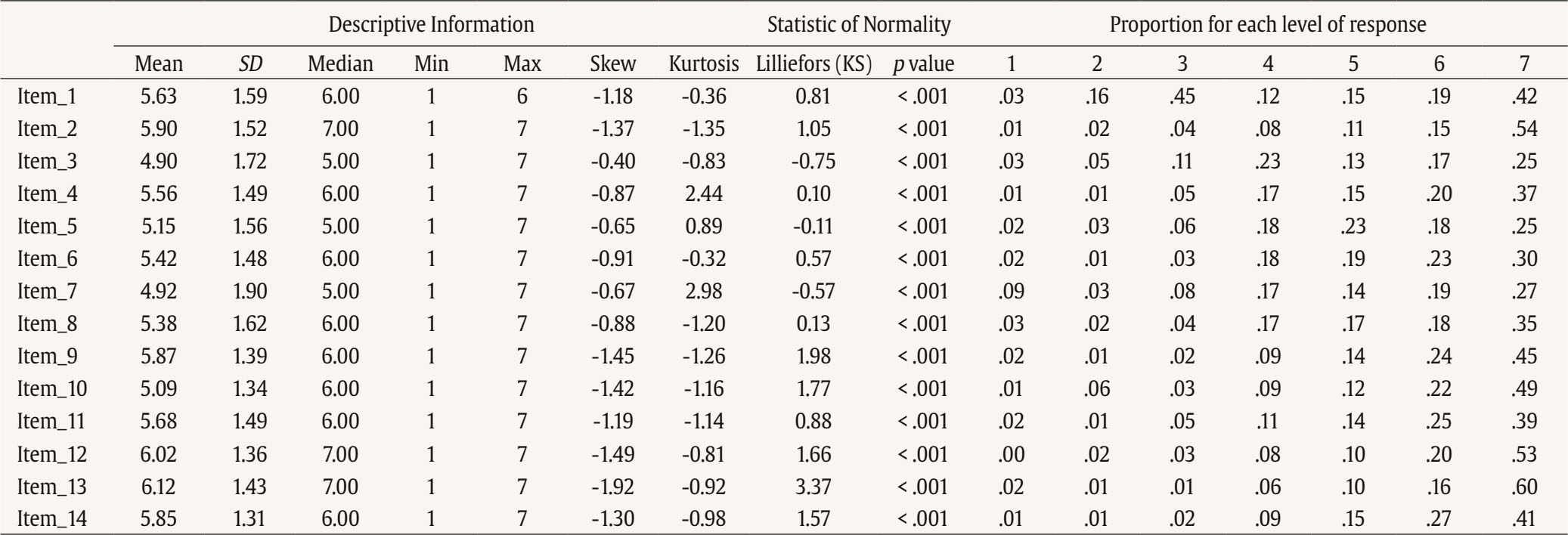 Note. KS = Kolmogorov-Smirnov; SD = standard deviation. Cronbach’s and omega coefficients were calculated from a total sample for the total score and the subscale scores corresponding to the RS-14 scale, with expected values above .70, indicating acceptable internal consistency (Revelle & Zinbarg, 2009; Trizano-Hermosilla & Alvarado, 2016). The analyses were conducted using JASP 0.18.02 for Windows. The MVN package (Korkmaz et al., 2014) was used to estimate univariate and multivariate normality distribution. The psych library (Revelle, 2017) and Lavaan (Rosseel, 2012) were used to perform reliability and CFA analyses, respectively was used to estimate the univariate and multivariate normality distribution. were used to perform the reliability and CFA analyses, respectively. Descriptive Results The Kolmogorov-Smirnov test was applied to the results of RS-14, statistical test recommended for large samples, like the one in this research, showed that no item met the assumption of univariate normal distribution (p’s < .001); likewise, the items did not show a multivariate normal distribution (see Table 1 and Table 2). Items 12 and 13 presented higher means with respect to the other items, indicating scores closer to 7, indicating maximum level of agreement with their statements. Regarding RS-14, the total scores ranged between 21 and 98 (M = 78.40, SD = 13.34). The data corresponding to the proportions of responses for each of the items allowed us to conclude that most of the responses were centered on scores between 6 and 7. Table 2 Descriptive, Statistic of Normality and Proportion for Each Level of Response by Dimension  Note. SD = standard deviation. Confirmatory Factor Analysis The RS-14 data were examined using a one-factor correlation model and a two-factor correlation model through CFA. Diagonally weighted least squares estimation was used, and the indicators were modeled as ordered categorical variables (Li, 2016). For all CFA models, standardized factor loadings are reported to facilitate interpretation and comparability with previous validation studies of the RS-14. Figure 1 Confirmatory Factor Analysis Diagram Model One. 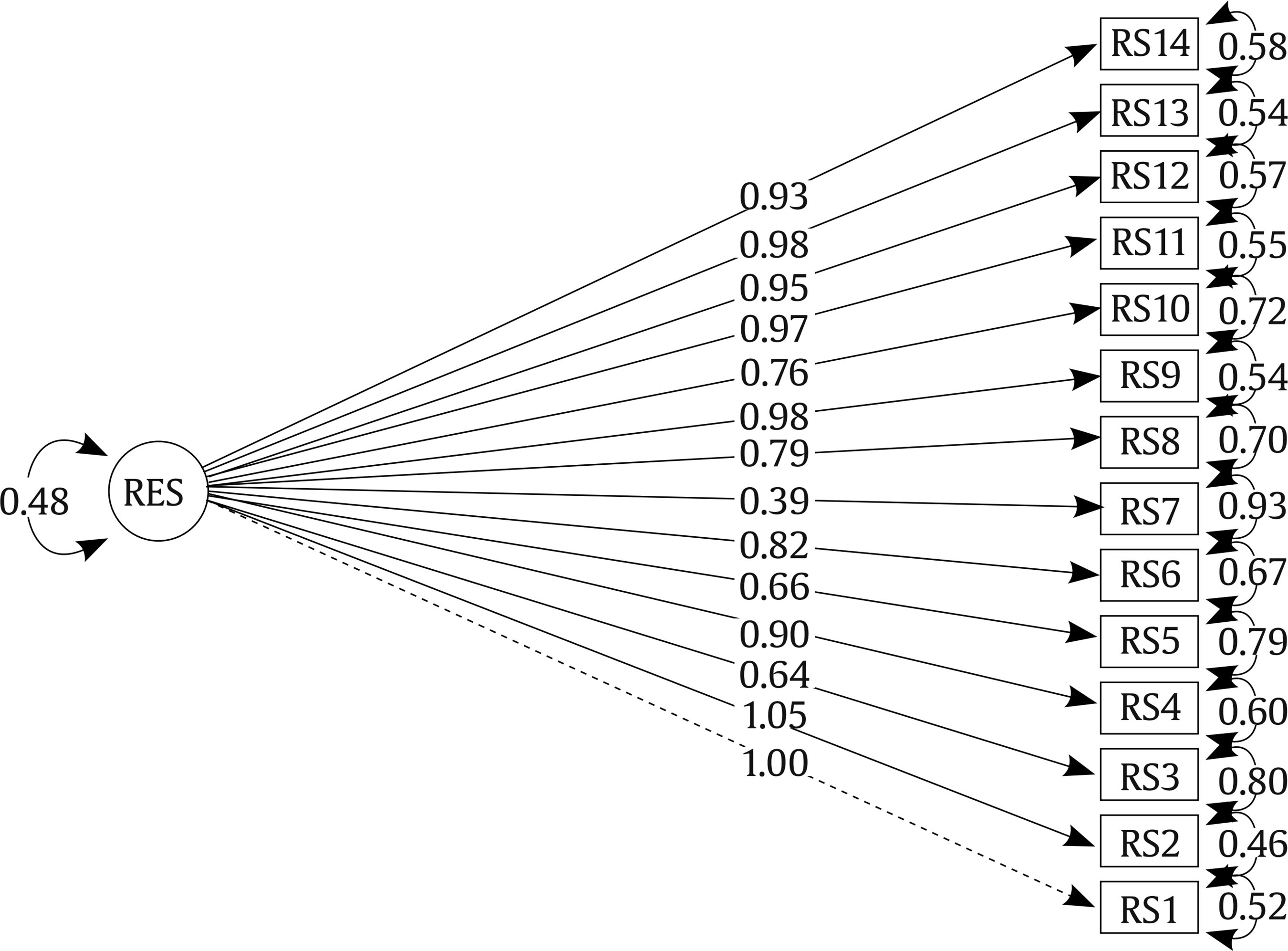 The goodness-of-fit tests provided initial evidence that, overall, the two proposed solutions did not fit well, as the critical ratio limit exceeded the acceptable threshold (χ²/df = 7.31 and 7.49), which could be related to the large number of individuals who participated in the study. The other indices showed very similar scores and within admissible limits, though low, for models 1 and 2, respectively (CFI = .84, IFI = .84 and .84, GFI = .87, AGFI = .82 and .82, RNI = .84, IFI = .84) (see Figure 1 and Table 3). The fit indices corresponding to RMSEA of .10 and .10 were above the expected value (an RMSEA and SRMR < .05 to .008 indicates a good fit), although the RMR was within acceptable limits for both models. Table 3 Goodness-of-fit Indices for the Five-factor Model and the Five-factor Model with Second Order 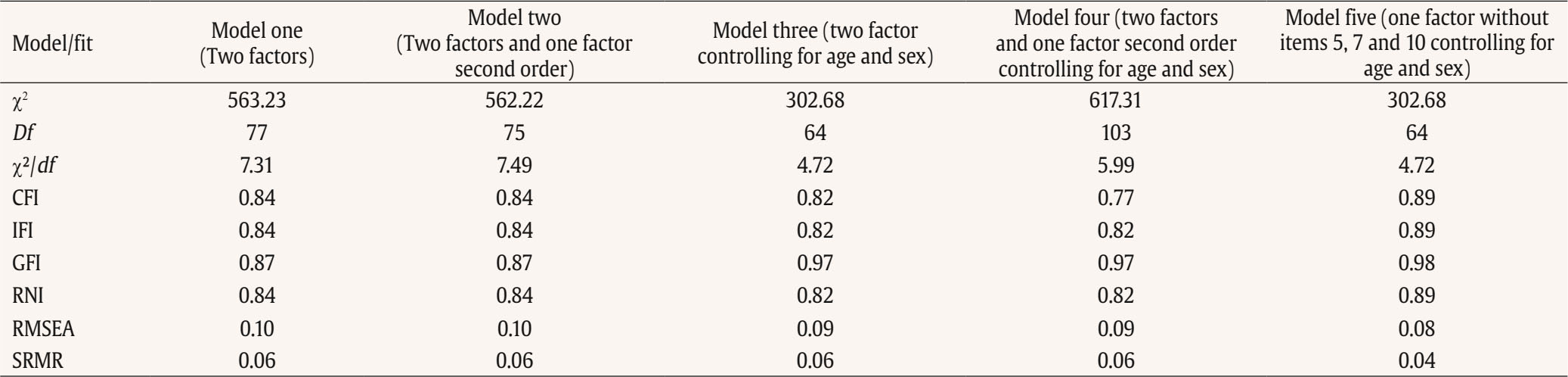 Note. χ2 = normal theory weighted least squares chi-square; df = degrees of freedom; CFI = comparative fit index; IFI = incremental fit index; GFI = goodness-of-fit index; AGFI = adjusted GFI; RNI = relative noncentrality fit index; RMSEA = root mean square error of approximation; SRMR = standardized RMR. Figure 2 Confirmatory Factor Analysis Diagram, Model Three (One Factor Controlling for Sex and Age). 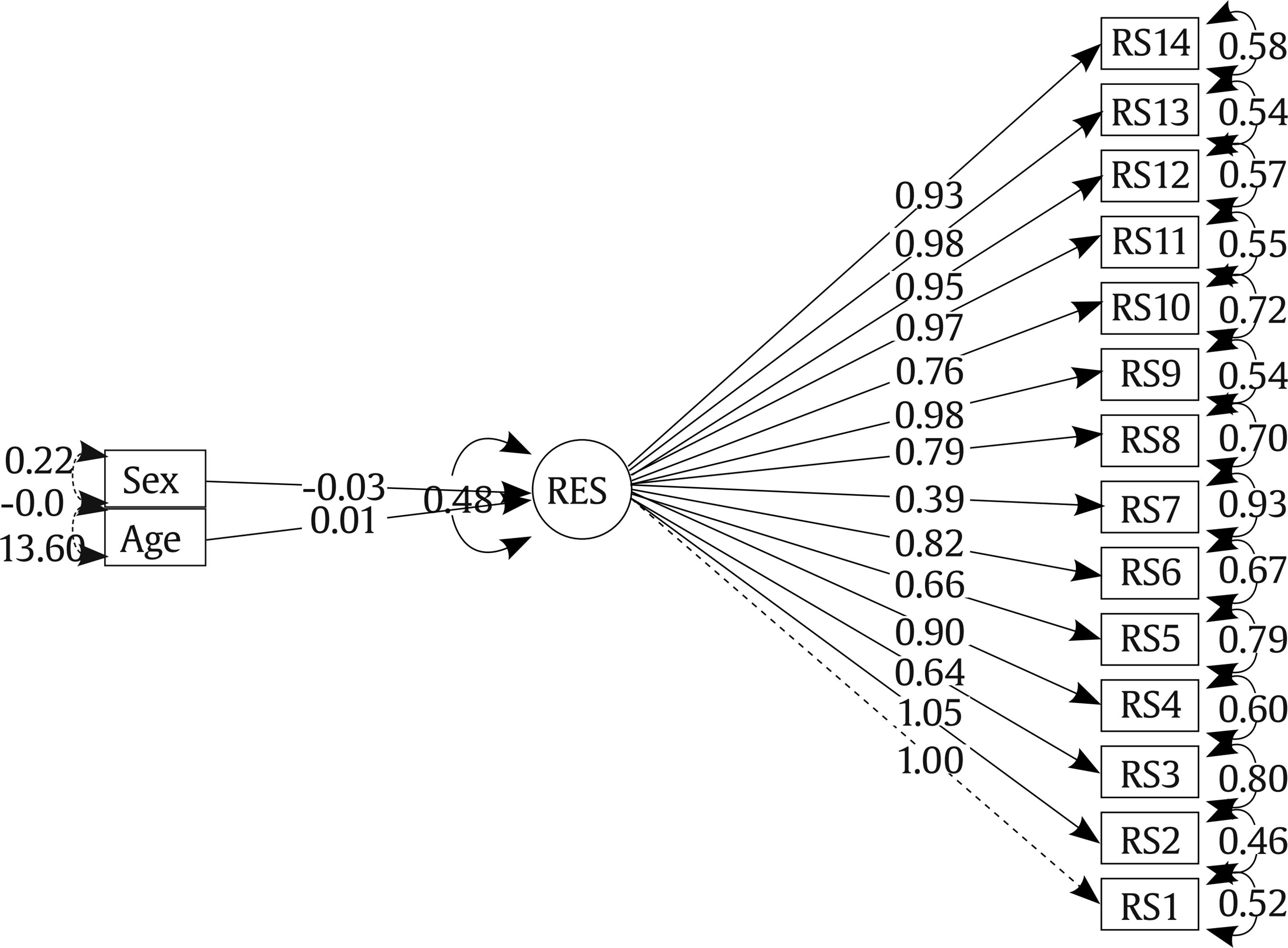 Figure 3 Confirmatory Factor Analysis Diagram, Model Two (second order). 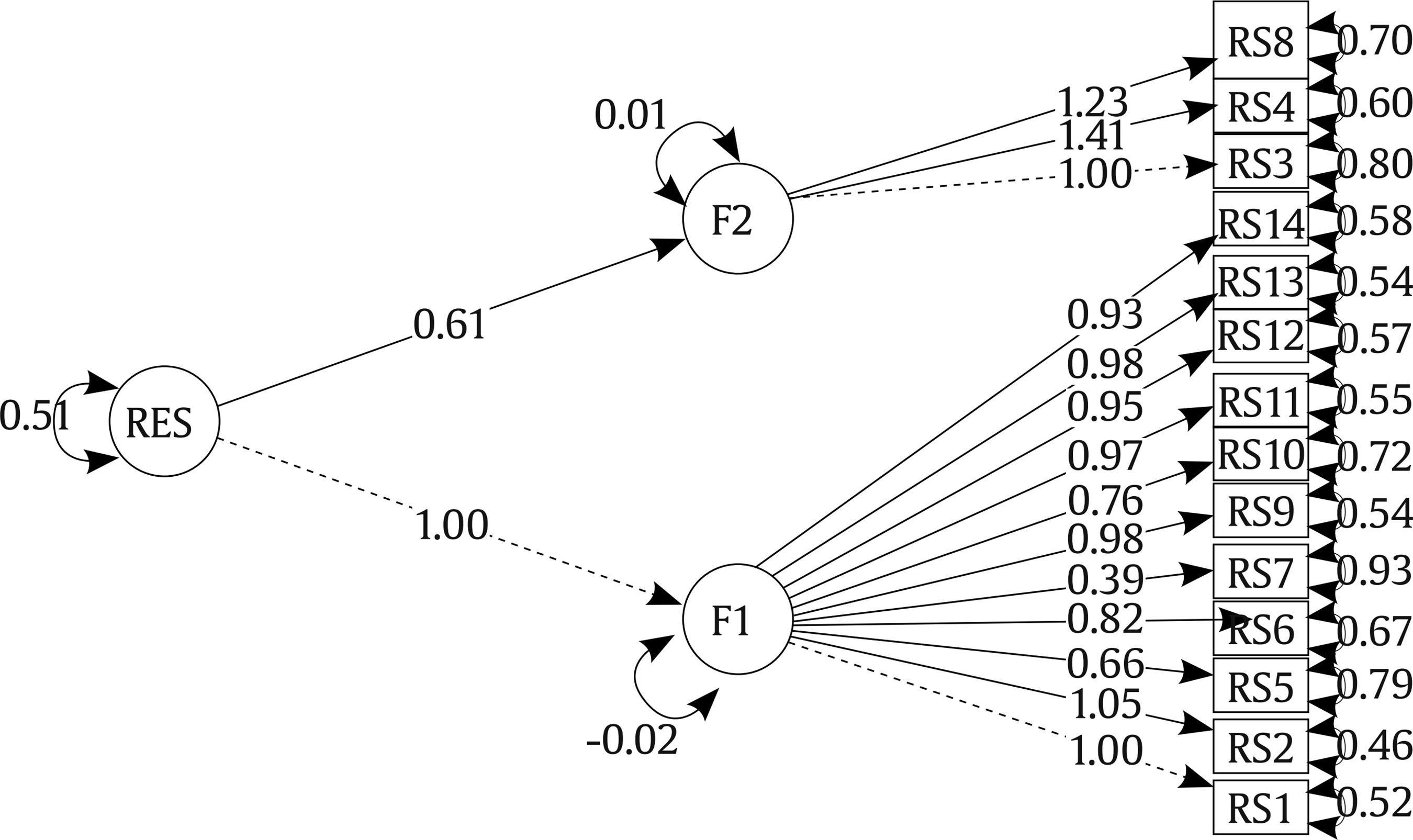 Figure 4 Confirmatory Factor Analysis Diagram, Model Four (Two Factors and One Second-Order Factor, Controlling for Sex and Age). 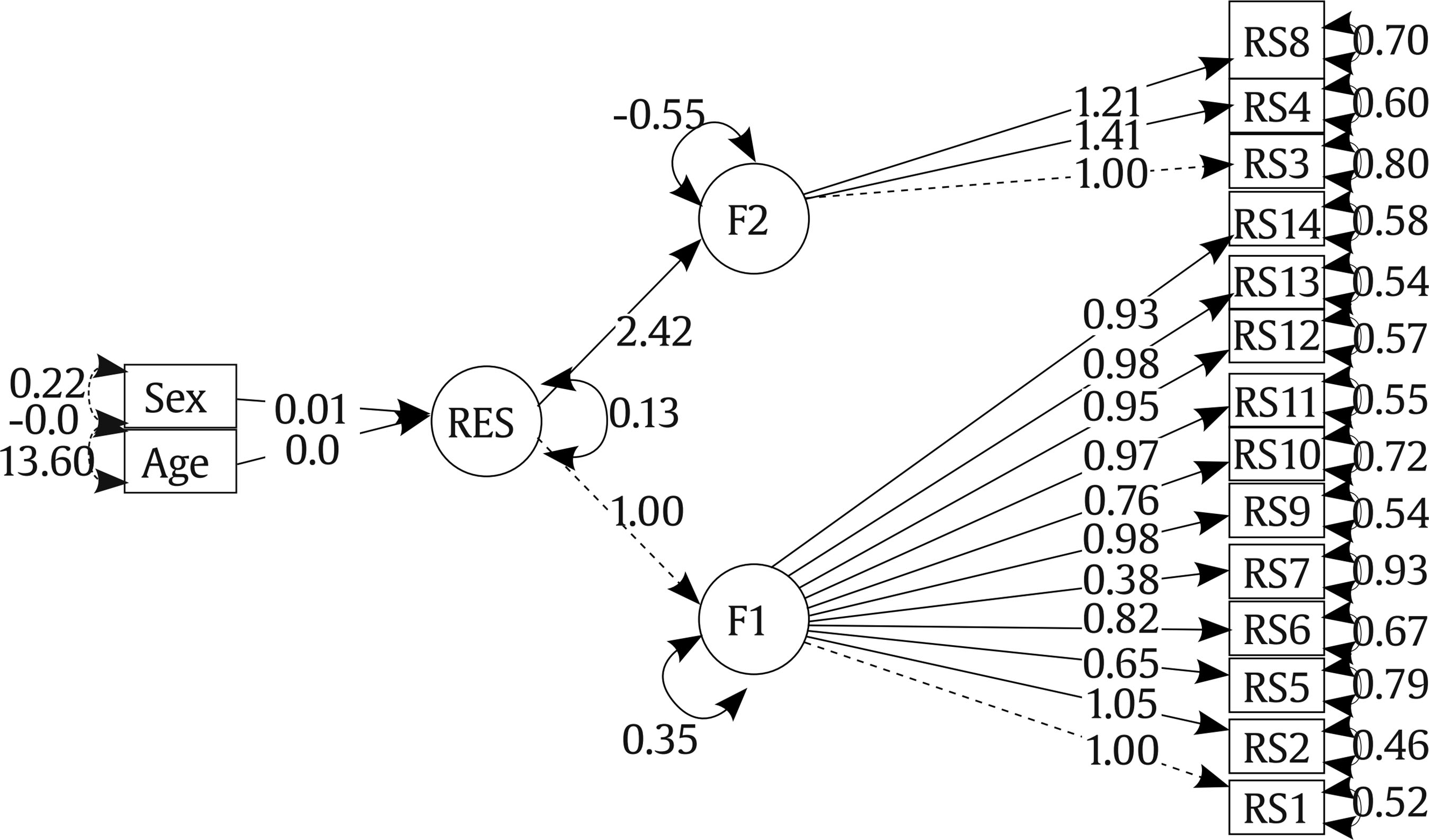 Given that Models 1 and 2 showed poor fit indices, a unidimensional model controlling for sex and age was proposed (see Figure 3), as well as a two-factor second-order model controlling for sex and age (see Figure 4). Sex and age were included as control variables in Models 3, 4, and 5, as previous research has shown that resilience scores can vary across the life span and between men and women (Aiena et al., 2015; Bennett et al., 2016). Controlling for these sociodemographic factors allows for a more rigorous evaluation of the RS-14 factorial structure by reducing potential confounding effects and ensuring that the observed model fit is not merely attributable to age- or sex-related differences. And Figure 4, composed of two factors controlling for age and sex. Model 3 showed poor fit indices (CFI = .82, IFI = .82, GFI = .97, AGFI = .97, RNI = .82, RMSEA = .09, SRMR = .06) (see Figure 2), as did Model 4 (CFI = .77, IFI = .82, GFI = .97, AGFI = .97, RNI = .82, RMSEA = .09, SRMR = .06) (see Figura 4). Given the findings, Model 5 was analyzed, which involved the removal of items 7, 5, and 10, as their factor loadings were the lowest in the model and these items might contribute to an overfitted model that does not generalize well (Chan et al., 2006). The theoretical analysis identified that item 5, “I feel that I can handle many things at once” (inconsistency with resilience), measures the ability to manage multiple tasks simultaneously, which is not a clear indicator of resilience and may, in fact, increase stress rather than reflect adaptability. Item 7, “I’m not afraid to face difficulties because I’ve been through them before,” focuses on the absence of fear in the face of difficulties, but resilience involves the ability to manage fear and negative emotions, not their absence or indifference. And item 10, “I can usually find something to laugh about,” introduces the use of humor as a strategy, but not all resilient people resort to humor as an adaptive mechanism, and measuring only this capacity may be insufficient (Masten et al., 2021; Park et al., 2021). Model 5, controlling for age and sex, showed reasonable fit indices (CFI = .89, IFI = .89, GFI = .98, AGFI = .98, RNI = .89, RMSEA = .08, SRMR = .04) and significantly better fit than the other two models across almost all fit indices. The removal of items 5, 7, and 10 appears to have considerably improved the model’s fitness, resulting in a more accurate and reliable representation of the latent variable (Figure 5). Figure 5 Confirmatory Factor Analysis Diagram, Model Five (One Factor without Items 5, 7, and 10, Controlling for Sex and Age). 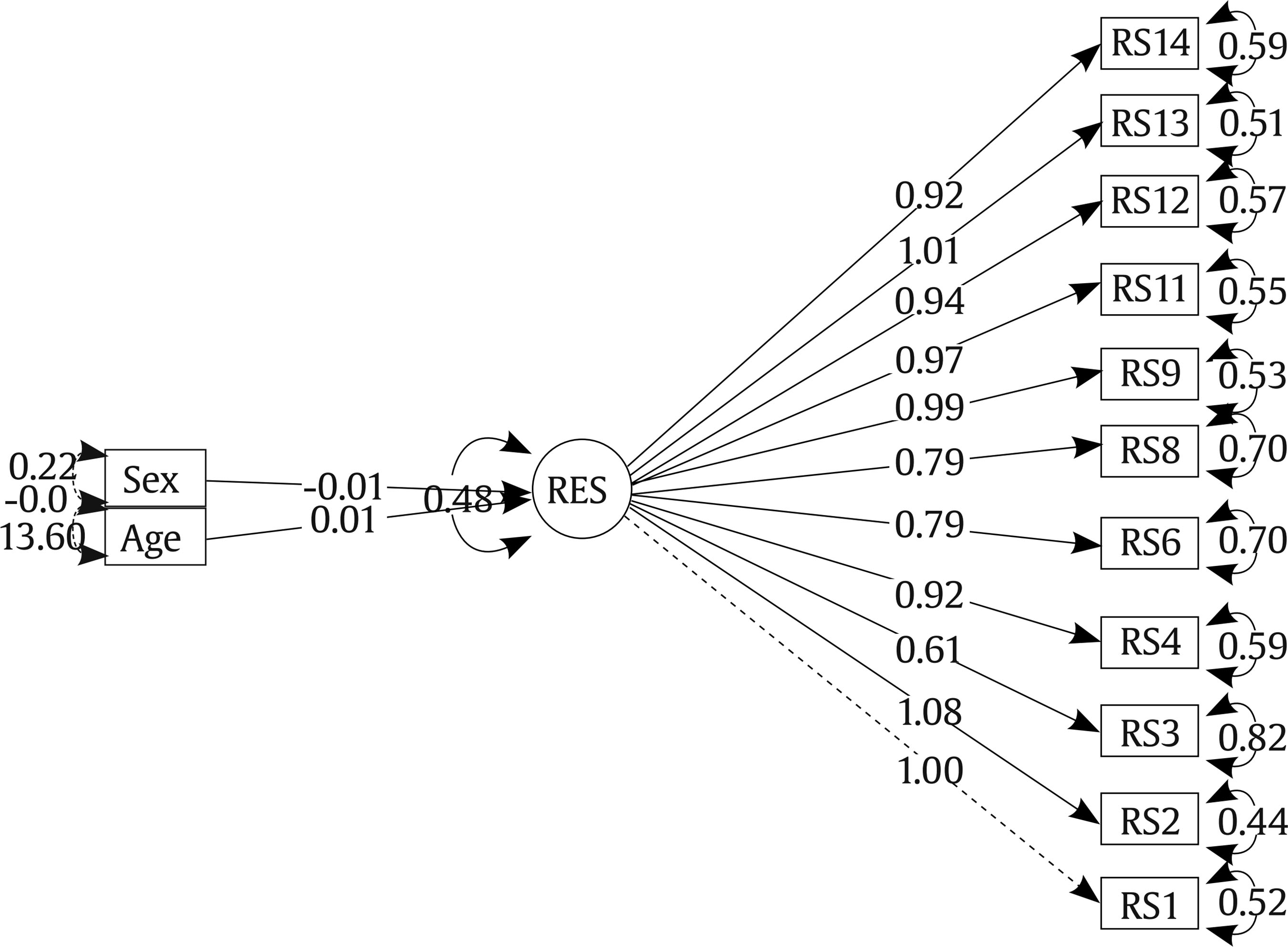 Internal Consistency The internal consistency of the RS14 instrument was evaluated using Cronbach’s alpha (α) and omega (ω), which were calculated from the overall score and the subscales of the instrument, considering the results of the CFA. Dimension I, called Personal Competence (α = .85; ω = .65), Dimension II, called Acceptance of Self and Life (α = .55; ω = .54), and the total scale (α = .87; ω = .87) [assuming the presence of two factors] are considered high. Regarding the proposed model after the CFA, eliminating items 5, 7, and 10, the reliability indices (α = .87; ω = .87) indicated that the scale has high internal consistency, demonstrating that the items are highly correlated with each other and reliably measure the same underlying construct.” Convergent Validity In the convergent validity analysis, the RS14 demonstrated significant associations with several theoretically related variables (see Table 4). The strongest correlation was observed with the CDRISC (ρ = .50, p < .001). Additionally, the RS14 was positively associated with future orientation (ρ = .30, p < .001) and self-esteem (ρ = .24, p < .001), indicating that higher resilience levels are linked to a more adaptive temporal outlook and a more positive self-evaluation. In contrast, a significant positive association was found with suicide risk (ρ = .25, p < .001), a finding that warrants cautious interpretation due to its unexpected direction. Interpretation of RS-14 Scores by Percentiles In accordance with the descriptive analyses performed, percentile score ranges were established to allow for the interpretation of RS-14 results in this population under a unidimensional model, obtained after the removal of items 5, 7, and 10, in line with the model that showed the best psychometric fit. Given that the scale reaches a maximum score of 77 and the distribution showed a higher concentration in the upper values, a clinical criterion based on percentiles (P10, P25, P75, and P90) was applied to highlight the extremes and increase sensitivity in the classification. Thus, total scores were grouped into five resilience levels: very low (≤ 46, up to P10), low (47-57, up to P25), medium (58-70, P26-P75), high (71-74, P76-P90), and very high (≥ 75, P95-P100). This complementary scheme not only identifies the medium levels of resilience present in the majority of the population but also distinguishes individuals located at the extremes of the distribution, who exhibit particularly low or exceptionally high levels of resilience. The purpose of this research was to analyze the psychometric properties of the RS-14 in Colombian victims of armed conflict and forced displacement, considering that this construct is essential for assessing the psychological resources deployed by individuals in situations of adversity and that resilience is a protective factor against multiple mental health problems (Cénat et al., 2018; Davydov et al., 2010; Fenwick-Smith et al., 2018) The total RS-14 scores in this population ranged from 21 to 98, with an average of 78.4. These data suggest high levels of resilience among the population studied, which are close to those found in populations from countries like Nigeria mean = 74 (Abiola & Udofia, 2011), Finland mean = 76 (Losoi et al., 2013), Italy mean = 76 (Callegari et al., 2016), England mean = 76 (Wagnild, 2009), and Poland mean = 73 (Surzykiewicz et al., 2019). Which differs from populations such as Kenya mean = 66 (Sutherland et al., 2020), and Japan mean = 64 (Nishi et al., 2010), which showed significantly lower scores, indicating a tendency toward lower levels of resilience. Considering that this population has experienced traumatic events related to the internal armed conflict, as well as exposure to economic and social vulnerability resulting from forced displacement, the presence of such high levels of resilience, as found with the RS-14, is noteworthy. These data are consistent with studies on the Colombian population, which generally show a greater tendency toward resilient characteristics (Bennett et al., 2016). A pattern that may be related to sociocultural characteristics that promote high levels of perceived social support, a quality widely associated with access to external resources and resilient ecosystems (Cénat et al., 2018; Londoño et al., 2012; Ntountoulaki et al., 2017; Sutherland et al., 2020). On the other hand, no significant differences were found between men and women with respect to the total RS-14 scores, suggesting similar dynamics of the construct between both genders, findings that coincide with results reported in Brazil and Greece (Damásio et al., 2011; Ntountoulaki et al., 2017). A notable aspect indicated that the statements with the highest scores corresponded to items 2, “I feel proud of what I have accomplished,” 12, “In an emergency, I am someone people can rely on,” and 13, “My life has meaning.” These items contain information related to social support and meaning in life, variables that have also been identified in relation to resilience in other studies (Cénat et al., 2018; Chen et al., 2020; Damásio et al., 2011; Sutherland et al., 2020). With respect to the results of the confirmatory factor analysis, the chi-square test obtained a value of 562 in the best-fitting model, which corresponded to the unifactorial scale. This value was high compared to other studies, although close to those found in research conducted with Chinese and Brazilian populations (Chen et al., 2020; Damásio et al., 2011). The RMSEA (root mean square error of approximation) fit index for the version that removed items 5, 7, and 10 obtained a score of .008, indicating an acceptable fit within reasonable limits, which is consistent with results found in studies on the RS-14 with vulnerable populations in Kenya (Sutherland et al., 2020) China (Chen et al., 2020), and Poland (Surzykiewicz et al., 2019). Some relevant validity evidence included goodness-of-fit indices, parsimony, and the fit produced by the two models explored, which were very similar, showing that the unidimensional model with item elimination is applicable to the Colombian population. In this regard, the CFI and AGFI indices were also similar to those obtained in the Kenyan population and slightly lower than those found in the French population. These data support the conclusion of a unifactorial structure, similar to other studies (Aiena et al., 2015; Damásio et al., 2011; Oliveira et al., 2015). However, it is necessary to note that in the CFA models some standardized factor loadings greater than 1 were observed, specifically in items 2 and 13 of the unidimensional models (Figure 5), as well as in several indicators of the second-order model (). These types of results, known as Heywood cases, occur when there is a high correlation between indicators, low error variance, or model overfitting, and do not necessarily imply a malfunction of the instrument, although they do limit the evidence of internal validity (Kolenikov & Bollen, 2012). Even though the unstandardized loadings and the global fit indices were adequate, these extreme factor loadings require cautious interpretation; therefore, future research should explore alternative models, reevaluate these items in new samples, and examine whether these values reflect particular characteristics of the population studied or structural properties of the Spanish version of the RS-14. Another piece of evidence for the performance of the one-factor model is the reliability of the scales and the total score of the instrument. Data showed high reliability for the total RS-14 score, unlike the scales (Dimension I: Personal Competence and Dimension II: Acceptance of Self and Life), as their reliability indices were lower, suggesting that in the Colombian population with these characteristics, the scale should be assumed under a unidimensional model. This information is consistent with findings from studies conducted in Kenya and China (Chen et al., 2020; Sutherland et al., 2020). Although the two-factor model initially reflected the theoretical structure of the RS-14, in this study the second factor was reduced to only three items, which limited its psychometric robustness. To avoid a model with a weak factor in terms of reliability and validity, we opted for a unidimensional solution, which demonstrated superior fit indices and internal consistency. This finding is consistent with previous validations in populations exposed to adversity (Chen et al., 2020; Sutherland et al., 2020). Nevertheless, we acknowledge the importance of capturing dimensions such as self-acceptance and purpose in life more comprehensively. Future research should consider the development of additional items that better reflect these aspects, particularly in highly vulnerable populations such as victims of armed conflict. It is possible that prolonged traumatic experiences, such as those suffered by the population of armed conflict victims and refugees, can negatively influence self-acceptance. These individuals face complex traumas, which may include forced displacement, violence, loss of loved ones, and economic hardship. This can lead to feelings of hopelessness, guilt, or rejection of their own identity or current situation, impacting Factor II reliability, which measures acceptance of oneself and life (Matheson et al., 2020). Additionally, Factor II may be affected by cultural differences in how aspects such as acceptance of personal circumstances and life, in general, are perceived and expressed. In Colombian populations affected by violence and displacement, self-acceptance might not align with the dimensions proposed by the scale, which was developed in different cultural contexts (Hewitt et al., 2016; Simancas-Fernández et al., 2022). Furthermore, the uncertainty and economic insecurity faced by many victims and refugees may hinder their ability to accept their current situation (Drožek et al., 2020), creating emotional instability that negatively affects responses to items related to acceptance of life as it is, reducing reliability. Regarding the instrument’s concurrent validity, the results were favorable, indicating that the RS-14’s structure and components explain a robust theoretical construct linked to psychosocial protective variables. This study confirmed a significant moderate correlation between the RS-14 and the CDRIS (Connor-Davidson Resilience Scale), with identical data to those found in the Chinese population (Chen et al., 2020), providing evidence of the construct’s similarity. Significant correlations were also found between the RS-14 and self-esteem, an important measure in evaluating individuals’ mental health (Cuoco et al., 2022). In this regard, some authors have warned that the risks of low self-esteem and mental health can be overcome through factors like resilience (Fenwick-Smith et al., 2018). Another correlation found was between resilience and the future dimension, showing that high levels of resilience in individuals are associated with a future-oriented perception centered on planning and achieving long-term goals. Although this relationship has not been studied in depth, it offers an important indication, as some studies have found correlations between resilience and meaning in life (Damásio et al., 2011). Based on the results of this study, it is concluded that the RS-14, eliminating items 5, 7, and 10 with a unidimensional model, is an instrument with acceptable validity and reliability indices for assessing resilience in the Colombian population of victims of armed conflict and forced displacement. However, some limitations were identified that can be addressed in future studies; variables such as perceived social support and life meaning were not evaluated, which seem to provide important clues for contributing to the theoretical and conceptual development of resilience in this population (Kelmendi & Hamby, 2023; Oviedo et al., 2022). The results suggest that while the RS-14 was designed to measure resilience in general populations, it may be limited in contexts where trauma has been extreme or prolonged, as in the population of victims of violence in Colombia. The two-factor structure may not adequately capture the complexities and nuances of resilience in these groups, where adversity can transform resilience into something more multifaceted (Renkens et al., 2022). Another aspect to consider is that some items on the scale may not resonate adequately with the lived reality of Colombians affected by violence. For example, item 5 (“I feel I can handle many things at once”) might be interpreted negatively or as a source of stress rather than a sign of resilience, especially in a context where dealing with multiple adversities can be overwhelming (Hewitt et al., 2016). Thus, the scale may not be sufficiently adapted to evaluate more complex forms of resilience that develop in contexts of violence, forced displacement, and chronic trauma (Ceballos Ospino et al., 2017; Gebresilassie et al., 2022). In these cases, resilience does not always manifest in the same way as in more stable populations, limiting the applicability of the RS-14. Given this, a future research direction could focus on developing and validating resilience instruments that are more adapted to the Colombian context, particularly to measure resilience in victims of armed conflict and displaced persons. These instruments could consider cultural, sociopolitical, and economic factors specific to this population, such as the impact of violence, forced mobility, and lack of access to essential resources, as well as dimensions beyond self-acceptance and personal competence, focusing on resilience as a construct that includes factors such as community support, spirituality, rebuilding life meaning, and family support networks. The study confirmed that the RS-14 is a valid and reliable instrument for measuring resilience in populations affected by armed conflict and forced displacement. However, significant differences in the reliability of Factor II (Acceptance of Self and Life) were observed, suggesting the need for greater cultural and contextual adaptation, as well as the use of the RS-14 as a unidimensional instrument. The poor performance of Factor II indicates that, in contexts of extreme adversity, such as forced displacement and prolonged violence, self-acceptance may be a difficult aspect to measure accurately. This highlights the importance of considering participants’ traumatic experiences when evaluating their resilience. The results suggest that, while the RS-14 is useful, it may not fully capture the complexity of resilience in contexts of violence and vulnerability. A greater adaptation of the items addressing specific sociocultural factors in the Colombian population is required. The study emphasizes the need for continued research on resilience in vulnerable populations, developing instruments that include additional dimensions such as social support and the reconstruction of life meaning. Longitudinal studies are also recommended to better understand the evolution of resilience over time in these populations.
Escala de Resiliencia RS-14 (Wagnild, 2009) Por favor, lea las siguientes afirmaciones. A la derecha de cada una se encuentran siete números, que van desde 1 = totalmente en desacuerdo, a la izquierda, a 7 = totalmente de acuerdo, a la derecha. Haga un círculo en el número o marque con una X en la opción que mejor indique sus sentimientos acerca de esa afirmación. Por ejemplo, si está totalmente en desacuerdo con un enunciado rodee con un círculo o trace una X sobre el número 1. Si no está muy seguro haga un círculo o trace una X en el 4, y si está totalmente de acuerdo, haga un círculo o trace una X en el 7 y puede graduar según esta escala sus percepciones y sentimientos con el resto de números. 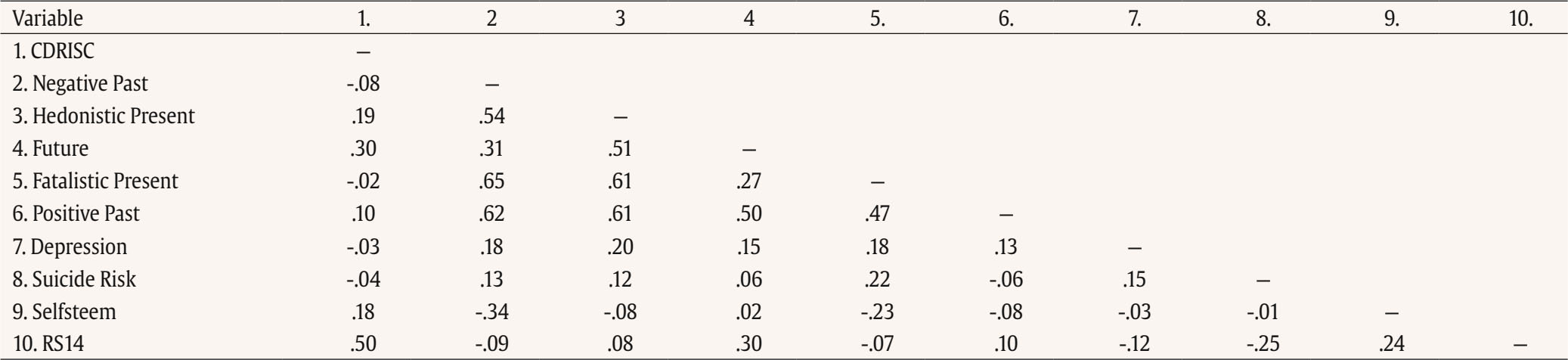 Note. The items marked with asterisks were eliminated in the new version of the RS14. Conflict of Interest The authors of this article declare no conflict of interest. Cite this article as: Bahamón, M. J., Javela, J. J., Trejos-Herrera, A. M., Cuesta-Guzmán, M., Ortega-Bechara, A., González-Gutierrez, O., & Sánchez-Villegas, M. (2026). Psychometric properties of the RS-14 resilience scale in victims of armed conflict and forced displacement. Clinical and Health, 37, Article e260727. https://doi.org/10.5093/clh2026a13 Funding: University of Sinú, University Simón Bolívar, University of Norte. References |
Cite this article as: Bahamón, M. J., Javela, J. J., Trejos-Herrera, A. M., Cuesta-Guzmán, M., Ortega-Bechara, A., González-Gutierrez, O., & Sánchez-Villegas, M. (2026). Psychometric Properties of the RS-14 Resilience Scale in Victims of Armed Conflict and Forced Displacement. Clinical and Health, 37, Article e260727. https://doi.org/10.5093/clh2026a13
Correspondence: marly.bahamon@docentes.umb.edu.co (M. J. Bahamón).Copyright © 2026. Colegio Oficial de la Psicología de Madrid


 PDF
PDF e-PUB
e-PUB CrossRef
 JATS
JATS Print
Print Send
SendEMAIL ALERT
Clinical and Health is licensed under a Creative Commons Attribution-NonCommercial-NoDerivatives 4.0 International License