From Lab to Classroom: Teachers’ Perspectives on Neurotechnology Integration
[Del laboratorio al aula: el punto de vista de los profesores sobre la integración de la neurotecnología]
Zhicong Zhang1, Chunyan Xu2, & Hua Shao1
1Quanzhou Normal University, Quanzhou, People’s Republic of China; 2Lanzhou City University, Lanzhou, People’s Republic of China
https://doi.org/10.5093/psed2026a10
Received 7 January 2025, Accepted 21 October 2025
Abstract
With the development of the field of educational neuroscience, the relationship between neuroscience and education is becoming increasingly close. The application of neurotechnology is gradually shifting from laboratories to real teaching environments. This study explores the acceptance and ethical views of teachers from six Chinese primary and secondary schools on neurotechnology applications in education through questionnaire surveys and semi-structured interviews. The findings revealed that teachers’ acceptance of neurotechnology was primarily influenced by their perceptions of safety, practicality, and educational fairness. In addition, students’ learning abilities interacted with the type of neurotechnology to shape teachers’ acceptance levels. However, teachers’ neuroscience training experience did not show a significant effect. The qualitative results further summarized internal and external factors influencing teachers’ acceptance. These findings highlight the need for policymakers, educators, and school administrators to prioritize student privacy, ensure fairness, and promote student development when integrating neurotechnology into educational contexts.
Resumen
Con el desarrollo del campo de la neurociencia educativa la relación entre neurociencia y educación se aproxima cada vez más. La aplicación de la neurotecnología está cambiando gradualmente de los laboratorios al mundo de la enseñanza. El estudio explora la aceptación y los puntos de vista éticos de profesores de seis escuelas primarias y secundarias chinas sobre las aplicaciones de la neurotecnología en educación por medio de cuestionarios y entrevistas semiestructuradas. Los resultados muestran que la aceptación de la tecnología por parte de los profesores estaba influida sobre todo por cómo veían la seguridad, su carácter práctico y la ecuanimidad. Además, la capacidad de aprendizaje de los alumnos interactuaba con el tipo de neurotecnología para configurar el nivel de aceptación de los profesores. No obstante, la experiencia de los profesores en formación en neurociencia no tuvo un efecto significativo. Los resultados cualitativos contribuyeron a resumir los factores internos y externos que influían en la aceptación de los profesores. Estos resultados destacan la necesidad que tienen los encargados de las políticas, los educadores y los administradores de los centros de priorizar la intimidad de los alumnos, garantizar la ecuanimidad y fomentar el desarrollo de los alumnos a la hora de integrar la neurotecnología en los contextos educativos.
Palabras clave
Neurociencia educativa, Neurotecnología, Docente incorporado al servicio, Intervención educativa, Ética educativaKeywords
Educational neuroscience, Neurotechnology, In-service teacher, Educational intervention, Educational ethicsCite this article as: Zhang, Z., Xu, C., & Shao, H. (2026). From Lab to Classroom: Teachers’ Perspectives on Neurotechnology Integration. Psicología Educativa, 32, Article e260453. https://doi.org/10.5093/psed2026a10
Correspondence: hdshaohua@163.com (H. Shao).With the global expansion of educational neuroscience, there is a growing demand for interdisciplinary research that combines neuroscience and pedagogy (Leisman, 2022). Neuroscience has the potential to revolutionize evidence-based education, much like the impact science and technology have had on evidence-based medicine (The Royal Society, 2011; Thomas, 2013). Advances in neuroscience tools and approaches have not only made research in educational neuroscience more ecologically valid, but also enabled the transferability of findings to educational contexts (Ba & Hu, 2023; Janssen et al., 2021; Zhang et al., 2018). Many discoveries in neuroscience are now being applied in educational settings for teaching language, mathematics, and science (Vaughn et al., 2020). However, despite these developments, the direct application of neurotechnology in real classroom environments remains limited. Neurotechnology, the “assembly of methods and instruments that enable a direct connection of technical components with the nervous system” (O. Müller & Rotter, 2017), has potential and great application in the development of evidence-based education (Privitera & Hao, 2022). Some researchers have developed some instruments and assessments based on neurofeedback in the brain for different educational scenarios (Chen & Wang, 2018; Zhu et al., 2021). Yet, several challenges hinder their broader adoption, including ethical concerns related to safety, privacy, feasibility, accessibility, and educational equity. Importantly, teachers’ attitudes and acceptance play a decisive role in determining whether these technologies can be successfully and responsibly integrated into teaching practice (Privitera & Hao, 2022). However, most existing studies have focused on the views of students, parents, or medical professionals, leaving a notable gap in understanding how in-service teachers perceive and evaluate neurotechnology in education. Moreover, little is known about how teachers’ neuroscience training and their ethical attitudes jointly influence their acceptance of neurotechnology. Therefore, this study wanted to investigate the factors associated with in-service teachers’ acceptance of the use of neurotechnology in their teaching. The findings of the study can inform the development of targeted professional development programs for teachers. Policymakers and educational institutions can use these insights to establish frameworks that ensure the safe, equitable, and responsible use of neuroscientific techniques in educational contexts. The research also can inspire interdisciplinary collaborations between neuroscientists, educators, and policymakers. By fostering collaboration, the implementation of neurotechnology in education can be further advanced. These collaborations can lead to innovative approaches and evidence-based practices that bridge the gap between the research lab and the classroom. Literature Review Development of Neurotechnologies Related to Education Cognitive neuroscientists employing cutting-edge techniques in neuroscience, coupled with the experimental paradigm of cognitive psychology, have yielded significant findings in the domains of memory, attention, and emotion. These findings offer valuable neuroscientific evidence for educators. A survey of over 1,000 teachers shows that more than 90% feel neuroscience impacts their teaching methods and 80% are open to collaborating with neuroscientists on educational research (Simmonds, 2014). In response, researchers have begun exploring how neuroscience techniques can be directly translated into classroom applications, such as enhancing students’ cognitive abilities or assessing learning progress (Davidesco, 2020). Broadly, these applications can be grouped into two categories: “neuroenhancement,” referring to techniques that aim to improve or modify cognitive and emotional functions, and “neuroassessment,” referring to tools that measure and evaluate brain activity to understand learning and behavior. Neuroenhancement techniques can be further classified methodologically into pharmacological enhancement, implantable technology enhancement, and neurostimulation technology enhancement (Li et al., 2022). Pharmacological augmentation primarily entails the use of clinically available therapeutic drugs. For instance, Adderall, a drug comprised of mixed amphetamine salts known to alter brain chemicals, is currently used to treat impulsive behavior and enhance attention in children diagnosed with attention deficit and hyperactivity disorder (De Jongh et al., 2008). It holds potential for cognitive enhancement in students. Oxytocin, a brain peptide hormone, has been found to play multiple roles in regulating pro-social behavior in humans (Dölen, 2015). In educational settings, oxytocin could be employed to decrease student misbehavior and facilitate peer interaction and group cooperation (Hyman, 2011). Implantable technology enhancement, on the other hand, focuses on the use of brain implants, such as invasive neuroprostheses. Neuroprostheses refer to artificial implant devices, including cochlear implants and visual prostheses, that are surgically inserted and utilize depth electrodes to stimulate specific brain regions. Although initially developed for clinical purposes, this technology has recently been explored for enhancing cognitive performance, albeit with mixed results (Jacobs et al., 2016; Suthana & Fried, 2014). Neurostimulation technology enhancement (non-invasive technology) mainly uses brain stimulation instruments that may have enhancement potential, such as transcranial magnetic stimulation or transcranial direct current stimulation (tDCS). The tDCS is a non-invasive technique that uses constant, low-intensity direct current (1-2 mA) to modulate cortical neuronal activity and has been shown to improve mathematical performance (Kadosh et al., 2010) and creative problem-solving skills (Ruggiero et al., 2018). These approaches highlight the potential to enhance specific cognitive skills relevant to academic learning, though ethical and safety considerations must be carefully addressed before educational adoption. Neuroassessment techniques primarily utilize non-invasive neuroscientific instruments to monitor and evaluate neural activity by measuring electrical signals or blood oxygen signals within the brain. These techniques encompass functional magnetic resonance imaging (fMRI), electroencephalography (EEG), and functional near-infrared spectroscopy (fNIRS). Unlike neuroenhancement techniques, neuroassessment techniques focus on objective recordings of neural activity in the brain using external instruments, without directly altering neural activity. EEG measures the electrical activity of the brain by placing electrodes on the scalp. It can complement traditional educational research methods and provide insights into learning processes that may not be observable in the classroom or accurately reported by students (Davidesco et al., 2021). Currently, EEG is being employed to assess children’s early reading difficulties (Gabrieli, 2016; Mayer, 2017), predict language and verbal memory development (Guttorm et al., 2005), and track student reading progress (Maurer et al., 2009). Additionally, EEG devices have been utilized to monitor students’ attentional states (Bevilacqua et al., 2019; Poulsen et al., 2017) and cognitive load (J. Wang et al., 2020) during classroom learning. Compared to EEG, fMRI and fNIRS possess distinct advantages in identifying the spatial localization of neural activity within the brain, making them valuable tools for studying mathematical thinking, scientific reasoning (Butterworth et al., 2011; Mason & Just, 2015), and language comprehension (Richards et al., 2017). In educational settings, fMRI holds potential for identifying students who may struggle to comprehend new knowledge and understanding the neurological causes behind their difficulties. It can also be employed to evaluate the effectiveness of innovative teaching strategies in addressing such challenges (Varma et al., 2008). In the pursuit of alternative interventions for students with learning difficulties, it is crucial to develop and validate non-invasive neurotechnologies for instructional assessment. Doing so enables educators to transition from standardized intervention programs to targeted, personalized intervention approaches (Seghier et al., 2019). The neural information gathered through these non-invasive tools can serve as a valuable foundation for Brain-Computer Interface (BCI) technology (Fontanillo Lopez et al., 2020). Such neural data holds the potential to provide theoretical and technical support for intelligent education and shape the future of education in the age of intelligence. By incorporating these non-invasive neurotechnologies, educators can gain deeper insights into students’ cognitive processes, individualize instruction, and develop evidence-based interventions to enhance learning outcomes. Likewise, fMRI and fNIRS studies help identify students’ learning difficulties and evaluate the neural effectiveness of teaching methods, paving the way for personalized and data-driven education. In summary, these emerging neurotechnologies not only deepen our scientific understanding of learning but also hold great promise for improving teaching strategies, assessing individual learning needs, and promoting educational equity. However, their integration into classroom practice requires careful ethical consideration and teacher preparedness—issues that form the focus of the present study. Ethical Controversy over the Use of Neuroscience Technology in Education The emergence of neuroethics as a new research field reflects the concerns regarding the potential dual impact of neuroscientific advancements on science and society. Neuroethics investigates several key issues, including individual homogeneity, agency and responsibility, privacy and security of brain data, and neural enhancement (Li et al., 2022). The ethical implications of BCIs have sparked discussions concerning the public and various fields such as medicine (Klein et al., 2016; Sample, Sattler et el., 2019; Sattler & Pietralla, 2022). In the field of education, ethical considerations regarding neuroscience and technology are particularly relevant, receiving substantial attention from policy makers, school leaders, teachers, educational institutions, as well as parents and students. Researchers have extensively discussed ethical challenges in literature reviews and examinations of current and future applications of brain-computer interfaces in education (Fontanillo Lopez et al., 2020). Consequently, the application of neuroscience technologies in education necessitates a cautious and rigorous approach. The application of neuroscience techniques poses challenges related to safety, data management, and educational equity. Firstly, personal safety is a primary concern as some techniques carry potential side effects. For instance, deep brain stimulation used in Parkinson’s treatment can lead to visual hallucinations and neurological or psychiatric side-effects like depression, mania, and anxiety (S. Müller & Christen, 2011). Neuroenhancing drugs also present risks such as addiction or hypersensitivity and irritability (Brukamp, 2013; Hyman, 2011). Secondly, the management of students’ neural data is another critical issue. Neural signals are closely linked to personal information and privacy. Protection of “brain privacy” is necessary to prevent unauthorized access to students’ brain data and unwarranted disclosure (Ienca & Andorno, 2017). Therefore, obtaining informed consent for data collection and establishing reasonable laws and regulations are vital in protecting the privacy of students’ brain data. On the other hand, it is equally important to appropriately interpret and use learner brain data. Like standardized tests or psychological measurements, data obtained through neurotechnology assessments may be overly emphasized or misinterpreted by educators. This can potentially lead to categorization, labeling, or racial segregation of students, negatively impacting their self-efficacy and self-perception (Davidesco et al., 2021). Furthermore, the issue of educational equity is a critical concern. One often-cited worry is that providing cognitive, emotional, and executive function-enhancing medications may widen educational opportunity gaps. Wealthier and more educated individuals are more likely to seek antidepressants and stimulants as treatment compared to those who are less affluent and less educated (Hyman, 2011). There is even the possibility of an “arms race” in the use of neurotechnology (Hyman, 2011), with irrational and unrestricted adoption of various neurotechnologies in pursuit of so-called prestigious titles. How these ethical challenges are addressed will impact the practicality and accessibility of neurotechnology applications in education. Although some researchers have begun to explore the ethical attitudes of the public towards the use of neurotechnologies (Hiltrop & Sattler, 2022; Müller & Rotter, 2017; Sample, Sattler, et al., 2019; Sattler & Pietralla, 2022), there is still relatively little research on the attitudes of participants in the field of education. Schmied et al. (2021) ascertained in a survey of education major undergraduates that respondents, when adopting a teacher’s perspective, exhibited greater reluctance towards the educational application of neurotechnology. Nevertheless, compared with in-service teachers, pre-service teachers generally possess limited classroom management experience and may have a more idealized understanding of educational practice (e.g., Poznanski et al., 2018; Yuan & Lee, 2014). They have not endured the teaching pressures, student management conundrums, and intricate educational evaluation frameworks that in-service teachers face. Consequently, their perceptions of neurotechnology in education might differ from those of practicing teachers who confront daily pedagogical, evaluative, and ethical challenges in real school settings. Consequently, the findings from student samples may not fully reflect the nuanced ethical considerations and acceptance patterns of in-service teachers. The Application of Neuroscience Training to Teacher Education Despite the undeniable connection between the brain and learning, there is a lack of consensus among educators and neuroscience researchers regarding the practical application of neuroscience evidence in the field of education (Privitera, 2021). Nonetheless, this disagreement has not hindered the growing trend of providing neuroscience training to teachers, driven by the increasing interest among educators (Hook & Farah, 2013; Zambo & Zambo, 2011) and policy recommendations in certain countries (Society for Neuroscience, 2009; The Royal Society, 2011). The introduction of neuroscience training for teachers aims to encourage a deeper understanding of the learning process, ultimately leading to pedagogical changes and improved effectiveness in education (Desimone, 2009). Several studies have reported positive outcomes of neuroscience training programs, such as improved scores on assessments of neuroscience content knowledge among teachers (Im et al., 2018; Schwartz et al., 2019) and increased confidence in comprehending and teaching neuroscience concepts (MacNabb et al., 2006; Roehrig et al., 2012). Furthermore, a scoping review conducted by Privitera (2021) revealed that neuroscience training had varying degrees of influence on teachers’ mindsets (Ergas et al., 2018), instructional strategy choices (Schwartz et al., 2019), and student achievement (Anderson et al., 2018). These findings underscore the potential benefits of neuroscience training for educators and warrant further investigation into its impact on the field of education. The Present Study In summary, the rapid development of neuroscience technologies has had a very significant impact and change in the field of education. However, a series of ethical issues that need to be addressed also limit the direct application of neuroscience techniques in education. Previous studies have found that public acceptance of neurotechnical devices in society is related to the invasiveness of the technology, framing effects, and to individual needs and values (Sattler & Pietralla, 2022). So, in the field of education, is there a relationship between teachers’ acceptance of neurotechnology and their ethical attitudes? Although studies have found positive effects of neuroscience training on teacher education, it is unknown whether neuroscience training improves teachers’ perceptions and acceptance of neurotechnology. Therefore, this study also intends to examine whether teachers’ experiences in neuroscience training are related to their acceptability of the use of neurotechnology in education. Referring to Schmied et al. (2021), this study intends to explore the acceptance differences among teachers with varied neuroscience training experiences towards applying different neurotechnologies (pharmacological augmentation, physical hardware, non-invasive instruments) to students of different learning abilities. High Ability Students (HAS) are defined as those who consistently perform above grade-level expectations based on academic assessments. Low Ability Students (LAS) are students whose performance falls below grade-level expectations. Students with Learning Disabilities (SLD) are those formally diagnosed with specific learning disabilities according to school records or standardized assessments. The following research questions would be addressed. RQ1. Are there differences in the acceptance of different types of neurotechnology by in-service teachers? RQ2. Does previous neuroscience training experience affect faculty acceptance of neurotechnology? RQ3. Are there differences in teachers’ acceptance of the application of neurotechnology to students with different learning abilities? RQ4. Is teachers’ ethical attitude towards the use of different neurotechnologies in education related to their acceptance attitude? Participants This study was conducted with teachers from experimental schools affiliated with the Educational Neuroscience Research Center at a university in China. Using a convenience sampling method, a total of 125 investigative materials were distributed to primary and secondary school teachers in six cities across China. It is important to note that partial teachers in these schools had received relevant training about neuroscience knowledge. We meticulously removed any invalid responses that were not carefully answered by using response time- and quality-controlled questions, resulting in a final dataset of 113 valid responses. Participants’ demographic information was organized into three thematic categories: 1) personal demographics: age ranged from 21 to 56 years (M = 32.22, SD = 7.75), with 23 males and 90 females; 2) professional background, including teaching experience, teaching discipline, and school type (see Table 1); and 3) neuroscience training experience, defined as participation in lectures, training sessions, or academic conferences aimed at popularizing neuroscience knowledge—51 teachers had prior training, while 62 had no such experience. Table 1 Table of Demographic Information on Survey Respondents (N = 113) 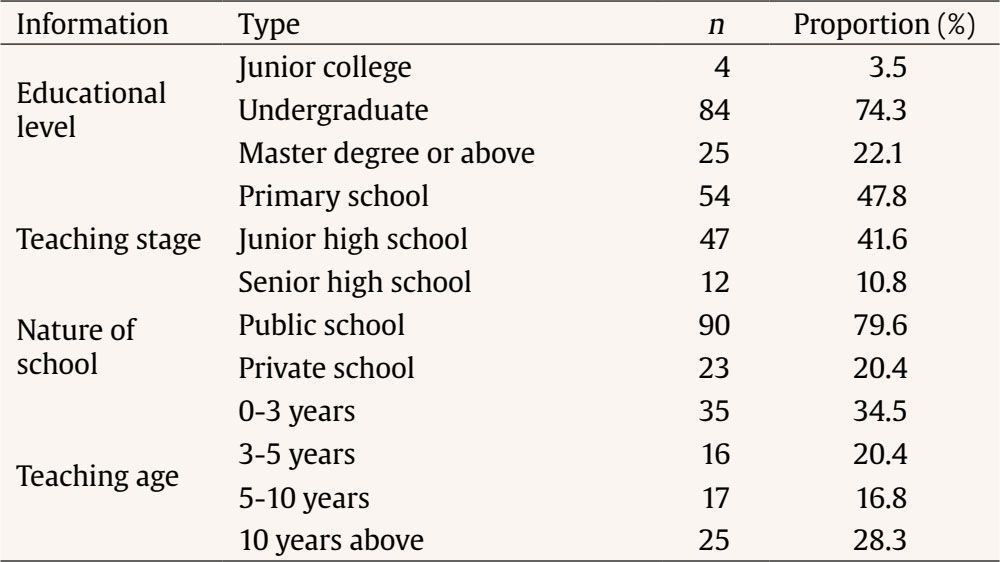 In addition, a total of 11 teachers from these six schools were selected for brief interviews. Information about the interviewees is presented in Table 2. The study received ethical approval from the researcher’s university ethics committee (NO. HR587-2022). Table 2 Table of Demographic Information on Interviewees (N = 11) 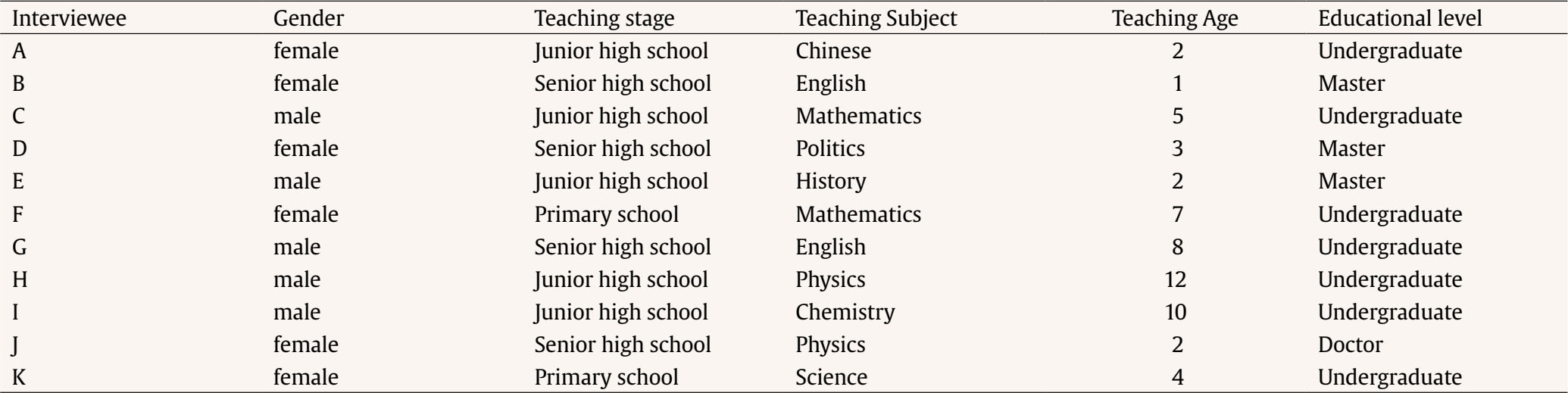 Research Tools Demographic Background The demographic background section of the survey collected information on various aspects concerning the teachers. The background questions included the participants’ age, gender, educational background (level of education and major), teaching background (years of teaching experience, teaching disciplines, teaching grades, and the type of schools they worked in), experience with neuroscience training (number of trainings attended), and their satisfaction with the training (measured on a 7-point rating scale). Finally, the survey inquired about the participants’ habits of reading neuroscience papers and scientific papers, as well as their prior experience with using neuroscience applications to enhance learning. Acceptability of Neuroscience Technology The acceptability material used in this study is primarily derived from an adaptation and translation of a study conducted by (Schmied et al., 2021). It consists of six scenarios that illustrate various applications of neuroscience technology. The materials were constructed using the Contrastive Vignette Technique (Burstin et al., 1980), which aids readers in identifying key information elements. Each scenario provides descriptions in eight areas: (1) current medical applications, (2) stage of development and technique description, (3) current or potential use in education, (4) scope of application, (5) specific examples of educational application, (6) considerations for transferring research findings, (7) invasiveness and short-term side effects, and (8) long-term side effects. The translation of the materials was performed by a master’s student in English and a master’s student in psychology. Following the translation, the materials underwent a rating process by 10 volunteers who assessed reading fluency (M = 6.33, SD = 0.23) and comprehensibility (M = 6.45, SD = 0.16) using a 7-point rating scale. Based on the feedback, the study materials were refined and finalized. The survey materials encompassed three categories of neuroscience techniques: pharmacological augmentation (Adderall, oxytocin), physical hardware (atDCS, neuroprostheses), and non-invasive instruments (EEG, fMRI). To ensure careful reading and familiarity with the main features of the technology, the researchers included a multiple-choice question at the end of each material and asked participants to recognize and select options that matched the characteristics of the technology. These techniques were incorporated into a total of six inquiry materials. Participants were tasked with expressing their acceptance of these technologies for three types of students (HAS, LAS, and SLD) after reading each material. The multiple-choice question presented three options, each representing a feature of the respective technology. Participants’ acceptance attitudes were assessed on a 7-point scale ranging from 1 (totally unacceptable) to 7 (totally acceptable). Participants who failed to correctly answer any of the comprehension questions were excluded from the analysis (n = 12), ensuring that only valid and attentive responses were retained. Ethical Attitude After assessing the participants’ acceptability attitudes, they were further prompted to express their ethical attitudes towards the application of this technology across three dimensions. Firstly, participants were asked to make judgments regarding safety, rating it on a scale of 1 (very dangerous) to 7 (very safe). Secondly, participants were asked to assess the potential disruption of educational equity, rating their level of agreement on a scale of 1 (strongly disagree) to 7 (strongly agree), where higher scores indicated a greater agreement that the technology could disrupt educational equity. Lastly, participants were asked to evaluate the feasibility of implementing this technology in education, rating it on a scale of 1 (not at all feasible) to 7 (very feasible). General Attitudes to the Relationship between Neuroscience and Education The general attitude questionnaire consisted of six questions developed by the researchers. Participants were asked to rate their agreement with each statement on a 7-point scale, ranging from 1 (strongly disagree) to 7 (strongly agree). The questions included: 1) neuroscience techniques should be used more in educational practice; 2) the results of neuroscience have a positive contribution to educational practice; 3) as primary and secondary schoolteachers, they should learn more about the knowledge of neuroscience; 4) as primary and secondary schoolteachers, they should apply the knowledge of neuroscience to their classes more often; 5) as primary and secondary schoolteachers, they should receive more training in neuroscience knowledge; 6) the results of neuroscience have a negative contribution to educational practice (reverse scoring). Higher scores on the scale indicated more positive attitudes of teachers towards the integration of neuroscience and education. The Cronbach’s alpha coefficient (α = .816) was calculated based on the current sample, indicating good internal consistency. Interview Materials This study adopted semi-structured interviews based on a standardized set of core questions, ensuring consistency across participants while allowing the interviewer to flexibly adjust follow-up questions according to participants’ responses. The interview outline began with an introduction of the research purpose and an emphasis on privacy protection. Then, teachers were asked about their knowledge in educational neuroscience and neurotechnology (e.g., “How familiar are you with neurotechnologies used in education?”; “Where do you usually get information about neuroscience or neurotechnology?”). Subsequent questions explored teachers’ attitudes toward neurotechnology from the perspectives of different disciplines and levels of teaching experience (e.g., “How do you perceive the use of neurotechnology in your subject area?”; “Do you think teaching experience affects attitudes toward neurotechnology?”). Participants were also asked to describe any personal or observed experiences of neurotechnology use in education and to share suggestions for promoting acceptance in schools. Each interview lasted approximately 20 minutes and was audio-recorded with participants’ consent. Investigation Procedure Participants were instructed to access the survey procedures via a provided link. After carefully reviewing the survey instructions and informed consent form, participants had the option to either withdraw from the study or affirm their informed and voluntary participation. Once they confirmed their participation, they proceeded to engage in the formal investigation process. The first part of the process involved participants reading vignettes about different neurotechnologies. The order of presenting these vignettes was determined by a pseudo-random design to minimize possible order-related influences. After reading each vignette, participants completed an acceptability attitude assessment and an ethical attitude assessment. In the second part of the study, participants were required to complete a general attitude survey focusing on the relationship between neuroscience and education. Finally, participants were invited to provide personal anonymous background information. As a token of appreciation, participants were informed that they would receive a randomly assigned reward at the end of the survey. Table 3 Difference Analysis of Teachers’ General Attitude and Reading Habits (N = 113)  Note. Number of Yes = 51, number of No = 62, same as Table 4. *** p < .001. Table 4 Difference Analysis of Teachers’ Ethical Attitudes (N = 113) 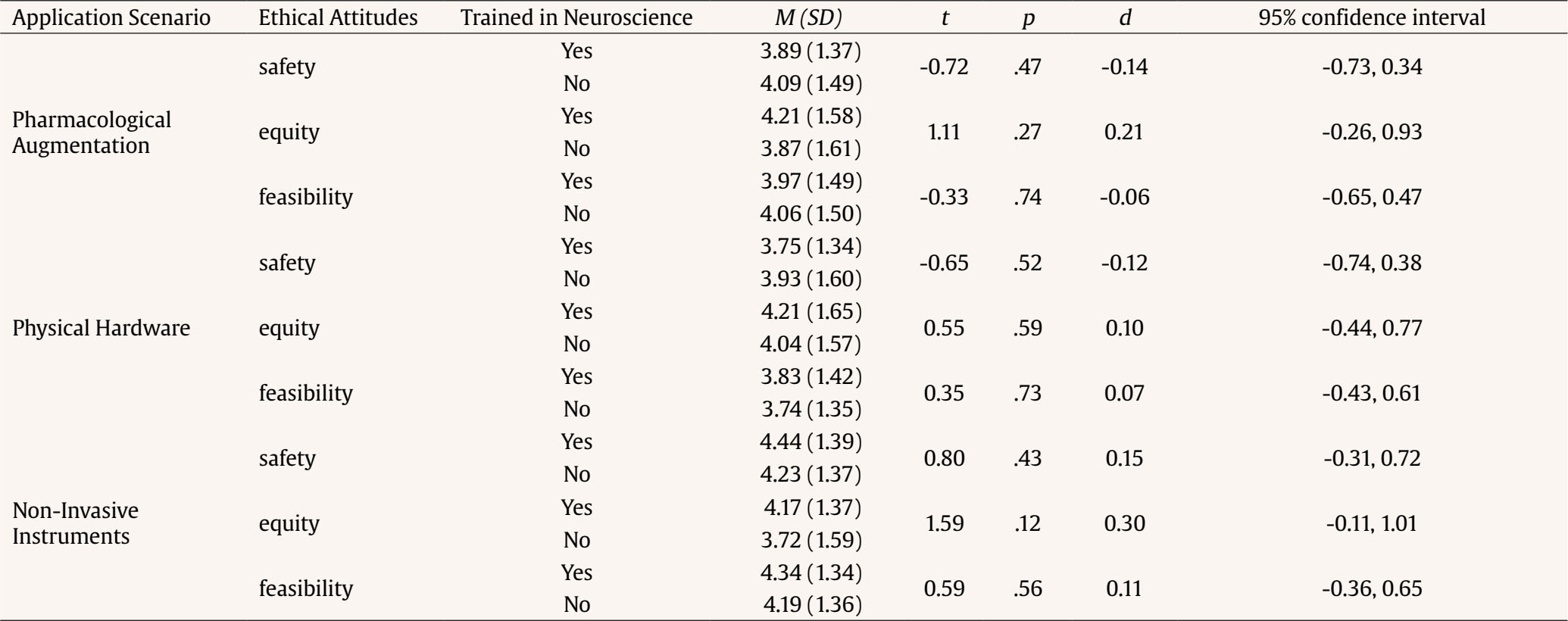 Reading Habits and General Attitudes To examine the impact of neuroscience training on teachers’ reading habits of scientific research papers and popular science articles, as well as their general attitudes towards the relationship between neuroscience and education, an independent sample t-test was conducted. Please refer to Table 2 for the detailed results. The findings displayed in Table 3 reveal that teachers who received neuroscience training demonstrated significantly more positive attitudes towards the relationship between neuroscience and education (t = 4.03, p < .001). Furthermore, they reported a significantly higher frequency of reading scientific research papers (t = 5.66, p < .001) and popular science articles (t = 4.51, p < .001). Ethical Attitudes To evaluate the impact of teachers’ neuroscience training on their ethical attitudes towards the application of neuroscience techniques, an independent sample t-test was performed. Upon examining Table 4, it becomes apparent that there were no significant differences in the attitudes towards safety, equity, and feasibility regarding the application scenarios of different neurotechnologies, irrespective of whether the teachers had received neuroscience training or not. Correlation Analysis To analyze the relationships between the variables in this study, Pearson correlation analysis was conducted. Tables 5-7 illustrate that across all three tables, there were significant positive correlations between teacher acceptance of the three types of scenarios and their attitudes towards the safety and feasibility of the technology. These correlations held true regardless of the academic abilities of the students, with correlation coefficients ranging from .43 to .68. For HAS, teachers’ acceptance of both pharmacological augmentation (r = -.41) and non-invasive instruments (r = -.21) had a significant negative correlation with fairness, and acceptance of non-invasive instruments had a significant positive correlation with general attitudes (r = .31). For LAS, teacher acceptance was significantly negatively correlated with fairness only in the medication scenario (r = -.28) and significantly positively correlated with general attitudes in all three scenarios (r = .31 - .41). For SLD, teacher acceptance was not related to perceptions of fairness in all three scenarios and was significantly and positively related to general attitudes in all three scenarios (r = .38 - .44). Table 5 Correlations between Acceptance of Pharmacological Augmentation and Ethical and General Attitudes  Table 6 Correlations between Acceptance of Physical Hardware and Ethical and General Attitudes  Table 7 Correlations between Acceptance of Non-invasive Instruments and Ethical and General Attitudes  Relationship of Neuroscience Training on Teacher Acceptance To explore the effect of experience with neuroscience training on teacher acceptance, the researchers did three-factor repeated measures ANOVA. Training experience was used as a between-subject variable, and the three scenarios and three types of students were used as within-subject variables. The Greenhouse-Geisser correction was used when the Mauchly sphericity test hypothesis was not met and F-values with fractional degrees of freedom are reported. Results found that the main effect of training was not significant, F(1, 111) = 0.412, p = .522, η2p = .004, with a 95% confidence interval of [-.39, .77]; the main effect of type of student was significant, F(1.49, 164.91) = 24.11, p < .001, η2p = .18. Teachers’ acceptance of the use of neurotechnology was significantly higher for SLD (M = 4.73, SD = 0.15) than for LAS (M = 4.45, SD = 0.16, p < .001) and HAS (M = 3.98, SD = 0.17, p < .001); it was also significantly higher for LAS than for HAS. The main effect of the scenario was significant, F 1.81, 200.64) = 7.64, p < .001, η2p = .064. Teachers’ acceptance of both pharmacological augmentation (M = 4.44, SD = 0.16, p = .002) and non-invasive instruments (M = 4.54, SD = 0.15, p < .001) was significantly higher than acceptance of physical hardware (M = 4.18, SD = 0.16). The interaction between student type and training experience was not significant, F(1.49, 164.91) = 1.81, p = .18, η2p = .016. The interaction between student type and scenario was significant, F(3.33, 369.36) = 3.75, p = .005, η2p = .033. The interaction between scenario and training experience was not significant, F(1.81, 200.64) = 0.38, p = 0.67, η2p = 0.003). The interaction of the three variables was not significant (F (3.33, 369.36) = 2.19, p = 0.08, η2p = 0.02). A simple effects analysis of the interaction between scenario and student type was conducted and the results are shown in Figure 1. For the HAS, teachers were significantly more receptive to non-invasive instruments (M = 4.23, SD = 0.17, p < .001) than to physical hardware (M = 3.80, SD = 0.18), and there was no significant difference in receptivity to pharmacological augmentation and physical hardware (p = .64). For the LAS, teachers were significantly more receptive to non-invasive instruments (M = 4.56, SD = 0.16) and pharmacological augmentation (M = 4.51, SD = 0.18) than physical hardware (M = 4.26, SD = 0.17), and there was no significant difference between pharmacological augmentation and non-invasive instruments (p = .96). For the SLD, teachers were significantly more receptive to both non-invasive instruments (M = 4.79, SD = .16) and pharmacological augmentation (M = 4.86, SD = 0.17) than physical hardware (M = 4.47, SD = 0.16), with no significant difference between pharmacological augmentation and non-invasive instruments (p = .89). Figure 1 Interaction Diagram of Student Tpes and Scenarios. 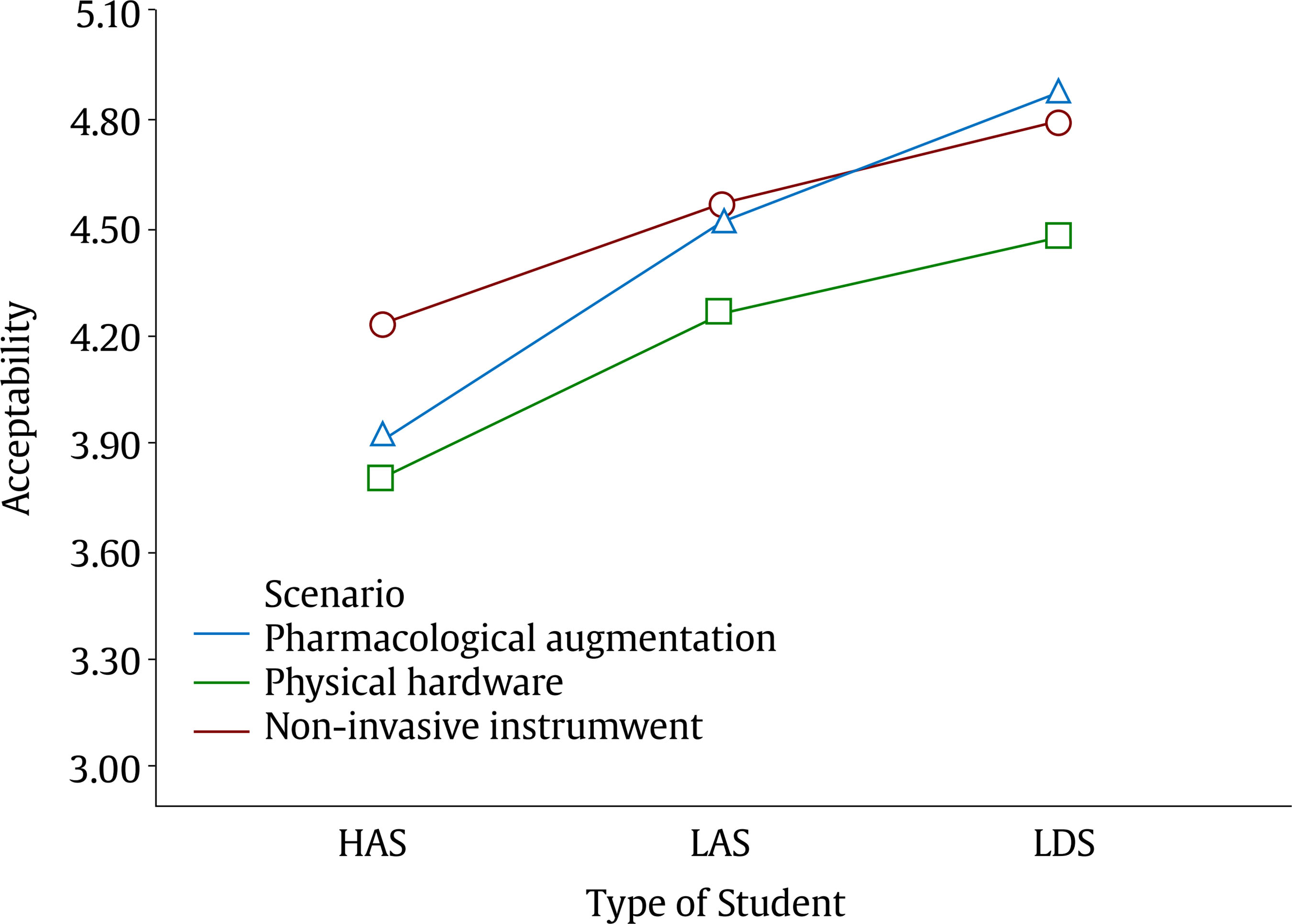 Interview Results The results of analyzing the interview materials revealed that there were differences in in-service teachers’ perceptions of the use of neurotechnology across disciplinary backgrounds and across teaching years. Mathematics and science teachers are more likely to actively learn about and explore in depth the principles and applications of neurotechnology due to their disciplinary characteristics’ focus on logic, science, and new technologies. Humanities teachers, on the other hand, may have a relatively low level of awareness of neurotechnology because their subject matter is less connected to it. In terms of teaching experience, newer teachers have higher expectations of neurotechnology and are willing to try to integrate it into their teaching. In contrast, teachers with longer teaching experience may show more concerns and conservative attitudes due to their reliance on traditional teaching methods and unfamiliarity with new technologies. Also they will be more cautious in considering the application of neurotechnologies, weighing multiple factors. These differences reflect the profound influence of individual teachers’ teaching experience and subject characteristics on their perception and acceptance of neurotechnology. Additionally, four major themes were identified through coding—two internal (e.g., knowledge reserve, learning ability) and two external (e.g., school support, training)—as summarized in Table 8. Table 8 Analysis of Thematic Factors Affecting Teacher Acceptance 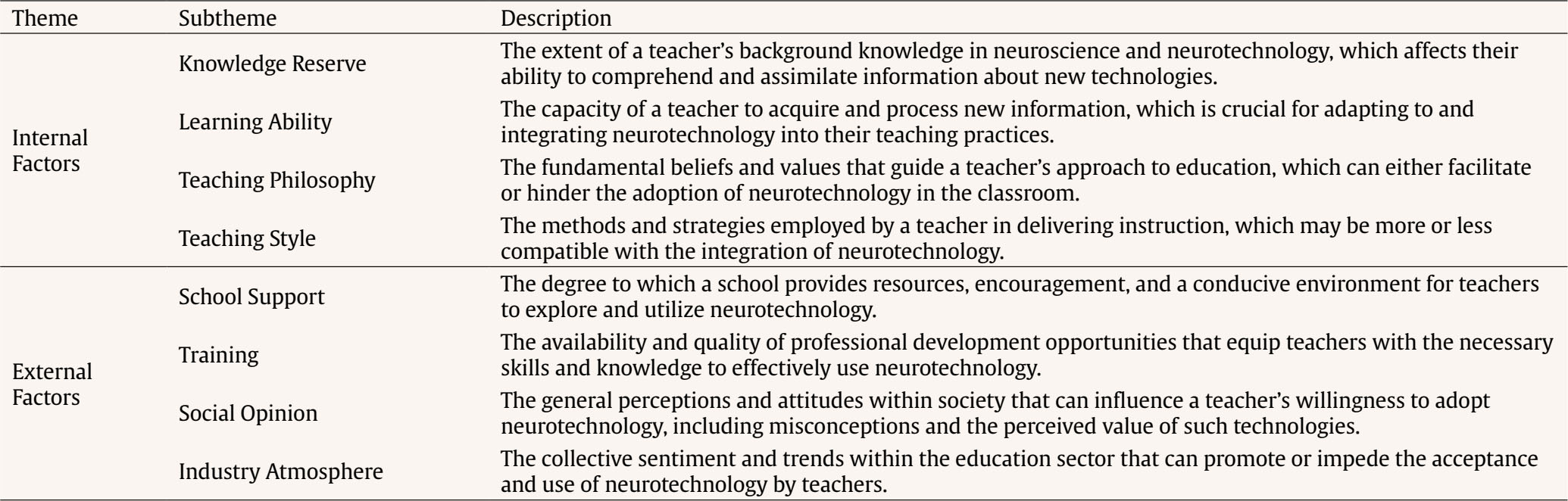 Teachers’ Attitudes towards the Application of Neurotechnology This study aimed to investigate the acceptance of different neurotechnologies among in-service teachers and analyze the influence of neuroscience training and ethical attitudes. The findings from the analysis of variance indicated that receiving neuroscience training had a significant impact on developing and strengthening positive attitudes among teachers regarding the relationship between neuroscience and education. Furthermore, the training experience significantly increased the frequency of their engagement with information related to neuroscience. The correlation analysis revealed significant relationships between teacher acceptance and several factors. Specifically, the perceived safety of neuroscience technology, its potential effects on educational equity, and the likelihood of implementation were all found to be significantly correlated with teacher acceptance. Teachers were more inclined to accept neurotechnology when they perceived it as safe and feasible for educational purposes. However, it is crucial to ensure that the introduction of neurotechnology does not hinder educational equity. Teachers tended to exhibit relatively tolerant ethical attitudes toward equity, particularly for low-achieving students and those with learning disabilities. In line with previous research (Schmied et al., 2021), the teachers in this study were more receptive to non-invasive neurological assessment instruments while being cautious about neuro-enhancing drugs and physical hardware, regardless of the type of student. This cautious attitude is also observed among students, parents, and healthcare providers (Forlini & Racine, 2012). The open-ended responses further revealed their concerns about safety when it comes to neurological drugs. Some teachers expressed a preference for using these drugs if they do not pose harm to the body. They emphasized the importance of safety and mentioned that if neurotechnology can help children with specific difficulties without adverse effects, it can be considered in small amounts. Safety becomes an ethical concern that deserves attention when promoting the use of neurotechnology in education. Another notable concern expressed by these teachers is the potential side effects of neurotechnology. While invasive neurotechnology may bring benefits to students, there are unknown factors that could lead to side effects, such as impacts on personhood or a sense of unnaturalness (Meier et al., 2019; Sample & Aunos et al., 2019). The teachers in this study acknowledged the potential benefits but also expressed fear of these side effects. Furthermore, educational equity emerged as a significant topic of concern for teachers. One teacher highlighted that neuroenhancement techniques, although effective, could exacerbate inequities in education and disadvantage students from lower socioeconomic backgrounds. This raises reservations among these teachers about the potential impact of neurotechnology on educational equity. It is important to recognize that while neurotechnology can serve as an instrumental tool, similar to other educational technologies, it cannot fundamentally address the underlying inequities in educational opportunities, processes, and conditions. These issues involve the rational and equitable allocation of educational resources in a fair and orderly manner. These findings clarify the perspectives of teachers regarding safety, side effects, and educational equity when considering the implementation of neurotechnology in education. Addressing these concerns and ensuring ethical considerations are considered critical in promoting the responsible and beneficial use of neurotechnology in educational settings. The study did not find a significant influence of training experience on the participating teachers’ ethical perceptions and acceptance attitudes toward the application of neuroscience techniques. This null effect may be explained by several factors. First, the current training formats are often short-term, lecture-based, and heavily theoretical, focusing on general neuroscience concepts rather than on the ethical, pedagogical, and practical implications of neurotechnologies. Such training may raise basic awareness but fail to foster deep reflection or behavioral change related to ethical decision-making in real teaching contexts (Privitera, 2021). Second, teachers’ ethical perceptions and acceptance attitudes are likely shaped by more stable personal and contextual factors, such as teaching experience, subject background, and exposure to educational policy discussions, which may not be easily altered through brief training sessions. Third, there may be a mismatch between the content of neuroscience training and teachers’ practical needs. If training focuses primarily on brain mechanisms in learning rather than on the classroom integration of neurotechnological tools, teachers may not directly connect the training experience with their ethical or practical evaluations of such technologies. The results of this study suggest that teachers’ willingness to accept neurotechnology in education is shaped by multiple interrelated factors rather than by a single determinant. Specifically, teachers’ perceptions of the usefulness of neurotechnology for improving teaching effectiveness, its ease of integration into classroom practice, and the surrounding social and institutional support all appeared to influence their overall acceptance attitudes. As one teacher stated, “If it can really help students focus better, I think it is worth trying. However, we need to understand how safe it is first.” Another participant emphasized practicality, noting that “We already have many tools to manage, and if this technology is too complicated, it will simply become one more burden.” Individual characteristics such as teaching experience and disciplinary background also played moderating roles. The interview findings revealed that teachers with more years of teaching experience tended to show greater caution and hesitation, while younger teachers and those from science-related subjects exhibited more openness toward exploring neurotechnological applications. For example, a senior teacher commented, “I have seen many new technologies come and go. I prefer to wait and see how this one develops.” In contrast, a younger science teacher expressed more enthusiasm, stating, “This could be the future of education, and I would like to try it with my students.” These findings highlight the importance of considering contextual and personal factors when promoting the educational use of neurotechnology, rather than focusing solely on the technical advantages of the tools themselves. In summary, the findings of this study have important implications for both the fields of education and neuroscience. The study underscores the significance of considering ethical factors, such as safety and equity, when implementing neurotechnologies in educational settings. Additionally, they emphasize the positive effect of neuroscience training on teachers’ access to neuroscience information. While the current study did not find a significant impact of training experience on teachers’ ethical perceptions and acceptance attitudes, it suggests the need to improve and refine neuroscience training for teachers. Enhancing the training content and format may help reduce biases and could equip teachers with a more comprehensive understanding of neuroscience, thereby potentially facilitating the effective utilization of neuroscience techniques in education. Limitation and Future Directions Despite its contributions, this study also has several limitations that should be considered when interpreting the findings. First, the sample was limited to experimental base schools associated with a single university in China. This restricted sampling framework reduces the representativeness of the data and may introduce contextual bias (Bornstein et al., 2013), as teachers from these schools may have greater exposure to neuroscience-related information than the general teaching population. Consequently, the results should be interpreted as reflecting the attitudes of this specific group rather than of all teachers. Future studies could address this limitation by including a larger and more diverse sample drawn from different regions, school types, and socioeconomic contexts, which would help enhance the external validity of the findings. Second, the measurement of teachers’ ethical attitudes toward neurotechnology relied on a single-item indicator. While single-item measures are sometimes used for pragmatic reasons, they tend to underestimate construct reliability and may fail to capture the multidimensional nature of ethical attitudes (Diamantopoulos et al., 2012). This limitation implies that the observed nonsignificant relationships involving ethics-related variables should be interpreted cautiously. Future research should develop and validate multi-item scales that comprehensively assess teachers’ ethical reasoning, perceived risks, and fairness concerns regarding neurotechnology. Finally, the cross-sectional design of the present study limits causal inference. Without longitudinal or experimental data, it remains unclear whether positive attitudes toward neuroscience lead to greater acceptance of neurotechnology, or whether teachers who are more accepting tend to perceive neuroscience more positively (Wang & Cheng, 2020). Future research could employ longitudinal tracking or intervention-based designs to examine how training, experience, and institutional policies shape teachers’ ethical awareness and technology acceptance over time. Such approaches would not only clarify causal pathways but also inform evidence-based professional development strategies for integrating neuroscience into education. Our groundbreaking study has transcended its limitations and revealed a remarkable correlation between teachers’ ethical attitudes toward neurotechnology and their acceptance of this cutting-edge field. The implications of these findings are monumental, as they shed light on the future application of neurotechnology within educational environments. This invaluable research offers profound insights that demand attention from all stakeholders in the field of education. Foremost, education regulators and policymakers shoulder the responsibility of orchestrating a well-regulated and harmonized educational landscape. Crafting judicious policies and ensuring equitable allocation of neurotechnology resources emerge as imperative tasks. Vigilant scrutiny and stringent qualification reviews must be in place to counteract unfounded claims propagated by certain institutions regarding the enhancement of students’ learning abilities through neurotechnology. We must safeguard our students from potential harm to their physical well-being and property. Moreover, utmost caution should be exercised to prevent any unwarranted collection or misuse of students’ neural signal data, effectively safeguarding their right to privacy, and ensuring it remains sacred and inviolable. In pursuit of an exemplary model, we can draw inspiration from the prestigious Brain Imaging Dialogue community established in the United Kingdom. This visionary initiative fosters early public deliberations surrounding brain science and technologies that may stir controversy. By convening eminent scientists, health workers, sociologists, philosophers, ethicists, religious representatives, citizens, policymakers, and legal experts, robust discussions on nonmedical applications of brain imaging technology transpire (Escobar, 2014). Adopting a similar approach within educational policy development will provide a platform for inclusive dialogue, allowing parents, teachers, and student groups to contribute their invaluable perspectives. Policies forged through such collective wisdom will invariably serve the best interests of the broadest spectrum of students, nurturing an environment conducive to their holistic growth and development. Secondly, it is imperative for educational administrators to provide teachers with comprehensive and multi-level training in neuroscience. This training should encompass a broad understanding of neuroscience as a discipline, the latest research findings, and a comprehensive knowledge of neurotechnology. By equipping teachers with a clear understanding of the scope and application of neurotechnology, they will be better positioned to integrate these technologies into their teaching methods without falling prey to misguided beliefs or neuromyths that may misguide their pedagogical approaches (Howard-Jones & Paul, 2014). Furthermore, fostering communication and collaboration between teachers and neuroscience researchers should be prioritized. Establishing platforms such as “industry-academia-research” project sites and workshops can facilitate meaningful exchanges, allowing educators to gain insights from cognitive neuroscientists and educational researchers. The goal is to transform educators into “educational engineers,” capable of translating the advancements made by experts into practical applications within the classroom (Fischer, 2009; Zadina, 2015). Thirdly, as direct facilitators of student learning, in-service teachers wield significant influence over students’ utilization of neurotechnology. It is crucial for teachers to acquire a solid foundation in neuroscience, enabling them to offer targeted guidance to students on the effective use of neurotechnology. However, caution must prevail when interpreting and adopting the results of neurotechnological assessments and predictions for students. Students should never be reduced to mere categories or labels based on these outcomes. Teachers must approach technology-driven assessments and predictions from a positivist and empirical standpoint, placing student-centered perspectives at the forefront rather than relying solely on instrumental motives. By providing multifaceted training in neuroscience, promoting collaboration between educators and researchers, and fostering a balanced approach to the use of neurotechnology, we can empower teachers to navigate the dynamic landscape of educational neuroscience. Through their expertise and ethical conduct, teachers will cultivate an environment that maximizes the benefits of neurotechnology while upholding the well-being and individuality of each student. In summary, our study’s findings are a catalyst for reform and transformation within the realm of education. They underscore the need for comprehensive regulation, ethically sound policies, and open deliberations. By embracing these insights and involving all relevant stakeholders, we can pave the way for a responsible integration of neurotechnology in education—an integration that harnesses its remarkable potential while safeguarding the well-being, privacy, and future of our students. Conflict of Interest The authors of this article declare no conflict of interest. Declaration of Generative AI and AI-assisted Technologies in the Writing Process During the preparation of this work the author(s) used ChatGPT 3.5 in order to polish language. After using this tool, the authors reviewed and edited the content as needed and take full responsibility for the content of the publication. Funding This research was supported by the Project Supported by National Social Science Foundation Western Project (No. 23XYY023). Cite this article as: Zhang, Z., Xu, Ch., & Shao, H. (2026). From lab to classroom: Teachers’ perspectives on neurotechnology integration. Psicología Educativa, 32, Article e260453. https://doi.org/10.5093/psed2026a10 References |
Cite this article as: Zhang, Z., Xu, C., & Shao, H. (2026). From Lab to Classroom: Teachers’ Perspectives on Neurotechnology Integration. Psicología Educativa, 32, Article e260453. https://doi.org/10.5093/psed2026a10
Correspondence: hdshaohua@163.com (H. Shao).Copyright © 2026. Colegio Oficial de la Psicología de Madrid


 PDF
PDF e-PUB
e-PUB CrossRef
 JATS
JATS Imprimir
 Enviar
ALERTA POR E-MAIL
La Revista de Psicología Educativa está distribuida bajo una licencia de Creative Commons Reconocimiento-NoComercial-SinObra Derivada 4.0 Internacional.com