Correlates, Antecedents and Consequents of Socio-emotional Competencies in Higher Education: A Scoping Review
[Los correlatos, antecedentes y consecuentes de las competencias socioemocionales en la educación superior: una revisión exploratoria]
Marcela de Moura Franco Barbosa1, Amanda Espagolla Santos1, Vinicius Coscioni2, & Lucy Leal Melo-Silva1
1University of São Paulo, Brasil; 2Utrecht University, The Netherlands
https://doi.org/10.5093/psed2026a11
Received 3 February 2025, Accepted 4 December 2025
Abstract
This study aimed to identify, analyze, and synthesize the correlates, antecedents, and consequents of socio-emotional competencies through a scoping review. The search was conducted in ERIC, PsycNET, PubMed, SCOPUS, and Web of Science databases. Empirical, quantitative studies that assessed socio-emotional competencies in samples of university students were included, resulting in eight articles. The factors identified in the socio-emotional competence instruments were grouped through content analysis into four categories: (a) interpersonal relationships, (b) self-management of emotions, (c) life administration and management, and (d) openness and exploration. Based on these categories, the correlates, antecedents, and/or consequents of socio-emotional competencies were identified. The findings highlight meaningful associations between socio-emotional competencies and other social and emotional variables, reasoning, learning, and strategies for coping with challenges in academic life. Practical implications for career interventions and the development of educational policies are discussed.
Resumen
El estudio pretende detectar, analizar y sintetizar los correlatos, antecedentes y consecuentes de las competencias socioeconómicas por medio de una revisión exploratoria. Se realizaron búsquedas en las bases de datos ERIC, PsycNET, PubMed, SCOPUS y Web of Science. Se incluyeron estudios empíricos, cuantitativos que evaluaban las competencias socioemocionales en muestras de estudiantes universitarios, de los que se sacaron ocho artículos. Los factores detectados en los instrumentos de competencia socioemocional por medio del análisis de contenidos se agruparon en cuatro categorías: a) relaciones interpersonales, b) autogestión de las emociones, c) administración y gestión de la vida y d) apertura y exploración. Teniendo en cuenta estas categorías se detectaron los correlatos, antecedentes y/o consecuentes de las competencias socioemocionales. Los resultados destacan una asociación significativa entre competencias socioemocionales y otras variables sociales y emocionales, el razonamiento, el aprendizaje y estrategias para lidiar con los retos de la vida académica. Se comentan las implicaciones prácticas para intervenciones en las salidas profesionales y el desarrollo de políticas educativas.
Palabras clave
Competencia sociemocional, Estudiantes universitarios, Correlatos, Antecedentes, Consecuentes, Revisión exploratoriaKeywords
Socio-emotional competence, University students, Correlates, Antecedents, Consequents, Scoping reviewCite this article as: Barbosa, M. D. M. F., Santos, A. E., Coscioni, V., & Melo-Silva, L. L. (2026). Correlates, Antecedents and Consequents of Socio-emotional Competencies in Higher Education: A Scoping Review. Psicología Educativa, 32, Article e260454. https://doi.org/10.5093/psed2026a11
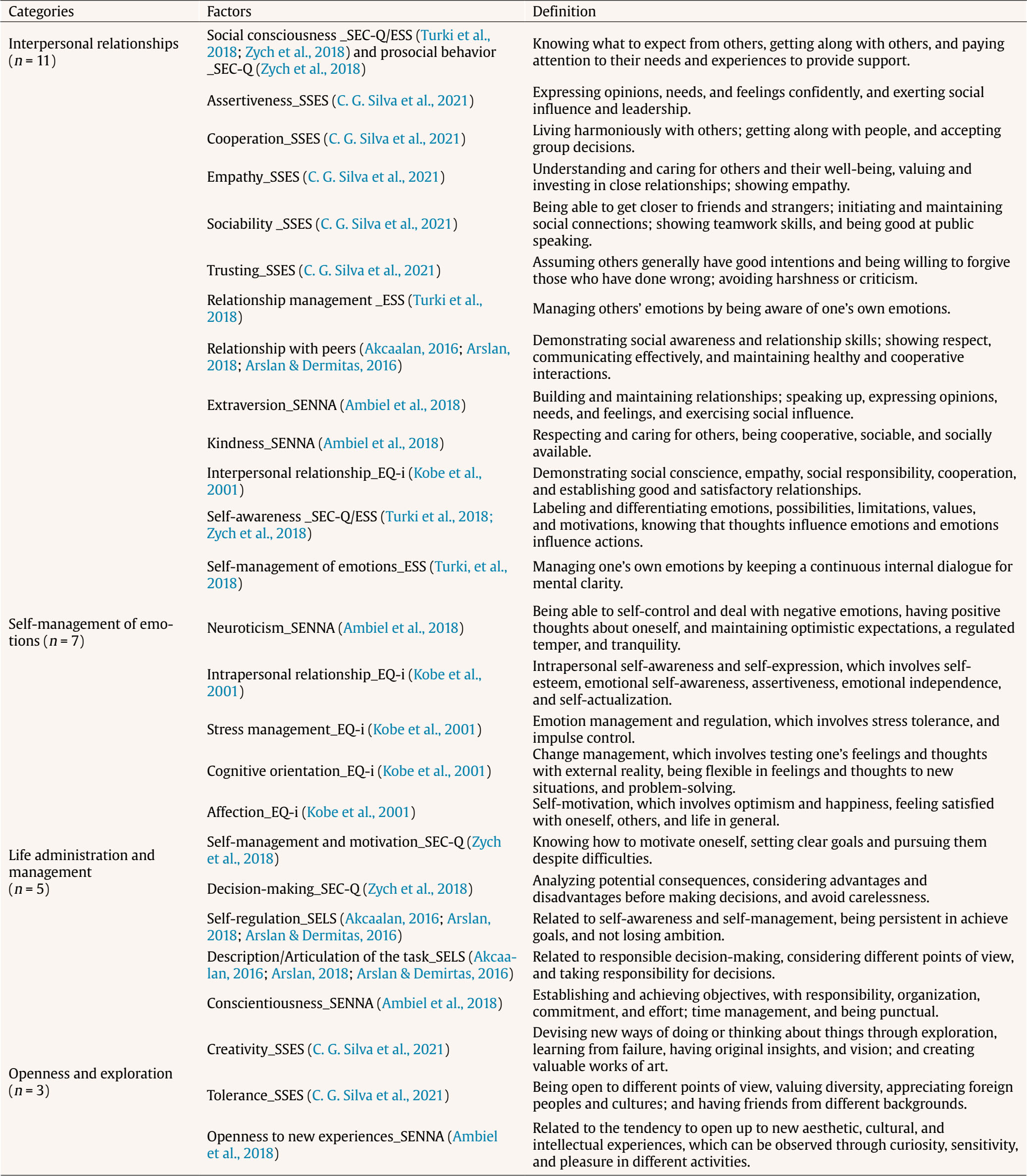
Correspondence: marcelafrancobarbosa@gmail.com (M. de Moura Franco Barbosa).Main Concepts Related to Socio-emotional Competencies The term socio-emotional competence refers to a set of competencies that encompass two key components: the social and emotional domains. Several theoretical approaches have been developed to support these two domains, including those centered on intelligence, skills, and competencies. D. C. McClelland (1973) suggested shifting the focus from intelligence to competence assessment. The latter represents a broader and more intensive ability to understand the environment in order to perceive, interpret, and anticipate appropriate actions (Gottfredson, 1997). In summary, skills are elements of competencies that contribute to the development of various types of competencies and are associated with know-how (Carroll, 1993). On the other hand, competencies are associated with task execution and are defined as a set of knowledge and practical skills (D. C. McClelland, 1973). Thus, three terms (intelligence, competencies, and skills) are frequently used in efforts to understand the socio-emotional dimension, with variations that include social, emotional, and socio-emotional aspects. One of the earliest related concepts is social intelligence, a term first used by Thorndike (1920), who defined it as the capacity to understand and manage individuals, act wisely in relationships with others, and respond or adapt to different social situations (Mayer & Salovey, 1993). The term social skills appears more frequently in recent literature and refers to different classes of social, situational, and cultural behaviors that contribute to healthy and productive interactions with others (Del Prette & Del Prette, 2019). Regarding the term social competence, although not equivalent, the concept is sometimes used as a synonym for social skill. Social competence can be understood as an evaluative concept referring to performance (manifest and/or private) in interpersonal tasks that meet situational demands and produce consequences. Thus, having well-developed social skills is a necessary but not sufficient condition for possessing social competence, which also requires the ability to perform those skills (Del Prette & Del Prette, 2019). From the perspective of emotional dimensions, the concepts of emotional intelligence, competence, and skill also stand out. One of the earliest approaches in this area is emotional intelligence, which refers to the ability to perceive, understand, manage, and use emotions effectively in oneself and others. According to Mayer and Salovey (1993), emotional intelligence is conceptualized as a set of cognitive abilities organized into four branches: perceiving emotions, using emotions to facilitate thinking, understanding emotional meanings, and managing emotions. This model emphasizes emotional intelligence as a form of intelligence related to information processing involving emotions. Mayer et al. (2016) further refined this definition, highlighting emotional intelligence as the capacity to reason about emotions and to use emotional information to enhance thought and decision-making. Complementarily, Goleman (1995) popularized the concept in applied contexts, framing emotional intelligence as a set of competencies that influence how individuals manage themselves and their relationships, including self-awareness, self-regulation, motivation, empathy, and social skills. Furthermore, Bar-On (1997) conceptualized emotional intelligence as a set of emotional, personal, and social competencies that influence an individual’s ability to succeed in life and maintain psychological well-being. Unlike approaches focused on cognitive abilities, Bar-On defines emotional intelligence as a construct that encompasses five core domains: intrapersonal, interpersonal, stress management, adaptability (reality testing and problem-solving), and general mood (optimism and happiness). Together, these perspectives underline the role of emotional intelligence in psychological well-being, interpersonal functioning, and adaptive behavior. On the other hand, emotional competence can be understood as a set of knowledge, abilities, skills, and attitudes necessary to understand, express, and regulate appropriate emotional phenomena in oneself and in relation to others (Bisquerra Alzina, 2003). Emotional skills, in turn, are organized into five basic dimensions: cooperation, assertiveness, responsibility, empathy, and self-control. These dimensions are convergent with the concept of emotional intelligence, which encompasses self-awareness and emotional management, self-motivation, empathy, and social skills (Mayer & Salovey, 1993). In this study, we used the term socio-emotional competencies in accordance with Schoon’s (2021) integrative taxonomy, Domains and Manifestations of Social-Emotional Competencies (DOMASEC), as it is broader and incorporates a range of skills. Socio-emotional competencies can be conceptualized as a set of adaptive capacities that develop through the interplay of social and affective processes, enabling individuals to perceive, experience, and regulate their own emotions, interpret others’ emotional states, and modify behavior in response to shifting circumstances (Marin et al., 2017). These competencies—distinct from strictly academic skills—emerge from reciprocal interactions between innate predispositions and environmental influences, evolve gradually over the lifespan, and remain amenable to enhancement through both formal and informal learning experiences (De Fruyt et al., 2015). Their manifestation—in relatively stable yet context-sensitive patterns of thoughts, feelings, and behaviors—depends on situational demands and can therefore be targeted by tailored interventions aimed at improving individual functioning (Schoon, 2021). Because socio-emotional competencies reflect dimensions of human capital—such as goal setting, responsible conduct, emotional self-control, and resilience—they have been empirically linked to academic achievement, career success, well-being, and broader socioeconomic outcomes (Organização para Cooperação e Desenvolvimento Econômicos [OCDE, 2015]; D. Santos & Primi, 2014). Research on these competencies spans multiple domains: in education, they inform programs for holistic student development from early childhood onward (Abed, 2016; D. Santos & Primi, 2014); in psychology, they underpin research on personality, school adjustment, and occupational behavior and in vocational guidance they guide interventions to support the adaptation of adolescents, young adults, and professionals across diverse training backgrounds and career transitions. In the context of hiring individuals or services, managers often report dissatisfaction with workers’ emotional regulation. They argue that cognitive and technical skills alone are insufficient to address the complex challenges of contemporary society. Thus, the present review focuses on studies addressing socio-emotional competencies in higher education. The development of these competencies is essential for fostering personal, social, and professional relationships. The contemporary world is characterized as volatile, uncertain, complex, and ambiguous (VUCA), as well as brittle, anxious, non-linear, and incomprehensible (BANI), requiring individuals to possess a diverse set of skills to navigate their personal and professional lives (Grabmeier, 2019). College students, who will soon enter the workforce, must be equipped with these socio-emotional resources. The term “socio-emotional competencies” broadly describes the cluster of abilities that enable individuals to perceive, express, and manage their own emotions; interpret and respond to others’ emotions; and to adapt behavior effectively as situations evolve. Often referred to in the literature as non-cognitive, character, or “soft” skills—in contrast to more readily quantifiable cognitive abilities (Abrahams et al., 2019)—these capacities range from emotion recognition and regulation to interpersonal problem-solving. Although “skill” and “competence” are sometimes used interchangeably, the term competence usually implies a broader repertoire, encompassing multiple, interrelated skills (OCDE, 2015). In practice, both the conceptualization and measurement of socio-emotional competencies vary widely across research traditions and academic disciplines (Schoon, 2021). Socio-emotional competencies have been defined and organized within various theoretical frameworks, each emphasizing different facets of emotional and interpersonal functioning. From a developmental-psychological perspective, Saarni (1999) identified eight core emotional competence skills: (a) awareness of one’s own emotions, (b) accurate perception of others’ emotions, (c) facility with an emotion-specific vocabulary, (d) empathic responsiveness, (e) differentiation between internal emotional experience and external expression, (f) adaptive regulation of aversive emotions, (g) effective emotional communication within relationships, and (h) emotional self-efficacy. This model highlights both intrapersonal awareness and the interpersonal application of emotional skills. In contrast, the Collaborative for Academic, Social, and Emotional Learning (CASEL, 2020) proposes a five-domain framework designed for educational contexts: (a) self-awareness, (b) self-management, (c) social awareness, (d) relationship skills, and (e) responsible decision-making (CASEL, 2020). Whereas Saarni’ (1999) framework emphasizes discrete emotion-processing abilities, the CASEL model foregrounds school-based skill development that integrates cognitive, affective, and behavioral dimensions to support academic and life success. Lechner et al. (2019) propose that the Big Five personality traits serve as an overarching organizational scaffold for socio-emotional competencies, since each broad trait—Openness, Conscientiousness, Extraversion, Agreeableness, and Emotional Stability—encompasses multiple, more-specific socio-emotional capacities (e.g., conscientiousness includes self-regulation and goal persistence; agreeableness includes empathy and cooperation). By mapping finer-grained skills onto enduring trait dimensions, researchers can leverage the well-validated Big Five taxonomy to predict educational, occupational, and health outcomes across diverse populations and cultures. Most recently, Schoon (2021) introduced the DOMASEC taxonomy as a response to long-standing conceptual inconsistencies in the field of social-emotional competencies. This two-level model organizes constructs across three core domains—intrapersonal (self-orientation), interpersonal (other-orientation), and task-oriented—and three distinct manifestations within each domain: affective, cognitive, and behavioral. For instance, within the intrapersonal domain, emotional self-efficacy (affective), self-concept (cognitive), and self-regulation (behavioral) are delineated; likewise, empathy (affective), perspective-taking (cognitive), and cooperation (behavioral) represent key facets of the interpersonal domain. A central motivation for developing this taxonomy was to address the pervasive jingle-jangle fallacy, a conceptual pitfall that undermines theoretical clarity and empirical comparability. The jingle fallacy involves applying the same label to different constructs, while the jangle fallacy refers to using different labels for conceptually similar constructs. These issues, rooted in divergent disciplinary languages and measurement approaches, have led to a fragmented knowledge base. As Schoon (2021) emphasizes, the DOMASEC framework aims to harmonize terminology across disciplines, promote conceptual precision, and support the classification, assessment, and integration of social-emotional competencies within and across research traditions. Although the Big Five functions effectively as a macro-level organizer—providing parsimonious, stable dimensions that subsume many socio-emotional skills—it differs conceptually from “competencies,” which are defined as trainable, context-sensitive abilities to recognize, regulate, and express emotions or behaviors in specific situations (Lechner et al., 2019). Personality traits describe a person’s general dispositions or tendencies (“I am generally organized”), whereas socio-emotional competencies refer to actionable capabilities (“I can apply stress-management strategies under pressure”) that can be explicitly taught, learned, and assessed in educational or therapeutic settings. By combining the trait framework with competence-based taxonomies such as DOMASEC, researchers and practitioners can achieve both broad predictive power and fine-grained guidance for intervention design. Socio-Emotional Competencies in Higher Education Political, health, and social changes, along with globalization and advances in technology and science, have been reshaping the world of work—intensifying the challenges of entering and remaining in the labor market and demanding lifelong, continuous learning (A. M. S. Silva et al., 2015). In this context, higher education plays a decisive role in the university–to-work transition, as students must develop not only cognitive and technical competencies but also socio-emotional competencies (Gondim et al., 2014). Accordingly, institutions should revise their curricula by incorporating interdisciplinary, active, and personalized teaching approaches that foster digital literacy, experiential learning, and the strengthening of socio-emotional repertoires (Teng et al., 2019). The growing demand for professionals capable of addressing complex problems with adaptability and resilience has elevated socio-emotional competencies—such as self-awareness, emotional regulation, empathy, and teamwork—to a central position in the contemporary job market (Adib-Hajbaghery & Sharifi, 2017). Empirical studies have identified these competencies as predictors of academic success, professional adjustment, and the physical and psychological well-being of university students (Expósito et al., 2018). Given their malleability and positive impact on the development of technical and cognitive skills, it is essential to map the primary correlates, antecedents, and consequents of socio-emotional competencies in university student populations. Studies investigating the predictors and consequents of socio-emotional competencies remain relevant, as these competencies contribute to strengthening students’ cognitive and technical skills sets. A systematic examination of variables identified in the literature as correlates, antecedents, and consequents of socio-emotional competencies can help elucidate theoretical models of how socio-emotional competencies interact with other variables in higher education. Therefore, this study aimed to identify, analyze, and synthesize the correlates, antecedents, and consequents of socio-emotional competencies through a scoping review of quantitative studies addressing university student samples. A scoping review is a method used to synthesize and disseminate research findings on a specific subject (Tricco et al., 2016). Its purpose is to map the state of the art in a thematic area using a rigorous and transparent process, providing a descriptive overview of the studies reviewed (Arksey & O’Malley, 2005). Unlike systematic reviews, scoping reviews do not aim to evaluate the quality of available evidence, but instead focus on identifying key concepts and research gaps within a given field (Arksey & O’Malley, 2005). They also differ from traditional literature reviews, as they follow a systematic approach. Research Strategy and Selection of Articles The ERIC, PsycNet, PubMed, Scopus databases, and the Web of Science index, which together encompass the scientific literature in the fields of Education, Psychology and Psychiatry, Health and Medical Sciences, and Medical and Social Sciences, were initially searched. The search strategy was limited to titles and abstracts, and the following string of search terms was used: (“emotional and social” OR “social and emotional” OR “social-emotional” OR “socio-emotional” OR “socioemotional”) AND (“skills” OR “competence” OR “competencies” OR “ability” OR “abilities” OR “intelligence” OR “learning” OR “development” OR “expertise”) AND (“university students” OR “undergraduate students” OR “college students”). Figure 1 presents the study selection process, according to the PRISMA Protocol (Moher et al., 2009). A filter was applied to limit search results to articles; however, no restrictions were imposed on language or publication year. The inclusion criteria were: (a) empirical studies, (b) quantitative designs, (c) assessment of socio-emotional competencies, (d) samples composed of university students, and (e) investigations of relationships with other variables. Studies involving specific groups, such as athletes or individuals with autism, were excluded due to the uniqueness of these samples. Figure 1 Flowchart of the Study Selection Process (PRISMA).  Eligibility Assessment of the Studies The selection of the corpus was carried out in accordance with the PRISMA guidelines for scoping reviews (Tricco et al., 2016), and the results are summarized in Figure 1. Two independent reviewers (both holding Master’s degrees in career development) searched the five online databases on June 15, 2022, and found 676 records. After removing duplicates, 358 articles remained. Studies that did not include the previously cited search terms were excluded, resulting in a set of 66 articles for further analysis. After applying the inclusion and exclusion criteria, 38 articles were selected for full-text review. Ultimately, eight articles were included in the review. A third reviewer (a specialist in career development) evaluated any articles in cases where questions regarding eligibility arose. Inter-rater agreement was verified using the kappa coefficient during the screening and eligibility phases. The kappa values indicated excellent agreement in both stages, k = .97, p < .001 and k = .86, p < .001, respectively. Data Extraction and Analysis Two independent coders (the same reviewers who conducted the eligibility screening) analyzed the eight full-text articles and extracted the following information: year and language of publication; country of data collection; theoretical perspective on socio-emotional competencies; definition and term used for socio-emotional competencies; study design; instruments used to assess socio-emotional competencies and factors evaluated; instruments used to assess other variables and their corresponding factors; sample characteristics; participant age (range, mean, and standard deviation); sample size; results (correlates, antecedents and consequents); and statistical analyses performed. Differences in data extraction between the coders were rare and were discussed with a third reviewer (the same one involved in the eligibility screening), when necessary. Data analysis was conducted in depth following data extraction. The studies were initially characterized based on bibliometric data (country of origin and terminology), theoretical perspective, and methodological characteristics (study design, instruments, and samples). This information was compiled into summary tables. Next, the factors from the scales or instruments used to assess socio-emotional competencies were identified. These factors were grouped according to taxonomies and definitions using content analysis (Bardin, 2011), which consists of three fundamental steps: pre-analysis, material exploration, and treatment of results. In the pre-analysis phase, all scales factors were identified and defined. During material exploration, coding was based on registration units, defined as the “smallest element of content whose occurrence is recorded according to the established categories” (Franco, 2008, p. 41, free translation). In this study, similar classifications were adopted for both the variables and the instruments used to measure them. The context unit, according to Franco (2008), is the “background” that helps give meaning to the units of analysis—that is, the portion of the message that allows for understanding information at a broader level (Bardin, 2011). In this case, the very instruments identified in the reviewed studies were considered the context unit. The factors identified were organized into categories created a posteriori, based on theoretical similarity. Finally, in the results treatment phase, interpretations and inferences were based on the content expressed in the analyzed instruments. The correlates, antecedents, and consequents were subsequently identified and mapped to each category of the socio-emotional competencies. The effects of the relationships identified were evaluated considering Pearson’s r and Spearman’s ρ, as these were the correlations reported by the included studies. Correlation values ranged from -1 to 1 and were interpreted as follows: values < .10 were considered spurious, < .30, weak, < .50, moderate, and > .50, strong (Cohen, 1992). For the effect sizes of antecedents and consequents, standardized regression coefficients were evaluated using the same cut-off points. General Characteristics, Bibliometric Data, Theoretical and Methodological Perspectives of the Studies Table 1 presents the bibliometric and methodological data of the included articles. All studies were published in English between 2001 and 2021; only one was published between 2001 and 2010, and six between 2011 and 2020. Most articles focused on Asia, especially Turkey, followed by the United States and Europe. No articles authored by researchers from Africa or Oceania were found. Regarding the theoretical perspective, four articles were based on the Collaborative for Academic, Social, and Emotional Learning (CASEL, 2020) framework. Two articles adopted the emotional intelligence models of Goleman (1995) and Mayer and Salovey (1993). One study was based on the Big Five model, and another was based on the Study on Social and Emotional Skills (SSES), developed by the Organization for Economic Cooperation and Development (OECD, 2015). Seven studies employed a cross-sectional design, while only one study was longitudinal. Three articles used the same instrument, the Social Emotional Learning Scale (SELS) (Coryn et al., 2009). As for sample characteristics, five studies included approximately 200 participants, with ages ranging from 17 to 37 years. Table 1 Summary of Articles by Country of Origin, Theoretical Perspective, Terminology Used, Study Design, Instruments Used, and Sample Characteristics 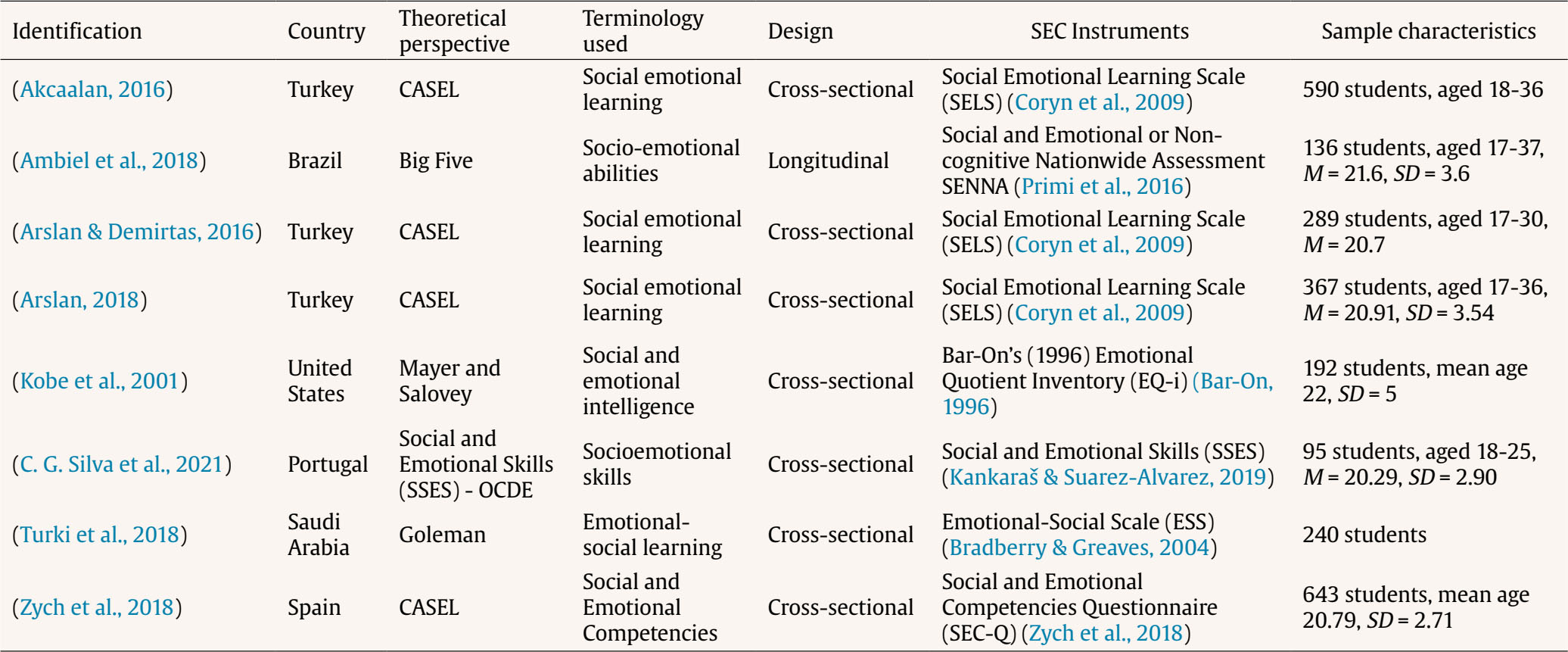 Note. Source: developed by the authors. Akcaalan (2016) and Turki et al. (2018) did not report the mean and standard deviation of participants’ age. Categorization and Dimensions of Socio-emotional Competencies in the Evaluated Instruments To organize the various dimensions assessed by the instruments included in this review, a content analysis was conducted based on the constructs and definitions provided by the original scales (Annex 1). This analysis resulted in the creation of four categories of socio-emotional competencies: (a) interpersonal relationships, (b) self-management of emotions, (c) life administration and management, and (d) openness and exploration. These categories were developed a posteriori through theoretical grouping and reflect conceptual convergences frequently cited in the literature on socio-emotional competencies. The categorization was grounded in an integrative theoretical framework discussed in the theoretical section, which incorporates models such as CASEL (2020), the Big Five personality traits (Lechner et al., 2019), emotional intelligence frameworks (Goleman, 1995; Mayer & Salovey, 1993), and the DOMASEC taxonomy (Schoon, 2021). Each category reflects shared elements from these perspectives and serves as an organizing lens for understanding the empirical constructs measured across the selected studies. Interpersonal relationships They refer to the ability to connect with others, demonstrate empathy and care, and maintain positive social interactions. This category aligns with the “interpersonal domain” of the DOMASEC model and the “relational skills” and “social awareness” domains of CASEL (2020). It encompasses factors such as empathy, cooperation, sociability, and prosocial behavior—skills essential for building meaningful connections and managing social dynamics. Eleven factors identified in eight articles were grouped into this category, with the study by C. G. Silva et al. (2021) contributing five of them. Self-management of emotions It involves the identification, regulation, and effective use of one’s emotional states. It corresponds to the “intrapersonal–affective domain” of the DOMASEC taxonomy and to the “self- awareness” and self-management components of CASEL, as well as to the emotional intelligence constructs proposed by Bar-On (1997) and Mayer and Salovey (1993). This category includes seven factors drawn from four studies, with significant contributions from Kobe et al. (2001). Table 2 Articles Distributed according to the Variables Investigated and Statistical Analyses Used  Note. Source: developed by the authors. Life administration and management It encompasses competencies related to setting and achieving goals, organizing tasks, and making responsible decisions. This category reflects the “task-oriented domain” of the DOMASEC taxonomy and the “conscientiousness” trait of the Big Five model. It includes factors such as decision-making, planning, self-regulation, and motivation, which are closely linked to academic and professional success. Five factors from five distinct articles were identified in this category. Openness and exploration It refers to the disposition to engage with new experiences, perspectives, and cultural contexts. It resonates with the “openness to experience” trait of the Big Five model and the “cognitive manifestations” of the interpersonal and task-oriented domains in DOMASEC taxonomy. This category includes dimensions such as creativity, tolerance for diversity, and intellectual curiosity. It was represented by three factors across two studies, with C. G. Silva et al. (2021) contributing the majority of them. This categorization allows for the integration of multiple theoretical perspectives and contributes to resolving recurring conceptual ambiguities in the field, such as the “jingle-jangle fallacy”—the conflation of distinct constructs under a single term or the use of different terms for similar constructs. Thus, the categories provide a coherent and theoretically grounded framework for analyzing how socio-emotional competencies are operationalized and assessed across higher education contexts. Table 3 Correlations between Socio-emotional Categories and Variables by Effect Size Intensity 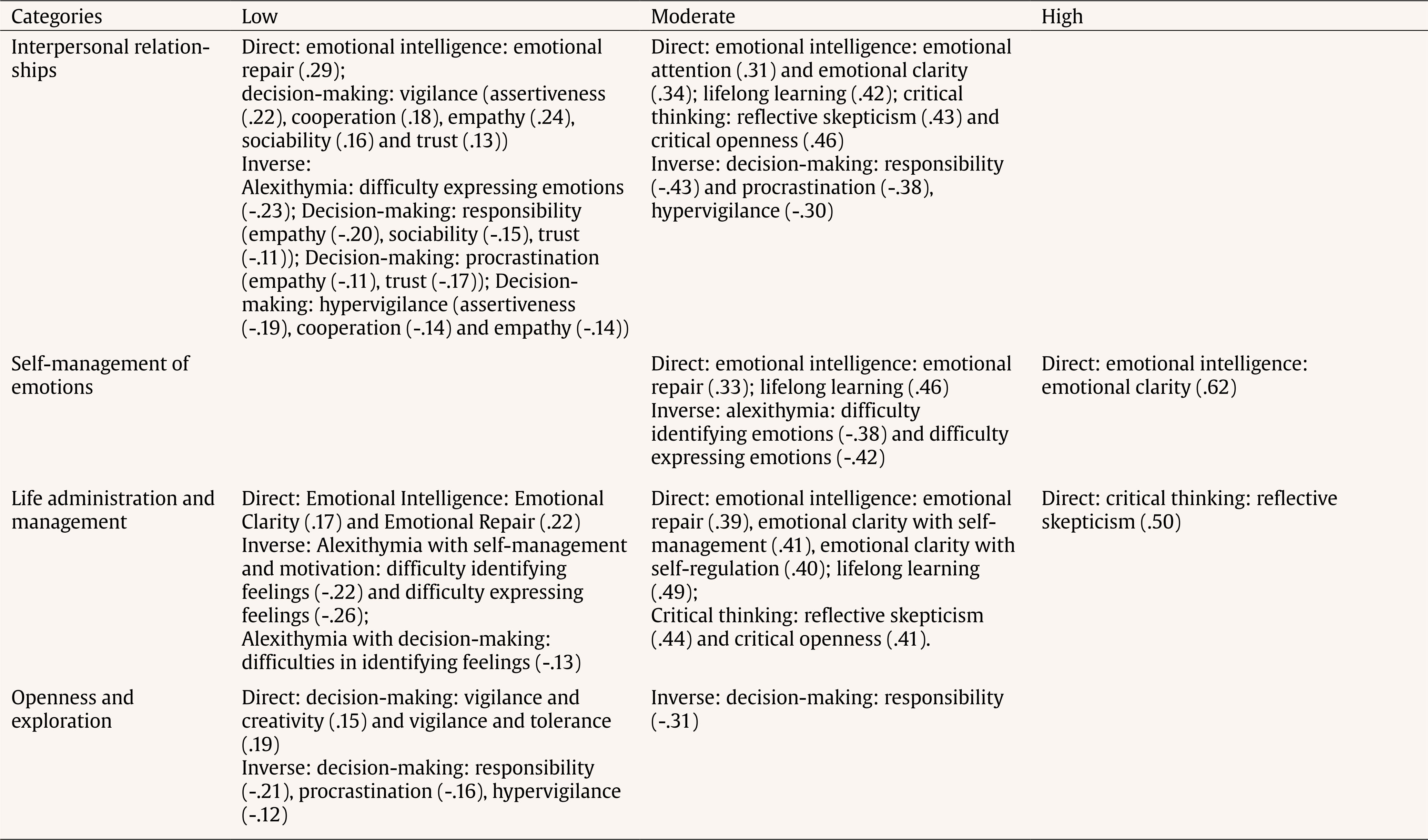 Note. Source: developed by the authors. Statistical Analyses Table 2 summarizes the variables related to socio-emotional competencies and the statistical analyses used to examine these relationships. Four studies investigated correlates, three articles analyzed consequents, and one focused on antecedents. Most of the statistical analyses used Pearson’s correlation coefficients, with one study employing Spearman’s correlations. Regression analyses were used to assess antecedents and consequents. Correlates As shown in Table 3, four studies investigated correlations between socio-emotional competencies and other variables, such as emotional intelligence, critical thinking, lifelong learning, decision-making, and alexithymia. Note that the instruments used to assess alexithymia, emotional intelligence, decision-making, and critical thinking measured these constructs as multifactorial. Emotional Intelligence. This construct refers to the ability to perceive, express, use, and regulate emotions, and was assessed across three dimensions: emotional attention, clarity, and repair (Zych et al., 2018). Strong correlations were found only between emotional intelligence and the factors within the self-management of emotions category. Additionally, emotional intelligence showed low to moderate correlations with factors from the interpersonal relationships, self-management of emotions, and life administration and management categories. Critical Thinking. Defined as a self-regulated reasoning process through which individuals make judgments by questioning, affirming, approving, or correcting during cognitive activities focused on a specific purpose. It is measured by two dimensions: critical openness and reflective skepticism (Arslan & Demirtas, 2016). Critical thinking presented moderate to high correlations with factors within the life administration and management category and moderate correlations with the factors in the interpersonal relationships category. Lifelong Learning. Defined as formal or informal learning that occurs throughout an individual’s life and is related to social and emotional aspects (Akcaalan, 2016). Lifelong learning showed moderate correlations with factors in the interpersonal relationships, self-management of emotions, and life administration and management categories. Decision-making. Defined as a set of strategies for addressing decisional conflicts, it is measured across four factors: vigilance (related to assertiveness), hypervigilance (impulsive and unplanned responses to decision-making situations), responsibility (defensive attitudes in relation to decision-making), and procrastination (evasive behavior in decision-making) (C. G. Silva et al., 2021). Responsibility, procrastination, and hypervigilance showed inverse correlations of low to moderate magnitude with factors in the interpersonal relationships and openness and exploration categories. Alexithymia. Defined as difficulty expressing and identifying emotions (Zych et al., 2018), it is understood as a set of deficiencies in the intra- and interpersonal processing of emotions (Páez & Velasco, 2001). Alexithymia represents the negative counterpart of Emotional Intelligence, with its components inversely correlated with those in the Mayer and Salovey’ (1993) Model. It showed moderate inverse correlations with self-management of emotions and low inverse correlations with factors from the interpersonal relationships and life administration and management categories. Antecedents As shown in Table 4, only one article investigated antecedents of socio-emotional competencies. Table 4 Antecedent and Consequent Variables and Their Magnitudes 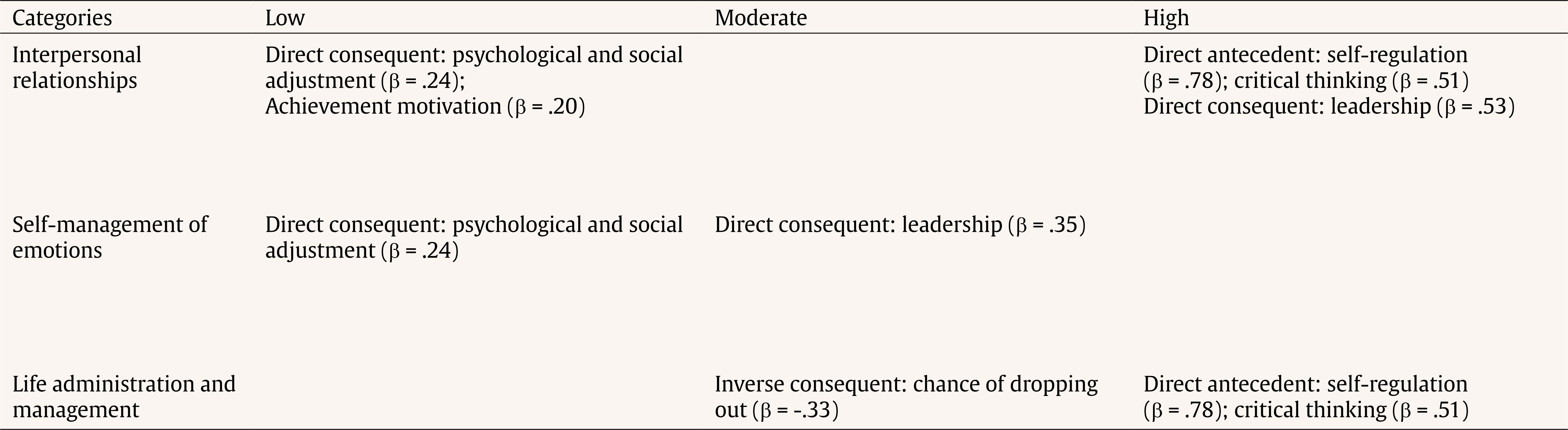 Note. The β found in the antecedents were extracted from a mediation model in which self-regulation is the antecedent, critical thinking is the mediator and socioemotional competencies are the dependent variables. Source: developed by the authors. Self-regulation. Defined as the ability to understand and manage one’s learning, emotions, and resources (Arslan, 2018), self-regulation was a strong and direct predictor of the interpersonal relationships and life administration and management categories. Critical Thinking. Understood as the ability to draw conclusions by questioning, affirming, approving, or correcting in response to situations (Arslan, 2018), critical thinking was identified as an antecedent of the interpersonal relationships and life administration and management categories, showing a strong effect. It also served as a mediating variable in the relationship between self-regulation and socio-emotional competencies. When included in the mediation model, the predictive effect of self-regulation on socio-emotional categories decreased but remained strong. Consequents As shown in Table 4, three articles investigated four variables associated with socio-emotional competencies. Leadership. This construct encompasses social and emotional components related to the ability to understand and interact with others, as good leaders demonstrate empathy and awareness of others’ needs (Kobe et al., 2001). Leadership emerged as a consequent of the interpersonal relationships category, showing a strong positive effect. Additionally, the self-management of emotions category was a predictor of leadership, with a moderate effect. Chance of Academic Dropout. This refers to the likelihood of a student abandoning their academic activities (Ambiel et al., 2018) and was identified as the only consequent of the life administration and management category, showing a moderate inverse effect. Psychological and Social Ad justment. This construct is understood as a set of skills related to social, occupational, and educational functioning, including problem-solving, perceived competence, and social skills (Turki et al., 2018). Similar to leadership, this variable was a consequent of the socio-emotional categories of interpersonal relationships and self-management of emotions, both showing low-magnitude effects. Achievement Motivation. This refers to the inclination to pursue challenging goals, exert control, overcome difficulties, strive for higher standards, stand out, compete, surpass others, and enhance self-esteem through the use of one’s own abilities. In academic contexts, it involves facing challenges with resourcefulness (Turki et al., 2018). This variable was identified as a consequent of the interpersonal relationships category, showing a direct effect of low magnitude. This scoping review identified, analyzed, and summarized the correlates, antecedents, and consequents of socio-emotional competencies based on eight articles retrieved from online databases in the fields of education, psychology and psychiatry, health, medical, and social sciences. Four studies investigated five correlates of socio-emotional competencies, one study investigated two antecedent variables, and three investigated four consequents. The identified variables are related to key aspects of life and career, particularly within academic and professional settings. These variables were classified into four categories: (a) social, referring to social functioning and interpersonal relationships; (b) emotional, focused on the identification of emotions; (c) reasoning and learning, encompassing understanding, judgment, decision-making, and knowledge acquisition; and (d) overcoming academic barriers, defined as strategies for achieving goals despite challenges. The correlates identified fall within the emotional domain (emotional intelligence and alexithymia) and the reasoning and learning domain (decision-making, critical thinking, and lifelong learning). These findings suggest that developing socio-emotional competencies may help prevent impulsive and unplanned decision-making. The results corroborate the literature, as socio-emotional competencies are frequently associated with a sense of control over one’s environment and an interest in learning (Gondim et al., 2014), as well as with emotional regulation and creativity, which are linked to positive affect and well-being in interpersonal relationships (Costa & Sánchez, 2013). The results also align with the findings of Damásio (2017), who argue that emotions support reasoning and learning. Although emotions were historically viewed as opposed to reason, current perspectives recognize their integration into reasoning, learning, and decision-making. Thus, emotions play a central role in cognitive orientation (F. M. T. Santos, 2007). Moreover, two antecedents were identified, both related to the reasoning and learning domain (self-regulation and critical thinking). These variables predicted socio-emotional competencies associated with interpersonal relationships and life administration and management. By managing their learning environment and maintaining a sense of a purpose, students gain greater control and a sense of responsibility over their plans and goals. The development of socio-emotional competencies is also associated with the creation of social networks that support the construction of life and career projects. Control over the learning environment enhances the depth and content of discussions and improves critical thinking. Therefore, critical thinking was identified as a mediating factor in the relationship between self-regulation and socio-emotional competencies. This finding aligns with the studies by M. M. McClelland et al. (2007) and Zimmerman et al. (1992), which show that self-regulation contributes to motivation, goal setting, and sustained attention in the classroom. Critical thinking can improve academic performance and also support the development of students’ socio-emotional competencies (Akcaalan, 2016). Finally, the identified consequents relate to the social domain (leadership and psychological and social adjustment) and to overcoming academic barriers (likelihood of dropout and performance motivation). These variables emerged from socio-emotional competencies in the domains of interpersonal relationships, self-management of emotions, and life administration and management. These findings are consistent García-Sancho et al. (2014), who argue that the development of socio-emotional competencies promotes academic success, the ability to adapt to the external demands, cope with adversity and stress, and establish and maintain healthier relationships and effective leadership. Similarly, Damásio (2017) states that individuals with well-developed socio-emotional competencies exhibit more positive self-perceptions, including greater self-efficacy, persistence toward goals, commitment, and higher academic performance. A greater number of studies have been conducted in other contexts, particularly in elementary education. Consequently, the body of knowledge in this field is more consolidated and advanced, with additional studies identifying further correlates, antecedents, and consequents of socio-emotional competencies. Gonçalves (2022) found that socio-emotional competencies are strong predictors of academic performance in school-aged children, highlighting the relevance of socio-emotional learning for academic success. Souza (2019) examined high school students and found that those with experience in the labor market tend to exhibit more developed socio-emotional competencies and greater career adaptability than their peers without such experience. Still within the educational context, Abed (2016) found that personality, self-efficacy, self-concept, and self-confidence positively predict individual achievement, development, academic training, and future success. Well-developed socio-emotional competencies are also associated with improved individual and team performance, better health and quality of life, a more positive organizational climate, and enhanced cognitive and learning skills. These findings prompt relevant reflections regarding the potential overlap between the proposed categories of socio-emotional competencies. It is recognized that certain socio-emotional competencies may exert influence across multiple dimensions of human functioning, reflecting the inherently multidimensional and integrative nature of these constructs (CASEL, 2020; Schoon, 2021). However, the categorization adopted in this study was guided by the predominant functional role of each competence, prioritizing its core theoretical focus as defined in the instruments and conceptual frameworks employed. For example, although decision-making may positively affect interpersonal relationships—by supporting conflict resolution or enhancing communication strategies—it is conceptually more closely aligned with self-regulation, goal setting, and life management processes. Therefore, it was classified under “life administration and management”, as this is the domain where its application is most autonomous and structurally significant. Such overlaps are intrinsic to the field of socio-emotional competencies, reflecting the complexity of real-life contexts in which different skills operate in an interdependent and dynamic manner. Rather than compromising the analytical clarity of the proposed framework, this overlap reinforces the understanding of socio-emotional competencies as dynamic systems capable of producing transversal effects across various contexts. This insight highlights the need for future research aimed at deepening the understanding of these interrelationships, thereby contributing to the development of more refined and comprehensive theoretical models and taxonomies. Moreover, further research focused on the university environment is essential to advance knowledge production and support the consolidation of theoretical models and robust interventions in higher education and professional contexts. Conclusion, Limitations, and Future Implications This scoping review identified, analyzed and summarized the correlates, antecedents, and consequents of socio-emotional competence in studies conducted with university students. The findings show relevant relationships between socio-emotional competence and social and emotional variables, reasoning, learning, and coping with academic challenges. These findings underscore the importance of further research and practical applications aimed at fostering the development of socio-emotional competence in university students. Most of the retrieved studies were cross-sectional, with only one using a longitudinal design, revealing a gap in studies of this nature. The publications predominantly investigated correlations between variables, with few studies focusing on antecedents and consequents; evidence in these areas remain limited. These findings suggest that socio-emotional competencies are seen as predictors of other variables, supporting the development of theoretical models that can inform the design of interventions. Such findings highlight the importance of fostering socio-emotional competencies to promote other competencies relevant for life and career. Regarding limitations, this scoping review followed the systematic and rigorous procedures in accordance with PRISMA guidelines (Tricco et al., 2016). The selection of online databases, search terms, and inclusion and exclusion criteria were well-founded and justified but reflect the authors’ methodological choices. Alternative decisions might have yielded different results, conclusions, and insights. Moreover, the use of varied terminology, such as social and emotional competencies, socio-emotional skills, emotional-social learning, social emotional learning, socio-emotional abilities, and social and emotional intelligence reveals the lack of terminological standardization, which may have hindered access to other relevant studies on this topic. Broader search strategies, including keywords related only to social or emotional adjectives, might have retrieved additional studies. However, we intentionally focused on studies that addressed both domains of competence (social and emotional) to specifically examine studies that conceptualize this construct as an independent domain. Finally, including other types of documents, such as theses and dissertations, might have expanded the scope of findings and perhaps uncovered additional correlates, antecedents, and consequents of socio-emotional competencies. The search and identification of correlates, antecedents, or consequents of emotional competencies is important, as it can provide insights for further investigations, support the design of interventions, and inform the development of educational policies. Thus, this study provides a comprehensive and systematized overview of the variables associated with socio-emotional competencies in higher education, serving as a reliable source for future researchers to identify both consolidated findings and gaps in the literature, thereby guiding new studies and research agendas. This may also support the implementation of programs to foster socio-emotional competencies more systematically and universally across disciplines and undergraduate and graduate programs. Based on the findings of the reviewed studies, there are potential implications for practices in both educational and career contexts, which can contribute to strengthening socio-emotional competencies. Interventions intentionally designed to promote these competencies, as well as other transversal and transferable competencies, are suggested. As an educational policy, more deliberate actions should be taken to encourage exploratory behavior, openness to new experiences, human interaction, and social engagement. For example, institutions could promote students’ involvement in activities beyond the classroom, such as sports, voluntary internships, participation in research laboratories, and university extension programs. The role of educational institutions is to encourage the continuous pursuit of knowledge and to prepare future generations to engage in environmentally sustainable, economically viable, socially equitable, and culturally inclusive activities. In this sense, well-developed and well-regulated socio-emotional competencies enable individuals to deal with the complex challenges of the 21st century. Cite this article as: de Moura Franco Barbosa, M., Espagolla Santos, A., Coscioni, V., & Leal Melo-Silva, L. (2026). Correlates, antecedents and consequents of socio-emotional competencies in higher education: A scoping review. Psicología Educativa, 32, Article e260454. https://doi.org/10.5093/psed2026a11 References |
Cite this article as: Barbosa, M. D. M. F., Santos, A. E., Coscioni, V., & Melo-Silva, L. L. (2026). Correlates, Antecedents and Consequents of Socio-emotional Competencies in Higher Education: A Scoping Review. Psicología Educativa, 32, Article e260454. https://doi.org/10.5093/psed2026a11
Correspondence: marcelafrancobarbosa@gmail.com (M. de Moura Franco Barbosa).Copyright © 2026. Colegio Oficial de la Psicología de Madrid


 PDF
PDF e-PUB
e-PUB CrossRef
 JATS
JATS Imprimir
 Enviar
ALERTA POR E-MAIL
La Revista de Psicología Educativa está distribuida bajo una licencia de Creative Commons Reconocimiento-NoComercial-SinObra Derivada 4.0 Internacional.com