Is Teaching a Women’s Thing? Gender Stereotypes in Students of Education Degrees
[¿Es la docencia cosa de mujeres? Estereotipos de género en estudiantes de Educación]
Victor Gonzalez-Lopez1, Susana Gomez-Redondo2, Borja Romero-Gonzalez3, & Alberto Soto-Sanchez3
1Department of Pedagogy, University of Valladolid, Campus Miguel Delibes, Valladolid, Spain; 2Department of Pedagogy, University of Valladolid, Campus Duques de Soria, Spain; 3Department of Psychology, University of Valladolid, Campus Duques de Soria, Spain
https://doi.org/10.5093/psed2026a9
Received 30 October 2023, Accepted 15 October 2025
Abstract
Teaching is one of the scenarios in which gender segregation is most visible, finding a higher number of women in this profession. Thus, the choice of the future university degree seems to be closely related to gender stereotypes. Therefore, the aim of this study is to know whether students of Early Childhood and Primary Education have gender stereotypes related to their future profession. The total sample of the study is constituted by 433 students (323 women and 110 men). Gender-stereotype adjectives were presented to them, and they were asked to rate the importance they granted the adjectives in relation to their future career. Adjectives such as “compassionate”, “delicate”, and “artístic” were rated as much more important in females and in those who studied Early Childhood. Therefore, our results suggest that our sample perpetuates both the gender stereotypes and the representations that underlie teaching career.
Resumen
La enseñanza es uno de los ámbitos en los que la segregación de género resulta más visible, encontrándose un mayor número de mujeres en esta profesión. Así, la elección de la futura titulación universitaria parece estar estrechamente relacionada con los estereotipos de género. Por tanto, el objetivo de este estudio es conocer si los estudiantes de Educación Infantil y Educación Primaria presentan estereotipos de género relacionados con su futura profesión. La muestra total del estudio está compuesta por 433 estudiantes (323 mujeres y 110 hombres). A los participantes se les presentaron adjetivos asociados a estereotipos de género y se les pidió que valoraran la importancia que otorgaban a dichos adjetivos en relación con su futura carrera profesional. Adjetivos como “compasiva”, “delicada” y “artística” se valoraron como mucho más importantes en las mujeres y en quienes estudiaban Educación Infantil. Por lo tanto, nuestros resultados indican que la muestra analizada perpetúa tanto los estereotipos de género como las representaciones que subyacen a la carrera docente.
Palabras clave
Género, Estereotipos, Carrera docente, FeminizaciónKeywords
Gender, Stereotypes, Teaching career, FeminisationCite this article as: Gonzalez-Lopez, V., Gomez-Redondo, S., Romero-Gonzalez, B., & Soto-Sanchez, A. (2026). Is Teaching a Women’s Thing? Gender Stereotypes in Students of Education Degrees. Psicología Educativa, 32, Article e260452. https://doi.org/10.5093/psed2026a9
Correspondence: Borja.romero@uva.es (B. Romero-Gonzalez).Traditionally, stereotypes have reflected the general expectations that exist in the overall imagination about certain social groups (Ellemers, 2017). Therefore, stereotypes are traits based on categories that are usually applied to a group of people because of beliefs that have been accepted and which generate expectations about the behavior of the members of that group (Agars, 2004; Kite et al., 2008; Suárez et al., 2011; Welle & Heilman, 2007). Specifically, gender stereotypes refer to consensual generalisations about the characteristics of men and women (Cuadrado, 2007; López-Zafra & García-Retamero, 2021; Moya, 2004), which is reflected in the collective imagination (Morales Santana et al., 2024). Men and women stereotypes include all the culturally accepted characteristics, both physical and psychological, about the prototypical aspects of these two categories (López-Sáez, 1993). Consequently, it can be asserted that the categories formed around gender are quickly detected, contribute to the prevalence of such stereotypes, and are easily polarizable (Ellemers, 2014; Kite et al., 2008). Similarly, such gender stereotypes offer a very simplified view of reality, reinforcing the perceived limits between women and men, as well as role differentiation and social inequality (Kite et al., 2008). These stereotypes or culturally shared beliefs can be descriptive, that is, relative to the characteristics of women and men, or prescriptive, relative to the characteristics that women and men must or must not have (Cuadrado, 2007; Moya, 2004; Prentice & Carranza, 2002). Traditionally, the content of gender stereotypes has been labelled along with the concepts of “communion” and “agency”. On the one hand, agency would be reflected in the achievement of goals, in an introspective view of the self, and in a self-oriented focus (competitiveness, assertiveness, decisiveness, ambition). From this perspective, assertiveness is understood as a masculine trait, as women may feel guilty when defending their rights and may even be perceived as authoritarian and masculine. Various studies have suggested that in many cultures men are expected to be assertive, while women are expected to be obedient. This fact imposes a limit on the expression of assertiveness in women (Dumanli & Esen, 2023; Lease; 2018; Manian & Sheth, 2021). On the other hand, communion, or the notion of communality, would refer to social functioning, well-being, and an orientation towards others and their welfare (affection, dependence, concern for others, compassion, warmth, expressiveness (Eagly & Karau, 2002; Eagly et al., 2020; Eagly & Steffen, 1984; Sczesny et al., 2019; Williams & Best, 1982). Thus, men have traditionally tended toward a view focused on the agency concept, whereas women have been recognized within the communal aspect (Eagly et al., 2020). If we apply these issues to the workplace, gender stereotypes have defined the professional access of men and women as a function of the characteristics that are attributed to each gender, generating a clear segregation in the professional roles (Jarman et al., 2012). Thus, “assertiveness and performance” have been considered characteristic indicators of men, whereas “warmth and care for others” have been commonly attributed to women (Kite et al., 2008). These observations have been explained throughout the years, simply referring to inherent biological differences between the two sexes (Ellemers, 2014). In fact, there are notable differences regarding the fatherhood/motherhood factor. Several studies (Correll et al., 2007; Heilman & Okimoto, 2008; Lyness & Judiesch, 2014) affirm that motherhood constitutes a work-related grievance, as it is perceived that mothers’ work capacity is diminished due to the additional efforts that they invest in childcare. For instance, according to data gathered in Education at Glance, the official document published by the Organization for Economic Co-operation and Development (OECD, 2021), 40% of women vs. 25% of men aged 25-64 years mentioned their family responsibilities related to taking care of the children and elder in the household as barriers to their participation in adult learning and training programs. As is pointed out in some studies (Lippa et al., 2014), job positions are still greatly segregated by sex, with women being overrepresented in professions related to the development of social skills and caregiving (nursing, education, etc.) and underrepresented in professions related to science or technology and in managerial jobs. In the academic scope, males (boys/adolescents) usually show greater levels of interest for mathematics, whereas females (girls/adolescents) are rather interested in language (Frenzel et al., 2010; Graham et al., 2008; Marsh et al., 2005). Despite progress made toward increasing women’s interest and involvement in science, technology, engineering, and math (STEM), women continue to be underrepresented and experience less equity and inclusion in some STEM fields (Schmader, 2023). This differs significantly from the skills exhibited by girls and boys in earlier educational stages. Gender, Education and Skills 2023 Report on the Persistence of Gender Gaps in Education and Skills seeks to understand the contradiction in boys’ and girls’ achievements in relation to skills and their development. The OECD study shows that adolescent boys are generally less likely than girls to achieve a basic level of proficiency in reading, mathematics and science, and that higher achieving girls do not continue to invest in skills development in areas such as mathematics and science, compared to higher achieving boys. This results in the fact that, despite overall gender gaps in math and science being quite small, young women continue to be underrepresented in STEM (science, technology, engineering, and mathematics) fields after graduation (Encinas-Marin & Cherian, OECD, 2023). Thus, males tend to choose degrees related to science, whereas females choose humanities. These gender differences in terms of academic interest are usually related to gender stereotypes (Plante et al., 2019), which can act as self-fulfilling prophecies. The degrees related to science and technology are rather focused on having agent characteristics, whereas the degrees based on caregiving and the development of social skills, such as education and nursing, are rather focused on communal characteristics. This could explain the great differences between the proportions of men and women in these university degrees. As the OECD study found, career choices are also reflected in gender disparities in the labor market. So, tertiary-educated women earn 76% of the earnings of their male peers. This could be possible because men are more likely than women to pursue studies in fields associated with higher earnings, such as engineering, manufacturing and construction, and ICTs, while women still choose fields associated with lower earnings, including education, welfare, and arts and humanities (Encinas-Marin & Cherian, 2023). Gender bias in the workplace may arise when people judge men and women in a different manner because of the use of gender stereotypes (Koch et al., 2015). This could be explained through the Role Congruity Theory, a notion coined by Eagly & Karau (2002), more specifically in relation to the generalized bias towards women leaders. According to this theory, a group will be positively evaluated when its characteristics are recognized as aligned with the typical social roles of that group. Thus, prejudice towards women leaders is due to inconsistencies between the characteristics associated with the female gender stereotype and those associated with typical leadership (Eagly & Diekman, 2005). In the same vein, caring professions, traditionally associated with the female gender, may show inconsistencies with characteristics associated with the male gender. The same is true if we relate it to attributes associated with agency and communion, where there is a potential bias associated with the group corresponding to one or the other. This would explain the congruity or incongruity between stereotypes about the requirements of the job position and those of the gender group, i.e., the greater the incongruity, the greater the gender bias. A clear example of incongruity is the social imagination and representations (patent or latent) related to some scientific fields. For example, in Biology, which is one of the fields where the presence of men and women has been equalised the most in the last decades, people continue to believe that men stand out, even when their female peers obtain better marks (Grunspan et al., 2016). Therefore, the feminization of a profession is associated with specific social, cultural, and labor values related to femininity (López & Sabater, 2019). The studies show that, despite changes in social dynamics, and in the participation and acceptance of women and men in non-traditional settings, there is a persistence of basic stereotypes about perceived differences between men and women (Clarke, 2020; Haines et al., 2016; Salin, 2020; Tabassum & Nayak, 2021). In this way, the feminization or masculinization of certain professions seems to remain in 21st-century societies, that is, there continues to be a disproportionate distribution of men and women in different occupations, and teaching is probably one of the scenarios in which this circumstance is most visible. The feminization of teaching remains a phenomenon characterized by the sexual division of labor, where women are predominantly qualified and directed towards these positions (Dantas & Antloga, 2023). The motivations for future female and male teachers to choose their profession may vary. The fact that future female teachers tend to prefer early childhood education studies in education faculties can be understood as an association between the teaching profession and roles such as motherhood, marriage, or being a spouse, along with a perception of suitability for life in those settings (Erginer & Saklan, 2022). The study conducted by Morales et al. (2024) indicates that among the participating students, there is a prevalence of the global gender identity of femininity, which may be influenced by two factors: on one hand, the presence of a greater number of women than men in the sample and, on the other hand, the direct association between individuals’ sex and stereotypical identification with traditional gender models. In Spain, democracy, which is founded on the principles of equal access and opportunities, improved the possibilities of women in the cultural, social and labor scopes. As was stated by González Pérez (2018) in a diachronic study about women and Spanish educational policies, with the advance of education, the presence of women increased in the different university degrees. However, the author stresses on the prevalence of sexist traits in education, which results in the fact that the making of decisions related to university degrees and employment options is still largely determined by gender patterns and their greater or lesser social acceptance. As in most countries of the OECD, Spanish women have a small representation in STEM degrees, while show great presence in degrees related to the educational sector (Spain, 79%; OECD, 78%) and in degrees related to health and well-being (Spain, 72%; OECD, 75%) (OECD, 2018a). As noted by González-Alba et al. (2021), the Spanish educational system is based on a model of early childhood education feminized. Education in general, and the stage of early childhood in particular, seems to have been assigned especially to women, as well as other professions related to caregiving. For instance, in 2021-2022 a total of 236,738 students were registered in architecture and engineering, of whom only 62,661 were women, that is, less than 26.5%. Regarding the degrees included in Health Sciences, there were 185,837 women and 73,130 men, i.e., 71.76% women. Furthermore, it is understood that the proportion of female teachers decreases as the educational level increases. For example, in early childhood education, the percentage of female teachers reaches 97%, but it tends to drop to 43% in higher education (OECD, 2017). The above described, which is linked to gender stereotypes in terms of the shared imagination of care, can be analysed from the theoretical tradition of the social role (Eagly, 1987; Eagly & Stephen, 1984; Eagly et al., 2000) and the impact of such roles on the distribution of men and women regarding the different social spaces. In the scope of education, the number of women who work as teachers in basic and early childhood education is notably greater than that of men, and the degree of segregation is directly related to the age of the children, that is, the younger the students, the greater the percentage of women teachers (Peeters, 2013). Specifically, in the case of Spain, according to data gathered by the Spanish Ministry of Education, Vocational Training, and Sport (Ministerio de Educación, Formación Profesional y Deporte ([MEFD, 2024]), the percentage of women who occupy a professional position within the teaching spectrum in non-university General Regime Education is considerably superior to that of men, as can be observed in Table 1. Table 1 Percentage of Men and Women who Work as Teachers in Spain (non-university education) 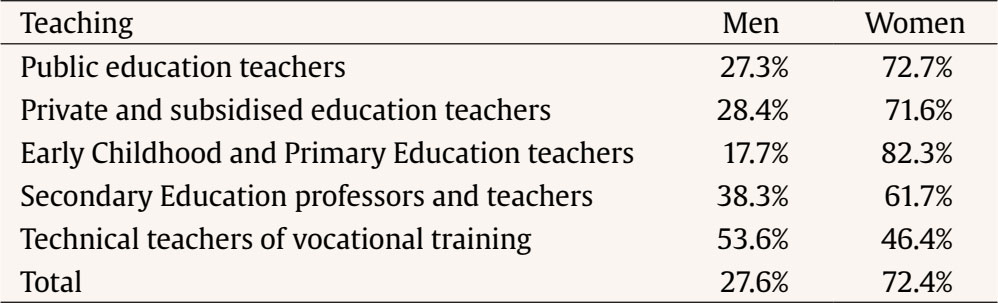 Note. Items extracted from Ministry of Education, Vocational Training, and Sport (Ministerio de Educación, Formación Profesional y Deporte [MEFD, 2024]). These data reflect the feminization of the teaching profession in Spain, i.e., feminized professional field, with two-thirds of teachers being women, increases as we descend in the educational stage. If we look in detail, feminization in the early school stages is almost absolute. The latest report shows that 82.3% of teachers in Early Childhood and Primary Education are women (MEFD, 2024). Moreover, different studies conclude that there are views or prejudices around men within this profession, which hinder their decision to choose this job; men who decide to study with the goal of teaching in Early Childhood or Primary Education centers are perceived as more likely to be homosexual (Lyons et al., 2005; Moss-Racusin & Johnson, 2016) and men who work in childcare are suspected to physically or sexually abuse the children (Farquhar et al., 2006; Lyons et al., 2005; Nentwich et al., 2013). Based on the presented evidence, it can be considered that Early Childhood Education and Primary Education professions are associated with gender stereotypes. Additionally, these professions have a high percentage of women, which could indicate that the choice of the future university degree seems to be rather a social matter derived from gender stereotypes. The OECD (2017) asserts that “given the magnitude of the phenomenon and its gradual increase at lower educational levels, it would be worthwhile to investigate the potential impact of the gender gap in teaching” (p. 4). Therefore, the aim of this study was to know whether, nowadays, students of Early Childhood and Primary Education have gender stereotypes related to the future profession they will carry out. For all the above reasons, this paper focuses on the relationship between the concepts of communion and agency, and the students’ beliefs and representations of education about themselves and their future profession. The aim is, therefore, to identify their self-perceptions, as well as possible stereotypes in relation to their field of study. We understand that such analysis is necessary to understand whether students themselves respond to gender bias. Given that some studies suggest gender stereotype differences between Early Childhood Education and Primary Education programs, gender-segregated differences were analyzed (female students studying Early Childhood Education and Primary Education; male students studying Early Childhood Education and Primary Education) to determine whether female and male students exhibit these biases. Moreover, the gender stereotypes present in women and men in each degree were compared, as well as those stereotypes underlying the two professions: Early Childhood and Primary Education. Based on the reviewed scientific evidence, it was hypothesized that women would consider adjectives associated with feminine gender stereotypes to be more important for their profession, both in Early Childhood Education and Primary Education programs. Additionally, we hypothesized that the Early Childhood Education program would show higher scores for adjectives considered stereotypically feminine, compared to those in the Primary Education program. Participants The total sample of the study was constituted by 433 students with a mean age of 20.79 years (SD = 3.53), with 323 women and 110 men. Of the total 433 participants, 153 (35.3%) were students of the Degree of Early Childhood Education (ECE), whereas the other 280 participants (64.5%) belonged to the Degree of Primary Education (PE). Of the 153 ECE participants, 146 were women (M = 20.47 years, SD = 2.71) and 7 were men (M = 22 years, SD = 2.82). In the PE group, of all 280 participants, 177 were women (M = 20.96 years, SD = 4.82) and 103 were men (M = 20.91 years, SD = 3.73). The rest of the sociodemographic variables are presented in Table 2. Table 2 Sociodemographic Variables 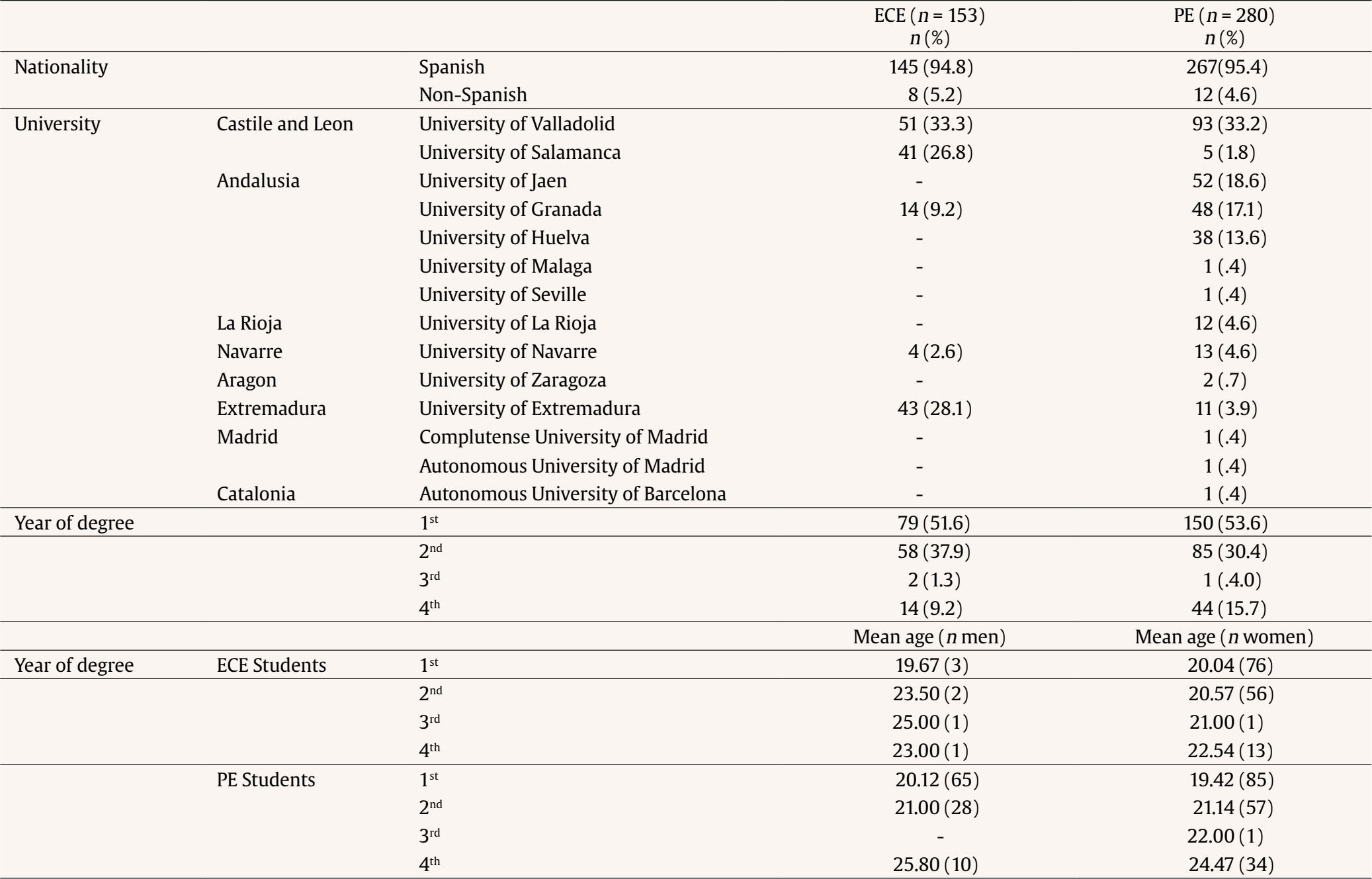 Note. ECE = Early Childhood Education; PE = Primary Education. The inclusion criteria were: being over 18 years of age, being registered in a university degree of Early Childhood or Primary Education, having connection to the Internet in order to complete the questionnaires, and having written and spoken mastery of the Spanish language. Table 3 Items Presented in the Gender-stereotypical Questionnaire 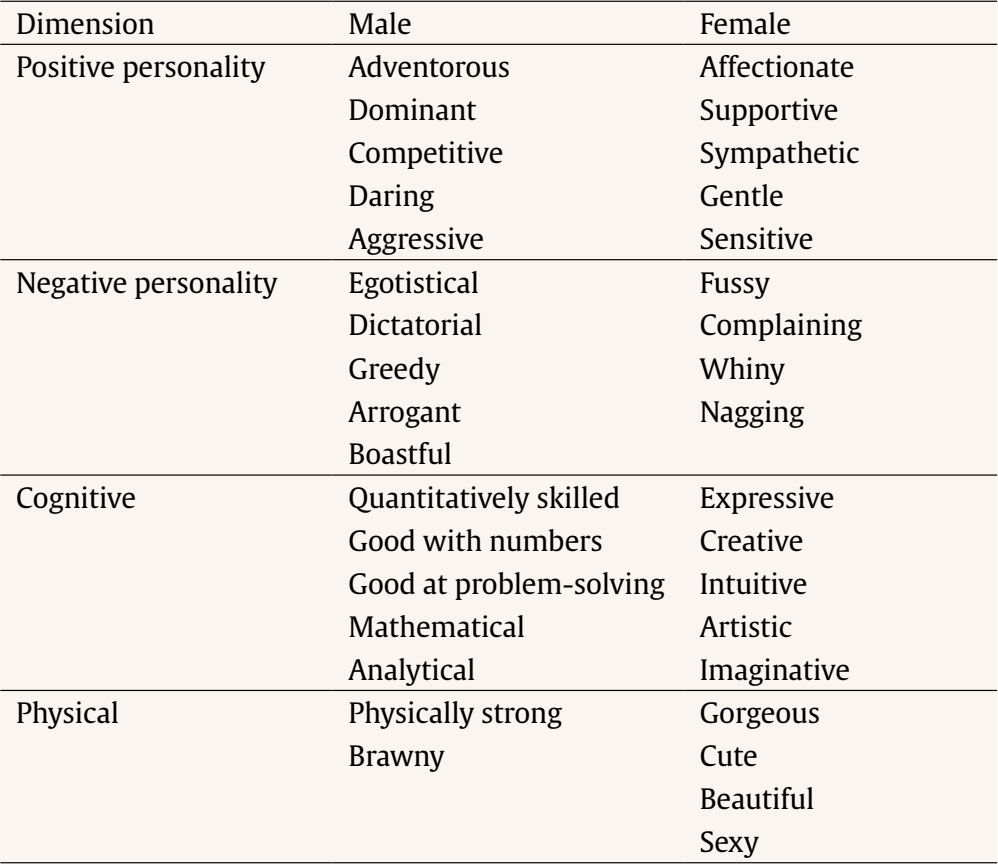 Note. Items extracted from Lopez-Zafra and Garcia-Retamero (2021). The exclusion criteria were: failing to complete the questionnaire in its entirety and studying the double degree of Early Childhood and Primary Education. Instruments Firstly, a battery of sociodemographic questions was administered, which included the following variables: age, gender, nationality, university degree, and current year of the degree in university, among others. With regard to the stereotypical characteristics based on gender, we used the 35 adjectives proposed by López-Zafra and García-Retamero (2021), which are subdivided into adjectives that refer to positive and negative personality, cognitive dimension and the physical aspect, which are in turn differentiated between those stereotypically labelled as male and female (Table 3). The students were asked to score each of the adjectives based on the importance they granted them in relation to their future performance as teachers of Early Childhood or Primary Education, in a 1-5 Likert scale (1 = not important; 5 = very important). Procedure The questionnaire was developed using an online questionnaire platform. For its design, Organic Law 3/2018, of December 5th, on the Protection of Personal Data and guarantee of digital rights, was considered, and the participants were requested to provide their informed consent in order to be included in the study, according to Declaration of Helsinki (Fortaleza, Brasil, in 2013). Then, the sociodemographic questions and the questionnaire of gender stereotypes were presented. The first version of the questionnaire was e-mailed to ten students to verify whether the questions were understandable and to ensure that no mistakes were made during the data gathering. Once it was verified that there were no errors in understanding the questions or in the data gathering, different universities were contacted to request their collaboration in the study. Universities that responded and accepted distributed the questionnaire among students in early childhood and primary education degrees. Additionally, the students who participated were asked to share the questionnaire with friends and classmates studying the same degree. In this way, a snowball sampling method was used for data collection. The questionnaire was disseminated in a total of fourteen Spanish universities. The students who were interested in collaborating in the study completed the questionnaire after giving their consent to participate. The sample was recruited between February and April 2022. Data Analysis The participants were categorised as a function of gender (male/female) and the degree they were studying (Early Childhood Education/Primary Education). Then, a descriptive analysis of the sample was conducted, using means and standard deviations for the quantitative variables and frequencies for the qualitative variables. To verify the existence of differences in the attributes they considered important for their future profession, several analyses of mean differences (Student’s t) were carried out. In the first analysis, the answers of the same gender were compared based on the university degree (females in Primary Education vs. females in Early Childhood Education, males in Primary Education vs. males in Early Childhood Education). Then, the answers of each of the degrees were compared according to gender (males vs. females in Childhood Education, males vs. females in Primary Education). Lastly, all answers were compared as a function of the university degree without differentiating between genders. To verify whether gender stereotypes were still replicated in the students, we calculated the means of the previously established dimensions (male and female positive personality, male and female negative personality, male and female cognitive dimension, male and female physical dimension), and they were compared using a Student’s t-test based on gender (López-Zafra & García-Retamero, 2021). The analyses were carried out using SPSS version 26.0 (IBM Corp., Armonk, NY, USA). Differences between Degrees according to Gender (Women in ECE vs. Women in PE, Men in ECE vs. Men in PE) The analysis of means between ECE and PE in women showed statistically significant differences in the following characteristics: good with numbers (t = -2.14, p = .03, d = 0.24) and mathematical (t = -2.71, p < .01, d = 0.30) as the two most important to the PE students, and affectionate (t = 2.80, p < .01, d = 0.32) and artistic (t = 2.1, p = .03, d = 0.25) as the most important to the ECE students. For the men, differences were found in the competitive (t = -2.250, p = .02, d = 0.82) and greedy (t = -2.08, p = .04, d = 0.68) characteristics, with the PE students obtaining a higher score. The mean scores and standard deviations are presented in Table 4. Table 4 Means and Standard Deviations in the Degrees according to Gender 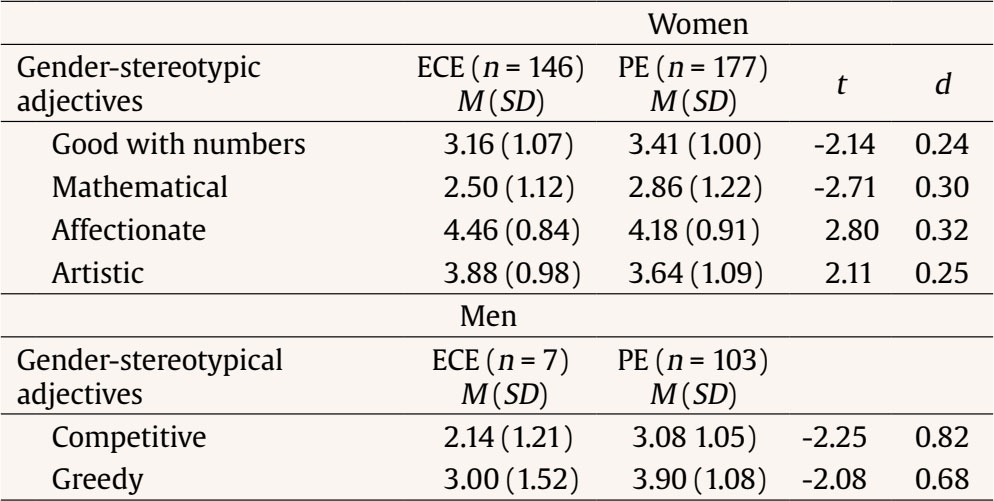 Note. ECE = Early Childhood Education; PE = Primary Education. Gender Differences according to the Degree (Women vs. Men in ECE, Women vs. Men in PE) In the ECE group, no statistically significant differences were found between genders. With respect to the PE group, there were differences between men and women in the dominant (t = -2.21, p = .02, d = 0.26), competitive (t = -2.39, p = .01, d = 0.30), aggressive (t = -2.75, p < .01, d = 0.35), greedy (t = -2.39, p = .01, d = 0.29), mathematical (t = -2.00, p = .04, d = 0.60), analytical (t = -2.33, p = .02, d = 0.29), physically strong (t = -2.37, p < .01, d = 0.43), brawny (t = -2.53, p = .0,1; d = 0.32), beautiful (t = -2.78, p < .01, d = 0.34), and sexy (t = -2.72, p < .01, d = 0.34) adjectives, with greater scores in the men, whereas the women obtained higher scores in the sympathetic (t = 3.45, p < .01, d = 0.20), gentle (t = 3.05, p < .01, d = 0.44), and artistic (t = 3.14, p < .01, d = 0.40) adjectives. The mean scores are shown in Table 5. Table 5 Means and Standard Deviations for Men and Women in the PE Degree 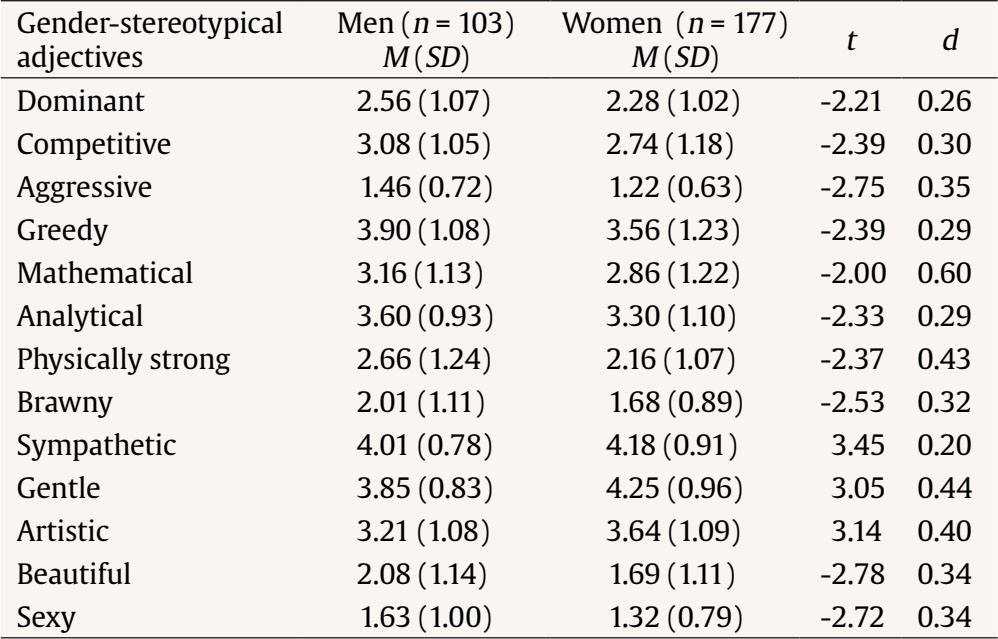 Differences in Gender-stereotypical Adjectives between Students of ECE and PE The statistical analyses conducted to verify the existence of differences between the ECE and PE groups showed higher scores in the dominant (t = -2.11, p = .03, d = 0.20), competitive (t = -2.96, p < .01, d = 0.28), greedy (t = -3.10, p < .01, d = 0.32), good with numbers (t = -3.25, p < .01, d = 0.32), mathematical (t = -3.98, p < .01, d = 0.41) and complaining (t = -1.99, p = .04, d = 0.21) characteristics in the PE group, and in the affectionate (t = 3.90, p < .01, d = 0.40), gentle (t = 3.18, p < .01, d = 0.31) and artistic (t = 3.74, p < .01, d = 0.38) traits in the ECE group. The means are shown in Table 6. Table 6 Means and Standard Deviations in the ECE and PE Degrees 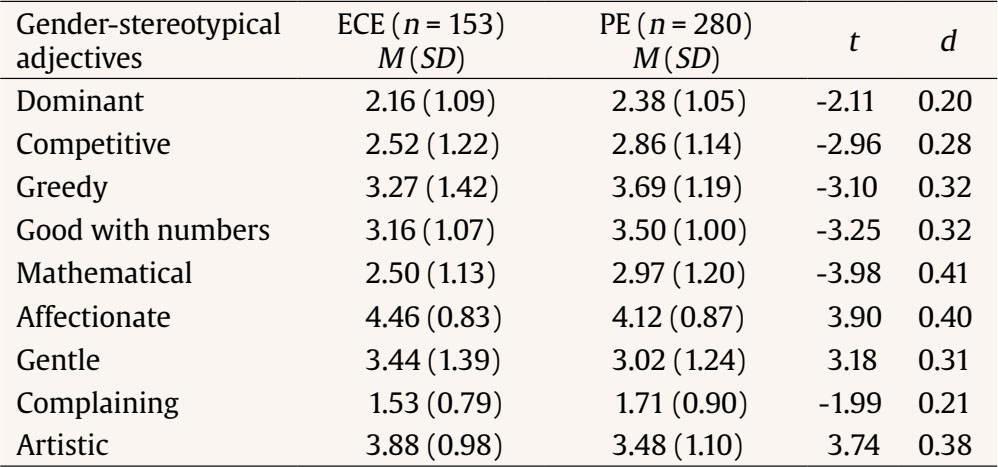 Note. ECE = Early Childhood Education; PE = Primary Education. Differences in Gender-stereotypical Dimensions between Female and Male Students Lastly, the existence of differences between genders was assessed in the entire sample as a function of the dimensions that were considered as gender-stereotypical. Statistically significant differences were found in the male positive personality (t = -3.12, p < .01, d = 0.37), male negative personality (t = -3.08, p < .01, d = 0.35), male physical dimension (t = -2.83, p < .01, d = 0.32), and female physical dimension (t = -2.67, p < .01, d = 0.28), with the males obtaining higher scores. On the other hand, the women considered female positive personality (t = 4.30, p < .01, d = 0.49) and female cognition (t = 3.10, p < .01, d = 0.62) as the most important dimensions. The means are found in Table 7. Table 7 Means and Standard Deviations in Gender-stereotypical Dimensions according to Gender in University Students  As we indicated in the introduction to this study, there is a strong feminization of the teaching profession in general (Adriany & Warin, 2014; Wu, 2023). However, women are particularly predominant at the lower levels of education. In 2019, an average of 84% of primary school teachers in OECD countries were women, compared to 64% in secondary education and 44% in higher education (OECD, 2022). In the case of Spain, data provided by the Ministry of Universities (Ministerio de Universidades, 2024) show that women represent 43.7% of the total number of teaching staff, falling to 26.3% among university professors. This gap narrows when referring to all teaching and research staff at the university: of the 137,090 people who were part of this group during the last academic year 2022-23, 76,548 were men and 60,542 were women (i.e., 44.16%) (Ministerio de Igualdad/Instituto de las Mujeres , 2024). Table 1, which compiles data on non-university teachers, confirms a trend inversely proportional to the level of education, with figures that considerably increase the disparity between men and women as we move down the educational ladder. Thus, compared to 72.4% of women teachers in various non-university education programs, there are a total of 27.6% men. Separating the data on male and female teachers by stage confirms that the gender gap is also disciplinary in nature. Thus, the only area in which the percentage of men exceeds that of women is in the case of vocational training technical teachers, where the former account for 53.6% compared to 46.4% in the latter. As can be seen, the gender gap in STEM disciplines is also reflected in teaching. As can be seen, this percentage varies in Secondary Education (38.3% of men versus 61.7% of women), falling sharply in Primary and Preschool stages (17.7% versus 82.3%). This significant decline reflects common gender biases, which are further exacerbated by the increasing masculinization of higher academic levels, especially in certain disciplines and in terms of managerial positions (Moosa and Bhana, 2023; OECD, 2018b; Petersen, 2014). Such data confirm the so-called “glass ceiling effect”. As expected, the data on study choices follow the same pattern as the employment statistics in terms of gender. In Spain, and according to data from the Ministry of Equality, in the academic year 2022-23 there were a total of 1,378,824 students enrolled in Spanish universities. Of these, 785,417 were women (i.e., 56.96 %) and 593,407 were men. In disciplinary terms,128,750 women and 35,637 men opted for an education-related degree, which include teacher training in early childhood education, teacher training in primary education and other teacher training degrees and educational sciences. This means that 78.32 % of students in education-related degrees are women. If we look in more detail, this feminization is considerably intensified in Early Childhood Education: compared to 4,907 male students (i.e., 9,33%), this degree is taken by 47,686 women (i.e., 90.67 %). In the case of Primary Education, there are 56,142 women (i.e., 68.63 %) and 25,659 men. Regarding the rest of the teacher training and education science degrees, the total number of female students is 24,922 (83.09%), with 5,071 male students. At this point, our sample shows identical trends (international and national) to those recorded by the OECD (2022), Spanish ministries, and studies such as that by Morales et al. (2024), in the comparison between degrees. Education is feminized, especially in early childhood. In our sample, 74.6% of students are women and 25.4% are men, with a female proportion exceeding 95% in the case of Early Childhood Education. Thus, the data for both degrees and those for Early Childhood Education do not differ excessively from the national average, with a feminization among participating students of almost three women (2.93) for every man. Other studies, such as that by Morales et al. (2024), present similar results, indicating a greater number of women than men in the sample population. However, separating the data by degree, it was found that, in Primary Education, the gender imbalance among participating students was not excessively significant, with a ratio of 1.71 females to every male, while in Early Childhood Education, there were almost 21 (20.86) female students to every male. Thus, access to school and the socio-educational imagery of early childhood education teachers, both in the first cycle (0-3 years) and the second cycle (3-6 years), are strongly linked to the female figure. In Spain, as in other countries with a similar sociocultural context, as in other countries of similar socio-cultural context, párvulos (the Spanish “kindergartens” promoted in 1838 by Montesinos) are the direct consequence of an industrial revolution that resulted, among other things, in the incorporation of women into the labor market. Although important, this origin as subsidiaries of the family and the maternal figure does not seem sufficient to explain the feminization of early childhood education today. As we pointed out at the beginning, this perpetuation is strongly associated with the stereotypes and social roles assigned to men and women (Sanchidrián, 2017), without it being possible to attribute it to a single dimension. It is a response of social, political, economic, and historical complexity which, among other aspects, includes the expansion of education and its institutionalization, which allowed women to enter the teaching profession (Kelleher et al., 2011). Furthermore, the image of school as an extension of the home and the mother is evident in its name, escuela maternal (nursery school), which prevails in some Spanish-speaking regions. In summary, early childhood education inherits a strong concept of care. Once again, and if we consider the intense feminization of teaching staff in the early stages of schooling, it is easy to deduce that gender congruence in relation to education is therefore closely linked to early childhood and the welfare-based conception associated with the female figure. In short: stereotypes associate the role of women with care, while executive positions and those with greater socio-economic prestige are increasingly in the hands of men. This supports the hypothesis initially put forward, as care is traditionally linked to the community, while prestige and decision-making are strongly associated with agency. If we stick to the statistics, over 80% of caregivers in Spain are women (Cruz Roja España, 2020), which is a greater percentage compared to the USA (61%) (National Alliance for Caregiving [NAC, 2020]). According to crossed data of Eurostat (2019), over 7.7 million European women aged 20-64 years are unemployed because they take care of a relative (child, sick person, or elder), while there are less than half a million men in the same situation. In other words, for every man who provides care informally in Europe, there are 17 women who do so, on average. Likewise, the dimension of care is associated with important theoretical foundations of Early Childhood Education, such as the Attachment Theory (Bowlby, 1979). The greater importance granted by the female students of the degree of Early Childhood Education to bonding and expression is shown in Table 5, since they gave more points to the affectionate, expressive and artistic traits. On their part, the female students of the degree of Primary Education granted greater relevance to the skillful aspect. This indicates that the sensitive, artistic, and affective dimension is connected to the education and care of the youngest children, whereas skill, rather associated with capacities and abilities, is more important in the stage of Primary Education. Therefore, the communal characteristics would be rather typical of Early Childhood Education, whereas the agent characteristics would be more present in the stage of Primary Education. This may be because the emotional and social needs for development vary between the two stages: while children in Early Childhood Education are in a stage of basic learning that requires a close relationship with adults of reference. On the other hand, Primary School children need greater openness to other learning contexts (Serrano-Díaz et al., 2024). About the gender differences, Table 6 indicates that the men granted more importance to the dominant, competitive, aggressive, ambitious, pretentious, mathematical and analytical domains, thus replicating the association between stereotypically male adjectives. This is consistent, as well, with the theory of congruity (Eagly & Diekman, 2005; Eagly & Karau, 2002), according to which, female educators would be more suitable for early care. This perpetuates not only gender stereotypes related to communal characteristics, but also the assumption of early childhood education continues to fulfill a more supportive than formative function. As the child grows and gains more independence, gender congruity would suggest that their teachers can more significantly exhibit characteristics related to autonomy and agency. Regarding the male students, it was not possible to establish a comparison, since there were only 7 men in the sample of Early Childhood Education, which, on the other hand, represents the feminization of these university degrees. Table 7 shows that women of both degrees considered the supposedly female characteristics of personality and cognition as more important, which is in line with the results of López-Zafra and García-Retamero (2021). Therefore, both women and men tend to score the adjectives that have been attributed to their gender over those attributed to the opposite gender. Interestingly, the men gave more points to the female physique than the women (although these scores were very low, with a mean of less than 2 points). Lastly, and at a general level, there were differences between degrees, with the “ambitious” and “good with numbers traits being more important in Primary Education, whereas the “affectionate”, “delicate”, and “artistic” traits were more important in Early Childhood Education. Such associations confirm, once again, clear dichotomies that perpetuate the gender biases and a strong dual view between men and women. When analyzing the differences between men and women in the degree of Primary Education (Table 6), the divergences related to the gender role are also clear: whereas the men granted more importance to the competitive, ambitious, mathematical and analytical categories, the women prioritized the compassionate, delicate and artistic traits. This indicates that, somehow, such representations perpetuate the values related to the meta-constructions derived from the theories of Bakan (1966), which are theoretical formulations that highlight the establishment of prototypes in which men are expected to engage more in behaviors attributed to agency, whereas women are expected to show greater dedication to communal behaviors (Moskowitz et al., 1994). Therefore, our results suggest that our sample perpetuates both the gender stereotypes and the representations that underlie Early Childhood and Primary Education teachers. Considering these two axes in relation to the social theories described above, agency remains linked to the male prototype, whereas communion is still strongly associated with the female stereotypes. Regarding the university degrees, the agent aspects would be rather associated with Primary Education, whereas the communal aspects would be more strongly related to Early Childhood Education. Lastly, this indicates that the degrees also perpetuate a powerful imagination of female and male teachers, which continues to influence the presence of men and women in both initial education and the teaching profession. These results carry several implications, as we can infer that the education received still does not adequately challenge gender stereotypes. Furthermore, the fact that future educators perpetuate stereotypes suggests that higher education, rather than serving as a space for emancipation and social critique, may be reinforcing gender-based structures of oppression. Additionally, considering theories like Bandura’s (1977) Social Learning Theory, children learn by observing and imitating behaviors, reinforcing the idea that teachers play a crucial role in gender socialization. If teachers do not question or challenge these stereotypes, children will continue to adopt traditional gender roles, consolidating their reproduction in society. At a practical level, it is necessary to include courses that address gender studies, diversity, and equity, to raise awareness among future teachers about the importance of not transmitting harmful stereotypes. Children who grow up in environments where gender stereotypes are reinforced may have a limited view of their abilities and aspirations. Girls may internalize the idea that certain professions or fields of study, such as STEM (Science, Technology, Engineering, and Mathematics), are “not for them,” while boys may be socialized into more aggressive or leadership roles, perpetuating inequality. Consequently, it is crucial to examine the factors that impact this phenomenon and consider the importance of raising the number of male teachers (Wu, 2023). Finally, the perpetuation of stereotypes in the classroom not only affects students but also society in general, as children who grow up with limiting gender ideas are more likely to reproduce inequalities in their future social and professional relationships. Regarding the possible limitations of this study, it was not possible to establish a comparison between the male students of both degrees, due to the lack of male students from Early Childhood Education in the sample. Such absence, which shows the strong feminization of this degree, may not allow drawing less biased conclusions about the representational differences between the two genders in such degrees. Likewise, it is worth questioning whether the students of other degrees unrelated to the scope of education consider in a different manner the gender stereotypes and the distributions of the social space according to the “expected” roles. A study with practicing teachers would also contribute to establishing a comparison that would allow discerning the existence or absence of evolution in this sense based on the new generations, as well as determining a set of predictors. Moreover, the beliefs of the teachers determine their behaviour in the classroom. Therefore, it is fundamental to know them, in order to improve both the quality of their training and their attitudes and future teaching practices. The already classic BAK system proposed by Woods (1996), that is, “beliefs”, “assumptions”, and “knowledge”, operates not only at the explicit level, but also, and probably more strongly, at the implicit strata. This is what Borg (2003) defined as “teacher’s mental lives”, whose complexity as an element that operates both individuals and groups has been highlighted by cognitive psychology. In this sense, we would like to point out that teachers acquire a fundamental role in the attainment of a fairer and more egalitarian society. The results show that the gender perspective may still be a pending subject in the curricula, study plans and attitudes of the teachers, including those who teach in the university degrees, in general, and in the field of Education, in particular. Conflict of Interest The authors of this article declare no conflict of interest. Acknowledgment Thanks to all the participants who have contributed to this research in a selfless way. Cite this article as: Gonzalez-Lopez, V., Gomez-Redondo, S., Romero-Gonzalez, B., & Soto-Sanchez, A. (2026). Is teaching a women’s thing? Gender stereotypes in students of education degrees. Psicología Educativa, 32, Article e260452. https://doi.org/10.5093/psed2026a9 |
Cite this article as: Gonzalez-Lopez, V., Gomez-Redondo, S., Romero-Gonzalez, B., & Soto-Sanchez, A. (2026). Is Teaching a Women’s Thing? Gender Stereotypes in Students of Education Degrees. Psicología Educativa, 32, Article e260452. https://doi.org/10.5093/psed2026a9
Correspondence: Borja.romero@uva.es (B. Romero-Gonzalez).Copyright © 2026. Colegio Oficial de la Psicología de Madrid


 PDF
PDF e-PUB
e-PUB CrossRef
 JATS
JATS Imprimir
 Enviar
ALERTA POR E-MAIL
La Revista de Psicología Educativa está distribuida bajo una licencia de Creative Commons Reconocimiento-NoComercial-SinObra Derivada 4.0 Internacional.com