Kaleidoscope Career Model: Validation among Portuguese Workers
[El modelo caleidoscópico de trayectorias profesionales: la validación en trabajadores portugueses]
Joana Carneiro Pinto
Católica Research Centre for Psychological, Family and Social Wellbeing, Universidade Católica Portuguesa, Lisbon, Portugal
https://doi.org/10.5093/psed2026a8
Received 11 July 2024, Accepted 10 October 2025
Abstract
This study aims to validate the Kaleidoscope Career Scale (KCS), an assessment instrument designed to measure the three parameters of the Kaleidoscope Career Model, for the Portuguese population. A total of 331 Portuguese workers participated, 163 men (57.4%), with an average age of 27.7 years (SD = 9.22; Median = 25; Min-Max = 18-70). Confirmatory factor analyses supported KCS three-factor structure, χ2(83) = 184, p < 0.001; χ2/df = 2.217; CFI = .933; TLI = .915; SRMS = .06089; RMSEA (90% CI = .0609 [.0491, .0727]), and Cronbach’s alpha estimates supported its good reliability. Convergent and discriminant validity also proved to be adequate. Multigroup analyses indicated adequate configural, metric and scalar invariance across genders. These findings support KCS usage as a valid and reliable measure to assess strategic career behaviors among Portuguese workers both in research and practice.
Resumen
El estudio pretende validad la Escala Caleidoscópica de Trayectorias Profesionales (KCS), instrumento de evaluación diseñado para medir tres parámetros del Modelo Caleidoscópico de Trayectorias Profesionales en la población portuguesa. Participaron 331 trabajadores portugueses, de los cuales 163 eran varones (57.4%), con una media de edad de 27.7 años (DT = 9.22, Mdn = 25, min. = 18, max. = 70). Los análisis factoriales confirmatorios avalaron una estructura trifactorial de la KCS, χ2(83) = 184, p < 0.001; χ2/gl = 2.217; CFI = .993; TLI = .915; SRMS = .06089; RMSEA (90% CI = .0609 [.0491, .0727]), y estimaciones de alfa de Cronbach que confirmaban una buena fiabilidad. La validez convergente y discriminante también eran adecuadas. Los análisis multigrupo indicaban una invarianza configural, métrica y escalar adecuadas con indepenencia del género. Los resultados avalan el uso de la KCS como medida válida y fiable para evaluar los comportamientos de trayectorias profesionales estratégicas en trabajadores portugueses tanto en la investigación como en la práctica.
Palabras clave
Modelo caleidoscópico de trayectorias profesionales, Validación de la escala, Análisis factorial confirmatorio, Validad convergente y discriminante, Invarianza de los génerosKeywords
Kaleidoscope Career Model, Scale validation, Confirmatory factor analysis, Convergent and discriminant validity, Invariance across gendersCite this article as: Pinto, J. C. (2026). Kaleidoscope Career Model: Validation among Portuguese Workers. Psicología Educativa, 32, Article e260451. https://doi.org/10.5093/psed2026a8
Correspondence: joanacarneiropinto@ucp.pt (J. Carneiro Pinto).The Kaleidoscope Career Model (KCM) was developed by Mainiero and Sullivan (2005, 2006) to describe careers as a dynamic and personalized process influenced by various forces that change over time. This model is particularly relevant for understanding careers in a contemporary context where flexibility and adaptation are essential. Although previous career models capture some complexity of the current labor market (e.g., protean career, Hall, 1996; boundaryless career, Arthur & Rousseau, 1996; customized career, Valcour et al., 2007; portfolio career, Cohen & Mallon, 1999, Gold & Fraser 2002; social cognitive career theory, Lent & Brown, 1996; life-design, Savickas et al., 2009), none is considered broad enough to explain the individuality, diversity, multiplicity, multidirectionality, unpredictability, and dynamism of current careers. Hence, the authors developed this model based on strong empirical research from a series of independent studies (including interviews, focus groups, and questionnaires) involving more than 3,300 professionals from the United States (Simmons, et al., 2022) aiming to contribute to personal reflection as well as to the organizational management of careers. The model is based on the metaphor of a kaleidoscope, an optical device that creates symmetrical and colorful visual patterns through the reflection of colored glass pieces. In the theoretical model, the “colored glass pieces” are equivalent to three parameters (Mainiero & Sullivan, 2005, pp. 113-114): (i) authenticity, prioritizing the alignment between individual and organizational values, where one feels the need for behaviors and attitudes to reflect their true essence, asking: “Can I be myself in the midst of all this and still be authentic?”; (ii) balance, focusing on the equilibrium between professional and non-professional matters (e.g., family, friends, personal interests) and coherence in decisions across life areas, leading one to ask: “If I make this career decision, can I balance the parts of my life well so there can be a coherent whole?”; and (iii) challenge, the need for stimulation with increasing levels of autonomy and responsibility, and access to learning, development, and progression opportunities, prompting the question: “Will I be sufficiently challenged if I accept this career option?”. These parameters are dynamic, always present, and interacting with varying intensity based on internal/personal factors (e.g., sense of identity, principles and values, life/career stage, goals) and external/contextual factors (e.g., organization, culture, leadership, advancement opportunities). As life evolves, the career pattern shifts to accommodate these changes (Mainiero & Gibson, 2018; Sullivan & Mainiero, 2007). Just as rotating the kaleidoscope’s glass compartment changes the patterns, providing a constantly different visual experience, the same happens with the multiple patterns and configurations a career can assume throughout an individual’s life (Mainiero & Sullivan, 2006). In nearly 20 years, numerous studies have used the model to explain current career patterns (e.g., Cabrera, 2007). Studies on antecedent variables are noteworthy, analyzing the impact of variables such as gender (e.g., Elley-Brown, et al., 2018; Mainiero & Gibson, 2018; Sullivan & Carraher, 2018), generation (e.g., Bulgur & Esen, 2023; Sullivan et al., 2009), professional group (e.g., Carraher et al., 2014; Dabbs & Pastore, 2017; Kuzhabekova & Lee, 2018; Shaw & Leberman, 2015), and different life roles (e.g., Aprianingsih, 2012; Grady & McCarthy, 2008; O’Neill & Jepsen, 2019) on the intensity of authenticity, balance, or challenge in career design. Additionally, studies have also analyzed how these three career parameters (individually or collectively) impact behaviors such as entrepreneurship (Au et al., 2021; Sullivan et al., 2007), networking (e.g., Simmons et al., 2022), and career success (e.g., Hildred & Pinto, 2023; Koekemoer & Crafford, 2019). However, most research has been conducted by the model’s creators and their team in the American context, which represents a major limitation (e.g., Bandeira et al., 2019; Tajlili, 2014). Therefore, it is crucial to obtain evidence of the model’s validity, reliability, and invariance across different cultures and contexts. Kaleidoscope Career Scale: Previous Validation Studies The Kaleidoscope Career Scale is an assessment instrument designed to measure the three parameters of the Kaleidoscope Career Model previously explained. It consists of 15 items (Sullivan et al., 2009), five items per dimension, using a five-point Likert scale ranging from 1 = this does not describe me at all to 5 = this describes me very well (examples of items: “I hope to find a greater purpose to my life that suits who I am” (authenticity), “If necessary, I would give up my work to settle problematic family issues or concerns” (balance), and “I continually look for new challenges in everything I do” (challenge). Initial studies (n = 744; Mainiero & Sullivan, 2005, 2006) indicated internal consistency coefficients, evaluated using Cronbach’s alpha, of .80, .81, and .84 for the parameters authenticity, balance, and challenge, respectively. The exploratory factor analysis (principal axis with oblimin rotation) indicated the presence of three factors corresponding to the model’s anticipated parameters, with eigenvalues greater than 1.0. These three factors explained 55% of the total construct variance, with factor loadings ranging from .524 to .827. In 2019, the scale was adapted for the Brazilian population by Bandeira et al. (2019). In a sample of 272 Brazilian professionals, using confirmatory factor analysis and the maximum likelihood estimation method, the authors found it necessary to create three new items for Authenticity and one new item for Balance, totaling 19 items. After testing the original model (15 items organized into three factors) and the competing model (19 items organized into three factors), and making necessary re-specifications of measurement errors, they concluded that the respecified competing model presented better fit indices, χ2 = 263.021, df =146, χ2/df = 1.80, CFI = .898, TLI = .881, RMSEA (90% CI = .054 [.044, .065]). The omega reliability indicators for the three factors were: Authenticity (ω = .66), Balance (ω = .78), and Challenge (ω = .79). In 2021, the scale was adapted for the Korean population by Lee and Jung (2021) in two distinct samples (n = 347 and n = 631). To preserve the original items’ meaning, authors decided to add one more item to each dimension (total of 18 items). The exploratory factor analysis (principal axis with varimax rotation) indicated the presence of three factors corresponding to the model’s anticipated parameters. These three factors explained 54.6% of the total construct variance, with factor loadings ranging from .374 to .796, and some items loading on more than one factor. Cronbach’s alpha for the total scale was .91, .88 for Challenge, .87 for Balance, and .83 for Authenticity subscales. Subsequently, a confirmatory factor analysis was performed, and the initial results indicated a poor model fit (χ2 = 415.826, CFI =.880, TLI =.911, RMSEA = .072 [064, .080], SRMR = .056). After analyzing the suggested modification indices, five items were removed (n = 13), and a new confirmatory factor analysis was conducted, yielding the following results: χ2 = 161.788, df = 62, CFI =.957, TLI =.945, RMSEA =.068 [.055, .081], and SRMR =.049. In 2022, as part of a study on the links between anxiety generated by the COVID-19 crisis regarding one’s professional future, available resources, and future career expectations, Pignault et al. (2022) translated the scale into French. The confirmatory factor analysis presented adequate fit indices, χ2 = 222.80, df = 72, χ2/df = 3.09, CFI = .993, TLI = .991, RMSEA (90% CI) = .06. The reliability indicators for the total scale and the three factors were as follows: Total (α = .85, ω = .90), Authenticity (α = .71, ω = .90), Balance (α = .88, ω = .93), and Challenge (α = .87, ω = .88). Very recently, the scale was adapted for the Turkish population by Töre and Naibolu (2023). Using a total sample of 526 participants, the exploratory factor analysis (principal axis with varimax rotation) indicated the presence of three factors corresponding to the model’s anticipated parameters, with eigenvalues greater than 1.0. However, four items were removed due to factor loadings below .40. The final version, consisting of 11 items (authenticity: 5 items; balance: 3 items, challenge: 3 items), had factor loadings ranging from .44 to .73. The authors also performed a confirmatory factor analysis that indicated a good model fit (Kline, 2011): χ2 = 140; df = 41; χ2/df = 3.41; CFI =.90; SRMR = .05; RMSEA = .06, with standardized factor loadings between .46 and .81. However, the Cronbach’s alphas found were .65 for the total scale, .62 for Authenticity, .66 for Balance, and .71 for Challenge. Except for the French study, no other adaptations of the instrument have been registered for countries within the European context. Therefore, the present study aims to adapt and present validity evidence for the Kaleidoscope Career Scale in a sample of Portuguese professionals. Participants A total of 331 Portuguese workers participated in this study, comprising 163 men (57.4%), with an average age of 27.7 years (SD = 9.22; Mdn = 25; Min-Max = 18-70). About 44% (n = 144) of these workers hold a bachelor’s degree. The participants primarily worked in the fields of media and culture (n = 52; 17.2%), mechanical and electric engineering (n = 38; 11.5%), education (n = 38; 11.5%), financial services (n = 35; 10.6%), and healthcare and social services assistance (n = 34; 10.3%), with 59.9% (n = 179) being employed full-time. Instrument Kaleidoscope Career Scale (Sullivan & Mainiero, 2008) It is composed by 15 items, 5 each for the authenticity, balance, and challenge subscales (e.g., “Please indicate the extent to which each of the following statements describes you: I hunger for greater spiritual growth in my life; I constantly arrange my work around my family needs; I continually look for new challenges in everything I do”), using a 5-point Likert-type scale (1 = this does not describe me at all, to 5 = this describes me very well). Data Collection Procedure This study is part of a broader project funded by the Fundação para a Ciência e Tecnologia (FCT; Foundation for Science and Technology), I.P., under the EXPL/PSI-GER/0321/2021 project – EURECA: New Career Strategies for New European Remote Careers. It was reviewed and approved by the Católica Research Centre for Psychological, Family, and Social Wellbeing (CRC-W) Review Board. Participants provided their written informed consent to participate in this study. The translation of the scale into Portuguese was carried out following the five-step model of Brislin et al. (1973), as suggested in the article by Töre and Naibolu (2023): (i) two translators and a specialist in career guidance and counseling, fluent in both English and Portuguese, performed the translation into Portuguese; (ii) two researchers and two psychologists evaluated the translation; (iii) two translators fluent in both English and Portuguese performed the back-translation into English; (iv) two psychologists fluent in English analyzed the back-translation; and (v) a specialist in career guidance and counseling and a translator completed the final version of the scale in Portuguese (Table 1). Table 1 Kaleidoscope Career Scale: The Original and Portuguese Versions 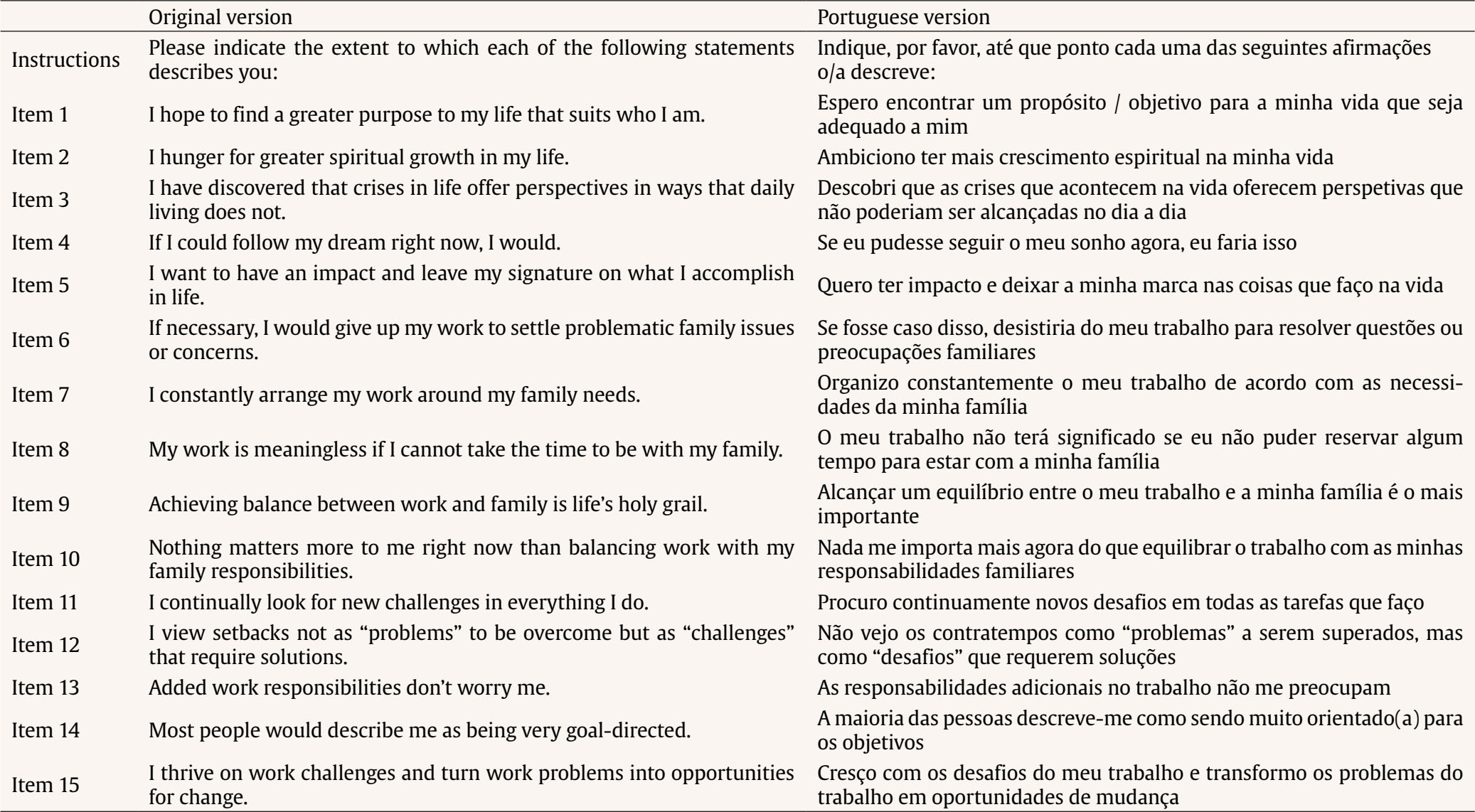 The assessment protocol was conducted online using the Qualtrics platform and subsequently imported to the Prolific platform. Participants were informed about all necessary ethical procedures through an informed consent process. They received a small financial compensation for their participation (£2; approximately €2.34). Data were collected in June 2022 and analyzed using SPSS (IBM, Version 28) and Jamovi (Version 2.4.11). Data Analyses Procedure The validity and internal consistency of the instruments were evaluated through Confirmatory Factor Analysis (CFA). Parameter estimation was based on the correlation matrix using the maximum likelihood method. The presence of multivariate outliers was assessed using the squared Mahalanobis distance (D²) (p1 and p2 < .001), and the normality of the variables was evaluated through the skewness (Sk) and kurtosis (Ku) coefficients for both univariate and multivariate data. No variables exhibited severe violations of normal distribution (|Sk| < 3 and |Ku| < 10) (Kline, 2011). The global fit quality of the hypothetical model was assessed according to the indices and their respective reference values (Hu & Bentler, 1999; Kline, 2011; Marôco, 2010): χ²/df < 5, Bentler’s comparative fit index (CFI) > .90, root mean square error of approximation (RMSEA) < .08, RMSEA, P[RMSEA ≤ .05], and standardized root mean square residual (SRMR) < .08. The local fit quality was evaluated through factor loadings and individual item reliability coefficients. When necessary, the model was re-specified using modification indices (> 11) and based on theoretical considerations (Maroco, 2010). Model comparisons were made using χ² and the Modified Expected Cross-Validation Index (MECVI). Models with lower MECVI values are preferable, indicating better fit and greater generalizability. Convergent analysis was assessed by examining positive and high mutual correlations within the construct (Marôco, 2010). To confirm convergent validity, composite reliability (CR) and average extracted variance (AVE) were calculated (CR > .70, AVE > .50) (Hair et al., 1998). Discriminant validity was evaluated by dividing the correlation between factor scores by the root of the multiplication of the internal consistency coefficients of each factor. If the result is below .85, discriminant validity exists (Campbell & Fiske, 1959, cited in Anastasi & Urbina, 1997). Internal consistency was evaluated using Cronbach’s alpha (α), with values > .70 considered good levels of internal consistency (Anastasi & Urbina, 1997). Measurement invariance across genders was conducted in three increasingly restrictive steps: configural invariance (same structural model applied to both samples), metric invariance (factor loadings constrained across groups), and scalar invariance (factor loadings and thresholds constrained across groups). Invariance was evaluated according ΔRMSEA, ΔCFI, and ΔTLI, for which values lower than .015, .01 and .02, respectively, indicate models’ invariance (Chen, 2007; Cheung & Rensvold, 2002; Vandenberg & Lance, 2000). Establishing scalar invariance allows for the comparison of latent means between groups. The critical ratio (CR) was calculated for these comparisons, with a CR value greater than 1.96 indicating a statistically significant difference in latent means at the .05 level (Byrne, 2013). Descriptive and Correlational Analyses Descriptive analyses of the items were conducted, as well as calculations of the item-rest correlation and Cronbach’s alpha if item deleted (Table 2). Mean scores for the various items ranged from 2.94 (item 13) to 3.92 (item 1), indicating results above the midpoint of the response scale. The two items with the lowest item-rest correlation are item 1 (.347) and item 6 (.364). No significant improvements in the overall Cronbach’s alpha of the scale were observed if any of the items were deleted. Regarding the correlations between items (Table 3), it was found that items within each parameter have higher levels of correlation with each other than with items from the other two parameters. The exception is item 5, which has a higher correlation with item 15 (Challenge) and item 7 (Balance). Table 2 Kaleidoscope Career Scale: Descriptive Statistics  Table 3 Kaleidoscope Career Scale: Items’ Correlations 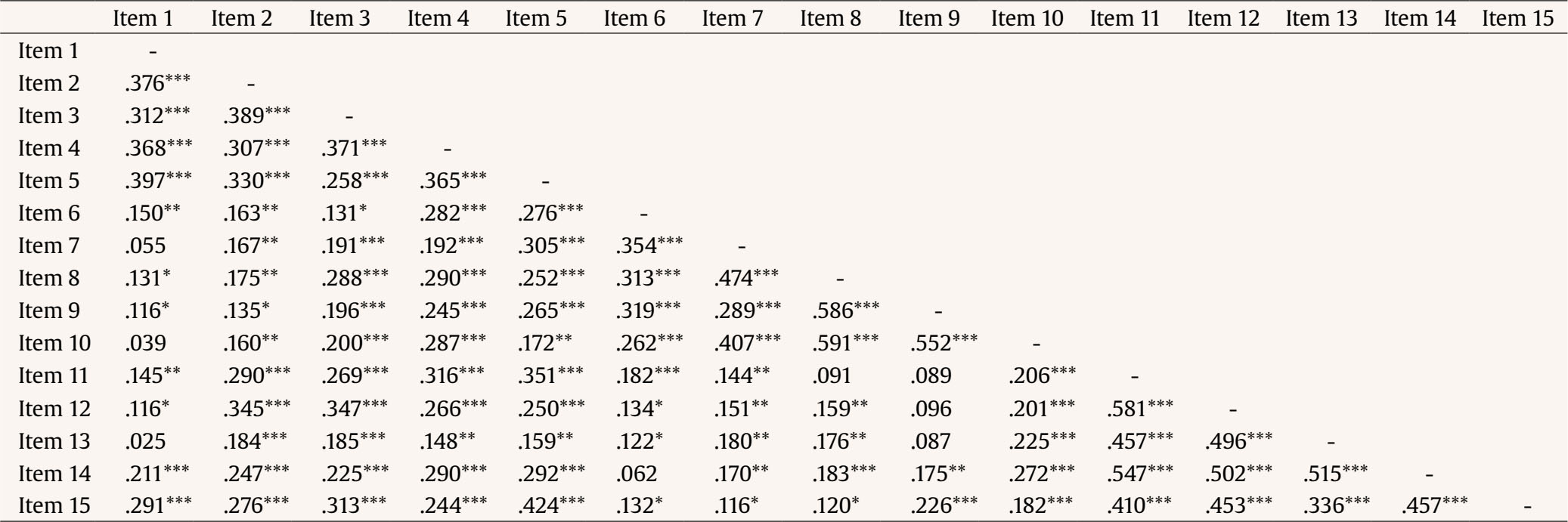 *p < .05, **p < .01, ***p < .001. Internal Validity The three-factor model, with 5 items associated with each factor as predicted by the theoretical model, was initially tested. The results of the confirmatory factor analysis indicated a poor fit of the model to the data χ2(87) = 242, p < .001; χ2/df = 2.781; CFI = .898; TLI =.876; SRMS = .0574; RMSEA (90% CI =.0736 [.0847, 1.726]). Considering the suggested modification indices, a correlation was established between the measurement errors associated with the following pairs of items: 5 and 15, and 7 and 9. The results of the confirmatory factor analysis for this revised model (model 2) indicated a slight improvement in the model’s fit to the data, χ2(85) = 209, p < .001; χ2/df = 2.459; CFI = .918; TLI = .898; SRMS = .0539; RMSEA (90% CI] = .0667 [.078, 1.547]), suggesting, based on the modification indices, the establishment of a correlation between the measurement errors associated with the following pairs of items: 5 and 3, and 5 and 7. The results of the confirmatory factor analysis for this revised model (model 3) indicated that the model’s fit to the data was good, χ2(83) = 184, p < .001; χ2/df = 2.217; CFI = .933; TLI = .915; SRMS = .06089; RMSEA (90% CI = .0609 [.049, .0727]. Comparison between models, using the MECVI, confirmed the robustness of the final model Table 4). Tables 5 and 6 present the factor loadings and the factor covariances. Standardized estimates of factor loadings range from .44 (item 6) to .79 (item 8). The covariance between Authenticity (F1) and Balance (F2) is .47, between Authenticity (F1) and Challenge (F3) is .60, and between Balance (F2) and Challenge (F3) is .31. Table 4 Kaleidoscope Career Scale: CFA Results according to the Three Tested Models  Table 5 Kaleidoscope Career Scale: Factor Loadings 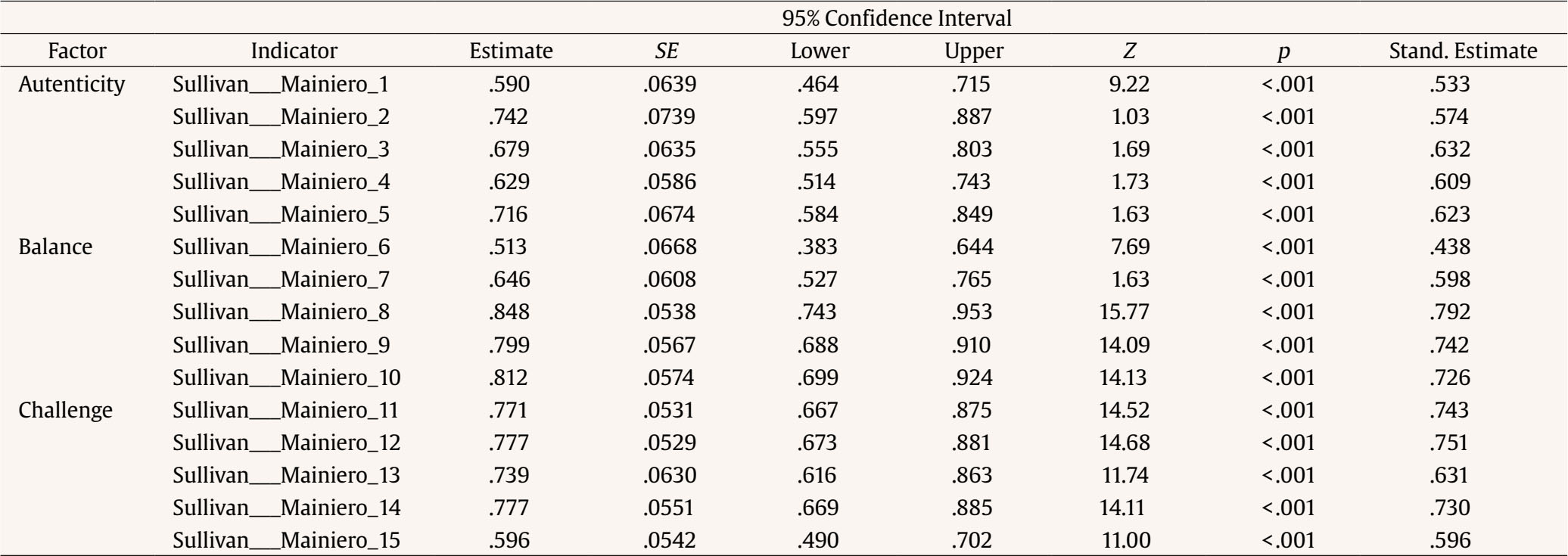 Table 6 Kaleidoscope Career Scale: Factor Covariances  Note. 1Fixed parameter Convergent and Discriminant Validity Composite reliability (CR) of the factors was F1 = .96, F2 = .97, and F3 = .98. The average variance extracted (AVE) also proved to be adequate – F1 = .91, F2 = .95, and F3 = .95. Good discriminant validity was observed between all factors as the AVE values are higher in all cases than r215 = .43. The calculation of discriminant validity, obtained by dividing the correlation between factor scores by the root of the multiplication of the internal consistency coefficients (Cronbach’s alpha) of each factor, yielded the following results: F1-F2 = .51; F1-F3 = .67; F2-F3 = .35, thus proving that the different constructs measured are indeed distinct from each other (< .85). Model Invariance The invariance of the model considering the gender of the participants was tested. The model resulting from the confirmatory factor analysis was tested in terms of its configural invariance, with the following results: χ2(166) = 288, p < .001; χ2/df = 1.73; CFI = .984; TLI = .979; SRMR = .081; RMSEA (90% CI] = .073 [.059, .087]). Next, metric invariance (factor loadings restrained) was examined, yielding the following results: χ2(178) = 351, p < .001; χ2/df = 1.97; CFI = .977; TLI = .973; SRMR = .090; RMSEA (90% CI =.084 [.071, .097]). Finally, scalar invariance (factor loadings and thresholds restrained) was tested, yielding the following results: χ2(220) = 352, p < .001; χ2/df = 1.6; CFI = .982; TLI = .983; SRMR = .083; RMSEA (90% CI = .068 [.053, .079]). Table 7 presents the results obtained for each model, as well as the differences in terms of CFI, TLI, and RMSEA. Table 7 Kaleidoscope Career Scale: Goodness-of-Fit for Ttests of Multigroup across Gender  Considering that the scalar model was the most parsimonious, it was considered the final model. The factor loadings of this scalar invariance model are shown in Table 8. Subsequently, a comparison between the latent variables across genders was performed. As presented in Table 9, significantly lower values were found for men in the dimensions of Authenticity and Balance. However, no statistically significant differences were found in the latent means for Challenge. Table 8 Kaleidoscope Career Scale: Factor Loadings for Scalar Invariance Model 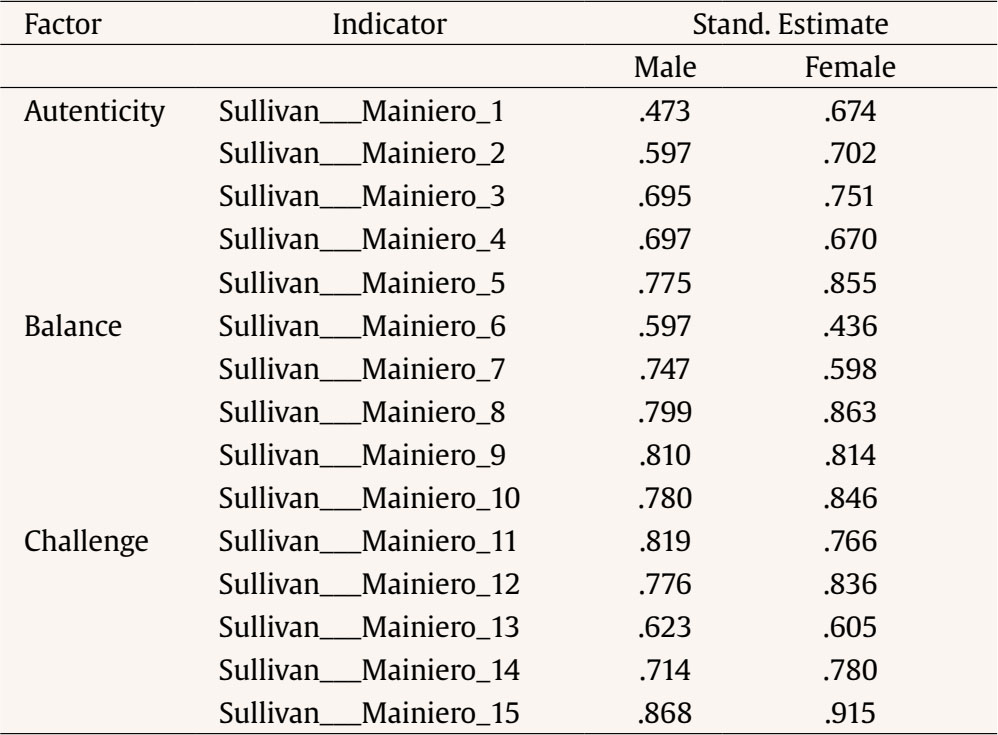 Table 9 Latent Mean Differences between Genders  The primary goal of the present study was to validate the Kaleidoscope Career Scale (KCS), an instrument that assesses the three parameters of the Kaleidoscope Career Model. This study aimed to analyze the fit of the theoretical model to the data in a sample of Portuguese workers using confirmatory factor analysis procedures. Results indicated a good fit, and unlike previous studies, there was no need to add or remove items. In Brazil, new items were added to the original version to ensure the instrument’s content was not lost in translation (Bandeira et al., 2019). In Korea (Lee & Jung, 2021) and Turkey (Töre & Naiboglu, 2023) the final versions of the instrument ended up with a reduced number of items. The item correlations demonstrated that items belonging to each dimension had higher correlations with each other than with items from other dimensions. However, some results need a closer examination. This is the case for items 5 (“I want to have an impact and leave my signature on what I accomplish in life”) and 7 (“I constantly arrange my work around my family needs”), and items 5 (“I want to have an impact and leave my signature on what I accomplish in life”) and 15 (“I thrive on work challenges and turn work problems into opportunities for change”), which belong to different dimensions (authenticity and balance; authenticity and challenge, respectively) but still showed moderate correlations. Authenticity drives individuals to make changes in their lives to better align their values with their behaviors (Mainiero & Sullivan, 2006). In this case, the person wants to make an impact on the world, which may involve managing relational responsibilities, such as deciding to prioritize family over other life roles, as well as dealing with and persevere through professional challenges (Cabrera, 2009). Similarly, items 3 (“I have discovered that crises in life offer perspectives in ways that daily living does not”) and 5 (“I want to have an impact and leave my signature on what I accomplish in life”), and items 7 (“I constantly arrange my work around my family needs”) and 9 (“Achieving balance between work and family is life’s holy grail”) belong to the same dimensions (authenticity and balance, respectively) but have lower correlations with each other. Leaving a mark on the world does not necessarily involve going through life crises, just as achieving balance between personal and professional responsibilities should not require constant effort to organize professional life around family needs. Career decisions are contextual and influenced by a complex and intricate network of relationships (O’Neil et al., 2013). These personal, familial, and professional relationships should support and contribute to the individual’s well-being rather than limit the potential career achievements (Elley-Brown, et al., 2018). These specific items required covariance to achieve a good model fit to the data. In the Portuguese version, the internal consistency indices of the subscales, evaluated through Cronbach’s alpha, were quite adequate and superior to most previous studies. It is noteworthy that the Brazilian version (Bandeira et al., 2019) encountered problems in the authenticity dimension, and the Turkish version (Töre & Naiboglu (2023) had issues in the authenticity and balance dimensions, with values below the recommended cutoff point of .70 (Nunnally, 1970). The tests of measurement invariance found that the KCS upheld for configural, metric, and scalar invariance across genders. Establishing these increasingly restrictive invariances provides strong additional support for the three-factor structure of KCS. This is an advancement over previous KCS studies, which mainly focused on the measure’s reliability and factorial structure. The results suggest that a score on the KCS construct understanding is similar for men and women. Considering the latent mean differences between genders, there are statistically significant differences between men and women in the dimensions of Authenticity and Balance, with higher scores for women. In contrast, there was no significant between-groups difference in Challenge. This finding aligns well with the literature, particularly with studies by Mainiero and Gibson (2018), Mainiero and Sullivan (2005, 2006), Sullivan and Mainiero (2007), and Smith-Ruig (2009), which identified different career pattern preferences for men and women at different life stages. In the early career stage, both genders tend to place equal emphasis on Challenge (Knowles & Mainiero, 2021). However, women tend to prioritize Balance and work-life integration (beta career pattern) and, in later stages of their lives, direct their careers towards Authenticity (e.g., Cabrera, 2007). In contrast, men tend to prioritize Challenge (alpha career pattern), especially in the early stages of their careers, and later emphasize Authenticity and Balance (Mainiero & Gibson, 2018). The present study confirms the quality of the Portuguese version of the Kaleidoscope Career Scale and its underlying theoretical model, making it a useful resource for research and practice. Professionals responsible for people management, whether from a personal or organizational perspective, can use this instrument to map the strategic career behaviors of men and women at different life/career stages and support them in designing and developing their careers according to their priorities of authenticity, balance, and challenge. The main goal of this study was to validate the Kaleidoscope Career Scale (KCS) for the Portuguese working population, establishing it as a robust and reliable instrument for use in both research and practice. Analyses conducted with this study’s sample confirmed the KCS’ original three-factor structure (Authenticity, Balance, and Challenge) using the 15 original items, without the need to add or remove any items. This outcome differentiates the Portuguese validation from adaptations found in Brazil, Korea, and Turkey, where modifications to the total number of items were deemed necessary. The psychometric quality of the instrument is supported by the model fit indices from Confirmatory Factor Analysis (CFA), which demonstrated a good fit of the model to the data. Furthermore, the internal consistency of the Portuguese version, assessed by Cronbach’s alpha, proved to be adequate and superior to most previous studies for the Authenticity and Balance dimensions, notably surpassing the critical values reported in the Brazilian and Turkish versions. Most importantly, the study successfully established configural, metric, and scalar invariance across genders, which represents a significant advance over prior KCS research. The verification of scalar invariance allowed for a reliable comparison of latent means, revealing that Portuguese women assign greater importance to the Authenticity and Balance dimensions than men, whereas the Challenge dimension showed no statistically significant differences. These findings align consistently with the Kaleidoscope Career Model (KCM) literature regarding different career priorities across genders at various life/career stages. The validation of the KCS in Portugal paves the way for a robust future research agenda, particularly regarding the integration of these results into new studies that adopt longitudinal and cross-cultural perspectives. Thus, future studies should apply the validated Portuguese KCS for multi-group analyses in different European and international contexts, with the aim of further testing measurement invariance and exploring cultural variations in career priorities. This will help mitigate the limitation that the majority of KCM research has been conducted in the American context. For instance, future cross-national comparisons could explore whether the KCS factor structure is more stable between European countries than between a European country and non-Western cultural contexts (e.g., Korea or Turkey). Additionally, longitudinal studies are essential to explore how the dynamic parameters of Authenticity, Balance, and Challenge change for Portuguese workers over time, especially during transitions between life/career stages. In this regard, a testable hypothesis could be, for example, that the effect of life/career stage on the preference for Authenticity will be more evident for men than for women, with men prioritizing it in later career stages. To gain a deeper and more personalized understanding of the quantitative results, particularly the gender differences, future research could also integrate qualitative methods (e.g., interviews and focus groups). This mixed-methods approach will allow researchers to explore the underlying contextual factors - such as the complex networks of personal, familial, and professional relationships - that influence the intensity of each KCM parameter, thereby enriching the quantitative findings. Thus, as an example, future studies could seek to clarify why women in Portugal prioritize Balance and Authenticity; and whether the higher priority on the Balance dimension among women will be a negative predictor of networking, while the focus on Challenge among men will be a positive predictor of career success. Given the instrument’s proven validity, future applied research should also focus on how organizations and human resource professionals can use the KCS to effectively map strategic career behaviors and design specific career development programs for their employees. Conflict of Interest The authors of this article declare no conflict of interest. Cite this article as: Carneiro Pinto, J. (2026). Kaleidoscope career model: Validation among Portuguese workers. Psicología Educativa, 32, Article e260451. https://doi.org/10.5093/psed2026a8 Funding This study has been funded by Portuguese national funds through the FCT – Foundation for Science and Technology, I.P. under project EXPL/PSI-GER/0321/2021 (EURECA: New career strategies for the new European remote careers). References |
Cite this article as: Pinto, J. C. (2026). Kaleidoscope Career Model: Validation among Portuguese Workers. Psicología Educativa, 32, Article e260451. https://doi.org/10.5093/psed2026a8
Correspondence: joanacarneiropinto@ucp.pt (J. Carneiro Pinto).Copyright © 2026. Colegio Oficial de la Psicología de Madrid


 PDF
PDF e-PUB
e-PUB CrossRef
 JATS
JATS Imprimir
 Enviar
ALERTA POR E-MAIL
La Revista de Psicología Educativa está distribuida bajo una licencia de Creative Commons Reconocimiento-NoComercial-SinObra Derivada 4.0 Internacional.com