Understanding the Relationship between Parental Involvement and Students’ Goal Orientation: A systematic Review 2014-2024
[El conocimiento de la relación entre la participación parental y la orientación hacia las metas de los estudiantes: una revisión sistemática 2014-2024]
Isabel Piñeiro1, María Adelina Guisande2, Carolina Rodríguez-Llorente1, Rocío González-Suárez3, Iris Estévez2, & Susana Rodríguez1
1University of A Coruña, Campus Elviña, A Coruña, Spain; 2University of Santiago de Compostela, Campus Vida, A Coruña, Spain; 3University of Vigo, Campus de Pontevedra, Spain
https://doi.org/10.5093/psed2026a13
Received 24 January 2025, Accepted 16 October 2025
Abstract
Understanding how different forms of parental involvement influence the motivational process of students is crucial for educational stakeholders. To address this issue, we conducted a systematic review of research articles published between 2014 and 2024 that explored the relationship between parental involvement and students’ academic goal orientation. We use the PRISMA statement as a guiding framework in the process of systematizing the search. Our review covers 24 research articles in which we analyze the different approaches to assessing the variables involved, synthesize the findings and identify key trends. The analysis reveals significant differences in the configuration of student goal orientation depending on parental involvement variables such as parental volitional actions (task support, promotion of learning at home, and home-school communication, and parental interest), parental motivational support (parental aspirations and expectations, academic socialization, and emotional support), parenting dimensions and forms of involvement (control/autonomy support, parental acceptance/rejection), or parenting styles.
Resumen
Comprender cómo las diferentes formas de participación parental influyen en el proceso motivacional del alumnado es crucial para los profesionales educativos. Para abordar esta cuestión, realizamos una revisión sistemática de artículos de investigación publicados entre 2014 y 2024 que exploraron la relación entre la participación parental y la orientación hacia las metas académicas del alumnado. Utilizamos la declaración PRISMA como marco guía para sistematizar la búsqueda. Nuestra revisión abarca 24 artículos de investigación en los que analizamos los diferentes enfoques para evaluar las variables implicadas, sintetizamos los hallazgos e identificamos las tendencias clave. El análisis revela diferencias significativas en la configuración de la orientación hacia las metas del alumnado en función de variables de participación parental, como las acciones voluntarias parentales (apoyo en las tareas, potenciar el aprendizaje en casa, comunicación entre el hogar y la escuela e interés parental), el apoyo motivacional parental (aspiraciones y expectativas parentales, socialización académica y apoyo emocional), las dimensiones y formas de participación parental (apoyo al control/autonomía, aceptación/rechazo parental) o los estilos de crianza.
Palabras clave
Participación parental, Orientación hacia las metas, Orientación motivacional, Revisión sistemática, PRISMAKeywords
Parental involvement, Goal orientation, Motivational orientation, Systematic review, PRISMACite this article as: Piñeiro, I., Guisande, M. A., Rodríguez-Llorente, C., González-Suárez, R., Estévez, I., & Rodríguez, S. (2026). Understanding the Relationship between Parental Involvement and Students’ Goal Orientation: A systematic Review 2014-2024. Psicología Educativa, 32, Article e260456. https://doi.org/10.5093/psed2026a13
Correspondence: iris.estevez.blanco@usc.es (I. Estévez).Our research underscores the significance of exploring the relationship between parental involvement and their children’s academic goal orientation. The current systematic review sheds light on how various forms of parental involvement can influence students’ motivation, particularly their academic goals, and how this impacts their academic outcomes (e.g., academic achievement). Our study gathers empirical evidence showing that parental volitional actions, motivational support, and parenting styles foster the adoption of mastery and performance-approach goals by students throughout schooling. On one hand, parents who express interest in their children’s academic progress foster independent behavior and motivation in their children. Additionally, we found that parental support in academic tasks is a strong predictor of a greater focus on mastery goals. On the other hand, democratic parents (high in affection and control) encourage their children to develop learning and task-oriented goals. In conclusion, this research demonstrates that parental involvement significantly influences emotional and motivational factors in students’ learning processes. For practice, our results imply that different forms of parental involvement such as helping with tasks, showing interest, and supporting children’s autonomy positively influence students’ goal orientation (particularly mastery and performance-approach goals) from elementary to high school. The motivation of individuals has been – and continues to be – a topic of significant interest in the fields of education, pedagogy, and educational psychology. There are various theories and conceptual approaches to explain motivation, but they all agree that it involves the processes of activating, directing, and persisting behavior (Pintrich & Schunk, 2002; Valle et al., 1998). In the academic context, motivation is considered one of the most significant variables influencing student learning outcomes (Corno, 2001). According to Pintrich and De Groot (1990), the motivational construct consists of three dimensions: a value component, where students engage in a task based on the value they place on it; an expectancy component, which involves students’ beliefs about their ability to perform a task; and an affective component, determined by students’ emotional reactions to performing a task. This systematic review aims to deepen our understanding of students’ goal orientation, which is a key aspect of the value component of motivation (Pintrich & Schunk, 2002). There are various proposals for classifying academic goals (Elliot & McGregor, 2001; Miller & Speirs Neumeister, 2017). However, they generally distinguish between learning or mastery goals and performance or achievement goals. Students may be focused on developing and improving task-related skills – mastery or learning goals –, demonstrating their ability to perform tasks compared to others – performance or achievement-approach goals – or hiding their inability to cope with a specific task from peers and/or teachers –performance or achievement-avoidance goals (Hsieh et al., 2007; Linnenbrink & Pintrich, 2002; Skaalvik, 1997). Mastery goals have been positively associated with various achievement and motivation factors, while performance goals have been linked to less adaptive outcomes (Giota & Bergh, 2021;Valle et al., 2015). Previous research (e.g., Dull et al., 2015; Moller & Elliot, 2006; Payne et al., 2007) demonstrated that learning goals are related to positive aspects such as greater persistence and dedication when dealing with challenging tasks, increased use of deep cognitive strategies, attributing academic success to effort rather than ability, greater interest, and higher academic self-efficacy. In contrast, the findings regarding performance goals are less consistent and havebeen associated at times with less desirable outcomes, such as anxiety (Liu et al., 2020). The theory of learning goals suggests that students’ goal orientations are influenced by both their school and family environments (Maehr, 2001). There have been few studies that have looked at the link between parental factors and academic goal orientation (Chan & Chan, 2007; Giota & Bergh, 2021; Kim et al., 2010). However, it is worth mentioning the findings of Eccles (2007), which demonstrated how parents’ beliefs and actions regarding their children’s accomplishments can significantly impact how children perceive their abilities and the importance they attribute to academic tasks. Families play a crucial role in their children’s education, significantly influencing their academic lives. The term “parental” includes not only mothers and fathers but also grandparents and other guardians. Parental involvement or participation can take on different strands of approach, potentially gradable on a continuum that extends from the most active participation and presence in the entire academic process to no participation or the lowest presence in the academic process of children and adolescents (Kristensen et al., 2023). Under the premise that parental involvement is essential for the development of a functional and adaptive motivational orientation that can ultimately condition students’ academic success (Falanga et al., 2023; Mata et al., 2018; Simpkins et al., 2012), in this systematic literature review (adhering to PRISMA 2020 guidelines and Cochrane Preferred Reporting Items for Systematic Reviews and Meta-Analyses; Higgins et al., 2023; Page et al., 2021), we are interested in delving into the results obtained to date in research papers implemented to analyze how parental support, interest in their children’s progress, expectations of their children or help in completing academic tasks, among others, may be predictors of motivational beliefs or academic goal orientation of those children (Chan & Chan, 2007; Giota & Bergh, 2021; Kim et al., 2010; Kristensen et al., 2023). Even though there is a growing body of literature focusing on familiar involvement in education, to date systematic reviews or meta-analyses have focused, to a large extent, on the study of the relationship between parental involvement and academic achievement (e.g., Erdem & Kaya, 2020; Jeynes, 2023). Consequently, the value and novelty of this study lie in gathering and systematizing the knowledge generated in the last ten years on the incidence of this involvement, specifically on one of the more predictive variables of academic outcomes: students’ goal orientation. Establishing common and consensual starting points for such broad and multifaceted phenomena is presumed to be a complex task. Thus, we aim to try to operationalize the constructs under study (parental involvement and goal orientation) to achieve clear findings in which the different epistemological, theoretical, or methodological approaches existing in the documentary universe analyzed converge. In addition, we have tried to detect possible knowledge gaps or conceptual inconsistencies existing on these topics to be able to convert them into empirical research objectives in future works. In short, the main objective of this paper is to identify, analyze, and synthesize the existing scientific evidence to help answer the following research question: To what extent and in what way do the different styles, contexts, and actions of parental involvement influence students’ goal orientation setting? Thus, we will be able to provide a reliable basis that will help – at a theoretical level – to advance in the approach of an explanatory model of the relationship between parental involvement and the goals pursued by their children and – at a practical level – to make decisions about changes, reforms or proposals that can be designed and implemented to improve the studied phenomenon. Eligibility Criteria The articles included in this systematic literature review underwent a rigorous selection process based on predefined criteria. Initially, filters were used to ensure the quality and relevance of the information. Articles published between January 2014 and April 2024 were considered, covering both Spanish and English languages within the field of psychoeducation and having full-text accessibility. We used additional criteria to refine the selection according to the main objective of the review. These criteria included variables that did not align with the aim of the study (n = 34), qualitative methodological approaches (n = 4), incompatible sample demographics (n = 4), and exclusion of purely theoretical studies lacking empirical data relevant to the research (n = 1). Strict adherence to these criteria ensured the quality and relevance of the studies included in the analysis. This is a systematic review study of the literature. The Research Ethics Committee of the University of A Coruña and University of Santiago de Compostela has confirmed that no ethical approval is required. There were no human participants involved in the research. Approval was not required by our institution for the present research because it is based on a documental research. Search Strategy We conducted a comprehensive review of scholarly literature to find studies exploring the connection between family involvement – informed by children and/or their parents – and academic goal orientation in the educational setting. We searched databases such as PsycInfo, Scopus, Web of Science (WOS), Dialnet, and ERIC from July to September 2023, with updates made through database search alerts until the final update in April 2024. Additionally, we manually checked the reference list of selected studies to address any potential research gaps or biases. Table 1 shows the search terms used during the database review. It is worth noting that we tailored the search parameters to include only articles with the specified descriptors in their title, abstract, or keywords. Table 1 Search Terms Used in Initial Database Search 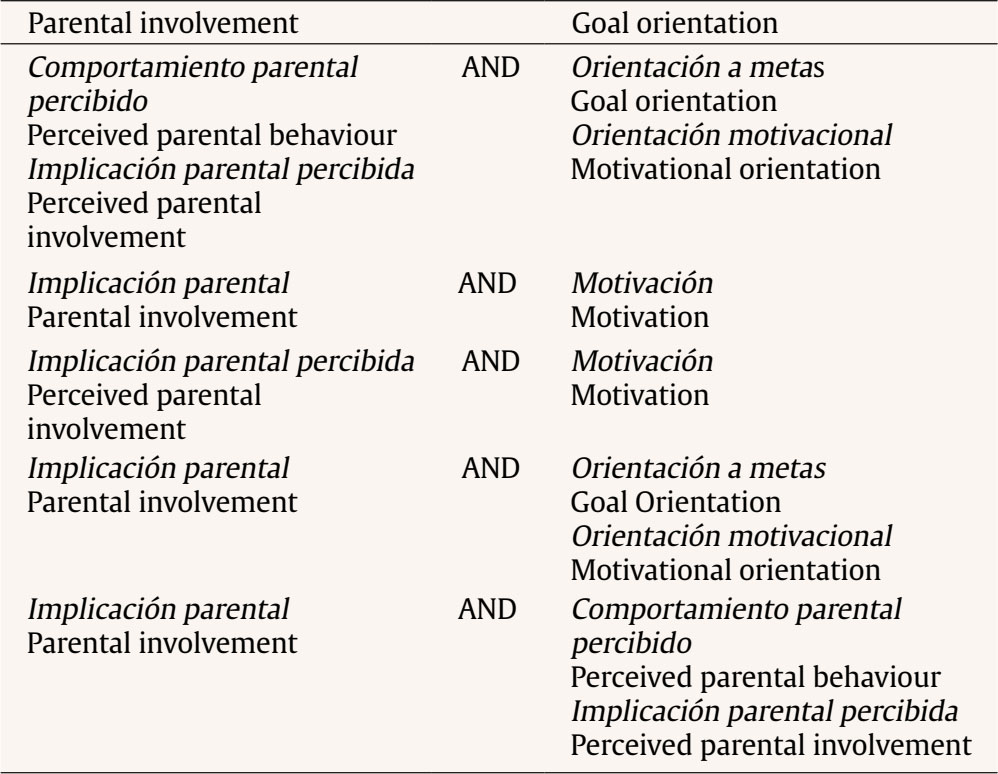 Note. The search equations were run in English and Spanish. Types of Studies, Participants, and Outcome Measures In this review, we have curated research studies that have examined the relationship between parental involvement – reported by parents or children – and students’ academic motivation, specifically focusing on children and adolescents’ goal orientation. The selected studies encompass participants in elementary or secondary education with ages ranging from 9 to 18 years. It is noteworthy that race, sex, socioeconomic status, and other sociodemographic factors, including area of residence (rural versus urban), were not constraints or exclusion criteria for our review. Selection Process The search process was conducted in several structured phases (see Figure 1 for a flow diagram illustrating the document selection process). In the identification phase, articles from the mentioned databases were identified based on the search terms and filters previously explained. Subsequently, in the screening phase, the titles and abstracts of each study were thoroughly reviewed, and potentially eligible documents were selected. Then, the pre-selected articles were screened to remove duplicates, incomplete papers, and articles not in English or Spanish. During the eligibility phase, the full content of the selected articles was reviewed to either discard or definitively select them. For this purpose, a document analysis was conducted using a matrix of information as the instrument (see Supplementary Material 1). Any discrepancies during the pre-selection and selection phases were resolved through discussion, reaching a consensus among all review authors. Once analyzed, the exclusion criteria listed above were applied. Figure 1 Flow Diagram of the Selection Process. 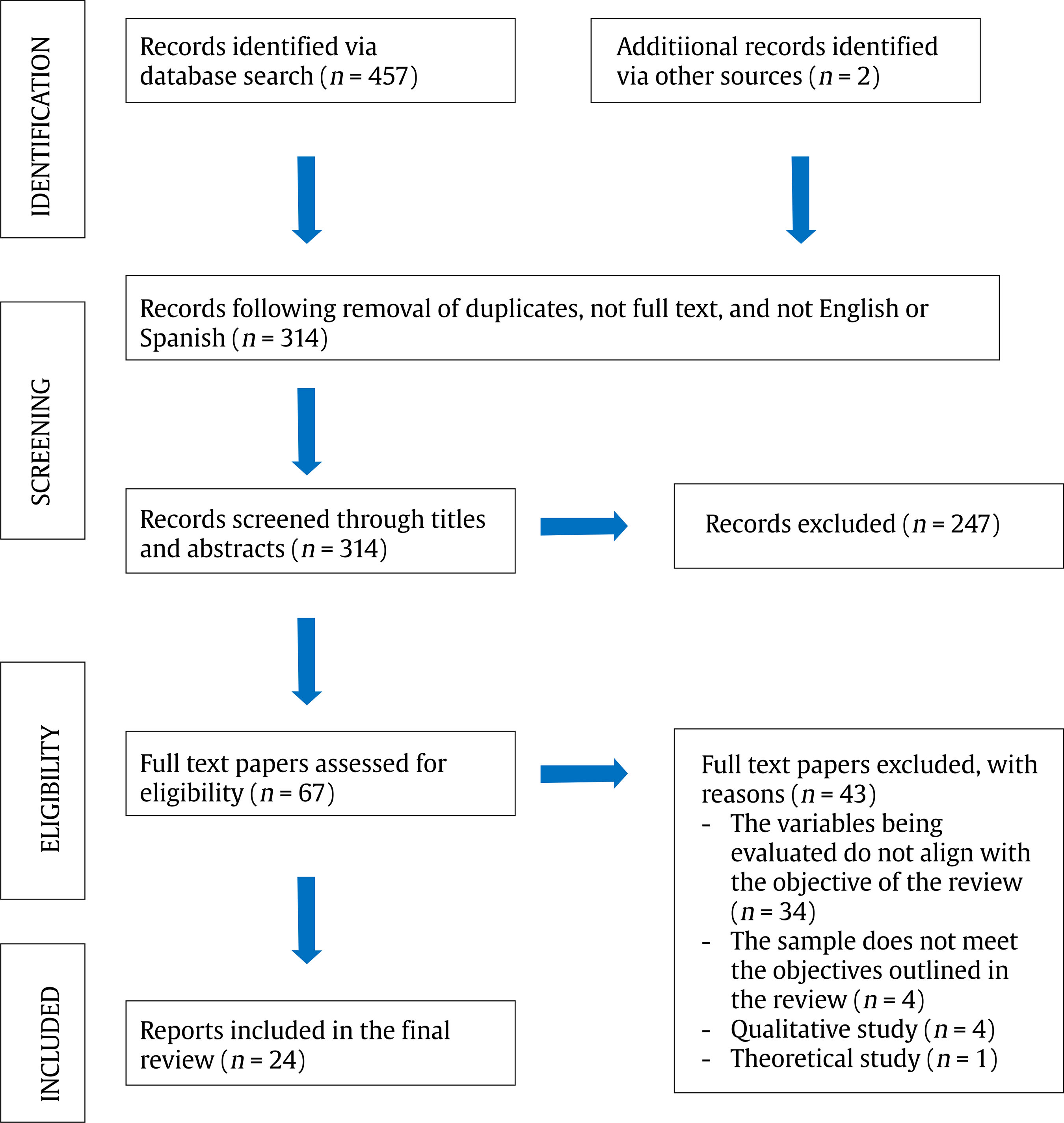 Description of Included Papers The initial database search yielded 295 results, from which 63 full-text articles were selected for detailed review based on predefined eligibility criteria. Following a thorough evaluation, 24 articles met the inclusion criteria and were included in this review. A descriptive table summarizing the key attributes of the included articles (n = 24) is provided in Supplementary Material 1, outlining the objectives, measures employed, main findings, and other relevant characteristics. Supplementary Material 2 contains the list of excluded articles with the reasons for their exclusion (n = 43). Additionally, in Supplementary Material 3 presents a table showcasing the impact indexes to gauge the quality of the selected articles. Methodology of the Articles Included All the studies evaluated present a quantitative methodological approach. Most of them are cross-sectional studies (n = 17) (see, e.g., Chen & Mok, 2023; Kosterelioglu, 2018; Lerner et al., 2022; Martins et al., 2020; Shi et al., 2024; Suizzo et al., 2023; Wehrspann et al., 2016; Zong et al., 2018), followed by longitudinal or prospective studies (n = 7) (see, e.g., Cimon-Paquet et al., 2023; Diaconu-Gherasim et al., 2022; Tunkkari et al., 2024; Zhou et al., 2023). Parental Involvement Assessment The study of parental involvement has evolved from the early work of Bloom (1964) to current approaches in family-school collaboration (Epstein, 2011). Its analysis reveals a multifaceted complexity that makes its precision and measurement difficult. This complexity lies in the various actions and behaviors that constitute parental involvement, from participating in school events to creating an enriching family environment. Therefore, it is crucial to know the measures used in its assessment, including the perceptions of children and parents and the various dimensions that compound parental involvement, such as volitional and motivational parental involvement, parental dimensions, and parenting styles. Parental Volitional and Motivational Actions in Children’s Education as Indicators of Parental Involvement Approaching the evaluation of parental involvement through the lens of engagement or interest in their children’s education, we observe that three studies have utilized the Parents’ Involvement in Children’s Learning Scale developed by Cheung and Pomerantz (2011; see also Chen & Mok, 2023; Li et al., 2020; Xu et al., 2020). This scale measures various facets of parental involvement, including a personal dimension that encompasses emotional support and a display of interest in the child’s educational pursuits, the cognitive dimension, which gauges direct assistance with homework, and the behavioral dimension, which assesses aspects linked to overseeing academic progress. Song et al. (2015) also gauge perceived parental support, albeit employing the metrics gathered in the statewide KELS Study 2005 (Kim et al., 2007). Similarly, Lerner and Grolnick (2020) used Grolnick and Slowiaczek’s (1994) Maternal Involvement Scale to assess three types of maternal involvement: school, personal, and intellectual/cognitive involvement. Also with a triadic division, Rodríguez et al. (2017) assessed perceived parental involvement using the Family Involvement Questionnaire (González-Pienda & Núñez, 1994). This scale also proposes the evaluation of involvement starting from three dimensions: one related to the interest in children’s progress, another that measures parental help in academic tasks, and the last one related to parental expectations. We also found studies that developed new scales to measure parental school involvement and academic socialization, building on the research of Cheung and Pomerantz (2011) and Wu and Yao (2013). On the one hand, Wei et al. (2022) measured academic socialization as the frequency with which parents discuss the importance of education, learning strategies, and other school-related topics with their children. On the other hand, Zong et al. (2018) assessed it as children’s perception of whether their parents discuss their educational future, provide valuable advice, or explicitly express academic expectations for them. Other instruments to measure academic socialization are those used by Cimon-Paquet et al. (2023), who used a scale that specifically measures the frequency with which parents spend time with their children discussing and inquiring about their unsupervised time (Stattin & Kerr, 2000); Suizzo et al. (2023), who employed the Parental Academic Socialization Questionnaire-Child scale (PASQ-C; Suizzo et al., 2012); or that utilized by Wehrspann et al. (2016), which in addition to assessing homework help, also employed several items adapted from Murdock’s (1999) Economic Value of Education scale. This scale served as a measure of academic socialization by assessing the degree to which parents communicate the value or utility of education to their children. Dimensions of Parenting as a Measure of Parental Involvement When studying parental involvement through parenting practices, various studies (Diaconu-Gherasim et al., 2022; Diaconu-Gherasim & Mirean, 2016; Martins et al., 2020) have assessed parenting dimensions using different translated and adapted versions of the Children’s Report of Parental Inventory (CRPBI). This inventory was originally developed by Schaefer (1965) and later refined and validated by Schludermann and Schludermann (1970). The original 52-item instrument is based on a three-dimensional model with three pairs of orthogonal factors: Acceptance vs. Rejection, Psychological Autonomy vs. Psychological Control, and Firm Control vs. Lax Control. In this review, we also found studies where only the Autonomy vs. Control dimension was assessed through individual instruments to measure parental autonomy and control. Autonomy, for example, was assessed in several studies (Li et al., 2020; Xu et al., 2018; Zhou et al., 2023; Zong et al., 2018) through a selection of items used in previous research, such as that of Wang et al. (2007), which in turn is based on other previous studies (McPartland & Epstein 1977; Steinberg et al., 1992). The items selected in turn conformed to two dimensions: decision making and opinion exchange. Other measures of parental autonomy support present in this review were Cheung and Pomerantz’s (2011) 12-item measure employed by Xiang et al. (2017), in which participants indicated the extent to which their parents use autonomy-supportive practices, and the 8-item dimension of autonomy support from the Parenting Context Questionnaire (Wellborn & Grolnick, 1988) employed by Lerner and Grolnick (2020) to assess children’s perceptions of their mothers’ autonomy support. Meanwhile, Lerner et al. (2022) utilized a combined assessment of autonomy-supportive and controlling parenting dimensions. In particular, they developed a questionnaire to assess the degree to which involvement supported or controlled autonomy. In line with this study, Shi et al. (2024) adapted measures established by several previous studies (Dumont et al., 2014; Moroni et al., 2015; Silinskas & Kikas, 2019). These authors assessed mothers’ autonomy support in terms of allowing or encouraging children to take the initiative to learn and solve task problems independently, as well as assessing mothers’ control in terms of exerting pressure and intrusiveness to achieve certain outcomes. Tunkkari et al. (2024) used a short version of the Learning Climate Questionnaire (Black & Deci, 2000) to measure both aspects. Regarding the assessment of parental control, several studies have used different scales to measure this construct. Zong et al. (2018), Xiang et al. (2017), and Xu et al. (2018) used the Parental Psychological Control scale developed by Wang et al. (2007), based on previous measures (Barber, 1996; Silk et al., 2003). This scale consists of 18 items distributed in three subscales: Guilt Induction, Deprivation of Love, and Affirmation of Authority. On the other hand, Shih (2021) used Shek’s (2006) Parental Psychological Control Scale, which includes 10 items to assess children’s perception of parental control. In addition, Cimon-Paquet et al. (2023) used a French version of the Parental Control Subscale by Stattin and Kerr (2000) in their research. These different measures provide a varied view of perceived parental control in the family context. Parenting Styles as a Measure of Parental Involvement We found a limited number of studies that explore the role of parenting styles. Two of these studies utilized Baumrind’s (1971) conceptual typology. On the one hand, Suarez-Valenzuela and Suarez (2022) identified three parenting styles: democratic, authoritarian, and permissive, using the revised version of Buri’s (1991) Parental Authority Questionnaire (PAQ). Meanwhile, Kosterelioglu (2018) used the Parents Attitude Scale (PAS) (Demir & endil, 2008), incorporating four parenting styles: democratic, authoritarian, overprotective, and permissive. Finally, León-del-Barco et al. (2019) utilized the Norms and Demands Scale child version (ENE-H) (Fuentes et al., 1999) to assess parenting styles from a more behavioral and home rules organization perspective. This scale assesses how parents establish and demand compliance with their rules, and consists of three factors: inductive, rigid, and lenient forms. Goal Orientation Assessment The reviewed studies demonstrate diversity in the measurement of goal orientation concerning parental variables. Some studies take a broader perspective on motivation, using measures that assess motivation from the intrinsic/extrinsic dichotomy, reflecting the influence of theories such as the Self-Determination Theory (Deci & Ryan, 1985). Other studies focus on a more self-regulatory perspective, assessing the motives behind behavior by measuring self-regulation and self-efficacy, aligning with the Self-Regulation Theory (Zimmerman, 2000). Finally, some studies focus on specific goal orientation, such as mastery and performance goal orientation, or approach and avoidance goals, based on theories such as the Achievement Goal Theory (Elliot & McGregor, 2001), which distinguishes between different types of goals and their influence on academic behavior and performance. Assessment of Goal Orientation from a Motivational and Behavioral Perspective From this global perspective, León-del-Barco et al. (2019) measured goal orientation with the Academic Goals Questionnaire (AGC). This 5-point Likert scale comprises 20 items designed to examine the reasons for students’ commitment to their studies. It is based on previous work by Hayamizu et al. (1989) and Hayamizu and Weiner (1991) and adapted to Spanish by González Gómez et al. (2002). It assesses four key motivational factors: external, introjected, identified, and intrinsic regulation. Cimon-Paquet et al. (2023) similarly explored autonomous and controlled motivation through the French version of the Academic Motivation Scale (AMS) (Vallerand et al., 1989). Shi and Wang (2024) assessed autonomous versus controlled motivation using scales established by Katz et al. (2011), validated for Chinese elementary school students. On the other hand, Wehrspann et al. (2016) used separate scales to measure intrinsic and extrinsic motivation. However, Wei et al. (2022) explored beliefs about educational value using a questionnaire composed of 9 items from Mickelson’s (1990) Abstract Attitudes toward Education Scale. From a self-regulatory perspective, Lerner and Grolnick (2020), Lerner et al. (2022), and Tunkkari et al. (2024) employed Ryan and Connell’s (1989) Self-Regulation Questionnaire. This scale consists of 23 items designed to measure the degree of autonomy in children’s school motivation, addressing four types of motivation: external, introjected, identified, and intrinsic regulation. These factors are similar to those identified by the Academic Goals Questionnaire (AGC). Assessment of Goal Orientation from the Avoidance and Approach to Performance and Mastery Perspective We also noted a group of studies that approached the assessment of goal orientation from the 2 x 2 theoretical framework. This theory classifies achievement orientations into four categories: mastery-approach goals, performance-approach goals, mastery-avoidance goals, and performance-avoidance goals. These studies either addressed all four categories of the model, or focused on only three, two, or one of them. Regardless of the number of goal orientation types assessed in each study, they used a large number of questionnaires to measure this construct. For example, six studies relied on Elliot and McGregor’s (2001) Achievement Goal Questionnaire (AGQ), which measures the four types of goal orientation (Diaconu-Gherasim & Mirean, 2016; Li et al., 2020; Shih, 2021; Song et al., 2015; Xiang et al., 2017; Zong et al., 2018). Other authors employed Skaalvik’s (1997) Academic Goals Questionnaire (Martins et al., 2020; Suarez-Valenzuela & Suarez, 2022), while Kosterelioglu (2018) employed Akın’s (2006) 2 x 2 Achievement Goal Orientation Scale, also obtaining the four factors solution. Studies such as Chen and Mok’s (2023), Suizzo et al.’s (2023), Xu et al.’s (2018), and Xu et al.’s (2020) measured goal orientation from a three-category structure using the Patterns of Adaptive Learning Scales (PALS) (Midgley et al., 2000). Diaconu-Gherasim et al. (2022) also employed this scale as well as a more general measure of intrinsic motivation using a brief version of the Intrinsic versus Extrinsic Orientation Scale (12 items; Harter, 1981). As for Rodríguez et al. (2017), these authors used two subscales of the Inventory of Attitudes toward Mathematics (IAM) (Tapia & Marsh, 2004) to measure performance and mastery goal orientation in mathematics. Finally, Zhou et al. (2023) addressed the unit measure of mastery goal using two items from previous studies (Pomerantz et al., 2005). Results on the Relationship between Parental Involvement and Goal Orientation After analyzing the methodology of the articles reviewed, we have taken into account these findings to present the main results regarding parental involvement and goal orientation. On the one hand, the results are described based on four categories of parental involvement we have established: parental volitional actions, parental motivational support, parental style, and educational style. Specifically, “parental volitional actions” have been operationalized as support in performing academic tasks (n = 7) (e.g., Lerner et al., 2022), home-school communication and parent interest (n = 4) (e.g., Xu et al., 2020), and promotion of learning at home (n = 2) (e.g., Lerner & Grolnick, 2020). “Parental motivational support” has been operationalized as the aspirations and expectations (n = 3) that parents have about their children (e.g., Zong et al., 2018), academic socialization (n = 5) (e.g., Zong et al., 2018), and parents’ emotional support for their children (n = 2) (Song, 2015). On the other hand, the “dimensions of parenting” were operationalized as autonomy support vs. parental control (n = 14) and parental acceptance vs. rejection (n = 3) (e.g., Martins et al., 2020). Finally, “parenting styles” (n = 3) (e.g., Suarez-Valenzuela & Suarez, 2022) were studied following the classification established by Baumrind (1971). Furthermore, in the description of these results, we emphasize whether the measures are reported by students (n = 18), fathers or mothers (n = 1), or both (n = 4). Regarding goal orientation, we present the main findings referring to studies assessing it from the avoidance and approach to performance and mastery perspective (n = 14) and those assessing it from a motivational and behavioral perspective (n = 7). Three studies explore goal orientation from both perspectives. Finally, we considered the educational stage of the student samples used in the studies selected. This included elementary school grades (n = 7), middle and high school grades (n = 15), and all stages (n = 2). The classification of the articles based on these categories of analysis can be found in Supplementary Material 4. Parental Volitional Actions and Goal Orientation Support in Performing Academic Tasks One of the most common forms of parental involvement is participating in academic tasks at home. This type of parental involvement involves parents monitoring and helping their children with tasks at home (Rodríguez et al., 2017). These behaviors include checking homework (Wehrspann et al., 2016) and personally teaching children (Song et al., 2015). The influence of parental involvement at home on students’ goal orientation has been extensively researched, yielding diverse findings. For instance, Rodríguez et al. (2017) identified a positive link between parental assistance with academic tasks and elementary school students’ orientation toward mathematics performance goals, but not toward mastery goals. On the other hand, Zong et al. (2018) reported positive associations between parental supervision of homework and the adoption of mastery, performance, and performance-avoidance goals in elementary school students. However, regression analysis results indicate that this form of parental involvement at home predicts the adoption of performance-approach goals when children perceive low psychological control from their parents. Conversely, homework support did not account for the adoption of mastery goals or performance-avoidance goals. In the case of secondary school students, perceived parental academic support was positively linked to mastery and performance-approach goal orientation, as observed by Song et al. (2015). Ultimately, academic support at home was found to be a significant predictor of higher mastery orientation, as well as higher performance-approach and performance-avoidance orientation in the long term. Among the articles measuring parental homework support, several authors have taken as a dependent variable motivational orientation toward other types of goals that we find interesting to analyze in this review. Wehrspann et al. (2016), for example, observed that parental-reported homework support did not correlate with children’s intrinsic and extrinsic motives toward school. However, this type of parental involvement perceived by students did correlate positively with students’ intrinsic motivation. For their part, Wei et al. (2022) in a longitudinal study with students from elementary to high school and both their parents observed that the greater the family’s help with homework, the greater the autonomous motivation – intrinsic and identified motivations – of the children. In the case of controlled motivation – extrinsic and introjected motives –, the effect of parental supervision of homework did not reach significance. Finally, Lerner et al. (2022) took a relative autonomy index (RAI) – measured from scores of intrinsic, extrinsic, identified, and introjected motivational orientation – from a group of elementary school students. They found that higher levels of autonomy-supportive home involvement by parents reported by the children were related to higher autonomous motivation. However, there would be no significant correlations between mothers’ time spent supervising homework completion and children’s long-term controlled and autonomous motivation (Shi et al., 2024). Home-school Communication and Parent Interest Other parental involvement actions in children’s education are showing interest in children’s progress and communicating with the school and/or teachers. Rodríguez et al. (2017)analyzed the relationship between interest in children’s progress and goal orientation, confirming that when children perceive their parent’s interest in their progress they would adopt mastery-approach goals. On the other hand, results from study showed that parental involvement in school – e.g., attending parent-teacher conferences – was positively associated with the adoption of mastery goals by a group of elementary school students. Finally, Lerner and Grolnick (2020) measured both mothers’ involvement in school and interest in academic progress reported by mothers and children at the elementary education stage. Higher levels of mothers’ school exchange had a positive effect on children’s autonomous motivation (RAI). On the other hand, for mothers who also showed support for children’s autonomy, showing interest in their progress also had an impact on children’s autonomous motivation. Similarly, Lerner et al. (2022) found that parents showed higher levels of interest and involvement in school than in homework, finding a positive correlation between parental interest and children’s autonomous motivation. Promotion of Learning at Home Although we found only two studies using this measure of parental involvement, promoting learning at home is critical to developing children’s interest in learning. In this regard, Lerner and Grolnick (2020) explored the effect of parental cognitive/intellectual involvement – e.g., taking the child to the museum or buying books – on autonomous motivation in elementary school children. In this study, a main effect of mothers’ cognitive/intellectual involvement on children’s levels of autonomous motivation was found. In subsequent research, Lerner et al. (2022) found that parents showed higher levels of cognitive/intellectual autonomy-supportive involvement than in homework performance. Furthermore, they observed a positive correlation between this type of involvement and children’s autonomous motivation. Parental Motivational Support and Goal Orientation Parental Aspirations and Expectations Parents have a set of qualities, skills, or behaviors, known as socialization goals, that they want their children to acquire to be competent (Darling & Steinberg, 1993). Zhou et al.’s study (2023) differentiated between parents’ self-development socialization goals – parents who want their adolescent children to be unique, autonomous, and assertive – and academic achievement socialization goals – parents who want adolescents to achieve academic success. The study found positive associations between parents’ self-development socialization goals and the adoption of mastery-oriented goals over time and identified the mediating role of parental autonomy support in this link. Parents with more socialization and self-development goals for their adolescent children were more likely to be autonomy-supportive, which predicted greater academic motivation one year later. In contrast, academic achievement socialization goals did not show this association. In the study by Rodríguez et al. (2017), parental expectations are described as parents’ beliefs about their children’s abilities to cope with academic and non-academic situations. Specifically, parental expectations about children – perceived by elementary school students – positively and indirectly explained mastery and performance goal orientation through motivational variables. Thus, parental expectations were related to the utility value of mathematics. In turn, the utility value was correlated with achievement goals and with mastery goals in mathematics. Academic Socialization One measure of parental involvement that has not been explored in depth in relation to goal orientation, but is of particular interest, is academic socialization. This is understood as the frequency with which parents discuss the importance of education with their children (Wei et al., 2022). In the study by Zong et al. (2018), parental academic socialization as perceived by elementary school children was found to be positively correlated with mastery, performance-approach, and performance-avoidance goals. In contrast, the research by Wei et al. (2022) yielded similar results for high school students, but the effect of academic socialization on the autonomous motivation of elementary school students was not appreciated. Along the same lines, Cimon-Paquet et al. (2023) observed moderate positive correlations over time between children’s self-reported academic socialization and their autonomous and controlled motivation. In addition, bidirectional associations were found between autonomous motivation and adolescents’ perceived parental socialization. The study by Wherspann et al. (2016) found a significant nonlinear association between adolescents’ perceived academic socialization and the adoption of intrinsic and extrinsic motives to learn. Specifically, the positive association between academic socialization and intrinsic motivation weakened at moderate levels of academic socialization and became negative at high levels of academic socialization. Conversely, there was no association between academic socialization and extrinsic motivation at low and moderate levels of academic socialization, but a strong positive association at high levels of academic socialization. These findings suggest that higher levels of communication about the value or usefulness of education do not always benefit children’s academic motivation. Finally, Suizzo et al. (2023), with a sample of low-income adolescents, observed that their intrinsic future goals and current mastery goals mediated the relationships between parental messages about the importance of working hard to succeed in school and their academic achievement. Adolescents who reported hearing more messages from their parents about the importance of hard work, learning, and education reported higher future intrinsic goals. Emotional Support There is growing evidence that perceived social support plays an influential role in various aspects of students’ adjustment in school (Izar-de-la-Fuente et al., 2023). This takes the form of perceived social support from parents, peers, and teachers. Studies have usually evaluated the support perceived by these three social agents as a unitary construct without distinguishing between the support provided by each of them in a differentiated manner. However, as Song et al. (2015) argue, support from a particular social agent may have more consequences than support from others in shaping motivation and performance during adolescence. Specifically, the reviewed articles focus on one particular component of social support: emotional support, understood as the belief that significant others respect us as individuals and attend to our feelings and needs, expressing empathy and concern for our well-being (see, e.g., Ahmed et al., 2010). In in the study by Song et al. (2015), the emotional support offered by parents perceived by adolescents predicted the widest range of motivation and academic achievement indices. Specifically, parental emotional support was positively correlated with mastery and performance-approach goals. In the long run, it predicted stronger mastery and performance-approach goals than any other type of support. Also using a longitudinal perspective, but with elementary school students, Shi et al. (2024) found that mothers with constructive homework involvement – e.g., showing positive emotions – influenced children’s autonomous motivation with homework later on. In contrast, showing negative emotions would favor the adoption of a more controlled motivation. Although most of the studies reviewed explore specific parental volitional and motivational actions, three articles took a unitary measure composed of different parental involvement behaviors that cannot be disaggregated, so we have chosen to describe these articles as a whole. Chen and Mok (2023) found that high school students’ perceptions of parental involvement at home and at school positively impact their adoption of mastery and performance-oriented goals. Xu et al. (2020) found that over time high school students’ perceived parental involvement and mastery goal orientation would decrease, while their orientation toward performance-approach goals would increase and their orientation toward performance-avoidance goals would remain stable. All in all, the level and changes in parental involvement would have significant effects on changes in mastery goal orientation, and not on performance goal orientations. Finally, Li et al. (2020) identified that high school students who report moderate parental involvement have higher levels of mastery and performance-approach goal orientation and lower levels of performance-avoidance goal orientation. Dimensions of Parenting and Goal Orientation Parenting refers to a series of parental behaviors that promote a persistent emotional climate in a wide range of situations (Darling & Steinberg, 1993). According to Schaefer (1965), parenting practices vary along the continuum of two dimensions: autonomy vs. control, and acceptance vs. rejection. Parental Control vs. Autonomy Support The results of different research studies coincide in pointing out the relationship between parental psychological control and children’s goal orientation. Thus, several studies indicated that parental psychological control was significantly positively related to children and adolescents’ performance-approach and avoidance goals (e.g., Martins et al., 2020; Xiang et al., 2017; Xu et al., 2018; Zong et al., 2018). In contrast, no relationship was appreciated between parental control and mastery-oriented goals. However, studies such as the one developed by Diaconu-Gherasim and Mirean (2016) found that the relationships between parental control and mastery and performance goal orientation were not significant in a sample of adolescents. Along the same lines, the work of Shih (2021) and Xiang et al. (2017) found a positive relationship between parental control and performance-approach and performance-avoidance goal orientation, although, in both studies, this relationship was found, equally, with mastery-avoidance goal orientation. Furthermore, in the study by Xiang et al. (2017), parental psychological control was associated with adolescent school adjustment in a maladaptive manner through its positive relationship with mastery-avoidance and performance-avoidance goals. Cimon-Paquet et al. (2023), in a longitudinal study with adolescents, found that perceived parental control through rules did not predict changes in controlled motivation over time, and controlled motivation also did not predict changes in parental control. The same was true for students’ autonomous motivation. Regarding parental autonomy support, results from several of the studies reviewed point to it being significantly positively related to children and adolescents mastery goal orientation (Martins et al., 2020; Xiang et al., 2017; Xu et al., 2018; Zong et al., 2018). Regarding performance-approach and performance-avoidance goal orientation, some authors have found significant positive relationships with the former (Martins et al., 2020; Xiang et al., 2017; Zong et al., 2018) and negative relationships with the latter (Diaconu-Gherasim et al., 2022; Martins et al., 2020), while in other research these relationships did not reach statistical significance (Xu et al., 2018; Zong et al., 2018). Regarding mastery-avoidance goals, studies by Diaconu-Gherasim and Mirean (2016) and Xiang et al. (2017) observed that they were positively related to the autonomy support offered by parents. On the other hand, Zhou et al. (2023) found positive associations between parents’ self-development socialization goals and mastery orientation over time and identified the mediating role of autonomy support in that relationship for elementary school students. Lerner and Grolnick (2020) also found that mothers’ autonomy support was positively related to autonomous motivation in a group of elementary school students. Specifically, it was appreciated that mothers’ personal involvement was associated with higher autonomous motivation when they were autonomy-supportive. In a later study by Lerner et al. (2022) with both parents, it was found that fathers and mothers who were involved for controlling reasons showed lower autonomy support. This affected children’s autonomous motivation. For their part, Li et al. (2020) measured psychological control and parental autonomy support together with the level of parental involvement. The results revealed four profiles: high control-low parental involvement (Profile 1), moderate control-moderate parental involvement (Profile 2), high control-high parental involvement (Profile 3), and high autonomy support-moderate parental involvement (Profile 4). Students in Profiles 3 and 4 exhibited similar levels of mastery and performance-approach goal orientation. However, adolescents in Profile 3 showed higher performance-avoidance goals when compared to those in Profile 4. Students in Profile 1 scored lower on both mastery-approach and performance-avoidance goals. Lastly, two studies examined parental psychological control and autonomy support during homework performance. Tunkkari et al. (2024) examined the bidirectional longitudinal relationships between psychological control and autonomy support during homework completion reported by mothers and academic motivation in a sample of adolescents. Maternal autonomy support in the performance of these tasks did not promote adolescents’ school satisfaction directly or indirectly through increased intrinsic motivation over time. As for maternal psychological control, it was positively related to adolescent demotivation and negatively related to intrinsic motivation. Specifically, higher levels of maternal psychological control predicted higher levels of subsequent adolescent demotivation. On the other hand, a decrease in maternal psychological control predicted higher levels of adolescent intrinsic motivation. In the case of elementary school students, Shi et al. (2024) found that a constructive involvement of mothers in homework, based on autonomy support, favored children’s autonomous motivation to do homework, whereas exerting control over the process would lead to the adoption of a more controlled motivation. Parental Acceptance versus Parental Rejection A limited number of articles have analyzed the acceptance-rejection dimension of parenting. Moreover, all of these studies have used measures reported by middle and high school students. In a study by Diaconu-Gherasim and Mirean (2016), statistically significant negative correlations were found between parental rejection and the adoption of mastery-avoidance and performance-approach goals, with these relationships being stronger for girls. In this research, a mediating effect of the orientation to performance-approach and performance-avoidance goals between parental rejection and academic achievement was proven. In a subsequent longitudinal study, Diaconu-Gherasim et al. (2022) observed that adolescents who indicated lower parental rejection held lower levels of mastery-oriented academic goals in the following school year. Specifically, mastery-approach goals mediated the relationship between adolescents’ perception of parental rejection and their intrinsic motivation in terms of curiosity and preference for challenge. Regarding mothers’ involvement, Martins et al. (2020) observed that maternal positive evaluation behaviors correlated positively with their children’s mastery and performance-approach goal orientation. The positive evaluation and support dimension would also contribute to the explanation of performance-approach goals, whereas the use of punishment would contribute to the adoption of performance-avoidance goals, and negatively with task-avoidance goals. The results of the regression analysis showed that the positive evaluation and support that adolescents perceived from their mothers explained the adoption of mastery and performance-approach goals and protected them from adopting performance-avoidance and mastery-avoidance goals. Parenting Styles and Goal Orientation Parenting styles are one of the constructs most widely used by researchers to analyze the influence of parents on their children’s learning (Suarez-Valenzuela & Suarez, 2022). Baumrind (1971) operationalizes the parenting style according to high and/or low levels of affect and control variables, resulting in four parenting styles: democratic (high in affect and control), authoritarian (low in affect and high in control), permissive (high in affect and low in control), and negligent (low in affect and control). Specifically, parenting styles based mainly on affection, communication, and positive control (Silinskas & Kikas, 2019) are considered more suitable than those based on the imposition of rules (Fernández-Alonso et al., 2017). Following this definition, Suarez-Valenzuela and Suarez (2022) observed that the parenting style – perceived by their children – was related to the goal orientation of adolescents. Specifically, the democratic style correlated positively with all learning strategies and with the task-oriented goals, as well as negatively with the task-avoidance goals. In contrast, the authoritarian style correlated with ego self-enhancement, ego self-protection, and task-avoidance goals. As for the permissive style, it did not correlate with any academic goals. In this research, motivational-familial profiles were explored and it was identified that the two most strategic profiles in students corresponded, firstly, to the learning-oriented student with a democratic parenting style; and, secondly, to the learning-oriented student with an authoritarian parenting style. In the case of younger students, León-del-Barco et al. (2019) found significant relationships between the types of goal orientation – measured in terms of learning, social evaluation, achievement, and reward goals – and the ways of setting and demanding that rules be met – inductive, indulgent, and rigid parenting styles – by their parents that they perceived. Elementary school students oriented toward social evaluation and reward goals were characterized by an indulgent parenting style, determined by the absence of rules and limits on their behavior. On the other hand, students oriented towards learning and achievement goals had parents with an inductive style, determined by the use of reason and explanations to their children of the consequences of breaking rules and performing prohibited actions. While most of the reviewed studies take measures of parental involvement perceived by children, the study by Kosterelioglu et al. (2018) explored parent-reported parenting styles starting from the classification by Baumrind (1971) and the 2x2 goal orientation model. One of the findings obtained in the study showed a positive, medium-level relationship between parenting styles and learning-approach goals and a positive, low-level relationship between parenting style and learning-avoidance goals. Democratic and overprotective parenting styles were found to have the strongest and most significant impact on learning approach goal orientation, while the overprotective and permissive parenting styles had the most significant impact on mastery-avoidance goal orientation. Authoritarian and overprotective parenting styles had the most significant impact on performance-approach and performance-avoidance goals. The study does not justify these findings, but the fact that two opposing parental styles explain the adoption of the same type of goal orientation is one of the reasons why it is considered more appropriate to study the dimensions that compose them (Baranowsky et al., 2013; Smetana, 2017). This systematic review aims to provide an overview of the current state of research exploring the relationship between the diversity of forms of parental involvement and its influence on shaping the academic goal orientation of their children. The beneficial impact of active – and quality – parental involvement extends beyond children’s academic performance to various aspects of their development and education. Research suggests that high-quality parental involvement can enhance students’ academic motivation (see, e.g., Barger et al., 2019; Kent et al., 2022; Kim et al., 2023) and other variables such as perceived competence, commitment to tasks, or the development of positive attitudes towards school (Vasquez et al., 2016). Therefore, the different forms and styles of parental involvement significantly influence affective-motivational factors of the student learning process, which mediate or moderate the learning outcomes or student performance (Kristensen et al., 2023). Among these variables, goal orientation can be highlighted (Song et al., 2015). The results from this systematic literature review are structured and described based on four key categories of parental involvement: parental volitional actions, parental motivational support, parenting dimensions, and parenting styles. Thus, in the following lines, we will try to highlight and discuss the main ideas identified. Firstly, several theoretical frameworks suggest that active parental involvement outside school such as helping with homework, communicating about the school, or showing interest in children’s progress promotes students’ learning outcomes (Epstein, 2011; Grolnick & Slowiaczek, 1994). The results of the current study expand those of former reviews by extending them to goal orientation theory. In particular, students demonstrate a higher mastery as well as performance goal orientation when their parents communicate and show interest in school progress (e.g., Lerner & Grolnick, 2020), supervise the completion of academic tasks at home (e.g., Rodríguez et al., 2017), and promote other learning activities outside school (e.g., Lerner et al., 2022). Therefore, when parents show interest in what is going on at school, supervise homework completion, and promote children’s cognitive stimulation, students adopt motivation goals such as gaining understanding and mastering new skills, as well as demonstrating competence. Secondly, the findings on the relationship between parental motivational support and goal orientation lead us to the discussion on parental aspirations and expectations. In this sense, the frequency and quality of conversations between parents and children about the importance of their education (academic socialization) is identified as one of the key variables (Wei et al., 2022). Thus, parents with more socialization and self-development goals for their adolescent children were more likely to be autonomy-supportive, which predicted students’ greater academic motivation. However, a surprising result is identified in the study by Wherspann et al. (2016). It seems that the more frequently parents communicate about the value or usefulness of education, the more it promotes the development of extrinsic motivation in children and inhibits the development of intrinsic goals. About this particular conclusion, it could be hypothesized that these communications (although frequent) by parents are formulated in terms of results or academic performance. The key would lie more in the focus of these conversations than in their frequency. Thus, the findings on this variable are not particularly conclusive. Following Suizzo et al. (2023), to understand this relationship it would be convenient to analyze the role played by other contextual variables – e.g., family socioeconomic level – and personal variables – e.g., student’s previous academic performance– in mediating the relationship between these two variables. Furthermore, those parents who offer higher levels of emotional support facilitate the orientation to mastery and performance-approach goals in their children (Song et al., 2015). Thirdly, another issue to highlight is the differential configuration of students’ goal orientation as a function of parental control and parental autonomy support. One of the most interesting results derives from the study by Li et al. (2020), given that it uses a person-centered approach to identify four parental profiles, combining both variables. Thus, the profile that stands out as the most adaptive and positive – in the development of mastery and performance-approach goal orientation – is the one characterized by showing high autonomy support and moderate parental involvement. On the other hand, as explained by several authors (Martins et al., 2020; Xiang et al., 2017; Xu et al., 2018; Zong et al., 2018), the parental involvement profile that seems to be associated with adolescent poor school adjustment is that of those parents characterized by showing high control and low parental involvement. When talking about parental acceptance and rejection, it is interesting to note that those students who have mastery-approximation goals perceive parental rejection to a lesser extent and promote more intrinsic motivation in terms of curiosity and preference for challenge (e.g., Diaconu-Gherasim et al., 2022), implying that this motivational orientation could be considered a protective factor in this sense as well. In addition, there is a consensus in determining that, positive evaluation and support would also contribute to the explanation of performance-approach goals, while the use of punishment would contribute to the adoption of performance-avoidance goals; and task-avoidance goals (e.g., Shih, 2021). Finally, regarding the last dimension (parental styles) it seems clear that democratic parents encourage their children to develop learning strategies and task-oriented goals, refraining from generating a task-avoidance goal orientation. In contrast, authoritarian parents promote to a greater extent the generation of task-avoidance goals in their offspring (e.g., Suarez-Valenzuela & Suarez, 2022). As for the permissive style, it did not correlate with any academic goals, which is also considered negative, since it assumes that parental involvement has no link with student behavior, losing the potential of this socializing agent. This highlights the value of implementing the person-centered approach to develop studies in the field of family styles and parental involvement and its influence on children’s academic motivation. In other words, when the variables are taken independently (control and support) the results suggest that parental psychological control was associated with adolescent school adjustment in a maladaptive manner through its positive relationship with mastery-avoidance and performance-avoidance goals (Xiang et al., 2017). However, it is important to remember that, for the design of adjusted and effective interventions, one must take into consideration how variables related to parental involvement work interactively and subsumed with others. This approach to analysis yields information with a more holistic character and with a greater capacity for application in the real context. One of the major limitations we have faced in carrying out this study is the operationalization of the variables under analysis. On the one hand, in the approach to the different forms of parental involvement, we encountered different prisms, approaches, theories, and meanings from which parental/family behaviors and profiles were established. On the other hand, the diversity of theories or paradigms from which student goal orientation was analyzed, the differential denomination of the different constructs, and the specificity in the analysis of some variables in isolation in certain studies, made the selection process of the papers that formed part of the final group of reports difficult (Elliot & McGregor, 2001; Miller & Speirs Neumeister, 2017). However, with this work it has been possible to identify some gaps and inconsistencies in the analyzed documentary corpus that studies the relationship between these variables. Consequently, it is considered interesting to conduct empirical research studying the influence of parental/family involvement in shaping students’ motivational orientation, but from a person-centered perspective. That is, it is concluded that it would be necessary to conduct empirical studies that do not operate with the variables in isolation but contemplate student motivation from a holistic approach. Through LCA (latent class analysis) it would be possible to identify and describe the diversity of motivational profiles among students and then analyze the relationship established with the different forms and profiles of parental involvement. This would lead to results with a highly significant potential for application and transfer to reality (McMullen & Hickendorff, 2018). Conflict of Interest The authors of this article declare no conflict of interest. Cite this article as: Piñeiro, I., Guisande, M. A., Rodríguez-Llorente, C., González-Suárez, R. , Estévez, I., & Rodríguez, S. (2026). Understanding the relationship between parental involvement and sudents’ goal orientation: A systematic review 2014-2024. Psicología Educativa, 32, Article e260456. https://doi.org/10.5093/psed2026a13 Funding This study was partially developed by the financial support provided for the lrlelsearch project PID2021-125898NB-I00 by the Spanish Ministry of Science and Innovation. Moreover, two of the authors obtained funding through fellowship grats for posdoctoral training within the universities of the Galician Universit System. Thes grants were bestowed by the Department of Economy, Industry, and Innovation of the Xunta de Galicia, Spain (Ref. ED481B-2023-132 and ED481B-2023-234) and the Fullbright postdoctoral program (Ref. ED481-2023-134). Supplementary data are available at https://doi.org/10.5093/psed2026a13 References References marked with an asterisk indicate studies included in the meta-analysis |
Cite this article as: Piñeiro, I., Guisande, M. A., Rodríguez-Llorente, C., González-Suárez, R., Estévez, I., & Rodríguez, S. (2026). Understanding the Relationship between Parental Involvement and Students’ Goal Orientation: A systematic Review 2014-2024. Psicología Educativa, 32, Article e260456. https://doi.org/10.5093/psed2026a13
Correspondence: iris.estevez.blanco@usc.es (I. Estévez).Copyright © 2026. Colegio Oficial de la Psicología de Madrid


 PDF
PDF Supplementary files
 e-PUB
e-PUB CrossRef
 JATS
JATS Imprimir
 Enviar
ALERTA POR E-MAIL
La Revista de Psicología Educativa está distribuida bajo una licencia de Creative Commons Reconocimiento-NoComercial-SinObra Derivada 4.0 Internacional.com