An Exploratory Study of Teachers’ Perceptions of School Administrators’ Affiliative Humor, Organizational Support, and Well-Being
[Un estudio exploratorio sobre la valoración de los docentes del humor afiliativo de los administradores de colegios y el apoyo organizacional y bienestar]
Ahmet Sahin1, Sinem Arslan Dönmez2, Ramazan Gök1,3
1Alanya Alaaddin Keykubat University, Turkey; 2Independent Researcher; 3Akdeniz University, Turkey
https://doi.org/10.5093/psed2026a21
Received 15 August 2025, Accepted 9 April 2026
Abstract
This study aimed to reveal the relationship between teachers’ perceptions of school administrators’ affiliative humor use and teachers’ mental well-being by focusing on the mediating role of perceived organizational support (POS). A cross-sectional survey was conducted with 542 teachers working in public primary schools located in Antalya, Turkey, using three measures: affiliative humor, perceived organizational support, and mental well-being. Mediation testing was performed using structural equation modeling and bootstrapping procedures. The findings of the study revealed that teachers’ perceptions of school administrators’ affiliative humor use were positively related to teachers’ mental well-being and POS. Furthermore, teachers’ POS was found to be positively related to their mental well-being. The results further suggested that POS was associated with the relationship between teachers’ perceptions of administrators’ affiliative humor and teachers’ mental well-being, indicating a partial mediating role within the examined model. Consequently, our results emphasize that when teachers perceive higher levels of affiliative humor by their school administrators, they tend to report higher levels of perceived organizational support (POS), and this perception is associated with higher levels of teachers’ mental well-being.
Resumen
Este estudio tuvo como objetivo mostrar la relación entre la opinión de los docentes sobre el uso del humor afiliativo de los directores de colegio y el bienestar mental de los docentes, centrándose en el papel mediador del apoyo organizacional percibido (AOP). Se realizó una encuesta transversal con 542 docentes que trabajaban en escuelas primarias públicas ubicadas en Antalya, Turquía, utilizando tres medidas: humor afiliativo, apoyo organizacional percibido y bienestar mental. Se realizó una prueba de mediación utilizando el modelado de ecuaciones estructurales y procedimientos de remuestreo. Los resultados muestran que la valoración de los docentes sobre la utilización del humor afiliativo por parte de los directores guarda una relación positiva con el bienestar mental de los docentes y el AOP. Además, se vió que el AOP de los docentes tiene una relación positiva con su bienestar mental. Los resultados también indican que el AOP se asocia con la relación entre la valoración de los docentes del humor afiliativo de los directores y el bienestar mental de los docentes, lo que indica un papel mediador parcial dentro del modelo examinado. En consecuencia, nuestros resultados destacan que cuando los docentes observan que hay un mayor grado de humor afiliativo en los directores del centro tienden a referir un mayor apoyo organizacional percibido (AOP), valoración ligada a un mayor nivel de bienestar mental de los docentes.
Palabras clave
Docentes, Directores de colegio, Humor afiliativo, Percepción de apoyo organizacional, Bienestar mental
Keywords
Teachers, School administrators, Affiliative humor, Perceived organizational support, Mental well-being
Cite this article as: Sahin, A., Dönmez, S. A., & Gök, R. (2026). An Exploratory Study of Teachers’ Perceptions of School Administrators’ Affiliative Humor, Organizational Support, and Well-Being. Psicología Educativa, 32, Article e260464. https://doi.org/10.5093/psed2026a21
Correspondence: ramazangok@akdeniz.edu.tr (R. Gök).
The global rise in the number of employees working long hours is notable, with approximately one-third of their lives spent at work (Goel & Singh, 2015). Extended work hours (Dembe, 2008) and toxic work environments (Collie et al., 2012) are major public health issues. Given the substantial amount of time spent at work, workplace emotions significantly influence their health and well-being (e.g., Benevene et al., 2019; Sonnentag et al., 2023). Thus, in the demanding world of education, where the well-being of teachers influences the quality of teaching and learning, understanding the factors that contribute to a positive work environment is essential. Affiliative humor, with its relationship-building and rapport-enhancing characteristics, is a potentially influential factor in fostering a supportive school environment and enhancing teacher well-being (e.g., Caudill & Woodzicka, 2017). In this sense, teachers’ perceptions of affiliative humor used by school administrators—who may be personified as the organization itself (Eisenberger & Stinglhamber, 2011; Eisenberger et al., 2002)—may offer a novel approach to mitigating negative workplace emotions and enhancing the perception of organizational support and teacher well-being. Teachers, like other professionals, spend extensive hours at school (Hojo, 2021). Research identifies time pressure and heavy workloads as primary stressors for teachers (Kreuzfeld et al., 2022) and notes that prolonged work hours can harm employee health (Bannai et al., 2015). Long working hours have been linked to psychological distress (Hojo, 2021), emotional exhaustion (Baeriswyl et al., 2021), burnout (Jomuad et al., 2021), and sleep issues (Bannai et al., 2015). Consequently, there is growing interest in work-life balance (Gragnano et al., 2020), workplace happiness (Bieda et al., 2019; Sudibjo & Manihuruk, 2022), and positive psychology (Gable & Haidt, 2005), including humor, perceived organizational support (POS), and mental well-being. Previous studies have examined the humor styles of administrators regarding organizational health (Recepolu, 2011), employee innovative behavior (Li et al., 2024), and job satisfaction (Fields, 2011). A recent study revealed the role of job satisfaction in the relationship between workplace happiness and mental health (Sudibjo & Manihuruk, 2022). Benevene et al. (2019) similarly investigated job satisfaction as a mediator between teachers’ happiness and health. On the other hand, Mensah (2021) explored job stress and mental well-being among employees, emphasizing the mediating role of social support. However, the comprehensive literature review revealed that the mediating role of POS in relation to affiliative humor use and mental well-being has not been previously addressed. Positive humor styles such as affiliative humor, affinity humor, and self-enhancing humor improve mental well-being (Guenter et al., 2013), creativity, decision-making (Brender-Ilan & Shertzer, 2024), and emotional well-being (Tsukawaki & Imura, 2022). Positive humor aids in perceiving stress less seriously and in disengaging from stress sources (Şahin & Gök, 2020). Thus, leader humor fosters employee innovation by enhancing harmonious workplace passion (Li et al., 2024). Conversely, negative humor styles, like self-defeating and aggressive humor, correlate with negative emotions such as emotional fatigue (Tümkaya, 2007), anxiety, low confidence, and depression (Wood et al., 2007). In addition, extant literature mentions the benefits of higher POS for employees, including higher job performance, increased job satisfaction, and enhanced commitment (e.g., Rhoades & Eisenberger, 2002; ahin, 2018; Zhang et al., 2023). Taken together, these findings highlight the relevance of POS beyond general organizational contexts, extending to educational settings. In the context of public education in Turkey, which is highly centralized and hierarchical, teachers tend to interpret organizational support through their interactions with school administrators, who act as primary organizational agents within the school. Put differently, administrators serve as the most visible representatives of the school organization, and their behaviors are often experienced and can be evaluated through followers’ perceptions. Therefore, teachers’ subjective interpretations of administrators’ attitudes and behaviors, including the use of affiliative humor, may be associated with how teachers perceive POS. However, despite the known impacts of affiliative humor and POS on workplace dynamics, there is a notable gap in their synergistic impact on teachers’ mental well-being within schools’ unique characteristics. Drawing on the Job Demands-Resources theory (Bakker et al., 2014; Demerouti et al., 2001) and research on positive school climate (Thapa et al., 2013), this study adopts an exploratory and relational perspective to examine the associations between teachers’ perceptions of school administrators’ affiliative humor and teachers’ mental well-being through POS. In doing so, the study aims to investigate how teachers interpret their administrators’ use of affiliative humor within everyday school interactions and how these interpretations are associated with teachers’ perceived organizational support and their mental well-being in public school settings. Accordingly, the results should be interpreted as exploratory associations among teachers’ subjective perceptions rather than as evidence of causal relationships or objective administrator behaviors. Literature Review Humor and Humor Styles Managers and subordinates utilize various strategies and tools to manage their daily communication and collaboration (Martin et al., 2004). One of these tools—humor—is any form of communication that induces laughter and joy and is shared socially through jokes, wits, puns, and other humorous expressions (Kuipers, 2008). It is regarded as an enjoyable form of communication that fosters positive emotions and perceptions among employees in organizational settings (Romero & Cruthirds, 2006). Martin et al. (2003) introduced a humor-style model with four dimensions: affiliative humor and self-enhancing humor, which support psychological well-being, and aggressive humor and self-defeating humor, which pose potential drawbacks. Affiliative humor involves sharing amusing anecdotes, witty remarks, and collective laughter to enhance rapport, mitigate conflicts, and strengthen social interactions. It is considered a healthy humor style because it benefits both humorists and the audience. Another healthy humor style is self-enhancing humor, which is characterized by maintaining a humorous perspective on life and using humor as a coping mechanism and emotion regulation. Self-enhancing humor is individual-oriented, helping individuals manage negative or stressful situations (Martin et al., 2003; Mesmer-Magnus et al., 2012; Romero & Cruthirds, 2006). In contrast, aggressive humor, associated with criticism and manipulation through sarcasm, teasing, ridicule, derision, and disparagement, is considered unhealthy as it negatively affects the well-being of others. Self-defeating humor, involving self-deprecation to amuse others, is also deemed unhealthy, as it seeks social acceptance by belittling oneself. However, its optimal use in organizations can increase the accessibility of humorists (Martin et al., 2003; Romero & Cruthirds, 2006; ahin, 2018). Humor plays a crucial role in interactions and influences organizations by enhancing staff motivation, communication, and conflict management (Hurren, 2006). Studies show that leaders’ positive humor fosters social support (Caudill & Woodzicka, 2017), high-quality relationships, and engagement with supervisors (Pundt & Herrmann, 2015), and lowers stress (Romero & Cruthirds, 2006). It also improves performance, reduces organizational threat, and supports change (Mesmer-Magnus et al., 2012). Furthermore, it influences job crafting, which in turn affects emotions, job satisfaction, person-job fit, POS, and work engagement (Tan et al., 2020). In schools, positive humor boosts teachers’ motivation, productivity, and job satisfaction while alleviating stress (Hurren, 2006). It serves as a coping skill, enhancing interpersonal relations and work environment, reducing student stress (Şahin, 2021), developing school culture (de Guzman & Arceo, 2022), and positively influencing teachers’ emotional labor (Liao et al., 2020). Mental Well-being Mental well-being is described as a state that helps individuals manage life stress, recognize their abilities, learn and work effectively, and contribute to their community (World Health Organization [WHO, 2022]). It involves maintaining a positive yet dynamic balance between resources and challenges in various aspects: individual, social, environmental, physical, and psychological (Benevene et al., 2020). Although there is no consensus on a precise definition of mental well-being, it is conceptualized in three dimensions: emotional well-being (positive feelings), psychological well-being (self-acceptance, personal growth, and purpose), and social well-being (quality relationships and social support) (Keyes, 2002). Considering the stress of teaching (Agyapong et al., 2022), teachers’ mental well-being is crucial for positive outcomes at schools (Capone & Petrillo, 2020). Teacher well-being, encompassing factors such as workload, organizational interaction, and student well-being, affects teaching effectiveness (Duckworth et al., 2009) and student outcomes (Glazzard & Rose, 2020). Teacher well-being is negatively associated with stress, burnout (Buri et al., 2019), and turnover intention (Collie, 2023). Given the positive correlation between happiness, life satisfaction, and mental health (Bieda et al., 2019) as well as the beneficial impact of positive humor in the workplace (Guenter et al., 2013; Martin et al., 2003), addressing teachers’ well-being is essential. As the use of affiliative humor in schools, especially by school administrators, may contribute to mitigating negative workplace emotions and enhancing the perception of teacher well-being, we propose the following hypothesis: H1: Teachers’ perceptions of school administrators’ use of affiliative humor are positively related to teachers’ mental well-being. Affiliative Humor, Perceived Organizational Support, and Mental Well-being Research on teacher well-being has been investigated by several theoretical perspectives. For instance, Positive Educational Psychology emphasizes the development of individual strengths, virtues, and positive experiences in educational settings, focusing on factors such as positive emotions, engagement, relationships, meaning, accomplishment, strength, and resilience (Noble & McGrath, 2015; Seligman, 2011) to enhance well-being. Put differently, this theory highlights the importance of cultivating positive emotions and personal growth for the engagement and satisfaction of teachers. Positive School Organizational Climate research, on the other hand, focuses on how shared values, supportive social relationships, and a constructive school environment influence teacher motivation, commitment, and well-being (Thapa et al., 2013). This perspective categorizes school climate into four dimensions, namely safety, teaching and learning, relationships, and institutional environment, and emphasizes that these dimensions interact to create a supportive environment to enhance student engagement, achievement, and teacher satisfaction. In other words, Positive School Organizational Climate emphasizes the collective and environmental aspects of schools that facilitate positive organizational experiences. The Job Demands–Resources (JD-R) theory conceptualizes well-being as the outcome of the balance between occupational demands, such as workload, emotional strain, and role conflict and job resources, including autonomy, social support, and feedback (Bakker & Demerouti, 2017; Demerouti et al., 2001). In other words, while JD-R theory provides a framework for understanding how excessive job demands could trigger burnout and well-being (Schaufeli & Taris, 2014), its primary focus lies in the functional role of resources in buffering stress and enhancing motivation. Although all these frameworks offer valuable insights into teacher well-being, the present study adopts Perceived Organizational Support (POS) as the primary theoretical lens. The mechanism of POS, based on a type of employee-organization interaction called organizational support theory (Eisenberger et al., 1986), explains how employees develop beliefs about the extent to which their organization values their contributions and cares about their well-being. Organizational support theory posits that employees form a generalized perception of the extent to which their organizations support them (Eisenberger et al., 1986). Although the theory was originally developed to explain employees’ perceptions of support from the organization as an abstract entity (Eisenberger et al., 1986), subsequent research has emphasized that employees’ perceptions of organizational support are largely shaped through interactions with organizational agents who are authorized to act on behalf of the organization (Eisenberger et al., 2002). In other words, POS emerges through the personalization of the key organization agents, such as administrators by employees. Employees attribute personality and intentions, positive or negative, to the organization based on how administrators treat them (Eisenberger & Stinglhamber, 2011). Accordingly, it refers to the general belief that employees have developed about the extent to which their organizations, as represented by administrators, value their contributions, care about their well-being, and support them in difficult situations (Eisenberger et al., 1986; Rhoades & Eisenberger, 2002). Numerous studies mention the benefits of POS for both employees and organizations. Higher POS correlates with better job performance (Eisenberger et al., 1990), enhanced job satisfaction (Rhoades & Eisenberger, 2002; Zhu et al., 2024), increased emotional commitment and reduced turnover (Eisenberger et al., 1986), improved cooperation and solidarity (Şahin, 2018), increased teacher retention (Rhoades & Eisenberger, 2002), and enhanced organizational commitment (Zhang et al., 2023). Conversely, low POS results in decreased performance (Rhoades & Eisenberger, 2002), reduced commitment, and higher turnover intention (Eisenberger et al., 2002). In educational settings, school administrators take up a noticeable position as organizational agents. Especially in highly centralized education systems, such as Turkey’s, school administrators are primarily responsible for enacting centrally determined policies, distributing workloads, managing instructional expectations, and fulfilling institutional demands. Under these circumstances, teachers’ daily experiences of the educational system are largely shaped through their interactions with school administrators. As a result, teachers’ perceptions of organizational support are formed through their interactions with school administrators rather than through abstract organizational structures (Bogler & Nir, 2012). This structural characteristic positions school administrators as the main organizational agents through whom organizational support is perceived or not. At this point, POS (Eisenberger et al., 2002; Eisenberger & Stinglhamber, 2011) may be pertinent for examining the associations among teachers’ perceptions of school administrators’ use of affiliative humor and their mental well-being in public schools. As school administrators are the most visible representatives of the organization, teachers often interpret the level of support provided by the organization through their interactions with administrators. Affiliative and self-enhancing humor are considered positive humor styles. However, unlike the more individual-oriented self-enhancing humor, affiliative humor is inherently extraverted, social, and interactive, promoting positive, non-harmful social interactions (Martin et al., 2003), and making it particularly relevant for enhancing teachers’ POS and mental well-being in educational settings. Through positive administrator–teacher interactions, affiliative humor signals a supportive and trusting workplace and shapes teachers’ beliefs that the organization (represented by the administrator) values their contributions and cares about their well-being. In contrast, self-enhancing humor is less likely to be perceived as a direct act of organizational support or a contributor to teachers’ collective well-being. According to the Organizational Support Theory, employees personify the organization through the behaviors of its agents (Eisenberger et al., 2002; Eisenberger & Stinglhamber, 2011). Therefore, in schools where teachers’ daily interactions with the organization are largely mediated by school administrators, administrators’ actions serve as important cues through which organizational support can be perceived. Accordingly, POS provides a coherent lens for examining how administrators’ affiliative humor communicates organizational care and value, thereby shaping teachers’ well-being. This proactive display of positive regard through humor may be posited to precede and shape teachers’ overall perception of organizational support, rather than merely being a consequence of pre-existing high POS. As posited by the extant literature, affiliative humor may be increasing POS through a number of mechanisms, including the promotion of a sense of belonging, the fulfillment of social needs, the fostering of positive relationships, and the reduction of teachers’ perceived stress. Utilizing affiliative humor by administrators to evoke positive emotions in employees (Şahin, 2018) may be associated with employees’ POS. Thus, we propose Hypothesis 2: H2: Teachers’ perceptions of school administrators’ affiliative humor use are positively related to teachers’ POS. Numerous studies have explored the mediating role of POS in various contexts, including employees’ perceptions of justice, organizational commitment, and turnover intentions (Loi et al., 2006); authentic leadership and intention to stay with the organization (Aria et al., 2019); the influence of interpersonal and informational justice on citizenship behavior (Cheung, 2013); and the connection between diversity management, job satisfaction, and organizational commitment (Ateş & Ünal, 2021). However, limited research has investigated the influence of POS on the relationship between school administrators’ affiliative humor use and teachers’ mental well-being. Consistent with JD-R theory, POS acts as a crucial job resource that fulfills employees’ basic needs for social support (Demerouti et al., 2001; Eisenberger & Stinglhamber, 2011). This fulfillment of needs may directly contribute to a positive emotional state and psychological resilience, thereby being linked to mental well-being. While a reciprocal relationship may exist in the long term, our model prioritizes the established pathway in which POS is associated with teachers’ mental well-being. Therefore, Hypothesis 3 was developed: H3: Teachers’ POS is positively related to teachers’ mental well-being. Administrators’ affiliative humor, while directly impacting teachers’ immediate mood and rapport, also serves a more systemic role in shaping their perception of their organization. Because administrators are key organizational agents (Eisenberger et al., 2002), teachers may interpret administrators’ affiliative humor use as signals reflecting how supportive and caring the organization is toward employees. Such interpretations may be associated with higher levels of POS. This enhanced POS subsequently serves as a psychological resource, satisfying teachers’ needs for belonging and esteem, thereby improving their mental well-being (Eisenberger & Stinglhamber, 2011; Rhoades & Eisenberger, 2002). Therefore, the relationship between perceived affiliative humor and teachers’ mental well-being may also be associated with teachers’ perceptions of a supportive work environment. Therefore, we propose Hypothesis 4: H4: Teachers’ POS mediates the relationship between teachers’ perceptions of school administrators’ affiliative humor use and teachers’ mental well-being. The Current Study This study examined the relationship between school administrators’ affiliative humor use and teachers’ mental well-being with a particular focus on the mediating role of teachers’ POS. Based on the literature review, we proposed the theoretical model as illustrated in Figure 1. Figure 1 Theoretical Model. 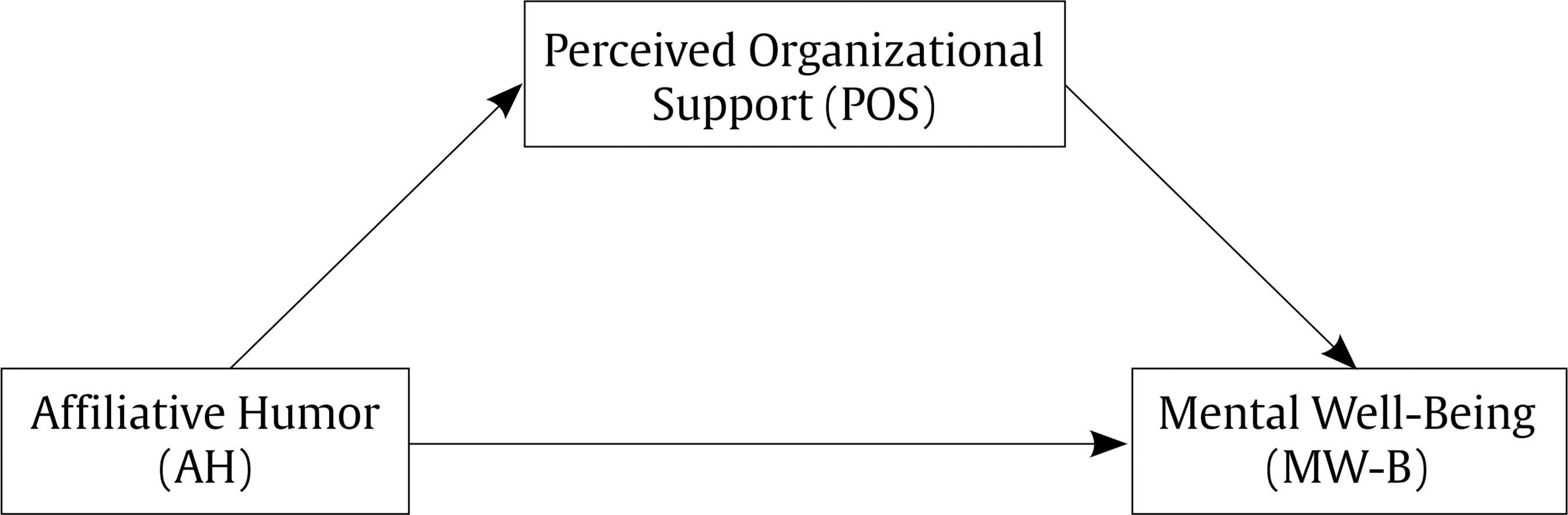 The model was conceptualized using school administrators’ affiliative humor style, teachers’ POS, and teachers’ mental well-being (Figure 1). We hypothesized that teachers’ perceptions of school administrators’ use of affiliative humor would be associated with teachers’ mental well-being both directly and indirectly through POS. Participants Five hundred and forty-two teachers working in public primary schools located in the central districts of Antalya, Turkey, participated in this cross-sectional study. The majority of the teachers were female (373, 68.8%), and the rest were male (169, 31.2%). Sixteen participants had associate’s degrees (3.0%), 449 had bachelor’s degrees (82.8%), 71 had master’s degrees (13.1%), and 6 had doctorate degrees (1.1%). The total teaching service years (TTSY) varied from 1 to 43 years (MeanTTSY = 20.22 years). Three hundred and sixty-five participants were primary school teachers (67.3%), 58 were English language teachers (10.7%), 43 were counselors (7.9%), 41 were preschool education teachers (7.6%), 25 were special education teachers (4.6%), and 10 were religion teachers (1.8%). Data Collection and Ethical Considerations The ethical clearance for this study was provided by the Ethics Committee of Alanya Alaaddin Keykubat University (2022/07). Prior to data collection, all participants were informed about the purpose of the study, the voluntary nature of participation, the confidentiality of responses, and their right to withdraw at any time. Informed consent was obtained from all participants. Data were collected using a voluntary self-report survey administered to teachers working in public primary schools located in the central districts of Antalya, Turkey, under the supervision of the Turkish Ministry of National Education (MoNE). Due to legal regulations imposed by the MoNE, all responses (such as school names or teacher and administrator identifiers) were obtained anonymously to protect the participants and ensure ethical compliance. In hierarchical and centralized education systems, such as the Turkish public-school context, teachers may feel reluctant to openly evaluate their school administrators if institutional identification is possible. Therefore, anonymity was essential to encourage candid and valid responses regarding administrators’ affiliative humor behaviors and perceived organizational support. Ensuring anonymity as a methodological strategy helped us minimize response manipulation. Analytic Procedure We tested the study hypotheses using structural equation modeling (SEM). Although teachers are theoretically nested within schools and administrators, school-level identifiers required for multilevel structural equation modeling were not available because of the anonymity of the data. Accordingly, the hypothesized model in this study was tested using single-level SEM in a theory-driven manner, focusing on affiliative humor use as a relational leadership behavior as felt and experienced by teachers, perceived organizational support as a mediator, and mental well-being as the dependent variable. Therefore, contextual variables (such as gender, seniority, and school-level identifiers) were not included in the hypothesized model. This approach is consistent with prior research (e.g., Aria et al., 2019; Ate & Ünal, 2021; Wibowo & Paramita, 2021) examining perceived leader behaviors and support as individual-level psychological constructs. Hypothesis testing requires a series of sequential steps. For any potential missing values, outliers, normality, and multicollinearity concerns underwent scrutiny for each variable before the data analysis. Then we addressed the common method bias concern. To confirm the reliability and validity of the measures, Cronbach’s alpha (α), standardized factor loadings, average variance extracted (AVE), composite reliability (CR), maximum shared squared variance (MSV), and heterotrait-monotrait ratio (HTMT) were calculated. To ensure reliability of the measures, Cronbach’s alpha and CR must exceed .70. Furthermore, for convergent validity, the AVE must be at least .50. However, AVE, which is a strict metric for convergent validity, is a more conservative measure than CR. Based on CR alone, the convergent validity of the construct may be acceptable, even though more than 50% of the variance is due to error (Fornell & Larcker, 1981; Malhotra et al., 2017). In order to check discriminant validity, we used the Fornell & Larcker’s (1981) criterion. Discriminant validity is also ensured when AVE is greater than MSV (Almén et al., 2018). Hair et al. (2021) suggest the HTMT of correlations to assess discriminant validity as a better alternative. For constructs that are more conceptually distinct, a threshold of .85 or below the HTMT value is recommended for strict discriminant validity, whereas a value of .90 is also proposed for more liberal ones (Henseler et al., 2015). Pearson’s correlation coefficient was used to assess the interrelationship between affiliative humor, POS, and mental well-being. Descriptive analyses were used to present the means and standard deviations of all the measures. We also investigated a variance inflation factor (VIF) test and bivariate correlations among the variables for multicollinearity concerns. After preliminary analyses, we conducted confirmatory factor analysis (CFA) to ensure the validity of the scales and measurement model and then tested the structural model by using single-level SEM (Kline, 2016). We evaluated the fit of the constructs using several indices, including the chi-square value (χ2), degrees of freedom (df), comparative fit index (CFI), Tucker-Lewis index (TLI), root mean square error of approximation (RMSEA), and standardized root mean square residuals (SRMR). We relied on Hair et al.’s (2014) recommendations that an χ2/df ratio below 5, CFI and TLI values beyond .92, RMSEA below .07, and SRMR below .08 suggest a good fit. In order to determine the significance of the indirect effect, we employed a 5000-sample bootstrapping technique to estimate the 95% bias-corrected confidence interval (Kline, 2016). Furthermore, we conducted the significance tests at .05, .01, and .001 levels as a precaution against type 1 error. Measures Affiliative Humor We used the 8-item affiliative humor (AH) subscale of the 32-item Humor Styles Questionnaire (HSQ) (Martin et al., 2003) to assess school administrators’ affiliative humor use as perceived by teachers in the school context. The HSQ is a self-reported instrument consisting of four dimensions, two of which are compatible styles (affiliative humor and self-enhancing humor) and two of which are incompatible styles (aggressive humor and self-defeating humor) (Martin et al., 2003). HSQ was first adapted to Turkish by Yerlikaya (2003) to evaluate university students’ humor styles. Şahin (2016) adapted this Turkish HSQ as a follower-report measurement to determine school administrators’ humor styles based on teacher opinions (χ2/df = 4.10, RMSEA = .059, SRMR = .069, GFI = .92, TLI = .94, Cronbach’s alpha = .74). Affiliative humor (AH) is related to the tendency to joke around with others, tell amusing stories, laugh with others, and amuse others (Martin et al., 2003), and is shared between the humor-producing and humor-receiving parties. As AH is an extroverted, interactive style of humor, it is observed and experienced by others. Put differently, individuals’ perceptions are primarily shaped by what they observe and experience. At this point, we may argue that the impact of school administrators’ affiliative humor on teachers’ outcomes (such as perceived organizational support and mental well-being) operates through perceived behavior rather than administrators’ self-perceptions. Therefore, in this study, we preferred using the AH scale as a follower-report format capturing teachers’ subjective perceptions of their administrators’ humor-related behaviors rather than their objective humor style, as in Şahin (2016). In this study, the AH scale consisted of eight items (e.g., “Our school administrators enjoy making people laugh”) to reflect teachers’ perceptions of their administrators’ humor behaviors. Five of the eight items were negatively phrased reverse items. Responses to all items were on a 5-point Likert scale ranging from 1 (totally disagree) to 5 (totally agree). Five negatively phrased items were reverse-coded. This adaptation aligns with our earlier theoretical assumption that the effects of administrators’ humor on teacher outcomes operate through perceived behaviors, not administrators’ self-perceptions. This approach ensures that the measure captures the impact of AF from the perspective of those who directly experience it. To address concerns regarding validity, we also conducted CFA, which demonstrated satisfactory model fit (χ2 = 41.33, df = 15, χ2/df = 2.76, RMSEA = .06, SRMR = .03, GFI = .98, TLI = .97) and standardized regression weights (all items significantly loaded on one latent factor; coefficients ranged from .52 to .79) for the AH scale in its adapted form. The internal consistency coefficient (Cronbach’s alpha) also indicated acceptable reliability (.86). Perceived Organizational Support We measured teachers’ perceived organizational support (POS) using the 8-item short form of the POS scale developed by Eisenberger et al. (1997). A sample item includes, “My organization strongly considers my goals and values”. Two of the eight items were negatively phrased reverse items. Responses to all items were on a 5-point Likert scale ranging from 1 (totally disagree) to 5 (totally agree). Two negatively phrased items were reverse-coded. The Turkish short form of the POS scale was previously validated by Uzun (2018), and according to the CFA results, the fit indices for the scale were χ²/df = 2.80, GFI = .93, AGFI = .87, IFI = .91, CFI = .91, and RMR = .05. The Cronbach’s alpha was .86. In our study, to address validity, we conducted CFA, which demonstrated a satisfactory model fit (χ2 = 58.24, df = 18, χ2/df = 3.24, RMSEA = .06, SRMR = .03, GFI = .99, TLI = .98) and standardized regression weights (all items significantly loaded on one latent factor; coefficients ranged from .63 to .84). The Cronbach’s alpha for this measure in the current study was 0.92. Mental Well-being Mental well-being (MW-B) was measured using the Short Warwick-Edinburgh Mental Well-Being Scale (SWEMWBS), a seven-item scale developed by Stewart-Brown et al. (2009). A sample item includes, “I’ve been feeling relaxed”. Responses to all items were on a 5-point Likert scale ranging from 1 = none of the time to 5 = all of the time. All items were positively phrased. The Turkish long form of the MW-B scale was previously validated on public school teachers by Şahin et al. (2019), with satisfactory fit indices (χ²/df = 1.98, RMSEA = .062, SRMR = .03, GFI = .97, AGFI = .94, NFI = .97, and CFI = .99) and reliability (Cronbach’s alpha was .84). Furthermore, the Turkish short form of the MW-B scale was validated on Turkish university students by Demirta and Baytemir (2019), and according to the CFA results, the fit indices for the scale were χ²/df = 1.98, RMSEA = .062, SRMR = .03, GFI = .97, AGFI = .94, NFI = .97, and CFI = .99. The Cronbach’s alpha was .84. Because we used a short form of the MW-B scale on public school teachers, we again tested the validity and reliability of the scale. The CFA in our study also demonstrated a satisfactory model fit (χ2 = 70.70, df = 12, χ2/df = 3.39, RMSEA = .07, SRMR = .03, GFI = .98, TLI = .97) and standardized regression weights (all items significantly loaded on one latent factor; coefficients ranged from .55 to .77). Cronbach’s alpha for this measure was 0.87. Common Method Bias Test A common methodological bias (CMB) issue may arise in studies that rely on self-reported survey data (Podsakoff et al., 2003). To address this potential issue, we assured the anonymity and confidentiality of the participants (Holtbrügge & Ambrosius, 2015). Furthermore, Harman’s single-factor test was conducted to ensure that instrument artifacts did not bias cross-sectional research results. Based on the unrotated principal component factor analysis, the first largest factor accounted for 36.99% of the variance, less than 50% threshold, indicating that CMB was unlikely to be an issue in our survey. This is also supported by the CFA results (Table 2), which showed that the single-factor model did not fit the data well (Kock et al., 2021; Podsakoff et al., 2003). Table 2 CFA and Model’s Comparisons  Note. AH = affiliative humor; POS = perceived organizational support; MW-B = mental well-being. Preliminary Analyses Due to missing values and outliers, 27 of the 569 responses were excluded, resulting in a final 542 teacher responses. The kurtosis and skewness values of all variables were within the range of -1.0 to +1.0, indicating acceptable normal distribution (George & Mallery, 2016). To eliminate multicollinearity concerns, we also calculated the VIF values (Table 1), which were found to be below the threshold of 10 (Hair et al., 2014). Furthermore, all correlations among the variables (Table 1) were found to be lower than 0.90, indicating the absence of significant multicollinearity issues (Pallant, 2013). Table 1 Descriptive Statistics, Correlations, and Reliability and Validity Values (N = 542)  Note. AH = affiliative humor; POS = perceived organizational support; MW-B = mental well-being. VIF values were reported only for the predictors (AH and POS) of the dependent variable (MW-B). The values in brackets indicate the square root of AVE. Off-brackets entries represent latent variable correlations. **p < .01, ***p <.001. We assessed the construct validity through convergent and discriminant validity analyses. Convergent validity was evaluated using standardized factor loadings and AVE. All standardized factor loadings were above .50, which is considered practically significant (Hair et al., 2014). All Cronbach’s alpha and CR values exceeded the .70 threshold, indicating that internal consistencies of measurements were ensured (Hair et al., 2014). The AVE values for POS and MW-B were .59 and .51, respectively, ensuring convergent validity. Nevertheless, the AVE value for AH was slightly below the threshold of 0.50, suggesting limited convergent validity. Despite AH demonstrating limited convergent validity, the CR value of AH was well above the acceptable threshold (.70). This indicates not a complete rejection of construct validity (Hair et al., 2021). Because the composite reliability was at a sufficient level and the construct satisfied discriminant validity criteria and demonstrated acceptable reliability (Fornell & Larcker, 1981; Hair et al., 2021; Malhotra et al., 2017), we retained AH in the measurement model. In order to evaluate discriminant validity, we first compared the square root of the AVE for each construct with the inter-construct correlations, indicating acceptable discriminant validity (Fornell & Larcker, 1981). All HTMT correlations were below the threshold of 0.85 (Henseler et al., 2015). Furthermore, all CR values were greater than those of AVE, with all AVE values being greater than those of MSV, further supporting discriminant validity (Almén et al., 2018; Fornell & Larcker, 1981; Malhotra et al., 2017). Measurement Model We conducted a series of CFAs to evaluate the validity of the scales and the hypothesized model by using IBM SPSS Amos 24.0 with the maximum likelihood calculation (Table 2). CFA results for the scales of AH, POS, and MW-B showed a good fit to the data. As for the models, the single-factor model and the two-factor model indicated poor fit. Only the hypothesized three-factor model had an acceptable fit to the data (χ2/df = 2.25; CFI = .96; TLI = .95; RMSEA = .05; SRMR = .04) and was significantly better than the single-factor model (ΔCFI = .33) and two-factor model (ΔCFI = .17), well above the recommended threshold (Cheung & Rensvold, 2002). For the hypothesized model, unstandardized regression weights, standard errors (SE), critical ratio (CR) values, corresponding significance levels (p), and standardized regression weights are presented in Table 3. Table 3 Standardized Regression Weights and Significance Levels 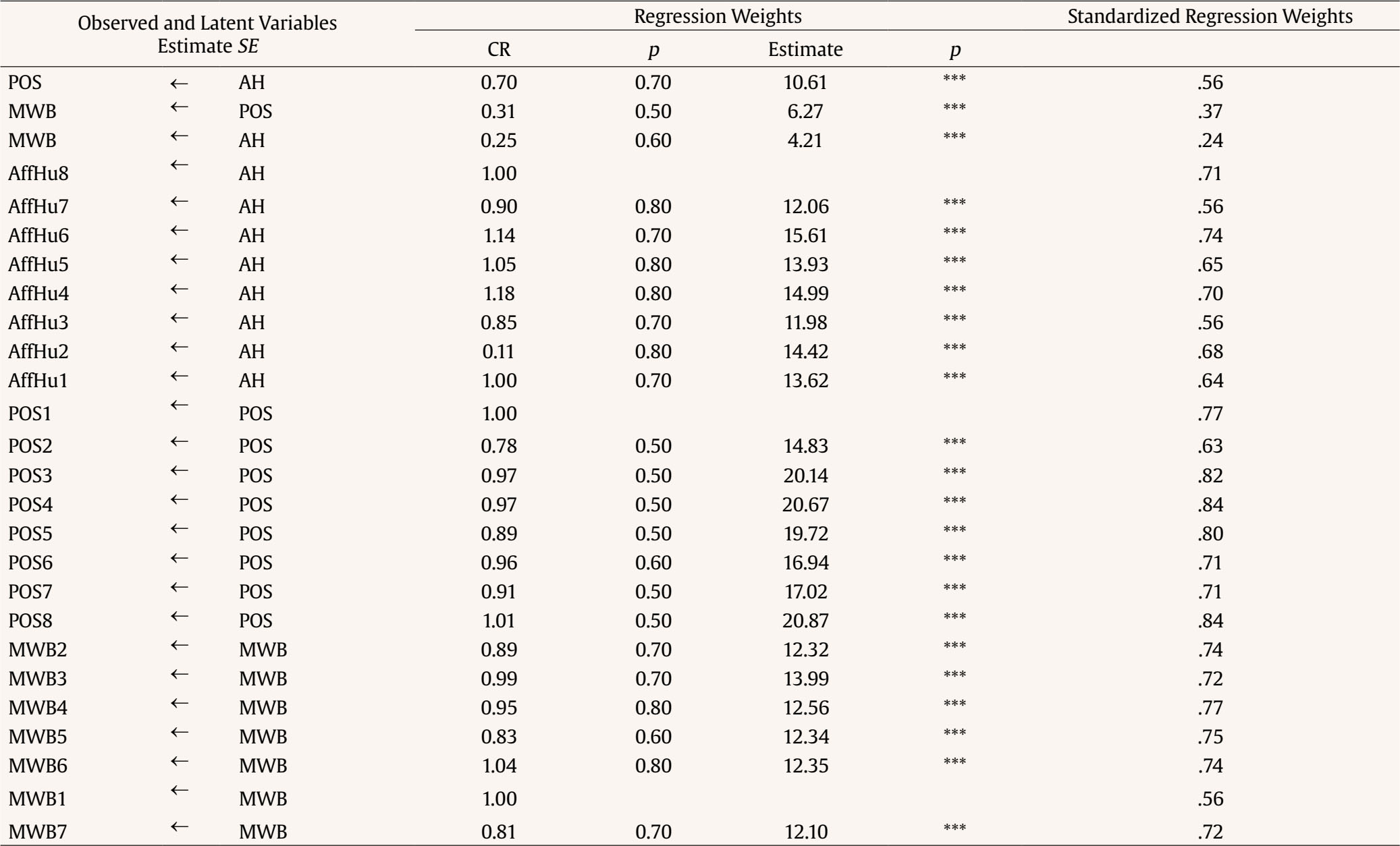 Note. AH = affiliative humor; POS = perceived organizational support; MW-B = mental well-being; AffHu1-AffHu8 = affiliative humor items; POS1-POS8 = perceived organizational support items; MWB1-MWB7 = mental well-being items. ***p < .001. Table 3 presents the individual factor loadings and the statistical significance of the observed and latent variables for the hypothesized model. All indicators loaded significantly on their respective latent constructs (p < .001), with standardized loadings ranging from .56 to .84, confirming the adequacy of the measurement model. Hypothesis Testing Single-level SEM was employed to test the hypotheses. The results of the analysis of AH, POS, and MW-B are shown in Figure 2 and Table 4. Figure 2 The Structural Model. 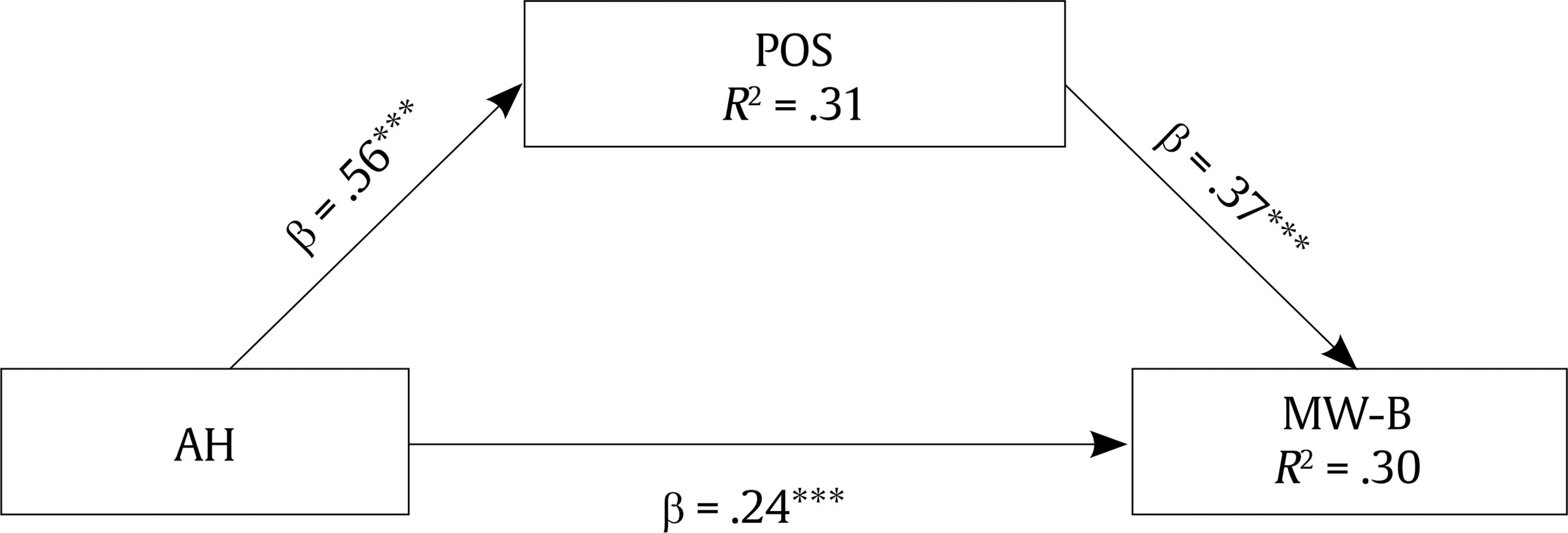 ***p < .001. Table 4 Hypotheses Testing Results  Note. N = 5,000; β = standardized coefficient; SE = standard error; CI = bootstrap confidence interval; AH = affiliative humor; POS = perceived organizational support; MW-B = mental well-being. ***p < .001. As shown in Figure 2 and Table 4, results showed that teachers’ perceptions of school administrators’ affiliative humor use were positively associated with mental well-being (β = .24, p < .001; 95% CI [.12, .37]). Thereby, H1 was supported. Teachers’ perceptions of school administrators’ affiliative humor use were positively associated with POS (β = .56, p < .001; 95% CI [.47, .64]). This provides support to H2. Consistent with H3, POS in turn was positively related to mental well-being (β = .37, p < .001; 95% CI [.25, .49]). Furthermore, Table 4 reveals that the indirect association between teachers’ perceptions of school administrators’ affiliative humor and teachers’ mental well-being through POS was statistically significant (β = .21; p < .001; 95% CI [.14, .29]). This finding highlights the importance of POS in the relationship between perceived affiliative humor use of school administrators and teachers’ mental well-being. Thus, H4 was also supported. The results also indicate that POS is associated with this relationship, indicating a partial mediating role within the proposed model. Overall, teachers’ perceptions of school administrators’ affiliative humor use explained 31% of the variance in POS. Affiliative humor and POS together explained 30% of the variance in mental well-being (Figure 2). This study was an endeavor to explore the relations among teachers’ perceptions of school administrators’ use of affiliative humor, teachers’ POS, and teachers’ mental well-being. Additionally, this inquiry sought to estimate the role of POS on the interaction between school administrators’ use of affiliative humor and teachers’ mental well-being. In this respect, the findings are interpreted as relationships among teachers’ subjective perceptions rather than as evidence of causal effects stemming from administrators’ actual behaviors. The data analysis revealed a positive relationship between teachers’ perceptions of school administrators’ use of affiliative humor and teachers’ mental well-being. Positive emotions foster happiness, a key determinant of well-being, and individuals who prioritize happiness tend to experience higher well-being (Huang, 2024). Teachers’ perceptions of school administrators’ affiliative humor may contribute to positive emotions at work (Romero & Cruthirds, 2006; Şahin, 2018) and may therefore be associated with teachers’ mental well-being. Affiliative humor enhances rapport and social interactions (Martin et al., 2003), strengthening solidarity and cohesion that individuals perceive as social support—a key antecedent of well-being. Those who feel socially supported tend to experience greater positive emotions, a more optimistic perspective, and higher overall well-being (An et al., 2024). This result is supported by Kim et al. (2016), who asserted that administrators’ use of affiliative humor positively impacts employees’ mental well-being by improving leader-employee relationships. It also aligns with previous research indicating that positive humor is linked to workplace social support (Caudill & Woodzicka, 2017), a positive work climate (Martin et al., 2004), and higher job satisfaction (Hurren, 2006), all of which are associated with employees’ mental well-being, while aggressive humor is often related to negative humor climates, potentially increasing teachers’ stress (Şahin & Gök, 2020) and being detrimental to relationships (Romero & Cruthirds, 2006). This study also confirmed the relationship between teachers’ perceptions of school administrators’ use of affiliative humor and teachers’ POS. The findings showed a positive correlation between administrators’ affiliative humor and POS, which is consistent with the findings of Eisenberger et al. (1986), suggesting that employees who feel valued and supported tend to report higher satisfaction, commitment, and performance than those who do not. Thus, leaders’ and colleagues’ use of affiliative humor can improve the workplace environment. Yang and Zhang (2022) found that administrators’ humorous behavior fosters informal relationships, which enhances organizational citizenship behavior. Leaders’ affiliative humor use also strengthens employee-organization bonds, supporting POS (Schneider et al., 2018). Teachers’ POS was positively correlated with their mental well-being, consistent with previous studies showing that POS enhances psychological well-being and work engagement, while a high workload diminishes these outcomes (Wang, 2024). Cooper et al. (2018) noted that leaders’ humor conveys friendliness and support, fulfilling employees’ social and esteem needs, and POS fosters psychological well-being by reducing technostress of educators (Solis et al., 2023). The study also revealed that POS partially mediated the relationship between school administrators’ use of affiliative humor and teachers’ mental well-being. This implies that teachers who subjectively perceive their administrators as humorous may tend to report higher POS, which in turn is associated with improved mental well-being. This finding aligns with Baran et al. (2012), who noted that POS reduces workplace strain and supports employee mental well-being, and Robert et al. (2016), who highlighted the role of leader-employee relationship and humor in job satisfaction. Similarly, Ho (2015) found that principals’ POS significantly mediates the link between humor and teachers’ emotional exhaustion, reducing burnout. The partial mediation of POS in the relationship between school administrators’ affiliative humor and teachers’ mental well-being might stem from several theoretical mechanisms. Teachers’ perceptions of school administrators’ use of affiliative humor may be associated with higher levels of organizational support, thereby related to their mental well-being. First, this positive effect of POS may be attributed to the personification of organizations, as POS formation begins with attributing human characteristics to the organization (Eisenberger & Stinglhamber, 2011). Employees tend to personify their organizations by focusing on attitudes and behaviors affecting their work life, it is important for management to cultivate a positive organizational culture. Since administrators’ attitudes and behaviors are attributed to the organization (Eisenberger & Stinglhamber, 2011), their use of affiliative humor may also be perceived as organizational. Since affiliative humor is positive and fosters favorable emotions, it likely enhances POS. Of course, affiliative humor is not the only factor that is associated with POS. Other mechanisms may also contribute to its increase. Already, our results revealed that affiliative humor explained 31% of the variance in POS. Ultimately, enhanced POS, together with the affiliative humor, appears to be positively related to teachers’ mental well-being. In essence, teachers’ perceptions of affiliative humor may be an important factor associated with teachers’ mental well-being, potentially in relation to their perceptions of organizational support. Second, teachers’ social and esteem needs may have an impact on this mechanism. Employees experiencing high POS have a more positive mood at work because their social and esteem needs are fulfilled. Administrators using affiliative humor might contribute to this perception of support. The fulfillment of these needs through affiliative humor may be positively related to mental well-being. A third possible factor that may be relevant in understanding this relationship is teachers’ perceptions of affiliative humor and its possible association with a positive work environment. Positive behaviors of administrators are often associated with a positive work climate, which is linked to higher POS; on the contrary, negative behaviors are perceived by employees as a decrease in POS. Consequently, the use of affiliative humor by administrators is seen as fostering a positive work environment since it creates positive emotions on both sides. A positive work environment may help teachers feel supported by their schools. However, what is linked to higher mental well-being can be both the positive work environment itself and to the teachers’ perception of a supportive work environment. Indeed, our results suggest that teachers’ perceptions of school administrators’ use of affiliative humor can be associated with higher levels of POS, which in turn is related to teachers’ mental well-being together with affiliative humor. Conclusion In conclusion the findings suggest that POS is associated with the relationship between teachers’ perceptions of administrators’ affiliative humor and teachers’ mental well-being, pointing to a partial mediating pattern in the model. This somewhat aligns with Robert et al.’s (2016) finding that job satisfaction is influenced by perceptions of leader-employee relationships together with the leader’s humor tone. As affiliative humor is positive, welcomed by both parties, and fosters favorable emotions on both sides (Martin et al., 2003), it is thought to have a positive effect on POS. Eisenberger and Stinglhamber (2011) mention that employees experiencing high POS have a more positive mood at work. Our results ultimately suggest that encouraging the use of affiliative humor in schools may be associated with teachers’ POS, which in turn appears to be positively related to their mental well-being. Implications This study suggests that teachers’ perceptions of affiliative humor used by school administrators may be associated with teachers’ mental well-being, offering insights into how interpersonal communication within schools is related to teachers’ perceptions of support and well-being. Quantitative estimates indicated relationships between teachers’ perceptions of administrators’ affiliative humor, teachers’ POS and their mental well-being. All the hypotheses were validated, showing that both teachers’ perceptions of administrators’ use of affiliative humor and higher POS may be related to teachers’ mental well-being. This study offers a theoretical model that explains the relationship between teachers’ perceptions of administrators’ affiliative humor, teachers’ POS, and mental well-being. Consequently, in a sample of Turkish teachers, we confirmed the possibility that teachers who feel supported by their organizations are more likely to have higher mental well-being in schools where school administrators tend to use affiliative humor. Limitations and Future Directions The primary limitations of this study were its reliance on self-report measures via Likert-scale questionnaires and its cross-sectional design. The data regarding school administrators’ use of affiliative humor were collected solely from teachers’ perceptions. Although teachers’ evaluations are particularly relevant to understanding how leadership behaviors are interpreted and experienced in everyday school interactions, relying on a single source of data may limit the extent to which the findings can capture administrators’ actual humor use. Consequently, the results should be interpreted as exploratory associations among teachers’ subjective perceptions rather than objective assessments of administrators’ behaviors, and with a restricted inferential scope due to the cross-sectional perceptual design. Nevertheless, we believe that future research could benefit from multi-source data designs, including both supervisors’ self-reports and teachers’ evaluations, to explore possible discrepancies between self-perceived and externally perceived humor styles and to further strengthen construct validity. In addition, a mixed-methods approach incorporating longitudinal studies and action research is recommended to examine the long-term effects, providing deeper insights into how POS and affiliative humor influence teachers’ well-being over time. Utilizing diverse data collection methods, such as interviews or observations, can enrich data. Furthermore, teachers’ professional seniority and tenure with the administrators were not included in the structural model. Professional experience and interaction time with school administrators may influence teachers’ interpretations of affiliative humor and perceived organizational support, which in turn influence mental well-being. At this point, another limitation of this study is its inability to account for the nested structure of teachers within schools. The absence of school-level identifiers precluded the use of multi-level structural equation modeling. Therefore, the results should be interpreted as reflecting individual rather than school-level perceptions. Future research may extend the current model by investigating seniority and school-level variables (as control variables, moderators, or grouping variables) via multilevel modeling techniques. Such designs would allow for a more comprehensive examination of how leader humor, perceived organizational support, and mental well-being function at different organizational levels. Nevertheless, this study remains significant, as it presents the initial findings regarding the mediating role of POS in the relationship between administrators’ affiliative humor and teachers’ mental well-being. This study examined the mediating role of teachers’ POS in the relationship between school administrators’ affiliative humor and teachers’ mental well-being. Future research should explore other organizational and personal factors that impact mental well-being, such as organizational climate, job satisfaction, turnover, happiness, stress, and commitment. Additionally, future studies should examine the effects of different humor styles, including aggressive humor, on mental well-being and validate findings in various school levels and organizational contexts. Affiliative humor used by school administrators can create a less stressful and more enjoyable school environment by fostering rapport and trust, thereby enhancing the school climate. Thus, school administrators should be encouraged to use affiliative humor to cultivate supportive and positive work environment perceptions by teachers. We recommend frequent use of positive humor styles in schools, as the results indicate that teachers who perceive their administrators as humorous may experience increased POS, which in turn is associated with improved mental well-being. Finally, school administrators should acknowledge the significance of POS and positive humor in promoting teachers’ well-being. Therefore, school policies should encourage supportive leadership practices and provide comprehensive mental health support. Conflict of Interest The authors of this article declare no conflict of interest. Cite this article as: Şahin, A., Arslan Dönmez, S., & Gök, R. (2026). An exploratory study of teachers’ perceptions of school administrators’ affiliative humor, organizational support, and well-being. Psicología Educativa, 32, Article e260464. https://doi.org/10.5093/psed2026a21 References |
Cite this article as: Sahin, A., Dönmez, S. A., & Gök, R. (2026). An Exploratory Study of Teachers’ Perceptions of School Administrators’ Affiliative Humor, Organizational Support, and Well-Being. Psicología Educativa, 32, Article e260464. https://doi.org/10.5093/psed2026a21
Correspondence: ramazangok@akdeniz.edu.tr (R. Gök).
Copyright © 2026. Colegio Oficial de la Psicología de Madrid


 PDF
PDF e-PUB
e-PUB CrossRef
 JATS
JATS Imprimir
 Enviar
ALERTA POR E-MAIL
La Revista de Psicología Educativa está distribuida bajo una licencia de Creative Commons Reconocimiento-NoComercial-SinObra Derivada 4.0 Internacional.com