Silent Emotional Exhaustion in Service Workers: The Hidden Toll of SelfDemand and Emotional Suppression
[El agotamiento emocional silencioso en los trabajadores del sector servicios: el peaje oculto de la autoexigencia y la supresión emocional]
Mariola Pérez Marqués & María Higes Morón
Private Practice, Spain
https://doi.org/10.5093/jwop2026a3
Received 3 April 2025, Accepted 2 March 2026
Abstract
This study examines whether self-demand, work engagement, and job crafting predict silent emotional exhaustion, conceptualized as concealed emotional fatigue that may remain behaviorally unexpressed. A total of 200 service-sector employees in Spain completed self-report measures, including a brief exploratory index of silent emotional exhaustion adapted to capture concealment. Descriptive statistics, Pearson correlations, and multiple regression analyses were conducted. Self-demand was positively associated with silent emotional exhaustion, whereas work engagement was associated with lower levels of this outcome. Job crafting showed a negative but non-significant relationship. The regression model explained 25.4% of the variance (R2 = .254; adjusted R2= .242; cross-validated R2 = .17; f² = .34). These findings highlight the relevance of identifying employees who remain outwardly functional while experiencing concealed emotional strain. Implications are discussed for psychosocial prevention and monitoring practices, as well as for future longitudinal research aimed at improving detection and intervention in organizational settings.
Resumen
RESUMEN
El estudio analiza si la autoexigencia, el compromiso con el trabajo y el rediseño del puesto de trabajo predicen el agotamiento emocional silencioso, entendido como la fatiga emocional oculta que puede permanecer sin traducción comportamental. Una muestra de 200 trabajadores del sector servicios en España cumplimentaron medidas de autoinforme, entre las cuales se incluyó un breve índice exploratorio de agotamiento emocional silencioso adaptado para poder captar el ocultamiento. Se llevaron a cabo estadísticas descriptivas, correlaciones de Pearson y análisis de regresión múltiple. La autoexigencia se asociaba positivamente con el agotamiento emocional silencioso mientras que el compromiso con el trabajo se asociaba con niveles inferiores de este resultado. El rediseño del puesto muestra una relación negativa aunque no significativa. El modelo de regresión explica el 25.4% de la varianza (R2 = .254; R2 ajustada = .242; R2 con validación cruzada = .17; f² = .34). Los resultados destacan la importancia de reconocer a los trabajadores que siguen abiertamente operativos a la vez que experimentan una tensión emocional oculta. Se comentan las implicaciones que puede haber para la prevención y el seguimiento, así como para la investigación futura dirigida a mejorar la detección e intervención en entornos organizativos.
Palabras clave
Agotamiento emocional silencioso, Autoexigencia, Compromiso con el trabajo, Rediseño del puesto de trabajo, Agotamiento emocionalKeywords
Silent emotional exhaustion, Self-demand, Work engagement, Job crafting, Emotional exhaustionCite this article as: Marqués, M. P. & Morón, M. H. (2026). Silent Emotional Exhaustion in Service Workers: The Hidden Toll of SelfDemand and Emotional Suppression. Journal of Work and Organizational Psychology, 42, Article e260771. https://doi.org/10.5093/jwop2026a3
Correspondence: miperezmarques@gmail.com. (M. Pérez Marqués).Occupational burnout remains one of the most pressing issues in work and organizational psychology. Traditionally, it has been conceptualized as a chronic response to prolonged work-related stress, comprising three core dimensions: emotional exhaustion, depersonalization, and reduced personal accomplishment (Maslach & Jackson, 1981). This definition has shaped decades of research, assessment, and intervention, highlighting the detrimental effects of burnout on both individual psychological health and organizational functioning (Maslach et al., 2001; Schaufeli et al., 2009). However, recent studies suggest that not all experiences of work-related exhaustion are expressed through the classic pattern of overt complaints, observable dysfunction, or withdrawal. A growing body of evidence points to the existence of workers who experience significant emotional strain while remaining outwardly functional. This has led to the exploration of less visible forms of psychological deterioration, including presenteeism (Johns, 2010; Lohaus & Habermann, 2019), surface acting (Clarke et al., 2024; Grandey, 2000, 2003), and sustained emotional suppression (Ma et al., 2023; Moore et al., 2008). Recent studies conceptualize emotion work as a form of emotion regulation embedded in job demands and resources, with meaningful implications for well-being and strain (Holman, 2021). In light of this conceptual evolution, it becomes crucial to identify concealed manifestations of emotional strain—presentations that remain outwardly functional but may carry substantial psychological cost (Bakker & Demerouti, 2017). In this context, the present study focuses on silent emotional exhaustion, defined here as a sustained state of concealed emotional fatigue that is not expressed through complaints, absenteeism, or observable performance deterioration. This presentation involves an apparently functional behavioral pattern that may conceal significant psychological strain, particularly in individuals who suppress emotions and internalize stress (Moore et al., 2008; Yikilmaz et al., 2024). This study focuses on concealment as a feature of emotional exhaustion, rather than on burnout as a syndrome. Consistent with this perspective, silent emotional exhaustion is conceptualized as a concealed manifestation of emotional exhaustion grounded in established theories of emotional regulation, surface acting (Grandey, 2000, 2003), and organizational silence (Morrison & Milliken, 2000), within broader perspectives on burnout and exhaustion (Maslach & Leiter, 2016). Because the study operationalizes this phenomenon through an exploratory adaptation of the emotional exhaustion dimension, it is presented as a focused examination of emotional exhaustion rather than a comprehensive assessment of the burnout syndrome. Related notions such as unvoiced burnout or masked emotional exhaustion have been discussed in clinical and popular literature, but have not been operationalized empirically within occupational psychology. Critically, the “silent” qualifier is not rhetorical but operational: it refers to the active suppression or withholding of exhaustion expression (e.g., not showing it, not voicing it), rather than to exhaustion intensity alone. Accordingly, this index may identify employees whose psychological strain could be missed by organizational screening practices that rely on overt complaints, observable disengagement, or absenteeism. Given its exploratory nature, it is essential to examine in which occupational settings this presentation may be more likely to emerge, and under what organizational conditions it can remain undetected. Silent emotional exhaustion may be especially relevant in emotionally demanding service occupations, including education and healthcare, where professional norms discourage the expression of vulnerability or emotional discomfort (Giorgi et al., 2020; Larena, 2025). The lack of visible indicators and the persistence of performance may delay detection and intervention, increasing the risk of chronic psychological deterioration (Miraglia & Johns, 2016). From a psychophysiological perspective, sustained emotional repression has been shown to induce chronic activation patterns and affective dissociation, even in the absence of overt dysfunctional behaviors (Gabriel et al., 2015; Moore et al., 2008). These mechanisms may be particularly pronounced in employees with high levels of self-imposed pressure, perfectionistic tendencies, or rigid internalized duty norms. Such individuals often downplay their emotional needs, normalize exhaustion as a marker of professional commitment, and avoid seeking support due to fears of inadequacy or appearing vulnerable (Flett & Hewitt, 2020; Hill & Curran, 2016). Over time, this internalized over-adaptation may silently erode psychological resilience, increasing vulnerability to persistent emotional exhaustion. High self-demand has been consistently identified as a psychological risk factor in occupational contexts, particularly when it takes rigid and self-critical forms (Flett & Hewitt, 2020; Limburg et al., 2017). According to the multidimensional model of perfectionism (Frost et al., 1990), a distinction is made between adaptive perfectionism—driven by personal growth and intrinsic satisfaction—and maladaptive perfectionism, characterized by error avoidance, fear of negative evaluation, and excessive concern with others’ expectations. The latter has been strongly linked to burnout, anxiety, somatic complaints, and reduced psychological well-being (Hill & Curran, 2016; Stoeber & Rennert, 2008). From the perspective of the Self-Determination Theory (Deci & Ryan, 2000), extreme self-demand aligns with a controlled form of motivation, based on internal pressure and contingent self-worth, rather than autonomous motivation rooted in genuine interest or value congruence. This type of motivational style has been associated with lower life satisfaction and increased vulnerability to emotional exhaustion (Howard et al., 2021; Van den Broeck et al., 2016). In contrast to this risk profile, work engagement has traditionally been considered a psychological buffer against emotional exhaustion. It is defined as a positive, fulfilling, and persistent work-related state characterized by vigor, dedication, and absorption (Schaufeli et al., 2006). Within the Job Demands-Resources (JD-R) model (Bakker & Demerouti, 2007), engagement is often considered a positive counterpart to burnout, and meta-analyses have consistently confirmed its protective role against emotional fatigue and psychological deterioration (Halbesleben, 2010; Lesener et al., 2019). From the perspective of the Self-Determination Theory, engagement is also associated with autonomous motivation, as it reflects the satisfaction of basic psychological needs—autonomy, competence, and relatedness (Trépanier et al., 2015). However, recent studies have raised concerns about dysfunctional forms of engagement, particularly among highly self-demanding individuals, where excessive emotional investment may mask underlying psychological distress (Han et al., 2020; Schaufeli, 2021). Within this dynamic of emotional self-regulation, job crafting also emerges as a relevant mechanism. It is defined as the set of proactive behaviors through which employees modify the boundaries of their tasks, relationships, or work perceptions to better align with their personal needs, interests, and capacities (Wrzesniewski & Dutton, 2001). In the framework of the Job Demands-Resources (JD-R) model, job crafting has been conceptualized as a strategy to reshape work environment by increasing motivational resources and reducing hindering demands (Tims et al., 2012). Empirical evidence supports a negative association between job crafting and burnout (Malik et al., 2019), although the impact depends on the type of crafting strategies employed. Interventions aimed at increasing structural and social resources appear to be more beneficial than those focused on avoiding tasks or reducing workload (Lichtenthaler & Fischbach, 2019; Zhang & Parker, 2019). In the context of silent emotional exhaustion, job crafting may function either as a healthy adaptive tool or, conversely, as a form of overadjustment that sustains unspoken emotional strain, particularly in rigid organizational settings with low perceived autonomy. Despite this conceptual evolution, empirical research has largely focused on overt manifestations of emotional exhaustion (e.g., complaints, disengagement, absenteeism), leaving comparatively less understood presentations in which employees remain outwardly functional while experiencing sustained internal fatigue. Consequently, organizational monitoring practices may overlook a subgroup of workers whose distress is characterized by concealment rather than visible dysfunction. To address this gap, the present study examines silent emotional exhaustion and tests whether self-demand, work engagement, and job crafting are associated with this concealed strain in a sample of service-sector employees. These variables may shape how employees cope with, express, or chronify emotional distress in the workplace. We therefore tested the predictive role of self-demand, work engagement, and job crafting in relation to silent emotional exhaustion in a sample of service-sector employees—a population particularly exposed to emotional demands and patterns of overinvolvement at work. We hypothesized that self-demand would be positively associated with silent emotional exhaustion, whereas work engagement and job crafting would be negatively associated with this outcome. Participants The sample consisted of 200 employees in service occupations in Spain, aged 24 to 59 years (M = 40.1, SD = 7.55). Of the total, 62% were men and 38% were women. Occupational areas included healthcare, education, retail, customer service, and public administration, with customer service being the most represented (24%). Job tenure ranged from 1 to 23 years (M = 9.78, SD = 4.73). Participation was voluntary, anonymous, and unpaid. Descriptive characteristics of the sample are presented in Table 1. Table 1 Demographic Characteristics of the Participants 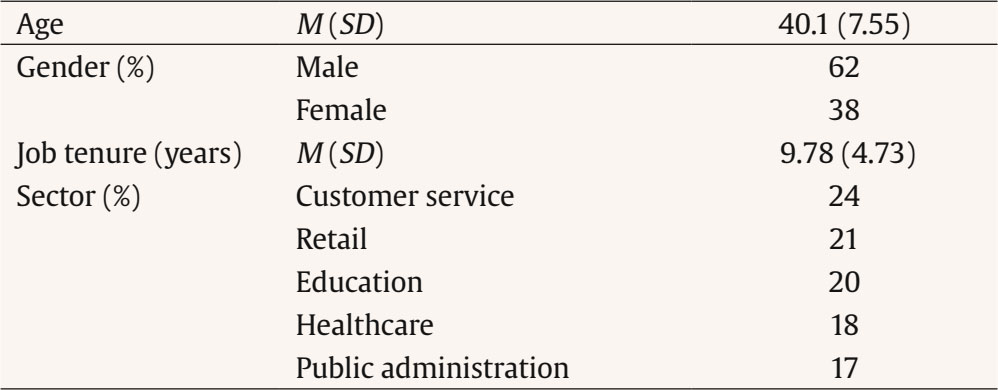 Note. N = 200. Percentages are rounded to the nearest whole number. A non-probabilistic convenience sampling method was used. The questionnaire was disseminated online through social media platforms, email, and professional mailing lists. An a priori power analysis using G*Power (Faul et al., 2009) indicated that a minimum of 138 participants would provide power ≥ .80 to detect small-to-moderate effect sizes (f² = .05) in a multiple regression model with three predictors. Instruments Data were collected through online self-report questionnaires. Internal consistency ranged from adequate to high across measures (α = .81-.88); the exploratory outcome measure is described below. Self-demand Self-imposed perfectionism was assessed using a 5-item short form drawn from the Frost Multidimensional Perfectionism Scale (Frost et al., 1990), focusing on self-critical perfectionism (e.g., “I expect more from myself than most people”). Items were rated on a 5-point Likert scale ranging from 1 (strongly disagree) to 5 (strongly agree). Internal consistency was high (α = .85). Work Engagement The Utrecht Work Engagement Scale (UWES-9; Schaufeli et al., 2006) was used to measure engagement at work. It consists of 9 items distributed across three dimensions: vigor, dedication, and absorption. A sample item is: “At my job, I feel strong and vigorous.” Participants responded using a 6-point frequency scale from 1 (never) to 6 (always). Internal consistency was high (α = .88). Job Crafting Proactive work adjustments were measured using the 15-item Job Crafting Scale developed by Tims et al. (2012), which assesses proactive changes aimed at increasing resources and optimizing job demands. Participants rated the frequency of their behaviors on a 5-point Likert scale ranging from 1 (never) to 5 (very frequently). A sample item is: “I try to develop my capabilities.” Internal consistency was high (α = .86). Silent Emotional Exhaustion Silent emotional exhaustion was assessed with a 6-item exploratory measure developed for the present study, based on adaptations of items from the emotional exhaustion dimension of the Maslach Burnout Inventory (Maslach & Jackson, 1981). Items were reformulated to capture concealed emotional exhaustion (e.g., “I feel emotionally exhausted but try not to show it”). Participants responded on a 6-point Likert scale ranging from 1 (never) to 6 (always). Internal consistency was adequate (α = .81). An exploratory factor analysis supported a unidimensional structure (KMO = .79), explaining 54.3% of the variance. This 6-item index should be regarded as a preliminary, exploratory operationalization with limited content coverage; further work is required to develop and validate a more comprehensive measure and to establish convergent, discriminant, and incremental validity against established burnout instruments. Procedure The study was conducted through an online, cross-sectional, self-administered survey distributed between November and December 2024. The survey was created using Google Forms and disseminated via professional mailing lists, LinkedIn, WhatsApp groups, and social media platforms (e.g., Twitter and Instagram) through a unique link. Participation was voluntary, confidential, and non-incentivized. An information sheet and informed consent were presented at the beginning of the questionnaire. The inclusion criterion was current employment in the service sector in Spain; no additional exclusion criteria were applied. The questionnaire was administered in Spanish and took approximately 10-15 minutes to complete. No identifying personal data were collected. The study adhered to the ethical principles of the Declaration of Helsinki. Given its anonymous, non-interventional nature, it was considered low risk. Data were handled in accordance with applicable data-protection requirements, including the General Data Protection Regulation (EU 2016/679), and confidentiality was safeguarded throughout. Data Analysis Statistical analyses were conducted using IBM SPSS Statistics (Version 28). Descriptive statistics (means and standard deviations), Pearson correlations among the main variables, and a multiple linear regression (enter method) were performed to examine predictors of silent emotional exhaustion. Regression assumptions were evaluated (normality of residuals, homoscedasticity, absence of multicollinearity; tolerance > .80, VIF < 2), and no influential outliers were detected (Cook’s distance < 1). Age, gender, and job tenure were examined as covariates. Gender differences were tested using independent-samples t-tests, and gender was included in a supplementary regression model; because these covariates did not meaningfully alter the pattern of results, the final model is presented without covariates. In addition, out-of-sample explained variance was estimated using 10-fold cross-validation (cross-validated R2). Specifically, the dataset was randomly partitioned into 10 approximately equal subsamples. In each fold, the same multiple linear regression model (enter method; self-demand, work engagement, and job crafting entered simultaneously) was estimated on 90% of the data (training set), and predicted values were generated for the remaining 10% (test set). Cross-validated R2 was computed as 1—(SSE/SST) based on prediction errors in each test fold and then averaged across folds. No model tuning was involved, as ordinary least squares regression was used. No statistical corrections were applied for self-report bias, although this limitation is considered in the Discussion. Descriptive statistics (means, standard deviations, and observed ranges) for the main study variables are presented in Table 2. Internal consistency was adequate for all measures (α > .80). Table 2 Descriptive Statistics for the Study Variables 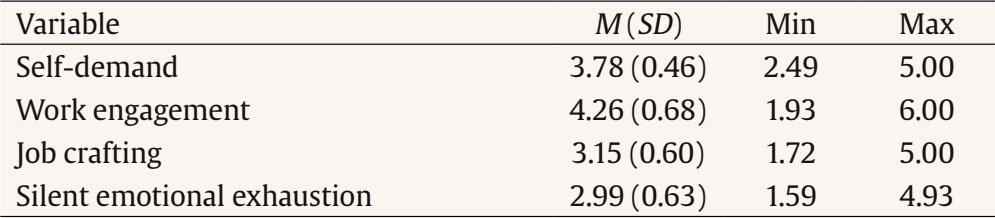 Note. N = 200. Values reflect individual mean scores per measure. Minimum and maximum indicate observed values. Response ranges were: self-demand (1-5); work engagement (1-6); job crafting (1-5); silent emotional exhaustion (1-6). Pearson correlations are shown in Table 3. Silent emotional exhaustion was positively correlated with self-demand (p < .01) and negatively correlated with work engagement (p < .01), whereas its correlation with job crafting was not statistically significant (p > .05). Table 3 Pearson Correlations Among Main Study Variables 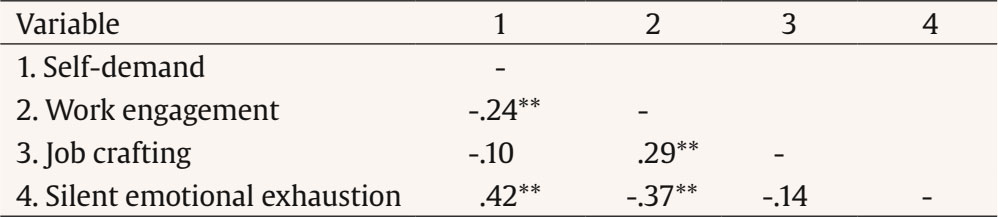 Note. N = 200. **p < .01. A multiple linear regression (Table 4) indicated that self-demand and work engagement were significant predictors of silent emotional exhaustion, whereas job crafting was not. The overall model was significant, F(3, 196) = 22.22, p < .001, explaining 25.4% of the variance (R2 = .254; adjusted R2= .242; f² = .34). The mean 10-fold cross-validated R2 was .17, indicating a more conservative estimate of out-of-sample explained variance. Table 4 Multiple Linear Regression Predicting Silent Emotional Exhaustion 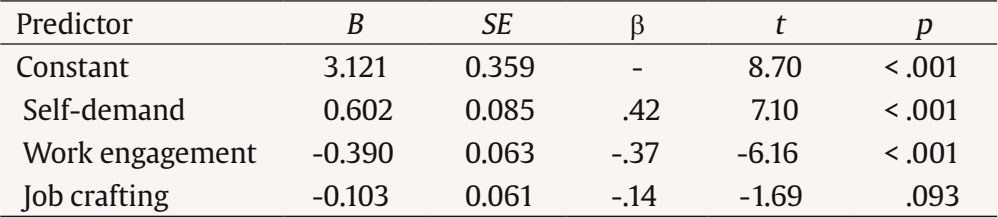 Note. N = 200; R² = .254; adjusted R² = .242; F(3, 196) = 22.22; f² = .34. p < .001. Independent-samples t-tests indicated no significant gender differences in silent emotional exhaustion, t(198) = 0.45, p = .653, d = 0.07. Including gender as a control variable in an additional regression model did not change the pattern of results; therefore, the final model is presented without covariates. To visually illustrate the relationship between work engagement and silent emotional exhaustion, Figure 1 presents a scatterplot showing their negative relationship. Figure 1 Relationship between Work Engagement and Silent Emotional Exhaustion. 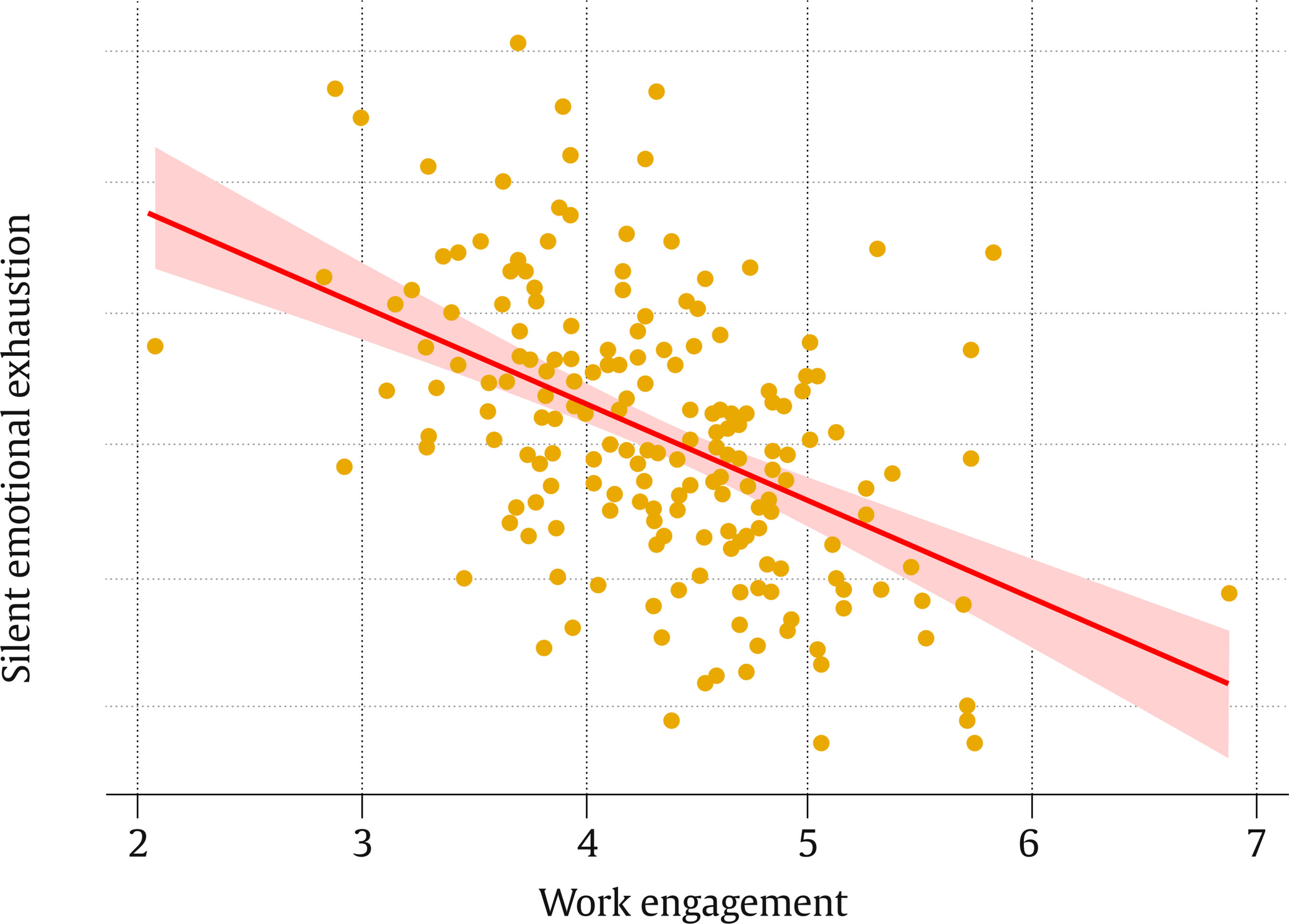 Theoretical Implications The findings of this study contribute to a deeper understanding of less visible forms of emotional deterioration at work by focusing on silent emotional exhaustion, conceptualized here as a pattern of concealed emotional fatigue that is not expressed through overt complaints or observable withdrawal behaviors and may therefore remain undetected. In line with the hypotheses, self-demand was positively associated with silent emotional exhaustion, whereas work engagement was negatively associated with this outcome. Accordingly, the present findings should be interpreted as preliminary evidence regarding a concealed presentation of emotional exhaustion rather than as support for a distinct construct. Job crafting showed a negative but non-significant relationship, suggesting that its role in this profile may be more context-dependent. Importantly, focusing on concealed emotional exhaustion may capture a presentation of strain that is not reflected in overt behavioral indicators. Employees experiencing this form of exhaustion can maintain performance, attendance, and task completion despite substantial internal fatigue. As a result, it may go undetected in organizational screenings that rely primarily on absenteeism, formal complaints, or visible disengagement. Conceptually, this pattern aligns with research on organizational silence (Morrison & Milliken, 2000) and surface acting (Grandey, 2000, 2003), as well as broader perspectives on emotion work as a form of emotion regulation embedded in job demands and resources (Holman, 2021), where emotional strain is actively regulated or suppressed rather than expressed. Explicitly assessing concealment may therefore complement traditional exhaustion measures by helping identify individuals whose distress remains behaviorally masked. These results highlight the relevance of self-demand as a psychological risk factor in contexts where emotional discomfort is internalized rather than articulated. As previous studies have shown, extreme self-demand—particularly in its dysfunctional form—can sustain patterns of overcommitment, emotional inhibition, and rigid self-sufficiency, facilitating the persistence of mental overload (Flett & Hewitt, 2020; Stoeber & Rennert, 2008). In such profiles, external performance may be maintained at the expense of psychological equilibrium, often accompanied by low emotional awareness and a tendency to downplay signals of saturation. This pattern aligns with the Self-Determination Theory (Deci & Ryan, 2000), which highlights the costs of controlled motivation driven by internal pressure and fear of failure (Howard et al., 2021; Van den Broeck et al., 2016). In contrast, work engagement was negatively and significantly associated with silent emotional exhaustion, consistent with its role as a psychological buffer. Within the Job Demands–Resources (JD-R) model (Bakker & Demerouti, 2007), engagement is often linked to autonomous motivation, characterized by vitality, dedication, and focus. Evidence supports its buffering role against burnout-related outcomes, even in emotionally demanding work environments (Lesener et al., 2019; Schaufeli et al., 2006). At the same time, recent literature suggests that engagement may become paradoxical when combined with high levels of self-demand, potentially concealing early signs of exhaustion under a façade of high functioning (Han et al., 2020). From this perspective, engagement may be most beneficial when accompanied by effective emotional self-regulation and when organizational climates do not implicitly reward overinvolvement or personal sacrifice. Regarding job crafting, although its association with silent emotional exhaustion was negative, it did not reach statistical significance. This finding is noteworthy given prior evidence linking job crafting to lower traditional burnout (Malik et al., 2019; Tims et al., 2012). One possibility is that, in presentations characterized by concealed strain, job crafting may sometimes function less as a resource-building strategy and more as a way of maintaining outward functioning. Rather than fostering sustainable adjustments, it may support continued functioning despite underlying emotional fatigue, depending on the specific crafting strategies used and the broader organizational context (Lichtenthaler & Fischbach, 2019; Zhang & Parker, 2019). Future studies should differentiate types of job crafting to clarify when it functions as a resource versus a compensatory strategy. In particular, effects may depend on the specific crafting dimension (e.g., increasing structural/social resources vs. seeking challenges vs. reducing hindering demands) and on boundary conditions such as autonomy, workload, and organizational support that determine whether proactive changes are feasible and beneficial. Overall, these findings suggest that it may be useful to examine concealed emotional exhaustion as a relevant presentation of work-related strain that may go unnoticed due to the absence of typical behavioral warning signs and may therefore be overlooked in organizational monitoring practices. Although this specific operationalization has received limited empirical attention, related lines of research on surface acting (Grandey, 2003), presenteeism (Johns, 2010), and sustained suppression (Moore et al., 2008) offer a strong theoretical basis. This work should be seen as a first step toward assessing concealed emotional exhaustion, with future research needed to examine its overlap with established burnout measures. Recognizing this pattern may help researchers and practitioners identify employees who remain outwardly functional while experiencing psychological strain below the surface. Practical Implications From an applied perspective, these findings underscore the need to refine current approaches to psychosocial assessment and occupational health. Detecting concealed emotional strain may benefit from assessment practices that capture less visible indicators—such as unvoiced distress, over-compensatory functioning, and persistently elevated self-demand. Screening approaches focused exclusively on overt symptoms (e.g., complaints, absenteeism, or visible disengagement) may fail to identify employees who remain outwardly functional while experiencing substantial internal fatigue. Promoting climates of psychological safety—where raising concerns is safe and expected—is also essential. Organizations should cultivate cultures in which expressing difficulty or vulnerability is not equated with weakness. This includes equipping leaders and HR professionals with skills to recognize organizational silence dynamics, respond to early warning signs, and implement sustainable well-being practices. Practical steps may include emotional literacy training, structured debriefing spaces in emotionally demanding roles, and confidential feedback channels that facilitate timely support-seeking without fear of stigma. In parallel, preventive efforts may benefit from explicitly addressing self-demand (e.g., norms around perfectionism, overcommitment, and “always coping”), which may help prevent exhaustion from becoming concealed and chronic. Limitations and Directions for Future Research Several limitations warrant consideration. First, the cross-sectional design precludes causal inference. Future research should employ longitudinal designs to examine the temporal dynamics of silent emotional exhaustion, including its development, maintenance, and potential reversibility. Second, the outcome measure was exploratory and based on adapted emotional-exhaustion items. Although it showed adequate internal consistency and a unidimensional structure in this sample, external validation is required. Given its brevity (6 items), the measure is intended to capture the core feature of concealed emotional exhaustion rather than the broader domain of the phenomenon. Future work should develop and validate a more comprehensive instrument and test convergent, discriminant, and incremental validity using established burnout measures. Third, explained-variance estimates derived from a single sample may overstate expected performance in new samples. We therefore reported a cross-validated R2 as a more conservative estimate; replication in independent samples remains essential to evaluate generalizability. Fourth, the sample consisted exclusively of service-sector employees in Spain, which limits generalizability. Future studies should include diverse occupational groups and cultural contexts. Complementary qualitative approaches (e.g., interviews or open-ended responses) may also deepen understanding of how concealed strain is experienced and maintained in different work environments. Finally, further research is needed to clarify the mechanisms through which self-demand may undermine the buffering role of engagement, and to examine whether job crafting functions as a genuine resource-building strategy or, in some contexts, as an effortful means of maintaining outward functionality. These insights could inform more nuanced organizational interventions. In summary, this study contributes to a more nuanced understanding of emotional exhaustion at work by examining silent emotional exhaustion as a potentially under-detected presentation of strain. Clarifying its measurement and its overlap with established burnout indicators may enhance early detection efforts and support more responsive prevention and care—capable not only of addressing what is spoken, but also what may remain unspoken. Conflict of interest The authors of this article declare no conflict of interest. Cite this article as: Pérez Marqués, M., & Higes Morón, M. (2026). Silent emotional exhaustion in service workers: The hidden toll of self-demand and emotional suppression. Journal of Work and Organizational Psychology, 42, Article e260771. https://doi.org/10.5093/jwop2026a3 References |
Cite this article as: Marqués, M. P. & Morón, M. H. (2026). Silent Emotional Exhaustion in Service Workers: The Hidden Toll of SelfDemand and Emotional Suppression. Journal of Work and Organizational Psychology, 42, Article e260771. https://doi.org/10.5093/jwop2026a3
Correspondence: miperezmarques@gmail.com. (M. Pérez Marqués).Copyright © 2026. Colegio Oficial de la Psicología de Madrid


 PDF
PDF e-PUB
e-PUB CrossRef
 JATS
JATS Print
Print SEND
SEND