Burnout in Firefighters: A Systematic Review and Quantitative Synthesis of the Scientific Literature
[El burnout en bomberos: revisión sistemática y síntesis cuantitativa de la literatura científica]
Carmen Expósito, Alicia Arenas, Donatella Di Marco, Macarena Torrado, & Francisco J. Sanclemente
University of Seville, Spain
https://doi.org/10.5093/jwop2026a5
Received 12 January 2026, Accepted 6 May 2026
Abstract
This study aims to conduct a systematic review and quantitative synthesis of burnout among firefighters, a professional group exposed to highly demanding situations. Eligible studies assessed burnout using validated instruments and examined its relationship with at least one additional variable, and were published in English or Spanish. Only studies using the Maslach Burnout Inventory and reporting zero-order associations were included in the quantitative synthesis.
Following PRISMA guidelines, 35 studies published between 2006 and 2025 were identified, of which 15 were included in the quantitative synthesis. Study quality was assessed using the Joanna Briggs Institute tool. Burnout was associated with individual, organisational, and contextual factors and, consistent with the Job Demands-Resources model, both job demands and resources showed moderate associations with burnout.
Overall methodological quality was high, but findings should be interpreted with caution due to heterogeneity across studies, cross-sectional designs, and potential reporting biases.
Resumen
El objetivo de este estudio es realizar una revisión sistemática y una síntesis cuantitativa del burnout en bomberos, un grupo profesional expuesto a situaciones altamente demandantes. Se han incluido estudios que evaluaban el burnout mediante instrumentos validados y analizaban su relación con al menos una variable adicional y que habían sido publicados en inglés o español. Para la síntesis cuantitativa únicamente se incluyeron los estudios que empleaban el Maslach Burnout Inventory y que reportaban asociaciones de orden cero.
Siguiendo las directrices de PRISMA, se identificaron 35 estudios publicados entre 2006 y 2025, de los cuales solo 15 se incluían en la síntesis cuantitativa. La calidad metodológica se evaluó con la herramienta de evaluación crítica del Joanna Briggs Institute. El burnout se asoció con factores individuales, organizacionales y contextuales y, de acuerdo con el modelo de Exigencias y Recursos laborales, tanto unas como otras mostraron asociaciones moderadas con el burnout.
La calidad metodológica en conjunto ha sido grande, aunque los resultados deben interpretarse con cautela por la heterogeneidad de los estudios, el predominio de diseños transversales y los posibles sesgos a la hora de informar.
Palabras clave
Burnout, Bomberos, Salud psicosocialKeywords
Burnout, Firefighters, Psychosocial healthCite this article as: Expósito, C., Arenas, A., Di Marco, D., Torrado, M., & Sanclemente, F. J. (2026). Burnout in Firefighters: A Systematic Review and Quantitative Synthesis of the Scientific Literature. Journal of Work and Organizational Psychology, 42, Article e260773. https://doi.org/10.5093/jwop2026a5
Correspondence: aarenas@us.esBurnout has become a major occupational health concern, particularly among professionals exposed to extreme job demands and chronic stress. Firefighting exemplifies this risk since it is characterised by exposure to highly unpredictable and demanding situations that often require rapid decision-making under pressure (Boffa et al., 2017; Griffin et al., 2016), as well as high levels of situational awareness and adaptability to act under partial or ambiguous information (Dos Santos & Son, 2024). Combined with other occupational stressors, such as the frequent exposure to high-stress incidents (Bhojani et al., 2018) and the frequent need to make split-second decisions under life-threatening conditions (Daylamani-Zad et al., 2022), these challenges place significant physiological and psychological strain on personnel, ultimately affecting their health and well-being (Haas, 2003). Over time, the cumulative exposure to these occupational hazards may increase workers’ risk of developing burnout. This syndrome has been recognised by the ICD-11 and the World Health Organization as a condition resulting from chronic workplace stress that has not been successfully managed. Specifically, this syndrome is characterized by three dimensions: a sense of exhaustion or loss of energy, increased mental distance from one’s job, including feelings of cynicism or detachment; and reduced professional efficacy (World Health Organization, 2019). While ICD-11 and WHO have defined burnout as the result of chronic workplace stress, its underlying mechanisms have been further conceptualised through theoretical models. Among these models, the Job Demands-Resources (JD-R) (Bakker et al., 2023; Demerouti et al., 2001) provides one of the most comprehensive frameworks for understanding how specific job characteristics contribute to the development of burnout. The use of the Job Demands-Resources framework is particularly relevant in high-risk professions such as firefighting. According to this model, burnout develops in situations where there is an imbalance between job demands and the resources available to cope with them. In the case of firefighters, this imbalance is common, although they possess multiple resources, as internal psychological strengths, resilience and social support (Bakirci et al., 2025; Rapisarda et al., 2024; Zhao et al., 2025). These resources are insufficient to counteract the demands they regularly face, including potentially traumatic situations, emergencies that put people’s lives at risk, irregular shift changes, 24-hour shifts, insufficient recovery time between shifts, and role among others. (Goh et al., 2021; Rapisarda et al., 2024; Shin et al., 2023; Soravia et al., 2021) This situation places firefighters among the professional groups at highest risk of developing burnout. Therefore, understanding this phenomenon through the theoretical framework of the Job Demands-Resources model is particularly useful to explain the vulnerability of this group and to guide the design of preventive strategies. However, in many countries (such as Spain), burnout is not officially recognised as an occupational disease and lacks specific criteria for assessing whether a case of burnout can be attributed to work (unlike other European countries such as Sweden or Denmark). Consequently, firefighters affected by burnout are not entitled to compensation, in contrast to countries where it is officially recognized as a work-related condition. Such disparities reflect a lack of consensus on how to classify and address burnout. Therefore, generating solid empirical evidence is crucial both to improve organizational practices and to guide occupational health policy. Although firefighters are considered a high-risk group due to the aforementioned occupational characteristics, there is still limited scientific literature that examines and addresses these threats. This gap is evident in the case of burnout, a health problem that particularly affects professionals whose work involves caring for others (Bouza et al., 2020). A simple comparison of studies indexed in the Web of Science (WOS) reveals a clear imbalance: while there are 316 results on burnout in firefighters, there are 1,115 studies focused on police officers, 4,072 on physicians, and 19,496 on nurses. This disparity in scientific production places firefighters in a position of lower research visibility, despite their high exposure to stress. By contrast, burnout is a well-documented phenomenon in other high-risk professions, especially in the healthcare sector (e.g., Claponea & Iorga, 2023; Luangapichart, 2022). Nevertheless, research on burnout in the firefighting profession remains scarce, even though research has found that, along with post-traumatic stress, burnout symptoms constitute the most common mental health issue among these professionals, with prevalence rates reaching up to 20% (Mitani et al., 2006). This lack of research hinders a comprehensive understanding of the phenomenon within this profession, specifically since The JD-R model is particularly useful for understanding burnout because it simultaneously accounts for demands and resources, offering a flexible framework to integrate the diverse psychological variables commonly examined in firefighter research. Therefore, a systematic review incorporating a quantitative synthesis of total effects is required to integrate the available evidence, identify consistent patterns, and disentangle the relative contribution of individual and organizational factors to burnout. This approach provides a clearer empirical basis for meaningful comparisons across studies and for the development of preventive measures and psychological care strategies tailored to firefighters’ specific needs. Considering the high physical, emotional, and organizational demands faced by firefighters, the limited institutional attention that burnout currently receives in Spain, and the increasing frequency of extreme weather events (e.g., the recent large-scale wildfires that affected Spain in 2025), for which the intervention of this occupational group is crucial to minimising human harm, there is a clear rationale for advancing research that clarifies which factors heighten their vulnerability to burnout. This review contributes to the existing literature by framing burnout in firefighters within the Job Demands-Resources (JDR) framework, thereby clarifying how demands and resources influence burnout risk in this high-stress occupation. Therefore, this study aims to synthesise the scientific literature on burnout in firefighters to better understand its impact on personnel health and to provide a solid scientific basis for future interventions. In addition to the qualitative synthesis, this systematic review incorporates a quantitative examination of the main effects, estimating the strength of the associations between job demands, job resources, and burnout. In line with the Job Demands-Resources framework, the review analyses how job demands contribute to burnout, and how job and personal resources may buffer this relationship. In addition, we analyse how existing research has disproportionately focused on demands rather than on protective resources. Protocol This systematic review was preregistered in the Open Science Framework (OSF) after the article screening stage and before the quality appraisal, data extraction, and synthesis phases. The registration aims to enhance transparency in the analytical and interpretive phases. DOI: https://doi.org/10.17605/OSF.IO/QESZ2 Design and Information Sources This study followed a systematic review design in accordance with the PRISMA 2020 guidelines. The review aimed to synthesize empirical evidence on burnout in firefighting professionals by identifying individual and organizational factors associated with the syndrome. Following PRISMA methodology, an advanced search was conducted in PsycInfo, Web of Science (WOS), and SciELO to retrieve all relevant studies available in these databases on burnout among firefighters on 30 January 2025. Eligibility Criteria Type of Article For the systematic review, only quantitative studies published in peer-reviewed journals written in English or Spanish with full-text availability were included. The exclusion of texts in other languages was carried out to minimize the risk of bias, as the only languages that the researchers could reliably understand without relying on external tools (e.g., automatic translators) were English and Spanish. Eligible articles had to specify the instrument used to assess burnout (e.g., Maslach Burnout Inventory; Maslach & Jackson, 1981). Eligible samples consisted exclusively of firefighters, hence, studies including a broader occupational group (e.g., first responders) were excluded. Table 1 Search Parameters and Criteria Used for the Systematic Search in Major Databases, including Key Terms, Search Dates, and Applied Filters 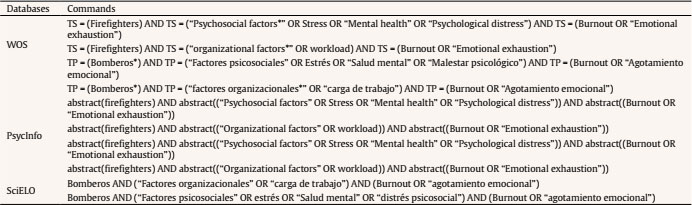 For the analysis of total effects, only studies meeting the above inclusion criteria and employing the Maslach Burnout Inventory (MBI) were considered. This restriction ensured methodological comparability across studies, as the MBI is the most widely used and validated instrument for assessing burnout dimensions. Search Strategy Regarding the search conducted in Web of Science (WOS), it was divided into two sub-searches: one focused on psychosocial factors (which yielded 253 papers) and another on organizational factors (which yielded 27 papers). The same search structure was applied in PsycInfo: one sub-search targeting psychosocial factors (resulting in 58 articles) and another focusing on organizational factors (resulting in 10 papers). These same searches were replicated in Spanish in both PsycInfo and WOS (see Table 1), but no results were obtained. The procedure was also repeated in SciELO: one search focused on psychosocial factors (which returned one result), and another on organizational factors (which returned no results). As a result of the various searches, a total of 349 papers were initially identified for screening. All records from the aforementioned searches were uploaded into Rayyan, where duplicate articles were removed, reducing the initial sample to 262 papers for further screening. The screening process was carried out independently by two researchers. Each researcher assessed whether the papers met the inclusion and exclusion criteria (see Table 1). As a result, 89 papers were initially found to meet the inclusion criteria. A second screening was then conducted to exclude articles that did not address burnout as the main topic or whose full text was not available online, yielding a final set of 35 articles selected for systematic review (see Figure 1). Figure 1 Flow Diagram. 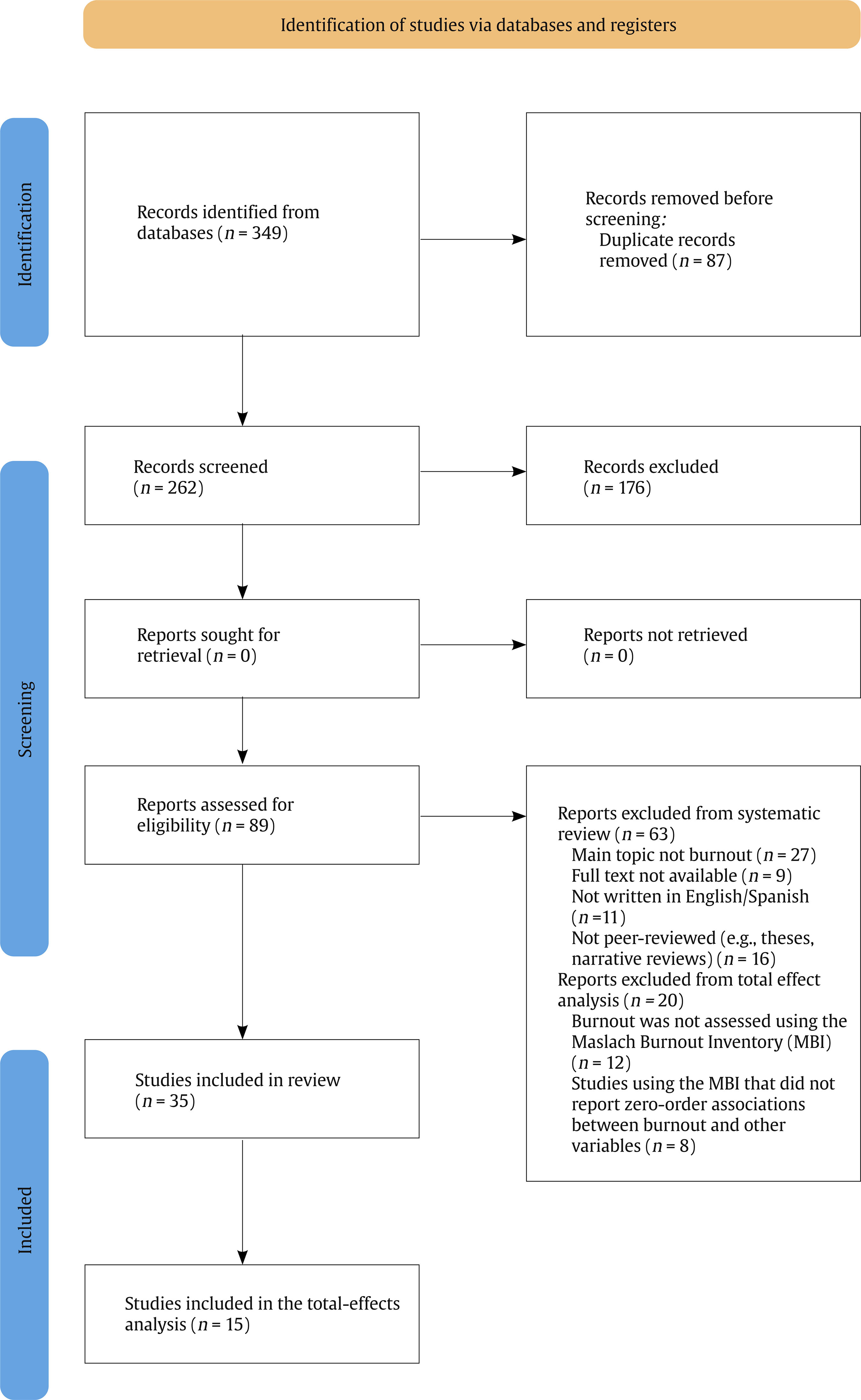 Study Selection The screening process was carried out in January 2025, using the Rayyan platform. Two researchers independently assessed all abstracts against the predefined inclusion and exclusion criteria. Disagreements were discussed in a joint session until consensus was reached, resulting in a final agreement rate of 100%. Data Extraction and Analysis For the systematic review, each study was reviewed to extract information related to burnout, including the instrument used for its assessment (e.g., Maslach Burnout Inventory), the specific dimensions analysed (emotional exhaustion, depersonalization, personal accomplishment), and the reported relationships between burnout and other psychological or contextual variables that the authors explicitly incorporated into their proposed model analysed in the paper (e.g., mediations involving sleep quality or interpersonal relationships within the team). Additionally, relevant contextual variables were collected to better interpret the findings. These included sociodemographic characteristics such as the country where data were collected, the time period (year of data collection), sample size, and representation of women in the sample (including the number of female participants and, when absent, whether such exclusion was justified). All available information related to burnout was recorded, including any mediating or moderating effects identified (particularly in cases where burnout functioned as a mediating or moderating variable in the relationship between other variables). Finally, when specific data on any of the previously mentioned aspects were not available, no assumptions were made; missing information was left uncompleted in order to avoid introducing bias into the study. Additionally, a quantitative synthesis of the total effects was conducted to estimate the magnitude of the direct associations between job demands, job resources, and burnout. The remaining studies were excluded from the quantitative synthesis because burnout was not assessed using the Maslach Burnout Inventory (MBI) or because they did not report zero-order associations between burnout and job demands or resources, as required by the JD-R framework. For this purpose, reported Pearson’s correlation coefficients (r) and odds ratios were transformed into Fisher’s Z values and subsequently reconverted into r to obtain a standardised and comparable measure of effect size magnitude. Although 35 studies met the inclusion criteria and were included in the systematic review, only 15 provided sufficient statistical information to compute these associations (see Appendix 3-9 for specific details). Quality Assessment The quality of the included studies was evaluated using the Joanna Briggs Institute (JBI) Critical Appraisal Checklist: the 8-item version for cross-sectional studies and the 11-item version for cohort studies. This tool has recently been updated to improve its applicability and to align its standards with current approaches to risk of bias assessment. These updates allow for the evaluation not only of the internal validity of studies, but also for differentiated judgments at the level of the study, outcomes, and individual results, enabling a more detailed and precise assessment of methodological quality (Barker et al., 2023). The use of this tool is especially appropriate in observational studies without control groups, where other instruments such as RoB 2.0 or ROBINS-I present limitations, as they require experimental or comparative designs. Moreover, the checklist format provides a clear guide for evaluating all relevant aspects of methodological quality, from the sample selection process to the adequacy of the statistical analyses performed. Although the quality appraisal was primarily conducted by a single reviewer, any uncertainties or ambiguities were systematically discussed with a second reviewer until consensus was achieved. While dual independent appraisal is ideal, the collaborative consensus-based approach ensured the methodological soundness and consistency of the quality assessments. The full results of the quality assessment can be found in the Appendix 1 of the Supplementary Material. Finally, most cross-sectional studies scored 7-8 out of 8, and all cohort studies at least 9 out of 11, indicating generally high methodological quality. The main limitation was that many studies did not control for potential confounders (e.g., age), which should be considered when interpreting the evidence. However, the high quality of the included studies supports confidence in the findings (see Appendix 1 for detailed ratings). Synthesis Method Although a meta-analytic approach is generally recommended, it was not conducted in this review due to a substantial heterogeneity in study designs, measures, operationalization of key variables (e.g., job demands, coping, emotional intelligence), and population characteristics (e.g., professional vs volunteer firefighters, gender representation, organizational context). Instead, a narrative synthesis combined with a quantitative estimation of the total effects were performed to capture the complex, context-dependent nature of burnout in firefighting. Extracted data were organized in predefined tables (author, year, country, sample, instrument used to assess burnout and findings) and the study selection process was documented through a PRISMA flow diagram (Figure 1; see Appendix 2). Additionally, to provide a general estimate of the magnitude of associations, total effects were calculated for the subset of studies employing the MBI. Zero-order correlations and odds ratios were extracted and transformed into Fisher’s Z, and subsequently back-transformed into Pearson’s r. Cohen (1988) indicated the following intervals for interpret r as r = .10 to .30 small effect, r = .30 to .50 medium effect, and r = .50 and higher as large effect. This procedure yielded overall effect size estimates separately for job demands and for job resources, according to the Job Demands-Resources framework. Full study-level data extraction is available in Appendix 1 (methodological quality, item-level JBI ratings) and Appendix 2 (structured extraction of sample information, effect estimates, mediators, moderators, and instrument details). Together, these constitute the complete data-extraction matrix for transparency and reproducibility. General Characteristics of the Studies Sample Details The studies analysed in this review presented widely varying sample sizes, ranging from 109 participants (Jo et al., 2017) to 18,936 (Jeung & Chang, 2021). This broad range highlights the diversity of the articles included in the review and may have implications for both the generalizability and the robustness of the conclusions drawn from them. Female Representation in the Sample Data on women were reported in only 48.57% of the cases (17 articles), with female representation in each sample being consistently low (typically around 5-6% of the total sample). The article with the highest proportion of female participants reported a 28% female participation rate. Although most of the articles did not provide a specific explanation for the absence of women in their samples, those that did offered two main reasons: either the proportion of women was so low that it was deemed non-representative and therefore excluded (e.g., Lee et al., 2018), or the exclusion was unintentional and attributed to the gender composition typically associated with the profession (e.g., Makara-Studziska, 2019). Countries of the Studies The final set of studies (n = 35) showed a diverse geographical distribution, although with a notable concentration in certain regions. China was the most represented country (n = 7), followed by South Korea (n = 6) and the United States (n = 5). Poland, Iran, and Portugal each contributed three articles. Other countries, such as France (n = 2), Kazakhstan, Japan, Greece, Taiwan, Romania, and Brazil (n = 1) had a limited representation. This distribution reflects a predominance of research in East Asia, although it is complemented by European and South American contributions. Burnout Scales and Measured Dimensions The most frequently used instrument to assess burnout was the Maslach Burnout Inventory (MBI), which appeared in 65.71% of the studies, followed by the Maslach-Pines scale (11.42%). Other tools employed included the Oldenburg Burnout Inventory (OLBI), the Link Burnout Questionnaire (LBQ), the Shirom-Melamed Burnout Measure (SMBM), and a short version of the MBI, each used in 5.71% of the cases. W. Kim et al. (2019) used an ad-hoc five-item Likert-type scale with high reliability (α = .941), while Jung and Park (2024) adapted a ten-item scale previously applied to paramedics (α = .903). However, these instruments were neither validated nor standardized, which limits both the replicability and the generalizability of their findings. Regarding the dimensions assessed, studies using OLBI, SMBM, LBQ, or the Maslach-Pines scale evaluated all the dimensions included in each respective tool. Among the 23 studies that used the MBI, 14 assessed its three core dimensions (emotional exhaustion, depersonalization, and personal accomplishment), four measured only the first two (Jo et al., 2017; Lee et al., 2018; Llorens et al., 2022; Lv et al., 2024), and five reported results solely for emotional exhaustion (Dyal et al., 2022; Jeung & Chang, 2021; Jung & Park, 2024; W. Kim et al., 2019; Roca et al., 2021). Burnout and Personal Characteristics Impact of Age on Burnout Findings regarding the impact of age on burnout levels have been inconsistent. Some studies found that younger firefighters experienced higher levels of burnout (J. Huang et al., 2021; Jung & Park, 2024), while others reported that younger firefighters showed lower levels of burnout (Dias et al., 2023). Additionally, some research indicated that middle-aged firefighters had the highest prevalence of burnout (Jeung & Chang, 2021), whereas other studies (Smith et al., 2018; Vinnikov et al., 2019) found no statistically significant relationship between age and burnout. Gender and Burnout Although the limited female representation in most samples made it difficult to examine gender differences, the few studies that did so reported inconsistent findings. Some authors found higher burnout levels among women (Jeung & Chang, 2021), whereas others observed greater burnout among men (Vinnikov et al., 2019). Education and Burnout The results regarding how burnout is affected by firefighters’ educational level have also shown contradictory findings. While some studies revealed that firefighters with higher educational levels exhibited greater levels of burnout (Jeung & Chang, 2021), specifically in the personal accomplishment dimension (Vinnikov et al., 2019), others found no significant differences between groups (Smith et al., 2018). Burnout and Demands Job Demands Burnout and Uniform. Other less explored factors, such as discomfort with the uniform or language barriers, have also been identified as significant predictors of burnout, particularly in relation to emotional exhaustion and cynicism (Vinnikov et al., 2019). Work Shifts. Jeung and Chang (2021) reported that firefighters who did not work rotating shifts exhibited higher levels of burnout compared to their colleagues working in 24-hour, two-shift, or three-shift systems. Similarly, Dias et al. (2023) found that for professional firefighters working in shifts increased the prevalence of burnout. However, for volunteer firefighters shift work was associated with lower levels of burnout. Job Position. It was found that administrative staff (Jeung & Chang 2021) and managerial personnel (Vinnikov et al., 2019) reported higher levels of burnout compared to their frontline colleagues. Burnout and Job Demands. High job demands are a clear risk factor for the development of burnout. Among them, lack of challenge was the most strongly linked to the syndrome, followed by role ambiguity (associated with low personal accomplishment), role conflict (related to depersonalization), and work overload (closely tied to emotional exhaustion) (R. Kim et al., 2020). Work overload, in particular, has been consistently associated with high levels of emotional exhaustion and depersonalization (Ângelo & Chambel, 2015; De Carvalho et al., 2021; Jeung & Chang, 2021; R. Kim et al., 2020; W. Kim et al., 2019; Roşca et al., 2021; Smith et al., 2019). Ângelo and Chambel (2015) pointed to a bidirectional relationship: the greater the burnout, the higher the perceived demands, and vice versa. Llorens et al. (2022) highlighted the negative impact of acute demands, noting that proactive coping strategies did not mitigate this relationship. However, W. Kim et al. (2019) suggested that effort-reward balance could act as a protective factor. Moreover, not all demands have the same effect: while a combination of high workload and low control (“high job strain”) increases exhaustion levels, frequent operational exposure may paradoxically be associated with greater personal accomplishment (De Carvalho et al., 2021). Finally, the reviewed articles identified several moderating factors in this relationship. Specifically, perceived meaning in work was found to buffer the impact of job demands on burnout, underscoring the importance of subjective interpretations of workload (Roşca et al., 2021). Burnout and Work-Family Conflict. Smith et al. (2019) found that work-family conflict was significantly associated with burnout. Complementarily, Wu et al. (2019) reported that cognitive reappraisal was only effective as a burnout-reduction strategy (and thus in decreasing work-family conflict) when levels of guanxi were high. That is, when employees had a good relationship with their supervisor. This highlights the importance of effective leadership for staff well-being. Personal Demands Job tenure and Burnout. With regard to the influence of job tenure on burnout levels among firefighters, mixed results have been reported. On the one hand, some studies (J. Huang et al., 2021; Jeung & Chang, 2021; Jung & Park, 2024; Katsavouni et al., 2016) found that longer job tenure was associated with higher levels of burnout, specifically emotional exhaustion and cynicism. On the other hand, other studies (Dias et al., 2023; Smith et al., 2018; Vinnikov et al., 2019) did not find a significant relationship between these variables. Impact of Family Responsibilities on Burnout. Dias et al., (2023) found that, among professional firefighters, having dependents was a risk factor (that is, it was associated with higher levels of burnout). In contrast, no significant relationship was found for volunteer firefighters. Neuroticism and Mastery-avoidance Strategies. Several studies have found that certain personality traits influence the development of burnout. Among them, neuroticism has been positively associated with higher levels of burnout (Lee et al., 2018; Tao et al., 2022; Vaulerin et al., 2016). Specifically, Vaulerin et al. (2016) observed that firefighters with high levels of neuroticism tended to adopt maladaptive mastery-avoidance strategies, which in turn increased the burnout levels experienced by these professionals. Coping. Avoidant coping strategies were consistently associated with higher levels of burnout (Chen et al. 2022a; J. Huang et al. 2021; Q. Huang et al., 2022; Llorens et al. 2022; Lv et al. 2024). Perceived Stress. Perceived stress has emerged as a relevant predictor in burnout models, both due to its direct relationship with the syndrome and its impact on self-efficacy perception (Lee et al., 2018; Lv et al., 2024; Makara-Studzińska et al., 2020; Smith et al., 2019; Tao et al., 2022). Additionally, personal variables such as emotional intelligence and self-efficacy may play a moderating role in this relationship (Michinov, 2022). Specifically, Makara-Studzińska et al. (2020) found that perceived self-efficacy acted as a protective factor against the development of burnout. Likewise, both self-compassion (Lv et al., 2024) and self-efficacy (Makara-Studzińska et al., 2019) were found to act as protective factors in this relationship, although with a key distinction: self-compassion functioned as a mediating variable, while self-efficacy acted as a moderator (except in relation to the “relationship deterioration” dimension), where it was not significant. For their part, Smith et al. (2019) did not find significant moderating effects of work-family conflict or occupational stress in their mutual relationship with burnout. Burnout and Resources Job Resources Burnout and Organizational Climate. Jeung and Chang (2021) found that organizational climate played a key moderating role between emotional labour and burnout: in a positive work environment characterized by good communication and support, the impact of emotional labour was mitigated. Conversely, while there was a direct relationship between burnout and emotional labour, in the absence of a supportive climate, the effects of emotional labour on burnout were intensified. Burnout and Social Support. Social support emerges in several studies as a variable directly associated with burnout, as well as a moderating or mediating factor. Low-quality relationships with supervisors or low overall social support were associated with higher levels of emotional exhaustion (Chen et al., 2022; De Carvalho et al., 2021; Mitani et al., 2006; Wu et al., 2019). Specifically, Wu et al. (2019) found that social support (operationalized through guanxi) acted as a protective moderator between burnout and work-family conflict. Similarly, Chen et al. (2022) also conceptualized social support as a moderating variable, in this case between avoidant coping and burnout. However, Tao et al. (2022) reported that perceived social support actually reinforced the relationship between neuroticism and burnout. As for the mediating role of this variable, Q. Huang et al. (2022) found that perceived social support predicted lower levels of burnout symptoms when adaptive coping strategies were used, and higher symptom levels when avoidant coping strategies were employed. Finally, other studies such as those by Llorens et al. (2022) found no relationship between social support and burnout. Burnout and Supervisor Relationships. Wu et al. (2019) emphasized that the relationship with supervisors (guanxi) served as a protective factor against burnout. Specifically, they found that individuals who perceived a strong relationship with their superiors showed lower levels of burnout under conflictual conditions, whereas in contexts of low guanxi, even the most functional coping strategies lost their effectiveness. Personal Resources Self-compassion and Self-efficacy. Studies assessed identified personality-related factors that help mitigate the effects of burnout, such as self-compassion and self-efficacy (Lv et al. 2024; Makara-Studzińska et al. 2020). Burnout, Religiosity, and Gratitude. Lee et al. (2018) found that religiosity and gratitude acted as protective variables against burnout. They highlighted that religiosity was associated with reduced levels of emotional exhaustion (but not with cynicism), and that gratitude had a mediating effect and played a stronger protective role against burnout than religiosity, acting as a direct predictor of lower levels of both exhaustion and cynicism. Coping. Problem-focused and proactive strategies were more strongly linked to lower levels of burnout (Chen et al., 2022; J. Huang et al., 2021; Q. Huang et al., 2022; Llorens et al., 2022; Lv et al., 2024). However, Dias et al. (2023) found that among volunteer firefighters proactive strategies were actually associated with higher burnout levels, whereas for professional firefighters these strategies had no effect on burnout. Nevertheless, proactive coping strategies did not moderate the relationship between burnout and work engagement (Llorens et al., 2022). Some strategies, such as cognitive reappraisal, were shown to be effective only when a supportive social environment was present (Wu et al., 2019), and actively seeking support did not always reduce burnout, possibly due to a lack of effective responses from the social context (Q. Huang et al., 2022). Finally, emotional intelligence and an integrative conflict resolution style were identified as protective factors against burnout. Moreover, emotional intelligence moderated the relationship between an integrative conflict resolution style and burnout, enhancing the protective effect of this coping style. Specifically, Michinov (2022) concluded that emotional intelligence had a direct protective effect against burnout, while also strengthening the protective role of integrative coping styles. Burnout and Vocational Calling. Jo et al. (2017) identified a paradoxical effect regarding vocational calling. Specifically, they found that in contexts of high emotional demand, vocational calling acted as a moderator between burnout and PTSD, intensifying their negative association. Burnout and Consequences Burnout and Depression Several studies have demonstrated a significant relationship between burnout and depression (Cui et al., 2022; Jung & Park, 2024; Tao et al., 2022). Among the dimensions of burnout, cynicism has been identified as the most strongly associated with depressive symptoms (Cui et al., 2022). Moreover, collegiality was found to have a moderating effect on this relationship, particularly in its emotional and obligatory dimensions, whereas instrumental and social image dimensions did not show significant effects. These findings are explained by cultural factors, such as the value placed on interpersonal support in contexts like China. Additionally, depression has also been identified as a mediating variable in the relationship between burnout and other factors, such as workload (Jung & Park, 2024) and work ability (Stefanowski et al., 2023), which underscores its central role in the impact of burnout on mental health. Burnout and PTSD Several studies have linked burnout to post-traumatic stress disorder (PTSD), particularly highlighting emotional exhaustion and cynicism as the dimensions most closely associated with this disorder (Katsavouni et al., 2016; Khoshakhlagh, Al Sulaie, Mirzahosseininejad, et al., 2024; Khoshaklagh, Al Sulaie, Yazdanirad, et al. 2024; Mitani et al., 2006). Liu et al. (2025) also identified emotional exhaustion as the burnout dimension most strongly related to PTSD. According to Katsavouni et al. (2016), this connection may be explained by the fact that both conditions share common risk factors, that emotional exhaustion may serve as a pathway through which PTSD impacts well-being and job performance, and that depersonalization may function as a dysfunctional coping strategy in response to traumatic experiences. Although W. Kim et al. (2019) did not find a direct relationship between trauma exposure and PTSD, they did identify a significant association between such exposure and higher levels of burnout, with burnout acting as a mediator in the relationship between traumatic experiences and the development of PTSD. These findings are consistent with those of Katsavouni et al. (2016), who also found associations between trauma and burnout, as well as between trauma and PTSD. Burnout and Musculoskeletal Symptoms Khoshakhlagh, Al Sulaie, Yazdanirad, et al. (2024) found a direct and significant relationship between burnout and musculoskeletal symptoms. Specifically, a sensitivity analysis revealed that high levels of emotional exhaustion increased the likelihood of experiencing musculoskeletal symptoms by 20%, while its absence reduced that probability by 14% (Khoshakhlagh, Al Sulaie, Mirzahosseininejad, et al., 2024). Burnout and Compassion Fatigue R. Kim et al. (2020) found that the relationship between workplace risk factors (e.g., role ambiguity) and burnout was moderated by compassion fatigue. Burnout and Performance Burnout among firefighters has been found to reduce work ability, with this effect mediated by symptoms such as insomnia, loneliness, and depression (Stefanowski et al., 2023). It has also been linked to sleep disorders (such as insomnia and shift work) that exacerbate emotional exhaustion and depersonalization (Wolkow et al., 2019). Furthermore, burnout was found to mediate the relationship between occupational stress and poor sleep quality (Dyal et al., 2022), and to negatively affect performance by increasing errors, absenteeism, and reducing workplace safety (Smith et al., 2018, 2020). Burnout as a Mediating Variable Multiple studies (Dyal et al., 2022; Katsavouni et al., 2016; Khoshakhlagh, Al Sulaie, Mirzahosseininejad, et al., 2024; Khoshakhlagh, Al Sulaie, Yazdanirad, et al., 2024; W. Kim et al., 2019; Mitani et al., 2006; Smith et al., 2018, 2020) have highlighted the role of burnout as a mediating variable in the relationship between stressors (e.g., trauma, occupational stress, or work-family conflict) and various negative outcomes, such as post-traumatic stress symptoms (PTSD), musculoskeletal problems, sleep disturbances, unsafe workplace behaviours, and a decrease in workers’ safety-related behaviours. This mediating role positions burnout as a central node within a network of health- and performance-related consequences. However, some recent studies have proposed rethinking the assumed directionality in certain explanatory models. In this regard, Liu et al. (2025) identified poor sleep quality as the most central node in their network analysis, suggesting that poor sleep quality could act as an antecedent factor to burnout. In contrast, several studies (Dyal et al., 2022; Khoshakhlagh, Al Sulaie, Cousins, et al., 2024) found that burnout mediated the relationship between occupational stress and sleep quality, rather than being a consequence of poor sleep, thus supporting the classical perspective in which burnout leads to impaired night-time rest. Khoshakhlagh Al Sulaie, Cousins, et al. (2024) also found that burnout functioned as a moderating variable between PTSD and sleep quality. Some studies also found that specific dimensions of burnout acted as mediators in different relationships (Tao et al., 2022). Specifically, emotional exhaustion and depersonalization mediated the relationship between neuroticism and anxiety, while depersonalization mediated the relationship between neuroticism and depression. Finally, Khoshakhlagh, Al Sulaie, Mirzahosseininejad, et al. (2024) and Khoshakhlagh, Al Sulaie, Yazdanirad, et al. (2024) found that burnout (specifically the dimension of emotional exhaustion) acted as a mediating factor in the relationship between PTSD and musculoskeletal problems, with emotional exhaustion being the most influential component. In fact, the impact of other variables (e.g., job stress, depersonalization, personal accomplishment, depression) on the PTSD and musculoskeletal problems relationship was also examined, but burnout emerged as the most influential mediating factor. Total Effects of Demands and Resources on Burnout A total effects analysis was conducted to synthesise the strength of the direct associations observed and evaluated in the included studies, thereby providing quantitative information on the impact of demands and resources on burnout (see Appendix 3-9 for more details). When data were available, findings were disaggregated by burnout dimension to provide an average estimate of the extent to which each component (emotional exhaustion, depersonalisation, or personal accomplishment) was affected by job demands and resources. However, some studies only reported an overall measure of burnout. In those cases, the reported overall burnout values were also included to compute the global impact of demands and resources (separately) on total burnout levels across studies. Specifically, zero-order relationships between demands/resources and burnout were examined. Reported Pearson’s correlation coefficients (r) and odds ratios were transformed into Fisher’s Z values and subsequently reconverted into r to obtain a standardised and comparable measure of effect size magnitude. Therefore, this section summarises the direct effects reported across the studies, excluding moderating and mediating mechanisms. On average, job demands showed a medium positive association with burnout (r = .36, SD = .10, N = 21), indicating that higher exposure to stressors is consistently correlated to higher burnout levels. Oppositely, job resources showed a medium negative association (r = -.33, SD = .13, N = 11), which reflects their protective role in mitigating burnout levels in these professionals. Specifically, job demands were medium positive associated with emotional exhaustion (r = .31, SD = .12, N = 23), while showing small positive association with depersonalization (r = .25, SD = .13, N = 20), and low personal accomplishment (r = .10, SD = .19, N = 9). In parallel, job resources were found to have a buffering effect over burnout. Specifically, job resources showed a small negative association with emotional exhaustion (r = -.23, SD = .16, N = 6), followed by depersonalization (r = -.20, SD = .21, N = 4) while showing a marginal negative relationship with personal accomplishment (r = -.01, SD = .41, N = 2). Overall, these findings are consistent with the Job Demands-Resources framework, whereby job demands uniquely and strongly relate to burnout over time, while job resources primarily buffer demands and relate more strongly to engagement (Bakker et al., 2023). Synthesis of the Results Overall, the results are aligned with the Job Demands-Resources framework, confirming that burnout among firefighters primarily results from the imbalance between intense job demands and insufficient personal and organizational resources. This pattern was supported by the total effects analysis, which revealed a moderate positive association between job demands and burnout and a moderate negative association between job resources and burnout. Resources showed their strongest protective effect on emotional exhaustion and depersonalisation, while their influence on personal accomplishment was weaker. However, the non-significant relationship observed between resources and the personal accomplishment dimension should be interpreted with caution since this correlation likely reflects a methodological inconsistency rather than a true absence of association. Specifically, while De Carvalho et al. (2021) conceptualised this dimension as low personal accomplishment, Mitani et al. (2006) assessed personal accomplishment directly. Although both variables capture the same construct, they are expressed in opposite directions; therefore, their effects tend to cancel each other out when averaged. After adjusting for this difference, both studies indicate the same underlying pattern, namely that higher resources are related to greater personal accomplishment (or lower reduced accomplishment). Nevertheless, the direction of the reported effects was not modified to preserve the integrity and comparability of the original data. Regarding the characteristics of the studies, a high methodological and geographical heterogeneity was found, with the greatest representation of studies conducted in East Asia. In contrast, no study was found to have been carried out in Spain, which clearly highlights a gap in the literature. As for female representation in the samples, it was extremely low because of the clear masculinization of this professional sector. However, the exclusion of women from these samples appears to be more of a methodological issue (lack of sufficient statistical power to conduct gender-sensitive analyses) than an ideological one or related to gender inequality. In turn, although there was broad methodological heterogeneity (use of LBQ, OLBI, SMBM), a clear trend was observed in the use of the MBI as the main assessment tool. Organizational factors (e.g., workload, role ambiguity, type of job position) have emerged as the main predictors of burnout. Likewise, although various individual and personality variables have proven to play a key role in the development of burnout (e.g., high neuroticism, perceived stress, or reactive coping strategies), others have also been identified as potential protective factors against burnout, by mitigating its adverse effects (e.g., proactive coping styles, self-efficacy, emotional intelligence, religiosity, etc.). Nevertheless, certain elements that the scientific literature usually considers protective (e.g., vocational calling and self-compassion) have proven to act as risk factors under certain conditions in this professional group. Finally, in this multidimensional and multifactorial conceptualization of burnout, it has been found that the syndrome produces multiple adverse consequences for professionals in this field (e.g., PTSD, depression, anxiety, musculoskeletal problems, lower safety behaviours, greater absenteeism), which entail significant costs both for the individual and for the organization. Comparison of the Divergent Findings with Previous Literature Although many studies have identified the expected patterns between burnout and the variables examined (e.g., workload, coping strategies), divergent results were observed in some cases, which appear to be closely linked to the specific characteristics of the profession. While previous literature predominantly considered social support a protective factor against burnout (Fan et al., 2024; Ruisoto et al., 2021), this review found mixed results. In certain high-tension scenarios, social support may paradoxically amplify stress responses and contribute to burnout, possibly due to overexposure to emotionally charged narratives or unhelpful peer reinforcement mechanisms. Similarly, results diverging from expectations were also found with regard to professional vocation, which has traditionally been conceptualized as a protective factor (McManus et al., 2011; Nahas et al., 2024). However, the findings of this review indicate that a strong identification with the professional role may increase vulnerability to burnout and post-traumatic stress disorder under conditions of high emotional load. In the case of firefighters, the internalization of roles centred on helping and sacrifice may foster overinvolvement, difficulties in establishing psychological boundaries, and sustained exposure to emotional distress, particularly in contexts of repeated trauma. Taken together, these findings suggest that factors commonly regarded as protective may operate differently in firefighters, highlighting the importance of interpreting burnout processes within the emotional, relational, and vocational context of this profession. These results prove the need of further research to clarify the conditions under which these factors function as protective or risk-enhancing mechanisms. Theoretical Implications First, this systematic review contributes to understanding burnout as a multidimensional and multilevel construct. It is not only a consequence of occupational stressors, but also a central, mediating, and moderating factor that connects psychological demands with both physical and mental health outcomes. In fact, burnout appears as a central node within occupational health networks, mediating between disorders (e.g., PTSD, stress or depression), and physical health issues (e.g., musculoskeletal symptoms or sleep disturbances). Second, the findings of this review are consistent with the core assumptions of the Job Demands-Resources (JD-R) model (Demerouti & Bakker, 2025; Demerouti et al., 2021), while also introducing important nuances. However, the results suggest that vocational calling, typically considered a protective factor, may under conditions of high emotional strain become a risk factor, thus challenging traditional interpretations of its role within burnout models. Furthermore, among the dimensions measured by the Maslach Burnout Inventory (MBI), emotional exhaustion consistently emerged as the most predictive and impactful component. This highlights the need for theoretical frameworks to give this dimension greater weight, both in conceptualization and in empirical modelling. Practical Implications The development of this review gains particular relevance when contextualized within the current institutional landscape many countries (such as Spain), where no structured and sustained policies exist for the prevention of burnout among firefighters. As Cevallos et al. (2024) point out, the absence of concrete preventive strategies within these institutions has contributed to an increase in negative behaviours among personnel, with evident consequences in their professional, family, and social spheres. Therefore, given this lack of systematic institutional policies, the results of the present study provide a theoretical foundation for the development of future interventions aimed at preventing burnout in firefighting bodies. Specifically, the conceptual framework derived from the results of this project can guide both occupational health professionals and responsible institutions in designing intervention programmes tailored to this workforce. These programmes should target both prevention and health promotion, at both individual and organizational levels. These recommendations are aligned with international best practices. For example, in Canada, standardized protocols for emotional debriefing (Critical Incident Stress Management, CISM) are applied, along with psychological resilience programmes designed specifically for fire services. In particular, the CISM model has become one of the most effective strategies for managing post-traumatic stress in emergency services (Mitchell, 2006). Transferring such initiatives to the Spanish context is not only viable but particularly necessary, given the current lack of structural measures in the country. Finally, to ensure the effectiveness of burnout prevention measures, it is essential that institutions go beyond merely complying with legal requirements regarding psychosocial risk (Ley 31/1995, 1995) and move toward a proactive and integrated management of these risks. Although the law mandates regular evaluations, these are often carried out reactively, without the systematic implementation of corrective plans. Therefore, the elaboration and execution of effective action plans is recommended, to identify risks as well as to promote real organizational changes in the work environment, leadership practices, and human resource allocation. In conclusion, this study not only advances understanding of the factors involved in the onset and persistence of burnout, but also provides a solid empirical and theoretical basis for designing public policies, organizational strategies, and clinical interventions tailored to the operational realities of firefighters, promoting their mental health, quality of work life, and sustainable professional performance. Strength and Limitations Strengths This study has several noteworthy strengths. First, it addresses a highly relevant yet underexplored topic in occupational health research: burnout among firefighters. The review was conducted following international standards (PRISMA 2020) and included a robust methodological quality assessment using the JBI Critical Appraisal Checklist. Conceptually, the analysis is grounded in well-established theoretical frameworks such as the Job Demands-Resources (JD-R) model, allowing for a multilevel and structured understanding of the phenomenon. Finally, this review highlights important gaps in the literature (such as the underrepresentation of women and the lack of studies from certain geographical areas) which adds value for guiding future research and preventive strategies. Limitations One of the main limitations of this study is the predominance of cross-sectional designs among the included articles, which precludes the establishment of causal relationships between variables. Furthermore, the heterogeneity of burnout measurement instruments impedes direct comparison of results and limits the feasibility of conducting meta-analyses. Additionally, the substantial methodological and conceptual heterogeneity observed across the included studies (in terms of measurement tools, operationalisation of key variables—e.g., job demands, coping, emotional intelligence—and sample composition) made it unfeasible to perform a meta-analysis with adequate comparability and statistical validity. This limitation was the main reason for conducting a total effects analysis instead, as it allowed for a more consistent synthesis of the available evidence despite the heterogeneity of study designs. The language restriction constitutes another limitation, as only studies published in Spanish and English were included. This inevitably introduces a geographical bias, excluding relevant research published in other languages (e.g., Korean or Portuguese) that met the inclusion criteria but were omitted due to language barriers. Additionally, the underrepresentation of women in this occupational group, given the specific characteristics of the profession, restricts the gender-based analysis and limits a comprehensive understanding of burnout among female firefighters. The exclusion of grey literature was a deliberate methodological choice aimed at ensuring the inclusion of studies with higher methodological rigor. However, this decision may have constrained the breadth of the review by omitting recent or context-specific findings that are not published in peer-reviewed journals. Another methodological limitation concerns the quality assessment and data extraction processes, which were primarily conducted by a single reviewer. Although uncertainties and ambiguities were resolved through discussion with a second reviewer, the absence of a fully independent dual-reviewer approach may introduce subjective bias. This limitation, mainly associated with resource constraints, ought to be considered when interpreting the consistency and objectivity of the extracted data and quality ratings. Lastly, some eligible studies were excluded due to lack of access to full texts, which may have impacted the completeness of the review. Regarding the review process, the search was limited to major databases, potentially resulting in the omission of relevant studies. Moreover, the methodological quality assessment was performed by a single reviewer, which may increase the risk of bias. Future Research Directions Based on the findings of this systematic review, several key priorities for future research on burnout in firefighters can be identified. First, there is a clear need for longitudinal and experimental studies that go beyond correlational designs and allow for the analysis of causal relationships between individual, organizational, and contextual factors. Most of the studies included in this review used cross-sectional methodologies, limiting the ability to determine temporal dynamics or directionality between variables. In contrast, longitudinal approaches would help to better understand how burnout evolves over time and how it interacts with related conditions such as post-traumatic stress disorder (PTSD), insomnia, or work capacity decline. Second, it is essential to empirically evaluate the effectiveness of psychosocial interventions designed to reduce burnout among firefighters. These could include programmes focused on the development of emotional competencies (e.g., emotional intelligence, regulation), resilience-based interventions, adaptive coping strategies, or organizational changes aimed at improving workplace climate, perceived equity, or access to social support. In this context, the role of transformational leadership also warrants further exploration, given its potential to mediate the impact of occupational stressors on psychological health. Thirdly, there is a need to expand sample diversity. The underrepresentation of female firefighters in most studies hinders gender-based analyses and the design of tailored interventions. Including women more actively in future research is essential from both an equity and a scientific perspective. Furthermore, the findings of the total effects analysis justify that future research should place greater emphasis on examining protective resources, rather than predominantly focusing on job demands. Specifically, the total effects analysis revealed that, although resources have been less frequently studies (there are fewer data available when compared to demands), their overall impact on burnout is comparable in magnitude to that of job demands. This finding underscores the importance of adopting a preventive and resource-oriented approach to occupational health in firefighting. In this sense, examining how job and personal resources (e.g., social support, resilience, or emotional competencies) can be strengthened is crucial to designing effective interventions that not only mitigate existing burnout symptoms but also prevent their onset. Finally, future studies should broaden the geographical scope of the current literature, which remains concentrated in East Asia and selected European countries. Greater attention should be paid to underrepresented sociocultural contexts such as Latin America, Africa, and Mediterranean countries like Spain, where structural differences may shape the manifestation and prevention of burnout. Moreover, once methodological standards are better aligned across studies, future reviews should aim to conduct meta-analyses to quantify effect sizes, identify moderators, and strengthen the empirical basis for intervention design. Statistical integration will be especially valuable for clarifying the magnitude of associations between burnout and its most critical predictors and outcomes. Based on these findings, it can be concluded that burnout is a multifactorial and multidimensional phenomenon that negatively impacts the overall health of professionals. Risk factors were identified at both the organizational level (e.g., excessive workload, role ambiguity, lack of recognition) and the individual level (e.g., high neuroticism, intensified vocational commitment, reactive coping strategies), all of which are associated with increased psychological symptoms (such as stress, depression, and PTSD) and physical health issues (particularly musculoskeletal disorders). Conversely, protective factors such as self-efficacy, the use of active coping strategies, and a positive relationship with supervisors act as buffers against professional burnout. Although the findings demonstrate strong internal consistency, they must be interpreted with caution due to several limitations: the predominance of cross-sectional designs, the underrepresentation of women, and the methodological heterogeneity across studies, which limits the generalizability of results. In summary, this study reinforces the urgent need to implement psychosocial risk prevention policies and early detection strategies for burnout in this professional group. It is recommended that systematic, multilevel, and sustained interventions be developed, grounded in validated theoretical frameworks such as the Job Demands-Resources (JD-R) model. This strategy should address both structural conditions of the work environment and the reinforcement of personal coping resources. Such measures could help prevent the chronicity of the syndrome and contribute to improving both the health of personnel and the quality of the service provided. Conflict of Interest The authors of this article declare no conflict of interest. Supplementary materials are available at https://doi.org/10.5093/jwop2026a5 Cite this article as: Expósito, C., Arenas, A., Di Marco, D., Torrado, M., & Sanclemente, F. J. (2026). Burnout in firefighters: A systematic review and quantitative synthesis of the scientific literature. Journal of Work and Organizational Psychology, 42, Article e260773. https://doi.org/10.5093/jwop2026a5 References |
Cite this article as: Expósito, C., Arenas, A., Di Marco, D., Torrado, M., & Sanclemente, F. J. (2026). Burnout in Firefighters: A Systematic Review and Quantitative Synthesis of the Scientific Literature. Journal of Work and Organizational Psychology, 42, Article e260773. https://doi.org/10.5093/jwop2026a5
Correspondence: aarenas@us.esCopyright © 2026. Colegio Oficial de la Psicología de Madrid


 PDF
PDF e-PUB
e-PUB CrossRef
 JATS
JATS Print
Print SEND
SEND