Exploring the Boundaries of Transformational and Authentic Leadership: A Comparative Analysis of Intrapreneurial Behaviour
[Explorar los límites del liderazgo transformacional y auténtico: un análisis comparativo del comportamiento intraemprendedor]
Alejandro González-Cánovas1, Alejandra Trillo1, Beatriz Lopez-Peña2, & Francisco D. Bretones1
1University of Granada, Spain; 2The Hague University of Applied Sciences, The Netherlands
https://doi.org/10.5093/jwop2026a7
Received 1 January 2026, Accepted 12 June 2026
Abstract
The literature has consistently shown that authentic leadership and transformational leadership are associated with positive employee behaviours, although the distinction between the two leadership styles remains a subject of debate. This study examines the relationship between the two leadership styles and employees’ intrapreneurial behaviour, considering the mediating role of optimism, self-efficacy, hope, and affective commitment. Based on a sample of 292 employees in the service sector in Spain, the results show that both leadership styles are negatively associated with intrapreneurial behaviour. However, these relationships are partially explained by the mediating effects of self-efficacy and optimism. The findings suggest a possible overlap between authentic and transformational leadership and highlight the importance of contextual and perceptual factors in understanding how leadership relates to intrapreneurial behaviour at work.
Resumen
La literatura científica ha demostrado sistemáticamente que el liderazgo auténtico y el transformacional están asociados con comportamientos positivos de los empleados, aunque la distinción entre ambos estilos de liderazgo sigue siendo objeto de debate. Este estudio examina la relación entre los dos estilos de liderazgo y el comportamiento intraemprendedor de los empleados, teniendo en cuenta el papel mediador del optimismo, la autoeficacia, la esperanza y el compromiso afectivo. A partir de una muestra de 292 empleados del sector servicios en España, los resultados muestran que ambos estilos de liderazgo están asociados negativamente con el comportamiento intraemprendedor. Sin embargo, estas relaciones se explican en parte por los efectos mediadores de la autoeficacia y el optimismo. Los resultados indican la existencia de una posible superposición entre el liderazgo auténtico y el transformacional, destacando la importancia de los factores contextuales y perceptivos para comprender la relación que guarda el liderazgo con el comportamiento intraemprendedor en el trabajo.
Palabras clave
Liderazgo auténtico, Liderazgo transformacional, Capital psicológico, Compromiso afectivo, Comportamiento intraemprendedorKeywords
Authentic leadership, Transformational leadership, Psychological capital, Affective commitment, Intrapreneurial behaviourCite this article as: González-Cánovas, A., Trillo, A., Lopez-Peña, B., & Bretones, F. D. (2026). Exploring the Boundaries of Transformational and Authentic Leadership: A Comparative Analysis of Intrapreneurial Behaviour. Journal of Work and Organizational Psychology, 42, Article e260775. https://doi.org/10.5093/jwop2026a7
Correspondence: fdiazb@ugr.es (F. D. Bretones).The concept of leadership continues to occupy a priority position in organisational research due to its ability to influence the behaviour of followers (Wang et al., 2025). In recent decades, new leadership models have proliferated that include aspects of morality and transparency, with the aim of addressing the loss of trust generated by some leaders and their unethical behaviour. Among these new leadership styles, Authentic Leadership (AL) stands out (He et al., 2025) characterised by self-awareness, relational transparency, balanced information processing, and an internalised moral orientation (Walumbwa et al., 2008). However, other publications have been critical of AL, pointing to a high degree of overlap with other established leadership styles, especially Transformational Leadership (TL) (Banks et al., 2016; Fischer & Sitkin, 2023). Transformational leadership, initially introduced by Burns (1978) and considered for decades to be one of the most influential models in the field (Mhatre & Riggio, 2014), is defined as a leadership style that seeks to meet the needs of followers by inspiring them, challenging existing assumptions, encouraging others to take risks, and adopting behaviours that encourage followers to identify with the leader (Banks et al., 2016). Both authentic and transformational leadership emphasise elements such as the moral influence of the leader, follower development, and relational behaviours oriented towards individualised support, which can translate into similar patterns of organisational behaviour (Hoch et al., 2018). This conceptual overlap reinforces the need to compare both styles within the same design in order to identify whether they produce different effects on complex behaviours such as intrapreneurial behaviour (IB). This has been defined as the process in which an employee detects and capitalises on opportunities through innovation, initiative and a willingness to take risks, with the aim of creating new products, services or processes (Neessen et al., 2019). IB has become a critical factor for business success and competitiveness, especially in economic sectors that require continuous adaptation and rapid innovation (Klofsten et al., 2021). In recent years, there has been a proliferation of research linking both types of leadership to innovative behaviour (Azizah et al., 2021; Gürlek, 2021). However, the results have been mixed, depending largely on the organisational context, the nature of the tasks, and the psychological resources of the employees (Klein, 2023). In the case of LA, previous studies suggest both positive effects on innovative and creative behaviours through mechanisms such as trust or empowerment (Rego et al., 2012), and that its strong normative orientation could limit the exploration of new ideas or generate excessive conformity among followers (González-Cánovas et al., 2024). Recent literature considers IB to be the manifestation of individual initiative and innovation and highly sensitive to leadership styles that promote meaning, motivation, and relational support (Klofsten et al., 2021). Therefore, if AL and TL are based on different psychological mechanisms, they should show different patterns in their ability to foster individual innovation. If, on the contrary, they share common foundations, their effects on IB would tend to coincide. Therefore, IB allows us to operationalise the conceptual debate on the overlap between the two styles and examine whether their influence on IB responds to truly differentiated pathways. Despite the relevance of the debate, there is a scarcity of studies that simultaneously analyse, under the same design, the differentiated influence of authentic and transformational leadership on innovative behaviours. On the other hand, relatively little is known about the underlying psychological mechanisms that could explain the results of these styles on employee initiative and innovation, especially in specific sectors such as the service sector, where innovation and continuous improvement depend largely, unlike more industrialised sectors that tend to rely on formal processes or technological developments, on the proactive behaviour of workers, who generate, adapt and implement ideas that directly impact service quality (Prieto & Pérez-Santana, 2014). Therefore, it is essential to understand how different leadership styles can promote or hinder intrapreneurial behaviour in environments where people are the key resource. In order to clarify this debate, this research analyses the independent impact of each of these leadership styles (AL vs. TL) on intrapreneurial behaviour, also integrating the mediating role of psychological resources which, despite having been suggested in studies as key resources, have been analysed in a fragmented or isolated manner: psychological capital and affective commitment (Jun et al., 2024). To this end, we will propose two parallel models, seeking to clarify whether both styles act differently or redundantly in IB. From an applied perspective, this research will provide managers with tools to develop and implement human resource policies and practices that foster an organisational culture oriented towards innovation and talent development. Theoretical Framework and Hypothesis Development Intrapreneurial behaviour has become a vital factor in guiding the positive attitude of followers and innovative behaviour within the organisation (Peng & Kim, 2020). In this sense, the Authentic Leadership style (Walumbwa et al., 2008), by promoting transparency, integrity and emotional support, would stimulate these entrepreneurial behaviours by emphasising a positive psychological state and trust towards employees (Wei & He, 2022). However, recent studies warn that authentic leaders may cling rigidly to their values and beliefs, which, combined with the fact that this leadership style tends to favour team cohesion, could restrict the generation of new ideas and risk-taking among subordinates, creating an environment in which they feel greater conformity with the status quo (González-Cánovas et al., 2024). From the perspective of social identity theory, strong identification with a leader perceived as prototypical can reinforce normative conformity and reduce creative deviation, which would help explain the potential negative effects of AL on discretionary behaviours such as IB (González-Cánovas et al., 2024). For all these reasons, we propose the following hypothesis: H1a: Authentic Leadership (AL) negatively influences employees’ Intrapreneurial Behaviour (IB). On the other hand, Transformational Leadership (TL) has been one of the models most closely associated with organisational change by promoting innovation through inspiration, stimulating critical thinking and providing individualised support (Farahnak et al., 2020). These leaders create organisational conditions that encourage workers to actively engage in initiatives that go beyond their usual duties, such as intrapreneurial behaviour (Boukamcha, 2019). From the perspective of social cognitive theory and the personal resources approach, TL contributes to increasing employees’ self-efficacy, sense of purpose, and willingness to take risks, all of which are closely linked to IB (Luthans et al., 2021). Authors such as Moriano et al. (2014) affirm the existence of a positive and significant relationship between TL and IB. In this regard, we propose: H1b: Transformational Leadership (TL) positively influences the Intrapreneurial Behaviour (IB) of employees. The relationship between IB and leadership style may be mediated by other personal resources developed by the individual. In this regard, Psychological Capital has established itself as one of the most robust frameworks for predicting innovative and creative behaviour (Luthans et al., 2007). Unlike other more stable traits, factors such as self-efficacy, optimism and hope can be strongly influenced by a leader’s behaviour (Luthans et al., 2021). This makes it a suitable model for capturing the psychological mechanisms through which leadership styles influence IB. According to Bandura’s (1997) social cognitive theory, self-efficacy is defined as a person’s perception of their own ability to act effectively in different situations. Several studies have demonstrated the positive influence of L on the perception of self-efficacy by promoting environments of authenticity, support, and transparency (Gelaidan et al., 2024; Mohammad et al., 2023). In the same vein, experts argue that transformational leaders can also contribute to the development of their followers’ self-confidence by providing them with support and positive reinforcement in the face of uncertainty (Nolzen, 2018). In line with social cognitive theory, greater self-efficacy increases the likelihood that workers will take on challenges, persevere in the face of obstacles, and explore new ways of performing their work, which are core behaviours in IB (Bandura, 1997). Self-efficacy has also been analysed as a mediator of the association between different types of leadership and intrapreneurial and innovative behaviours (Lei et al., 2021). Therefore, we formulate: H2a: Self-efficacy (SE) mediates the relationship between AL and IB among employees. H2b: Self-efficacy (SE) mediates the relationship between TL and employees’ IB. Another potential mediating variable between leadership and IB would be optimism. Authentic leaders are perceived by their followers as confident, hopeful, optimistic, resilient, and of high moral character, which is often conveyed to their followers (Kleynhans et al., 2022). Optimism is commonly defined as a person’s ability to attribute positivity to events that have occurred (Saleem et al., 2022). People with an optimistic attitude do not remain focused on past events, but concentrate on making their present more efficient, exploring new options, adopting a realistic perspective, and maintaining a flexible mindset (Amankwaa et al., 2021). On the other hand, transformational leaders inspire optimism in their employees by using intense emotions to motivate them to adopt positive thinking, thereby encouraging the generation of new ideas and the construction of a promising vision (Le et al., 2018). From a psychological capital perspective, optimism helps employees interpret situations of change as opportunities rather than threats, which encourages experimentation and proactive initiatives (Luthans et al., 2021). Given that optimism facilitates the ability to face challenges and generate innovative solutions (Youssef & Luthans, 2007), we propose: H3a: Optimism (OP) mediates the relationship between employees’ AL and IB. H3b: Optimism (OP) mediates the relationship between employees’ TL and IB. Snyder’s (2000) research argues that mentoring and constant interactions with optimistic leaders can inspire hope among followers, as leaders with high levels of optimism, such as authentic leaders, are considered credible sources of energy and motivation. According to Saleem et al. (2022), hope is defined as an individual’s motivational disposition to achieve a specific goal. Regarding the link between transformational leadership and hope, Le & Lei (2018) point out that these types of leaders can strengthen employee confidence through both transparency and credibility. This, in turn, contributes to increasing workers’ hope by enhancing their decision-making capacity and their determination to achieve the proposed goals (Avolio et al., 2004). Authors such as Jun et al. (2024) verified the positive influence of TL on employees’ perception of hope. Within the framework of psychological capital, hope is related to the ability to generate alternative routes to goals and persevere in them, which is especially relevant when employees must explore and implement new ideas in their workplace (Youssef & Luthans, 2007). Hope has also been analysed as a factor that mediates the relationship between both types of leadership and positive employee behaviour, since it influences employees’ hope of achieving established goals (Avolio et al., 2004) and can lead them to develop more innovative solutions and find new ways to address challenges and opportunities (Zhou & George, 2001). Therefore, we propose the following sub-hypotheses: H4a: Hope (HO) mediates the relationship between AL and IB among employees. H4b: Hope (HO) mediates the relationship between employees’ TL and IB. On the other hand, according to social identity theory, leaders tend to influence employee behaviour by modifying their cognitive, emotional and psychological states by becoming reference points for the ingroup and giving meaning to organisational membership (Wang et al., 2021). Thus, leaders who show a marked prosocial orientation are those who tend to care about the well-being of their workers, supporting them through various resources. This positive exchange between leaders and employees can encourage employees to feel more valued and more connected and emotionally dependent on their organisation (Wu et al., 2020). As a result, their emotional commitment to the organisation will be strengthened, significantly impacting their attitudes and behaviours in the workplace and encouraging innovative work behaviours (Zhu et al., 2019). Fadhel et al. (2019) described affective commitment as the emotional connection of employees. Transformational leaders, thanks to their influence, ability to motivate and stimulate individuals, can encourage employees to put aside their personal interests in order to achieve team goals, while deeply understanding their leaders strengthens their affective commitment (Clifton, 2019). Furthermore, social identity theory indicates that psychological factors related to individual perception, such as workers’ affective commitment, can play a key role as mediating variables in the relationship between leadership and employee behaviour (Wang et al., 2021). Authors such as Phomane and Douglas (2021) demonstrated that affective commitment has a mediating effect between transformational leadership and innovative employee behaviour, as Ribeiro et al. (2020) also concluded, stating that affective commitment mediated between authentic leadership and innovative and creative behaviours. Therefore, we propose that: H5a: Affective commitment (AC) mediates the relationship between employees’ AL and IB. H5b: Affective commitment (AC) mediates the relationship between employees’ TL and IB. Data Sampling and Collection In order to test the hypotheses put forward, we conducted a study using several standardised questionnaires on a sample of employees from five food companies in the retail sector in southern Spain, a country whose economy is characterised by a high weighting of the service and retail sectors, where service quality and continuous adaptation to customer preferences are critical to competitiveness. A total of 501 questionnaires were distributed, obtaining responses from 295 employees (58.28%). Of these, three questionnaires were excluded from the research (0.59%) for various reasons, such as incomplete data or the selection of multiple answers for a single item, resulting in a final sample of 292 employees. The age range was between 18 and 65 years, with an average of 37.5 years. On the other hand, the length of service of the employees in the company ranged from one to more than 20 years, with a predominance of people with a length of service in the company of between 1 and 3 years. Finally, in terms of gender distribution, there was a slight predominance of women (53.46% women vs. 46.54% men). Participation was voluntary and anonymous. Data confidentiality was guaranteed, and employees were informed of the exclusively academic purpose of the study. The questionnaires were administered online during a period enabled by the participating companies. Measurement Scales In relation to the measurement instruments used, we employed the following standardised questionnaires. To measure Authentic Leadership (AL), we used the Spanish adaptation by Moriano et al. (2011) of the Authentic Leadership Questionnaire (ALQ) by Avolio & Gardner (2005). This scale consists of 16 items distributed across four dimensions: self-awareness, transparency in relationships, balanced processing, and internalised morality. Responses were collected on a Likert scale from 1 (never) to 5 (always). The scale demonstrated strong reliability, as evidenced by both Cronbach’s alpha (α = .957) and McDonald’s omega coefficients (ω = .969). To measure Transformational Leadership (TL), we used the 16 TL items from the MLQ-5X (short form) questionnaire by Bass and Avolio (1995), adapted into Spanish by Alonso et al. (2010). This subscale consists of four dimensions: idealised influence (attribution), idealised influence (behaviour), inspirational motivation, and intellectual stimulation. Responses were collected on a Likert scale from 0 (never) to 5 (always). The scale showed good reliability across both Cronbach’s alpha and McDonald’s omega coefficients (α = .968; ω = .968). To measure the level of Affective Commitment (AC) we used the affective dimension of the Organisational Commitment Questionnaire (OCQ) by Meyer and Allen (1997) adapted into Spanish by Arciniega and González (2006). The scale consists of seven items that reflect an individual’s degree of identification and positive feelings towards an organisation. Responses were collected on a Likert scale from 1 (strongly disagree) to 7 (strongly agree). Internal consistency indices indicated adequate reliability for this scale (α = .907, ω = .911). On the other hand, to measure the variables Hope (HO), Optimism (OP) and Self-efficacy (SE), we used the Psychological Capital Questionnaire (OREA) by Meseguer-de Pedro et al. (2017). On this scale, each factor consists of three items. Responses were collected on a Likert scale from 1 (totally uncertain) to 4 (totally certain). The scale demonstrated acceptable Cronbach’s alpha and McDonald’s omega reliability indices across all three dimensions: Hope (α = .731, ω = .761), Optimism (α = .788, ω = .789), and Self-Efficacy (α = .773, ω = .723). Finally, to measure the Intrapreneurial Behaviour (IB) variable, we used the Intrapreneurial Behaviour Scale developed by Stull and Singh (2005), adapted into Spanish by Moriano et al. (2009). This scale consists of seven items distributed across two dimensions: Innovation and Risk Taking. All items were evaluated on a scale from 0 (strongly disagree) to 4 (strongly agree). The reliability indices for this scale were favourable, with both Cronbach’s alpha and McDonald’s omega indicating good internal consistency (α = .847, ω = .847). Data Analysis and Procedure To analyse the data collected, we will use the SPSS statistical package (Version 25) for measures of central tendency and dispersion, as well as the Smart PLS statistical package (Version 4) to analyse the interconnection of the items with their respective constructs, ensuring reliability and discriminant validity. Finally, we applied partial least squares structural equation modelling (PLS-SEM) to determine the explained variance and the relationships between the endogenous variables, which allowed us to estimate the mean explained variance, the effect size and the significance of each of the relationships that make up the proposed models (Hwang et al., 2020). PLS-SEM was chosen because of its suitability for predictive models with multiple mediators and its ability to work with moderate sample sizes, following the methodological recommendations of Henseler et al. (2015). In addition, we verified the existence of common method bias (CMB), which is common in research using the PLS-SEM method derived from the measurement technique. This phenomenon can occur in research that uses only a single data collection method, as is the case here with the use of Likert scales to measure dependent and independent variables (Kock et al., 2021). Authors such as Schwarz et al. (2017) state that this bias must be taken into account, as its variability can have a significant influence on constructs, distorting results, and compromising their validity. To mitigate the bias of the common method, measures such as anonymity, psychological separation between scales through differentiated instructions, and the absence of correct or incorrect answers were incorporated. As we have pointed out, we first analysed the bias of the common method (CMB). The results obtained showed VIF coefficients below the threshold of 10 (see Table 1 [AL] and Table 2 [TL]), so we were able to confirm that the proposed models do not present collinearity problems (Myers & Myers, 1990). Table 1 Inner VIF Values for the AL Model 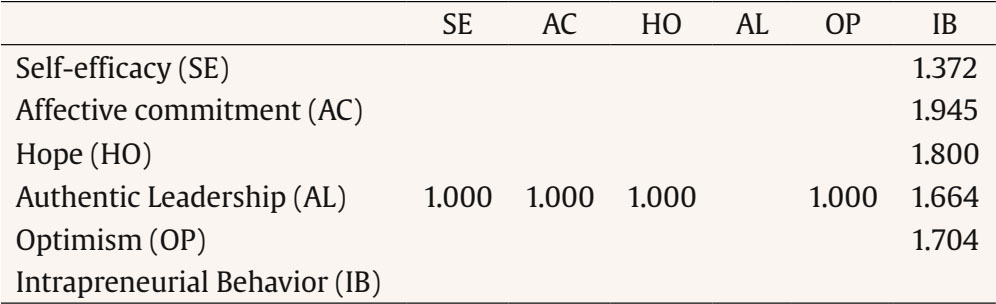 Note. SE = self-efficacy; CA= affective commitment; HO = hope; AL = authentic leadership; OP = optimism; IB = intrapreneurial behavior. Table 2 Inner VIF Values for the TL Model 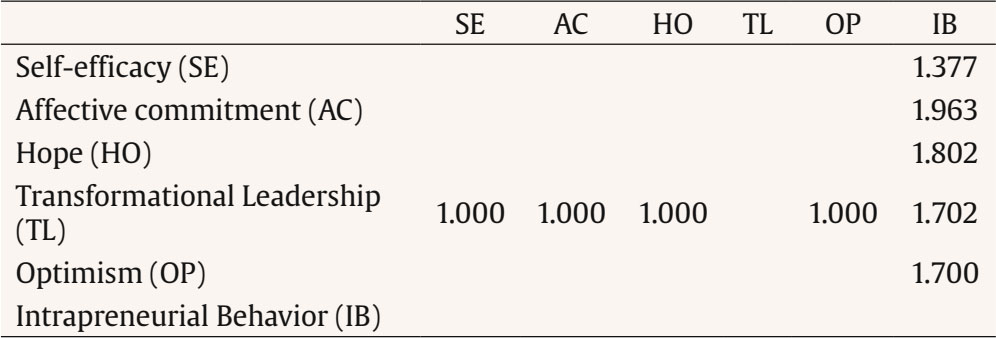 Note. SE = self-efficacy; CA = affective commitment; HO = hope; TL = transformational leadership; OP = optimism; IB = intrapreneurial behavior. Secondly, we analysed the factorial structure of each item in the different questionnaires used in the study, as well as the weight of the loadings for each item. The results obtained showed high factor loadings in all cases with the exception of the self-efficacy variable item (CP4 “I am confident that I could effectively handle unexpected events”), which had a factor loading below .60 (Chin, 1998), so it was decided to eliminate it, validating the rest of the items with their corresponding construct. Next, we analysed the reliability of the data obtained (Table 3). As can be seen, the Cronbach’s alpha and composite reliability (CR) data were above .70 in all cases (Nunnally & Bernstein, 1994). Given the non-equivalence of the factor loadings across the measures, McDonald’s omega was additionally estimated as a more appropriate reliability indicator, also yielding values above .70 (Hayes & Coutts, 2020). In addition, to assess the convergent validity of the proposed models, we performed an analysis of the extracted mean variance (AVE), obtaining values above .50 in all cases (Cheung et al., 2023). Table 3 Mean, Deviation, Reliability, AVE, and CR  Note. AVE = average variance extracted; CR = composite reliability. Subsequently, we analysed the discriminant validity of each of the instruments, applying the criterion developed by Fornell and Larcker (1981), which establishes that the square root of the AVE between the constructs and their measures must be greater than the correlations between their constructs. As can be seen in Table 4, this criterion was met in both the case of Authentic Leadership (AL) and Transformational Leadership (TL). Table 4 Discriminant Validity of the AL and TL Models  Note. Square root of AVE on diagonal; correlations between constructs are shown below the diagonal. Figure 1 Measurement and structural model results for Authentic Leadership. 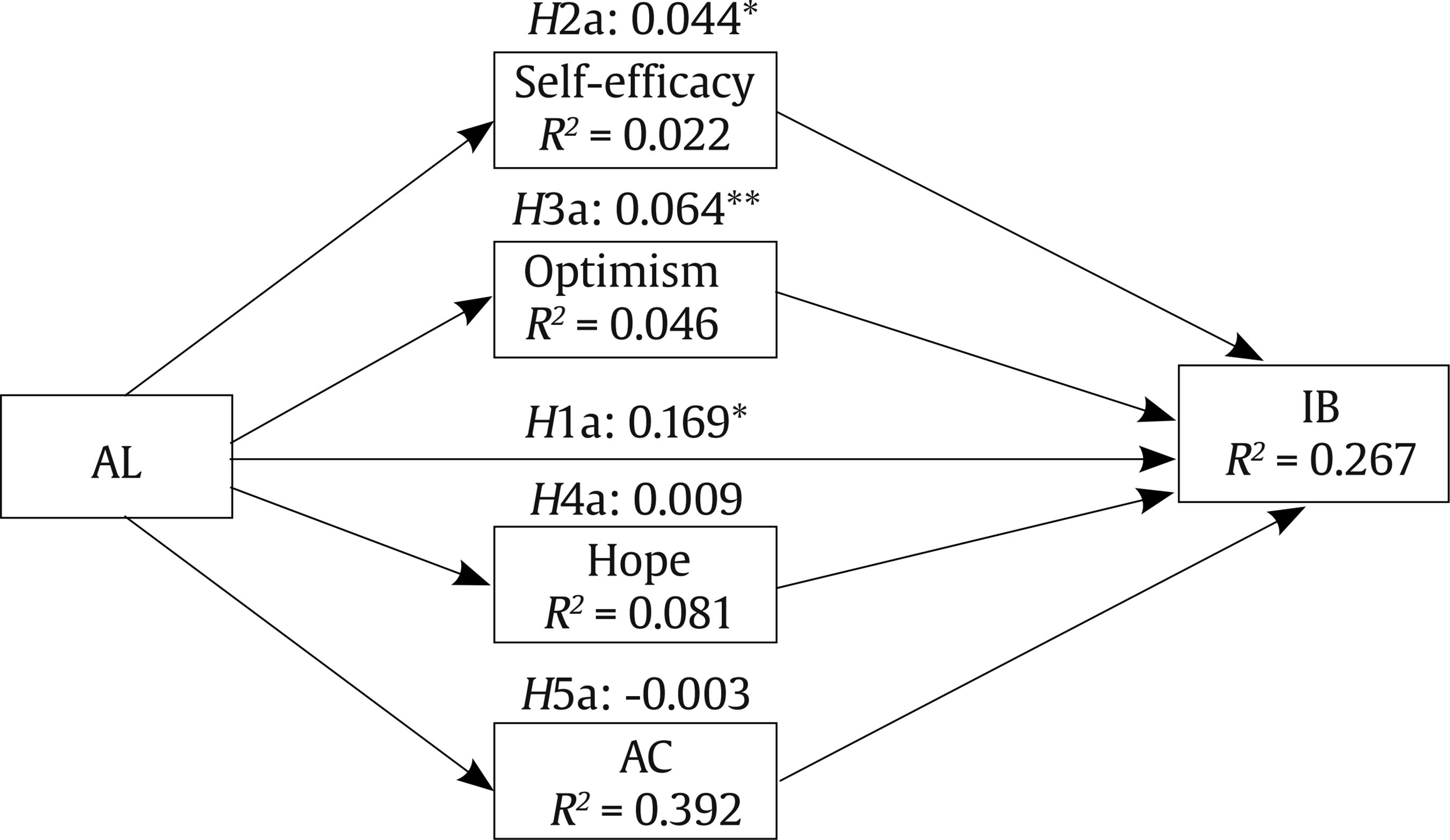 **Significance at the .01 level. *Significance at the .05 level. Once the validity and reliability of the instruments had been analysed, we decided to determine the contribution of each of the predictor variables to the endogenous variable. To do this, we carried out an analysis using structural models, taking as a reference the trajectory coefficient (β) and the value of R2 through bootstrapping with 10,000 cases for both Authentic Leadership (Figure 1) and Transformational Leadership (Figure 2). Figure 2 Measurement and structrural model results for Transformational Leadership. 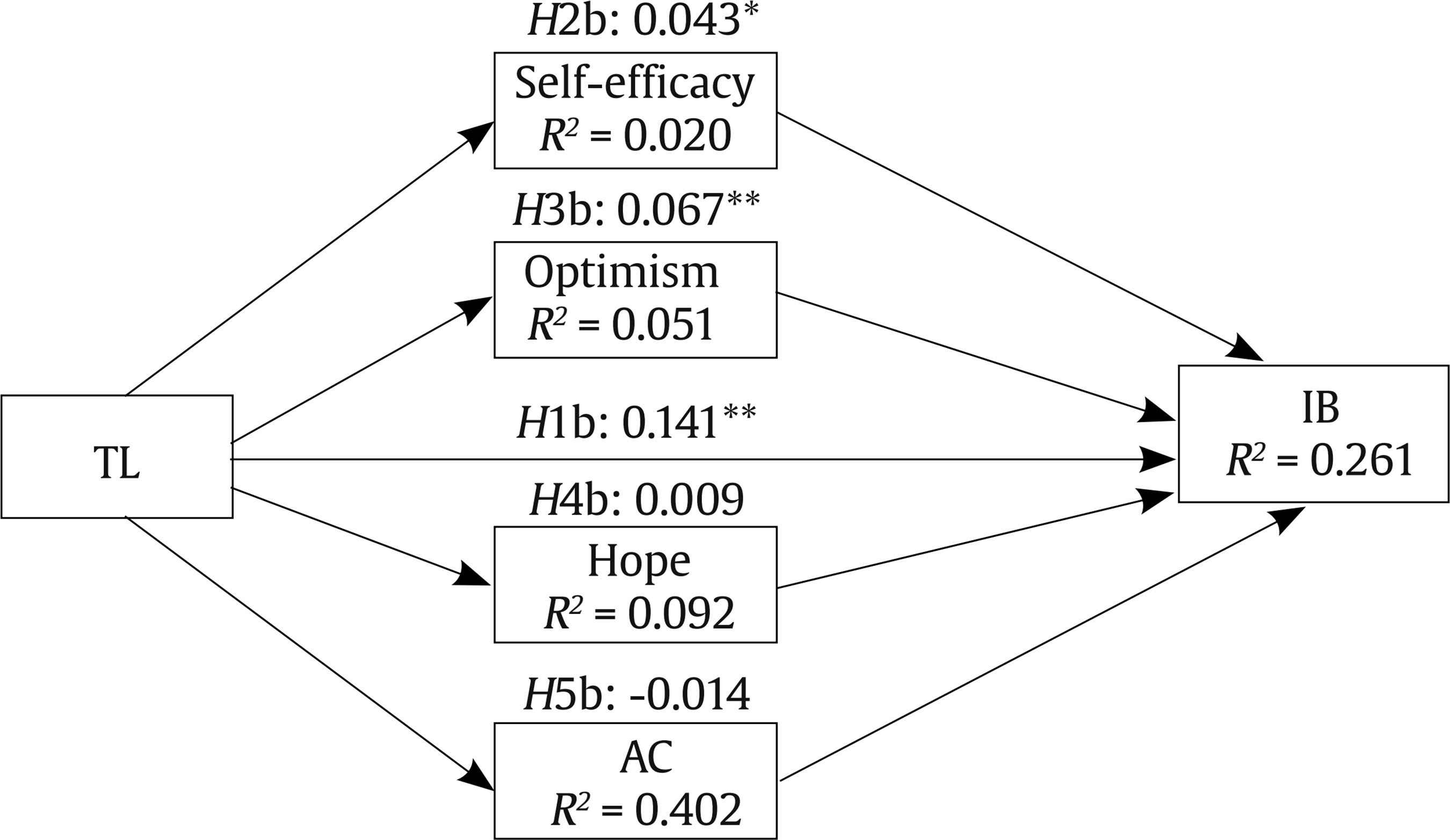 **Significance at the .01 level. *Significance at the .05 level. From the results obtained, we can point out that, although we can observe a significant relationship between the variables TL and IB, as we indicated in our hypothesis H1b, this relationship has a negative effect, contrary to what was established in our initial hypothesis. In other words, a higher degree of TL generates a decrease in IB. On the other hand, we can confirm H1a since, as we had proposed in our initial hypothesis, the relationship between AL and IB has a negative effect, so that, as with TL, a higher degree of AL generates a decrease in IB. However, we were unable to confirm our H4a and H5a, as the mediation values of HO and AC in the relationship between AL and IB were not statistically significant. The same was true for H4b and H5b, as the mediation of HO and AC in the relationship between TL and IB was not statistically significant. Likewise, we were able to confirm hypotheses H2a and H2b, as well as H3a and H3b, by obtaining significant values in the mediating effect of self-efficacy and optimism on the relationship between both leadership styles (AL and TL) and intrapreneurial behaviour (IB). On the other hand, we also evaluated the effect size of the variables with respect to the hypotheses (f2). According to Cohen (1988), f² values can be classified as weak (0.02), moderate (0.15), and strong (0.35) effects. In summary, from the data obtained, we can point out that Authentic Leadership had a small effect on IB (H1a), SE, OP and HO, while it had a very high effect on AC. We obtained similar results in the case of Transformational Leadership, which had a small effect on IB (H1b), SE, OP and HO and a strong effect on AC. As can be seen in Figures 1 and 2, the value of R² in the models was .267 and .261 respectively, indicating an adequate explanatory capacity of the model (Hair et al., 2014). We also analysed the goodness of fit of the models proposed for each type of leadership. To do this, we used the Standardized Root Mean Square Residual (SRMR) value, employing a bootstrapping of 10,000 samples, obtaining very similar final values of .075 in the AL model and .073 in the TL model, which, being less than .08 (Henseler et al., 2014), reflect a good fit for both proposed models (see Tables 5 and 6), although with similar fit values. Table 5 Fit Indices for the Variables and the AL Model  Note. Q2 = coefficient of determination; RMSE = root mean square error; MAE = mean absolute error; SRMR = normalized root mean square residual. Table 6 Fit Indices for the Variables and the TL Model  Note. Q2n = coefficient of determination; RMSE = root mean square error; MAE = mean absolute error; SRMR = normalized root mean square residual. Finally, we analysed the predictive capacity of the model using the PLS Predict technique with 10 folds and one repetition, following the instructions of Shmueli et al. (2019). This methodology is recommended as it allows both the explanatory power and the predictive capacity of the model to be evaluated on a data set different from the one originally selected (Carrión et al., 2016). To carry out a more accurate evaluation, the values of the coefficient of determination (Q2), root mean square error (RMSE) and mean absolute error (MAE) were considered. In our case, we verified that all indicators exceeded the threshold of 0 (see Tables 5 and 6), confirming the predictive validity of the proposed model (Woodside, 2013). Several conclusions can be drawn from the results obtained. Firstly, contrary to our hypothesis, the results obtained reveal a significant but negative relationship between transformational leadership and intrapreneurial behaviour. Although this leadership style has traditionally been associated with intellectual stimulation, the promotion of innovation and risk-taking, it is possible that, in certain organisational contexts, it generates excessive dependence of employees on their leaders. This dependence can manifest itself in a constant need for guidance and encouragement to undertake new initiatives, which inhibits creative autonomy. These findings are consistent with previous studies (Klein, 2023), in which the visionary nature of transformational leadership, characterised by clear and decisive strategic direction, could limit the freedom perceived by followers to propose ideas that deviate from the established vision, thereby reducing the expression of intrapreneurial behaviours. In relation to the mediation effects examined, the results show that neither hope nor affective commitment had a mediating effect on the relationship between transformational leadership (TL) and intrapreneurial behaviour (IB), which contradicts our initial hypotheses. One possible explanation is that hope, although linked to a positive orientation towards the future, may be more related to perseverance in contexts of uncertainty than to the active promotion of organisational change. In this sense, its influence on behaviours involving innovation, risk or breaking with the established order (characteristics of intrapreneurial behaviour) could be limited (Neessen et al., 2019). As for affective commitment, although it is associated with a strong sense of belonging, identification and harmony with the organisation, it can, in certain circumstances, inhibit behaviours that challenge the status quo, especially if these are perceived as potentially disruptive or generating internal conflict. Thus, affectively committed employees may avoid getting involved in intrapreneurial initiatives for fear of destabilising organisational cohesion. These results are consistent with those of previous research, which has also highlighted the absence of mediating effects of these variables in contexts of leadership and innovation (Azizah et al., 2021). We obtained similar results in the case of authentic leadership, where neither hope nor affective commitment had a mediating effect on its relationship with IB. These results suggest that, although authentic leaders foster a positive climate based on trust and transparency, these specific personal resources may not be sufficient on their own to activate intrapreneurial behaviour, especially if emotional stability and relationship maintenance are prioritised (Hughes et al., 2018). On the contrary, the results obtained in the present study do confirm the mediating role of self-efficacy and optimism in the relationship between authentic leadership (AL) and intrapreneurial behaviour (IB), as well as in the relationship between transformational leadership (TL) and such behaviour, as proposed in our hypotheses. In this sense, authentic leaders, through their ethical consistency, transparency and integrity, promote the creation of psychologically safe environments in which employees can develop solid beliefs about their own ability to face work challenges and generate change. Thus, this perception of self-efficacy, together with a generalised feeling of optimism about the future, acts as a catalyst for intrapreneurial behaviour, which involves initiative, personal confidence, risk tolerance and a focus on continuous improvement (González-Cánovas et al., 2024). Similarly, there is also evidence that transformational leadership actively promotes the development of these personal resources, which act as key mechanisms in activating innovation-oriented behaviours. Through intellectual stimulation, the establishment of a shared vision and inspiring motivation, transformational leaders contribute to strengthening the self-efficacy and optimism of their followers, thus facilitating a context conducive to the emergence of intrapreneurial behaviours (Gürlek, 2021). Transformational and Authentic Leadership: Two Sides of the Same Coin? The results of our study have shown that both types of leadership have very similar results on the variables studied, which contributes to fuelling the debate in the literature surrounding the differentiation between AL and TL. In line with the conclusions of Banks et al. (2016), we cannot affirm that there is a real differentiation between the two types of leadership, at least in the context and under the conditions studied here. AL and TL have shown very similar predictive power, which leads us to consider a possible conceptual and functional overlap or superimposition that calls into question the need to maintain them as distinct models. Anderson & Sun (2017) also stated that another reason for this overlap is that the measurement scales may not be sufficiently differentiated, which would require the development of more precise tools. For all these reasons, our research aligns with this critical line of thinking, which considers that the importance of authentic leadership as a separate theory has been overestimated, viewing it in many cases as merely an ethical reformulation of the term and one that has been shown to have the same results in practice as transformational leadership. Here, we cannot categorically state that they are the same, but we can conclude that in the context of the service sector in Spain, no differentiation has been demonstrated in the intrapreneurial behaviours of employees with the mediating variables analysed and, therefore, there are indications that they could be. Limitations and Future Recommendations This research has some limitations that should be taken into account. Firstly, the size and type of sample used may not facilitate the generalisation of the results, despite the use of statistical measurement techniques (PLSPredict) that have attempted to minimise this effect. Therefore, further research in other sectors or regions is recommended to verify the findings obtained. A second limitation relates to the research design, as the data were obtained at a specific point in time. This methodological characteristic opens up the possibility of phenomena such as reverse causality, endogeneity and the influence of uncontrolled external variables (González-Cánovas et al., 2024). Therefore, it is recommended that other longitudinal studies be carried out to capture these possible temporal fluctuations and analyse their possible positive and negative effects. Finally, in terms of future research, an integrative model of both types of leadership could be proposed, or it could be verified whether both types of leadership, despite obtaining similar results in the behaviour of their followers, operate through different psychological mechanisms, or further investigation could be carried out into why, in certain contexts, these types of leadership can limit the innovative behaviour of employees. Conflict of Interest The authors of this article declare no conflict of interest. Acknowledgements The authors would like to sincerely thank the workers who selflessly participated in this study, as well as to the anonymous reviewers of this article. Cite this article as: González-Cánovas, A., Trillo, A., Lopez-Peña, B., & Bretones, F. D. (2026). Exploring the boundaries of transformational and authentic leadership: A comparative analysis of intrapreneurial behaviour. Journal of Work and Organizational Psychology, 42, Article e260775. https://doi.org/10.5093/jwop2026a7 Funding This study was partially funded by the University of Granada’s Unit of Excellence in Work, Territory, and Competitiveness (UCE-PP2023-08). References |
Cite this article as: González-Cánovas, A., Trillo, A., Lopez-Peña, B., & Bretones, F. D. (2026). Exploring the Boundaries of Transformational and Authentic Leadership: A Comparative Analysis of Intrapreneurial Behaviour. Journal of Work and Organizational Psychology, 42, Article e260775. https://doi.org/10.5093/jwop2026a7
Correspondence: fdiazb@ugr.es (F. D. Bretones).Copyright © 2026. Colegio Oficial de la Psicología de Madrid


 PDF
PDF e-PUB
e-PUB CrossRef
 JATS
JATS Print
Print SEND
SEND